
Welcome to the first lesson of your 30-day DSA sprint. This opening module builds the judgment that makes later patterns useful: before writing code, you need to recognize what kind of solution can possibly fit the input size.
In interview problems, constraints are not decoration. They are an early design signal. By the end of this lesson, you should be able to inspect a problem’s maximum input size, estimate whether a candidate approach is viable, and state a reasonable target complexity such as , , or .
Constraints set the performance budget
An algorithm must finish before the platform’s time limit. If it performs far too many operations on the largest legal input, the submission receives Time Limit Exceeded even if its logic is correct.
Big-O notation describes how an algorithm’s work grows as the input grows. The most useful growth rates for interview preparation are:
| Complexity | Typical interpretation | Usually plausible when |
|---|---|---|
| A fixed amount of work | Any input size | |
| Repeatedly cut the search space | Huge inputs, often sorted or monotonic | |
| Process each input item once | Up to millions of items | |
| Sort, then process; divide-and-conquer | Often up to hundreds of thousands or more | |
| Compare many pairs; two full nested scans | Often a few thousand items | |
| Examine triples; three nested scans | Usually only a few hundred items | |
| Enumerate subsets / binary choices | Usually around | |
| Enumerate permutations | Usually around |
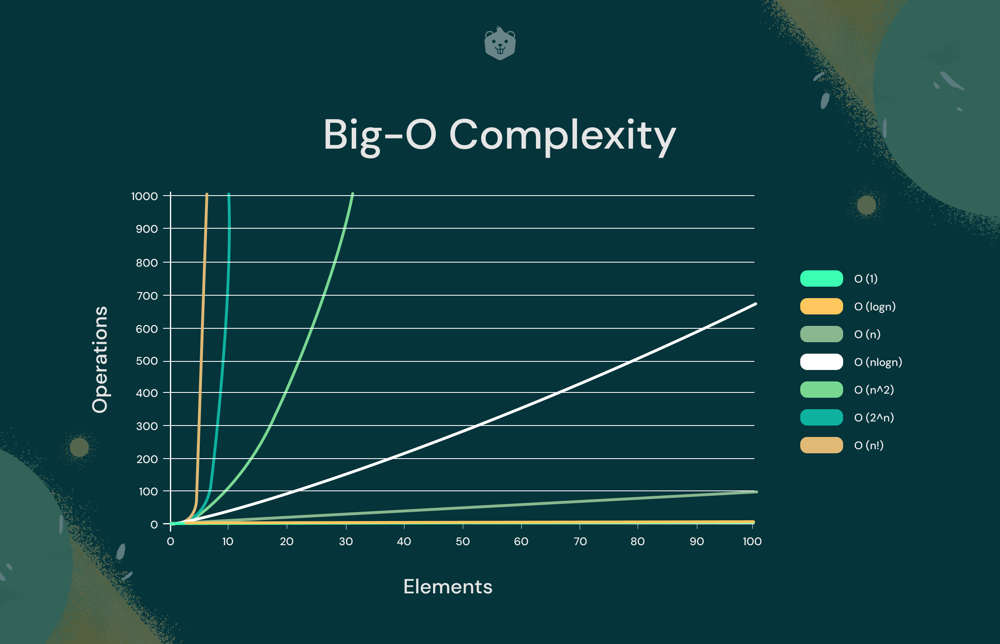
The graph matters more than its precise pixel values. For a small input, several approaches may work. For a large input, growth rate dominates everything else:
- At , an solution performs roughly units of pairwise work.
- At , the same shape becomes roughly units.
- A linear scan at is only on the order of iterations.
- Sorting values costs on the order of , roughly a few million comparison-scale operations.
So, if a prompt says , a pairwise comparison approach is not merely “a little inefficient.” It is normally disqualified before you begin coding.
LeetCode Feels Easy After This Reverse Runtime Trick
Watch “LeetCode Feels Easy After This Reverse Runtime Trick” by AlgoMonster for a concise explanation of why constraints reveal the required speed of a solution.
Watch the constraint signal to see the central idea: a limit such as n \leq 10^5 makes quadratic work suspect immediately. Then watch the budget heuristic for rough thresholds connecting input sizes to complexity classes. Finish with the examples, where the method is applied directly to problem constraints. Treat the numerical cutoffs as estimates rather than guarantees.
Big-O gives a growth model, not a stopwatch
A common rule of thumb says an online judge can execute roughly to simple operations per second. This is useful for rapid reasoning, but it is not a universal law.
Actual runtime depends on:
- the platform’s time limit;
- the programming language and runtime;
- whether operations are simple arithmetic or expensive string, object, or allocation work;
- the number of test cases;
- input/output overhead;
- constant factors hidden by Big-O notation.
JavaScript makes this caveat especially relevant. A tight loop over numeric arrays behaves differently from repeatedly allocating objects or manipulating long strings. Still, for interview decisions, asymptotic complexity comes first. Do not spend time micro-optimizing a quadratic solution when the constraints require a linear or linearithmic one.
Think in two stages:
- Asymptotic screening: Is the approach in the right complexity class for the maximum input?
- Implementation judgment: If it is, can you implement it cleanly and avoid obviously costly operations?
For now, the first stage is the goal.
A target complexity is usually a ceiling, not an exact mandate. For example, if , the constraints may indicate that you need or better. If you discover a valid solution, that is excellent. The constraints do not require you to use sorting simply because sorting would fit.
A reliable workflow for reading constraints
Use this sequence before you commit to an approach.
1. Identify every quantity that can grow
Do not focus only on the variable named . A problem may include:
- array length ;
- number of queries ;
- grid dimensions and ;
- number of test cases ;
- string length ;
- a bound on numeric values, such as .
The relevant work may depend on one variable or several. For a grid, visiting every cell is , not vaguely “quadratic.” If and , that scan visits cells, which is often reasonable.
For query problems, consider both dimensions. If and , scanning the full array for every query costs:
At the maximum values, that is around iterations. Even though each individual limit is “only” , their product makes the straightforward approach infeasible.
2. Use the maximum legal input, not a friendly example
A sample input of length five says almost nothing about performance. Analyze the largest values allowed by the prompt.
If there are multiple test cases, look carefully for a statement such as:
That total-sum constraint is usually the important one. It says all test cases together contain at most elements. Without such a bound, you may need to account for the worst-case cost across every test case.
3. Estimate the candidate’s dominant work
You do not need exact counts. Ask what the algorithm must repeatedly do:
- one pass through an array: ;
- sort then scan: ;
- compare every pair: ;
- choose every possible subset: ;
- try every possible ordering: .
This is a first-pass estimate. In a later lesson, you will formally calculate the complexity of JavaScript loops and recursion. At this point, recognize the broad shapes well enough to reject impossible strategies.
4. Rule out approaches before searching for an optimization
Suppose .
A solution that checks all pairs is almost certainly too slow. You should stop investing in that branch of thought and search for a pattern that can reach or : perhaps sorting, hashing, pointers, a sliding window, or preprocessing.
This is the practical value of constraints: they shrink the space of possible ideas.
5. Check inherent lower bounds
Sometimes the required output itself determines the time complexity.
If a problem asks you to return every subset of an array of size , there are already subsets to output. No algorithm can produce all of them in time because the output is exponentially large.
Likewise, if you must read arbitrary array values, you generally cannot do better than : you must at least inspect the input. This prevents an unhelpful obsession with finding solutions where linear work is unavoidable.
A practical constraint reference
Use this as a conservative interview heuristic, not as an absolute performance table.
| Largest relevant input | A likely acceptable target | What this often permits |
|---|---|---|
| may be possible | Permutations, exhaustive ordering | |
| may be possible | Subsets, bitmasks, backtracking | |
| may be possible | Triple-based dynamic programming or enumeration | |
| is often plausible | Pair comparisons, two-dimensional DP | |
| Prefer or | Hashing, sorting, binary search, scans | |
| Usually ; sometimes | Tight linear processing | |
| Very large numeric bounds | or | Binary search on a range, math-based reasoning |
Two cautions are essential:
- Small constraints are ambiguous. If , , , , and sometimes even may all fit. You need the problem structure to choose the intended method.
- Large constraints are highly informative. If , then is normally impossible, regardless of how elegant the code looks.
Reading common interview examples
Consider the following constraint-first interpretations.
Pair target in an unsorted array
Suppose a problem asks whether any two values sum to a target, with:
The direct idea is to try every pair. There are approximately:
pairs, which is . At the maximum constraint, that becomes billions of checks.
The constraint therefore tells you to seek an or solution. You do not yet need to know the implementation details, but likely candidate families are:
- a one-pass lookup structure;
- sorting followed by a linear scan with a disciplined pointer strategy.
The next module will develop the one-pass hash-map solution explicitly.
Generate every subset
Now suppose:
This small bound is a signal that exponential exploration may be intended. There are:
possible subsets, a manageable number in many settings. Here, avoiding exponential work may be impossible if the problem genuinely asks to consider or return all subsets.
The important contrast is that the same phrase “array of integers” can lead to entirely different strategies depending on whether is at most or at most .
Process a large grid
Suppose a grid has:
The total cell count can reach:
A full traversal that visits each cell a constant number of times has complexity , which is often appropriate. But an approach that compares every cell with every other cell has complexity:
That would mean on the order of comparisons at the maximum size and is not viable.
Always translate dimensions into the number of basic units your algorithm touches.
Many range queries
Suppose an immutable array has elements and there are range-sum queries. Summing from scratch for each query costs in the worst case, which is too slow.
The constraints tell you that doing substantial work per query is the wrong direction. You should seek a method with a one-time preprocessing cost and very cheap queries. The exact technique comes in the prefix-computation lessons; the complexity signal comes first.
How to communicate this in an interview
A strong complexity decision is brief, numerical, and connected to the rejected alternative. For example:
“With up to , checking all pairs would be , about comparisons in the worst case, so I would rule that out. I’m targeting expected time with extra lookup space, or if sorting is suitable.”
This statement demonstrates three things:
- you read the constraints;
- you can reject brute force for a concrete reason;
- you know what performance level the solution must reach.
If an interviewer does not provide constraints, clarify the scale before settling on an approach. A useful question is: “Should I optimize for tens, thousands, or hundreds of thousands of elements?” If no answer is available, explain the tradeoff: a simple quadratic solution can be reasonable for small input, while a linear or linearithmic alternative is safer for production-scale input.
Make constraints your first move
Before solving a practice problem, spend about thirty seconds recording:
- The maximum size of each input dimension.
- Whether there are repeated queries or multiple test cases.
- Which complexity classes are clearly impossible.
- Your target: for example, “must be or better.”
- Whether output size itself requires a slower complexity class.
This is not busywork. It prevents a common beginner failure mode: fully implementing a correct brute-force solution only to realize afterward that the constraints made it impossible from the start.
The central takeaway is simple: constraints place a budget on computation. Small inputs can permit exhaustive search; inputs around usually demand linear or linearithmic work; very large bounds often require logarithmic or mathematical reasoning. Treat these as informed estimates, account for all dimensions and total test-case volume, and remember that the target is usually “this fast or faster.”
Next, you will use that target to structure your thinking: first derive a clear brute-force solution, then identify exactly which repeated work an optimization must eliminate.
Can't find a good explanation? Sign up and we'll make it for you
Sign up