
Hello! In our previous lesson, we dove into the mechanics of distributing data across a cluster of cache servers using consistent hashing, a key pattern for building scalable data storage. Now, we shift our focus from how data is stored to how services communicate—a fundamental aspect of any distributed system.
This lesson directly addresses your interest in building resilient, scalable systems by tackling one of the most critical architectural decisions: choosing between synchronous and asynchronous communication. We will analyze the deep trade-offs between these two models, focusing on their impact on system resilience and introducing the pivotal concept of eventual consistency. Mastering this topic is essential for designing systems that can handle the scale and unpredictability of the real world, a core part of your goal to excel in senior engineering roles.
1. The "Crack Cocaine" of Programming: The Synchronous Illusion
As an experienced developer, you are intimately familiar with the synchronous programming model. You make a function call or an API request, and your code blocks, waiting for a response before it proceeds. This request-response pattern is intuitive, straightforward, and easy to debug. It's how most of us learn to code.
However, this simplicity can be a deceptive comfort, especially as systems grow in complexity and scale.
Synchronous vs Asynchronous Programming
The YouTube channel Modern Software Engineering offers a compelling perspective on this in the video "Synchronous vs Asynchronous Programming." It argues that our attachment to the synchronous model is a "leaky abstraction" that fights against the concurrent nature of the real world.
First, watch the segment that explains why the synchronous model, while simple for single-threaded code, creates significant complexity when dealing with concurrency and distributed systems. This part runs from the metaphor. The key idea is that managing shared data and state across multiple threads or users within a synchronous framework forces us to add complex, error-prone mechanisms like locks and semaphores. Next, watch the segment that details the many ways communication can fail in a distributed synchronous system, from new ways for things to go wrong. The crucial takeaway is that from the caller's perspective, many different failures (network partition, service crash, high load) are indistinguishable, yet each leaves the system in a different state.
This leads to the primary risk of synchronous communication in distributed systems: tight coupling.

When Service A calls Service B synchronously, it's not just waiting for a response; it's creating a hard dependency. Both services must be available at the same exact time. If Service B is slow, Service A is slow. If Service B fails, Service A is at risk of failing too, potentially leading to a cascading failure that takes down an entire feature or application.
What is the difference between synchronous and ...
The article from Design Gurus provides a clear, practical breakdown of these concepts.
First, read the section defining synchronous communication. This will formalize its advantages and drawbacks. Then, jump to the section on its use cases. Notice that synchronous calls are best suited for immediate, client-facing requests where the user is actively waiting, like login authentication or fetching data to render a page.
In short, synchronous communication trades scalability and resilience for simplicity and immediacy. This can be a perfectly valid trade-off for certain use cases, but for the core workflows of a large-scale system, it often becomes a liability.
2. Embracing Reality: The Asynchronous Model
Asynchronous communication breaks this tight coupling. The sender, or producer, dispatches a message to an intermediary—typically a message queue or an event log—and then immediately moves on to its next task without waiting for a response. A consumer service picks up and processes that message at a later time.
This "fire-and-forget" pattern is like sending an email. You don't stop everything you're doing and wait for a reply; you trust that the email system will deliver the message and you'll see the response when it arrives.
The primary benefits are the flip side of the synchronous model's weaknesses:
- Decoupling: The producer and consumer do not need to be available at the same time. The message broker isolates them.
- Resilience: If a consumer service fails, the producer is unaffected. Messages simply accumulate in the queue until the consumer recovers. This prevents cascading failures.
- Scalability & Elasticity: The broker acts as a buffer, smoothing out traffic spikes. You can handle sudden bursts of requests by queuing them, allowing consumer services to process the workload at a sustainable pace. You can also scale the number of consumers independently to increase processing throughput.
However, this resilience comes at a price.
What is the difference between synchronous and ...
Now, let's look at the other side of the coin in the same Design Gurus article.
Read the section that defines asynchronous communication and its trade-offs. Pay close attention to the mention of eventual consistency. Then, read about the ideal use cases for asynchronous patterns, such as background processing, high-traffic systems, and event-driven architectures where one action needs to trigger multiple independent downstream processes.
The key trade-offs are increased operational complexity and a shift from immediate to eventual consistency. Tracing a request that flows through multiple asynchronous services is harder, and you must accept that data updates take time to propagate through the system.
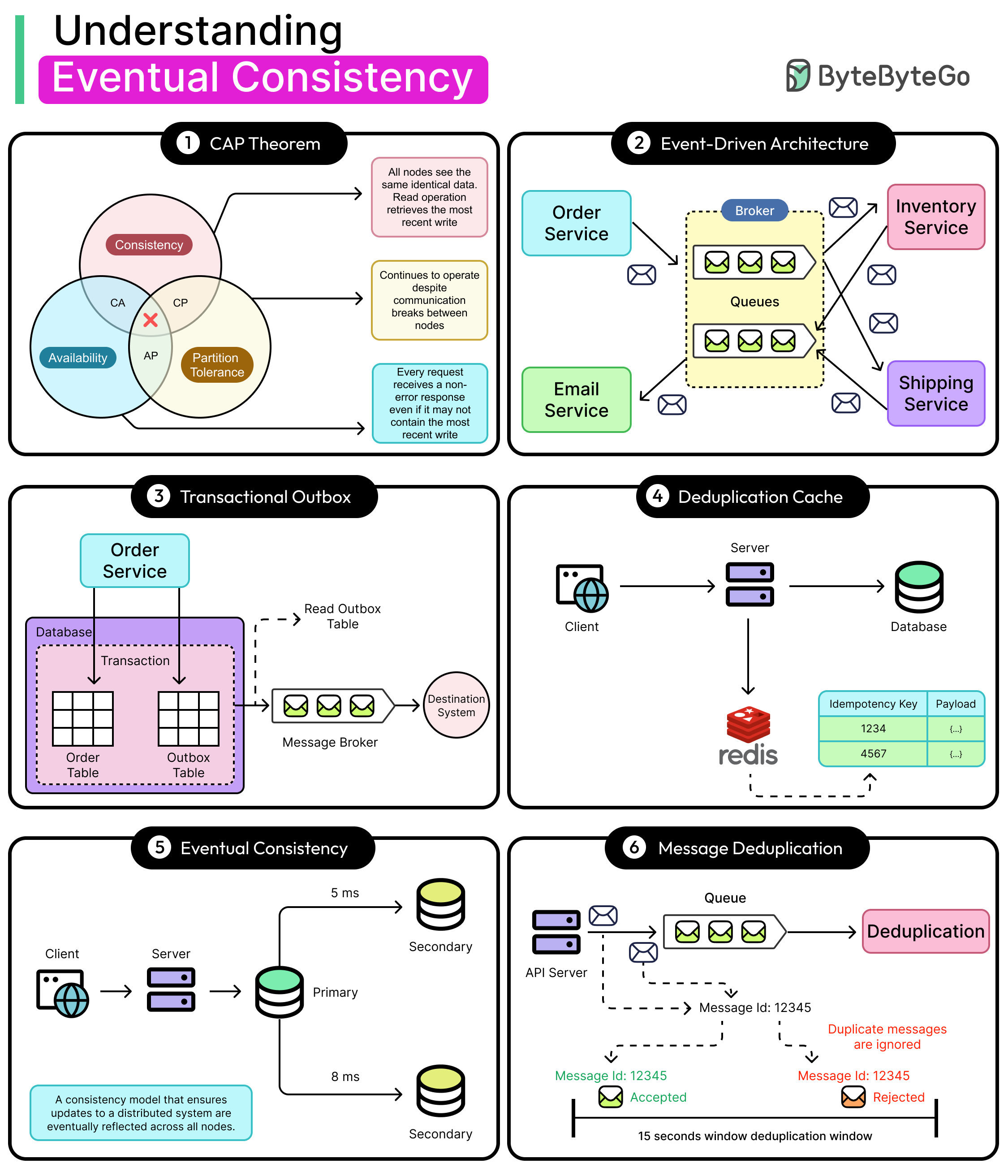
3. A Deep Dive into Eventual Consistency
Eventual consistency is not just a side effect of asynchronous communication; it is a fundamental consistency model for building highly available and partition-tolerant distributed systems. It's a concept you'll encounter repeatedly in system design.
The formal definition is simple: if no new updates are made to a given data item, all replicas will eventually converge to the same value.
This stands in contrast to strong consistency models like linearizability, which guarantee that all replicas appear as a single, up-to-the-minute copy of the data. While strong consistency is easier for developers to reason about, it comes at a steep price.
Distributed Systems 7.3: Eventual consistency
Martin Kleppmann, a leading researcher in distributed systems, provides an excellent explanation in his video "Distributed Systems 7.3: Eventual consistency."
First, watch the introduction, which explains the costs and limitations of strong consistency (linearizability). This sets the stage for why we need alternatives. Next, watch the practical example using a calendar app. This demonstrates how concurrent updates on different devices (replicas) can lead to conflicts and how systems resolve them, eventually arriving at a consistent state. Then, watch the section that formally defines eventual consistency and introduces "strong eventual consistency," where convergence is guaranteed even if updates are applied in different orders. Finally, watch the summary of the advantages and challenges. The key benefit is that operations can always be fast and reliable because they don't have to wait for network communication. The main challenge is conflict resolution.
As the video showed, when two clients update the same data concurrently, a conflict occurs. The system needs a strategy to resolve it. "Last writer wins" is the simplest strategy but can lead to lost data. More sophisticated strategies, often based on data structures called CRDTs (Conflict-free Replicated Data Types), can merge concurrent changes automatically.
Another critical pattern for managing workflows in an eventually consistent world is the Saga Pattern. A saga is a sequence of local transactions where each step publishes an event that triggers the next. If a step fails, the saga executes compensating transactions to undo the preceding changes. This allows you to maintain data consistency across multiple services without the need for slow, blocking distributed transactions.
4. A Framework for Decision-Making
So, how do you choose? The decision is not purely technical; it's a strategic one that depends on the specific business requirements of the workflow you are designing.
Synchronous vs Asynchronous Microservices: The Architects Guide
This article provides a pragmatic, decision-focused framework for architects.
First, study the Decision Matrix and Architectural Decision Checklist. These provide a clear set of questions to ask for every inter-service communication path. The primary question is always: "Does the client require an immediate response?" Next, it's crucial to understand common mistakes. Read the section on common failure patterns, such as the "Sync-over-Async" anti-pattern. This is invaluable practical knowledge that will help you avoid architectural pitfalls. Finally, read the first two questions in the FAQ section, which succinctly summarize the primary risk of synchronous communication and the necessity of the Saga pattern.
Here’s a summary of the trade-offs in a single table, combining insights from our resources:
| Aspect | Synchronous Communication | Asynchronous Communication |
|---|---|---|
| Interaction Pattern | Blocking request-response. Caller waits. | Non-blocking "fire-and-forget." Caller continues. |
| Coupling | Tightly coupled. Services must be available together. | Loosely coupled. Services operate independently. |
| Resilience | Low. Prone to cascading failures. | High. Failures are isolated by the message broker. |
| Latency | Low for a single quick call; high for a chain of calls. | Higher for a single operation; high overall system throughput. |
| Scalability | Challenging. Must scale dependencies together. | High. Consumers can be scaled independently to meet load. |
| Consistency | Immediate (within the transaction scope). | Eventual. Data updates take time to propagate. |
| Complexity | Simple to implement and trace. | More complex; requires a broker and observability tools. |
| Best Use Cases | User-facing reads (e.g., login, get profile). | Background jobs (e.g., send email, process video), high-volume writes. |
Conclusion
In this lesson, we dissected the fundamental trade-offs between synchronous and asynchronous communication. You've learned that while synchronous communication offers simplicity, it creates tightly coupled, brittle systems that are prone to cascading failures. Asynchronous communication, by contrast, enables resilient, scalable, and decoupled architectures at the cost of increased complexity and the need to manage eventual consistency.
Key Takeaways:
- Synchronous communication trades resilience for immediacy. It is simple but creates tight coupling and risks cascading failures.
- Asynchronous communication trades immediacy for resilience. It uses a message broker to decouple services, enabling independent scaling and failure isolation.
- Eventual consistency is a core principle of highly available asynchronous systems. It guarantees that all replicas will converge on the same state over time, but requires strategies for conflict resolution.
- The choice between sync and async is a strategic architectural decision based on business requirements, not a simple technical preference. Default to asynchronous for decoupling unless a workflow absolutely requires an immediate, blocking response.
In our next lesson, we will build directly on this foundation by exploring the tools of the trade. We will "Explain the difference between a message queue (e.g., RabbitMQ) and a distributed log (e.g., Kafka)," two of the most popular technologies for implementing the asynchronous patterns we've discussed today.