
Hello! In our last two lessons, we built producer-consumer systems first with RabbitMQ and then with Kafka. You saw firsthand how to configure things like publisher confirms, consumer acknowledgements, and offset commits. These are the low-level mechanisms that control the reliability of your messaging.
Today, we'll connect those mechanisms to the high-level guarantees they provide. We will formalize and compare the three fundamental message delivery semantics: at-most-once, at-least-once, and exactly-once. Mastering these concepts is non-negotiable for designing robust, scalable distributed systems. It's a topic that separates senior engineers from junior ones, and it's almost guaranteed to come up in the technical interviews you're preparing for.
1. The Three Guarantees
In any distributed system where a producer sends a message to a consumer, there's always a risk of failure. A network connection could drop, a service could crash, or a broker could restart. Delivery semantics are the promises a system makes about how it will handle these failures.
Let's start with the formal definitions. The following blog post by Jack Vanlightly, a well-known expert in messaging systems, provides a clear and concise breakdown.
RabbitMQ vs Kafka Part 4 - Message Delivery Semantics ...
This article provides an in-depth comparison of how RabbitMQ and Kafka handle delivery guarantees. We will use it throughout this lesson.
Please read the introductory section that defines the three guarantees, starting from the definitions.
To visualize these concepts, consider this diagram. It shows the possible outcomes for a message traveling from a producer to a consumer under each semantic.
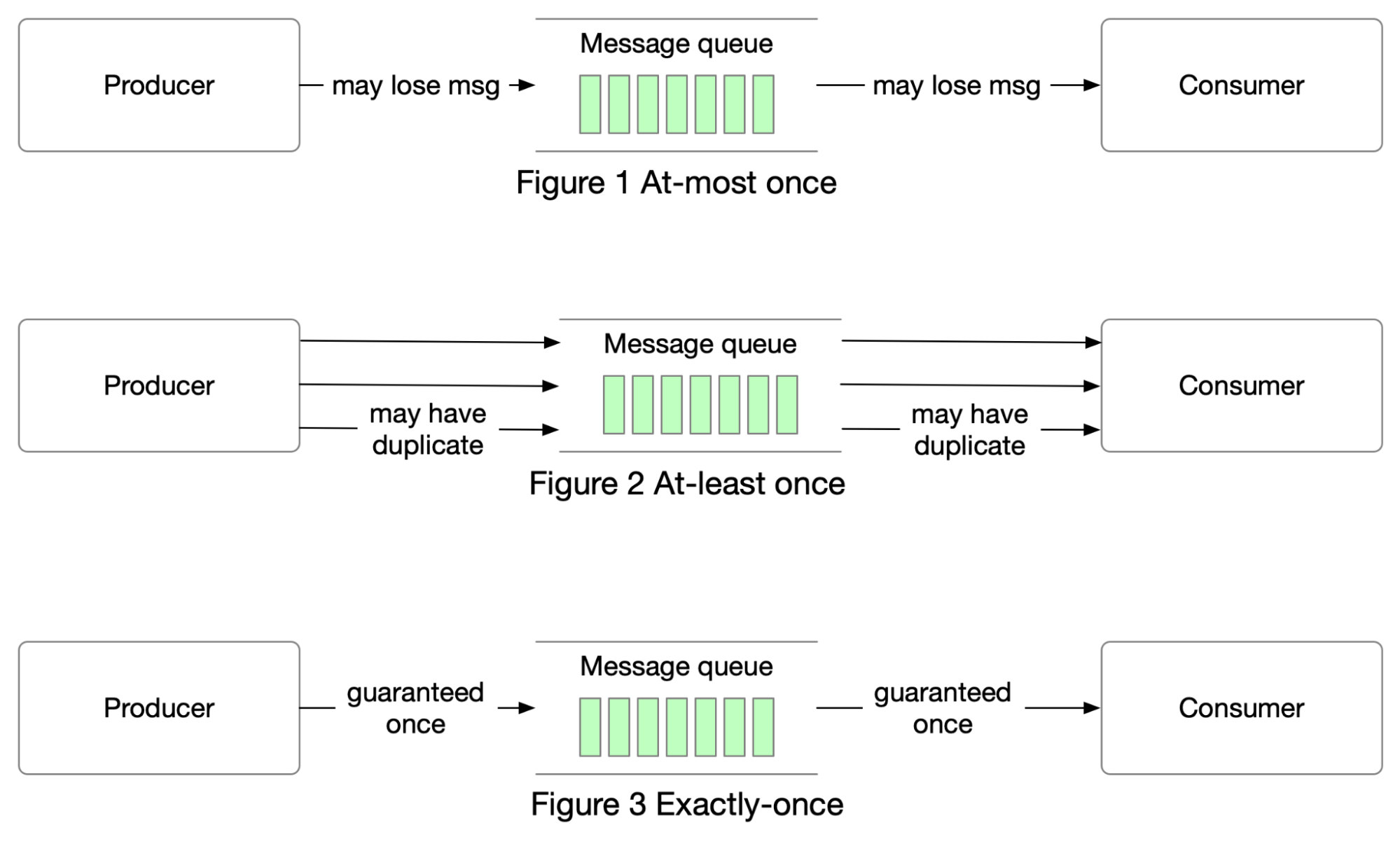
As you can see, the trade-offs are clear:
- At-most-once: Prioritizes speed and low overhead over reliability. It's a "fire and forget" approach. You might lose data.
- At-least-once: Prioritizes reliability over efficiency. You won't lose data, but you might have to process the same message more than once.
- Exactly-once: The "holy grail" that promises reliability without duplication. As we'll see, this is much more complex than it sounds.
2. The Dominant Paradigm: At-Least-Once and Idempotency
In most production systems that handle critical data—like e-commerce orders, financial transactions, or user data updates—message loss is unacceptable. This rules out "at-most-once" for many core business flows. Therefore, at-least-once delivery is the practical default for building reliable systems.
However, this choice introduces a new challenge: message duplication. If a consumer processes a message but crashes before it can acknowledge it, the message broker will assume it failed and redeliver it. How do we prevent this from causing problems, like charging a customer twice?
The answer is idempotency. An operation is idempotent if running it multiple times has the same effect as running it once.
The following video, featuring a Staff Engineer from Meta, explains this crucial relationship and why it's the standard answer in system design interviews.
Message Queues in System Design Interviews w/ Meta Staff Engineer
This excerpt from "Message Queues in System Design Interviews" focuses on the practical implications of delivery guarantees.
Watch the segment from "at least once delivery". Pay close attention to the example of making an operation idempotent by changing it from an increment action to a set action. This is a classic pattern.
The consequences of failing to make your consumers idempotent can be severe. The next video emphasizes this point vividly.
Kafka, RabbitMQ, or SQS? Start Here
This video, "Kafka, RabbitMQ, or SQS? Start Here", contains excellent, practical advice on building robust message-driven systems.
Please watch the section from the discussion on idempotency. The speaker lists several nightmare scenarios—double charges, duplicate emails, incorrect inventory—that are all direct results of non-idempotent consumers.
Implementing Idempotency
So, how do we build idempotent consumers? The core idea is to track which messages have already been processed. A common approach involves:
- Generating an Idempotency Key: The producer includes a unique identifier in the message header or payload. This could be a UUID generated by the client, a hash of the request body, or a business-specific ID like
order_id. - Checking a Deduplication Store: Before processing a message, the consumer checks if the idempotency key exists in a fast, centralized store (like Redis or Memcached).
- Conditional Processing:
- If the key exists, the message is a duplicate. The consumer can safely skip processing and just acknowledge the message.
- If the key does not exist, the consumer processes the message and then atomically stores the idempotency key in the deduplication store before acknowledging the message. The key should be stored with a Time-to-Live (TTL) that is longer than the maximum possible message redelivery time.
This flow is a standard pattern for achieving "exactly-once effect" at the application layer.

3. Guarantees in RabbitMQ and Kafka
Let's ground these abstract concepts in the technologies you've used. Your choices in configuring producers and consumers directly map to these semantics.
In RabbitMQ
The Jack Vanlightly article provides a detailed breakdown. Here's how the concepts map to the features you've seen:
- At-most-once:
- Publisher: Don't use publisher confirms.
- Consumer: Use automatic acknowledgements (
autoAck=true). The broker acknowledges the message the moment it sends it, before you've even processed it.
- At-least-once: This is what you built in a previous lesson.
- Publisher: Use publisher confirms. The broker confirms it has received and taken responsibility for the message.
- Queues: Use durable or quorum queues so messages survive broker restarts.
- Messages: Publish messages as persistent.
- Consumer: Use manual acknowledgements (
autoAck=false) and send theackafter you have finished processing the message.
RabbitMQ vs Kafka Part 4 - Message Delivery Semantics ...
Let's review the mechanisms within RabbitMQ.
Read the section on RabbitMQ Delivery Guarantees. Focus on how Publishing acknowledgements (Publisher Confirms) and Consumer acknowledgements work together to provide these guarantees. This should be a good refresher of the code you wrote.
In Kafka
Kafka's model is different due to its log-based nature, but the principles are the same.
- At-most-once:
- Producer: Set
acks=0. The producer doesn't wait for any confirmation from the broker. - Consumer: Commit the offset for a message before you process it. If you crash mid-processing, the offset is already updated, and the message is lost.
- Producer: Set
- At-least-once: This is the loop you implemented in the last lesson.
- Producer: Set
acks=all(oracks=-1). This ensures the producer only considers a write successful after the message has been replicated to the configured number of in-sync replicas. - Consumer: Process the message(s) first, then commit the offset. If the consumer crashes before committing, the next consumer to start will read from the last committed offset, re-processing the messages.
- Producer: Set
Kafka also has a powerful feature for the producer side:
- Idempotent Producer: By setting
enable.idempotence=truein the producer config, Kafka automatically handles retries in a way that prevents duplication from network errors between the producer and the broker. This ensures each message is written to the log exactly once, simplifying one part of the problem.
RabbitMQ vs Kafka Part 4 - Message Delivery Semantics ...
Now let's look at Kafka's approach.
Read the section on Kafka Delivery Guarantees. Pay attention to how Producer Message Acknowledgement (Acks) and Consumer Offset Tracking are the key levers for controlling delivery semantics.
4. The Myth and Reality of "Exactly-Once"
You will often see "exactly-once" advertised as a feature. However, in a distributed system, true exactly-once delivery is theoretically impossible. This is a classic distributed systems constraint known as the Two Generals' Problem.
Kafka, RabbitMQ, or SQS? Start Here
This video provides one of the clearest explanations of why "exactly-once" is so tricky.
Watch this segment from "across a network". The presenter uses the Two Generals' Problem to explain why a producer can never be 100% sure if its message was received if the acknowledgement is lost.
When systems like Kafka claim "exactly-once semantics," they are referring to exactly-once processing, which is achieved through specific, constrained mechanisms.
-
Idempotent Consumers (The Practical Approach): As we've discussed, this is the most common way to achieve an "exactly-once effect." The system uses at-least-once delivery, and the application logic ensures duplicates are handled gracefully.
-
Transactional Systems (The Specialized Approach): Kafka provides this for use cases that happen entirely within its ecosystem. A Kafka Streams application, for example, can read a message from one topic, process it, and write a result to another topic and commit the consumer offset, all within a single atomic transaction. If any part fails, the whole thing rolls back.
RabbitMQ vs Kafka Part 4 - Message Delivery Semantics ...
Let's see how Kafka provides its transactional guarantee.
Read the section on Kafka's transactional capabilities. Note the key limitation: the primary use case is a "read-process-write" cycle where the input and output are both Kafka topics. The guarantee breaks the moment you need to write to an external database or call an external API within that same transaction.
For your interviews and practical design work, always lead with at-least-once delivery and idempotent consumers. It's the most robust, flexible, and widely applicable pattern.
Conclusion
You've now moved from the "how" (publisher confirms, manual acks, offset commits) to the "what" and "why" of message delivery guarantees. Understanding these semantics is fundamental to architecting systems that can be trusted with important data.
Key Takeaways:
- At-most-once: Fastest, but risks data loss. Use for non-critical telemetry or metrics.
- At-least-once: Guarantees delivery but can create duplicates. It's the standard for reliable systems.
- Idempotency: The mandatory counterpart to at-least-once delivery. Consumers must be designed to handle duplicate messages without causing incorrect side effects.
- Exactly-Once: True "exactly-once delivery" is a myth in distributed systems. What is achievable is an "exactly-once effect" through either idempotent application logic or constrained transactional systems like Kafka Streams.
- Your Go-To Pattern: For most scenarios, the winning combination is at-least-once delivery from the message broker coupled with idempotent consumers in your application.
This lesson concludes our deep dive into asynchronous processing fundamentals. You now have a solid understanding of the trade-offs, technologies, and reliability patterns involved. In the next module, we will zoom out and see how these components fit into a larger microservices architecture, where reliable, asynchronous communication is the glue that holds everything together.