
Hello! Welcome to the next lesson in our journey through distributed data management.
In our last two lessons, we tackled the challenge of maintaining data consistency during write operations across multiple services using the saga pattern. We saw how both choreography and orchestration ensure that a business transaction either completes fully or is properly compensated. However, this raises a new question: if our data is now spread across different service databases, how do we efficiently read it back to present a unified view to the user?
Imagine a user wants to view their complete order history on an e-commerce site. This might require fetching order details from the OrderService, payment status from the PaymentService, and shipping updates from the ShippingService. Querying each service in real-time can be slow and complex.
Today, we will address this very problem. Your learning outcome is to explain the CQRS pattern and its use cases for optimizing read/write workloads. CQRS, or Command Query Responsibility Segregation, is a powerful architectural pattern that offers an elegant solution to this challenge. It is a frequent topic in senior-level system design interviews, and understanding its principles and trade-offs is crucial.
1. The Core Principle: Separating Reads and Writes
At its heart, CQRS is based on a simple idea: the model you use to update information (a Command) can be different from the model you use to read information (a Query). This is a departure from the traditional Create, Read, Update, Delete (CRUD) approach where a single data model and data store often serves both purposes.
Let's visualize what this separation looks like.
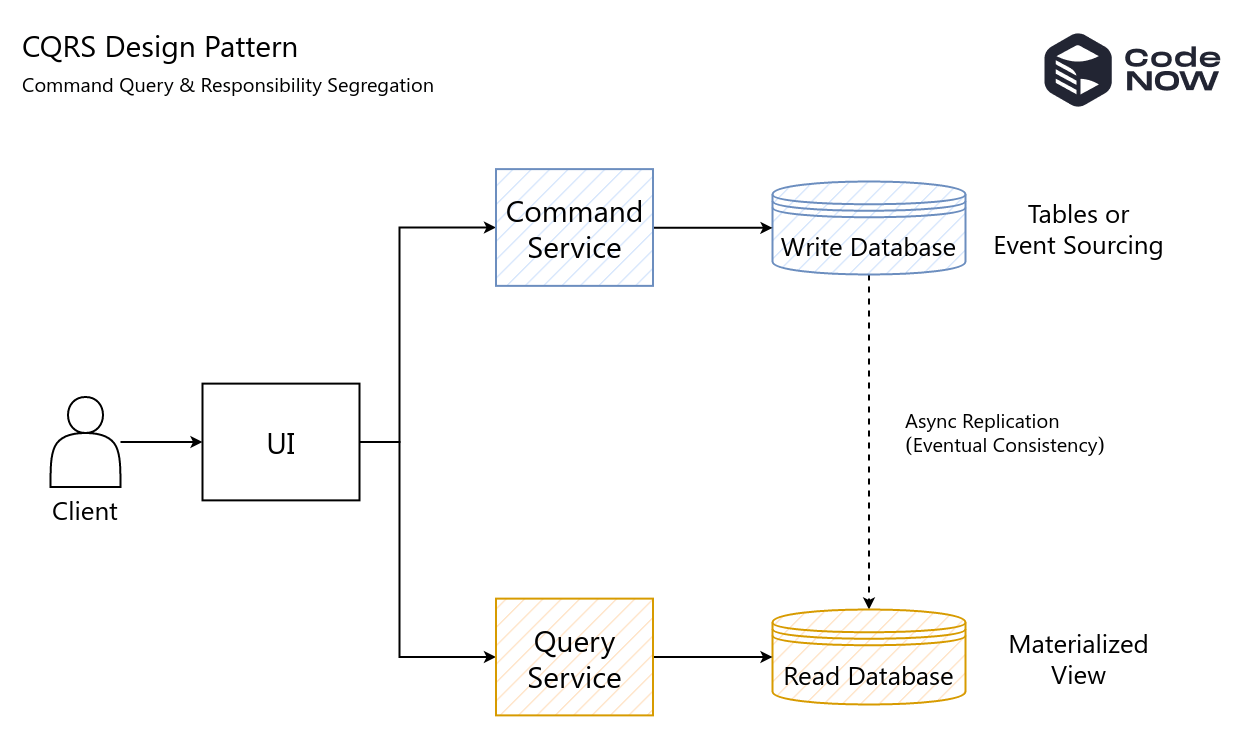
As the diagram shows, the architecture is split into two distinct sides:
- The Command Side: This side handles all state changes. Commands are imperative statements representing an intent to change something (e.g.,
PlaceOrderCommand,UpdateShippingAddressCommand). This side is optimized for writes, focusing on transactional consistency and validation. The data model is often normalized and aligns with the rules of your domain aggregates. - The Query Side: This side handles all data retrieval. It is designed to be highly efficient for reads. The data models on this side are often denormalized and specifically tailored to the needs of the UI or client application. For instance, a single query might return a "customer dashboard" object that is pre-compiled from multiple sources on the write side.
To dive deeper into these core principles, let's turn to a resource structured like an interview guide.
21 Advanced CQRS Interview Questions and Answers for ...
The article "21 Advanced CQRS Interview Questions and Answers" provides a crisp and clear explanation of the fundamental concepts. It's excellent for framing these ideas in the context of an interview discussion.
Please read the first five questions in the "Core CQRS Principles" section. Focus on: The fundamental principle of CQRS. The problem it solves (a single model becoming too complex). The clarification that separate databases aren't strictly required but unlock the pattern's full potential. The role of an event bus in synchronizing the read and write sides.
A key takeaway from the reading is the role of the event bus. When the command side processes a command successfully, it publishes an event (e.g., OrderPlaced). A separate process listens for these events and updates the read models. This asynchronous update mechanism is what leads to eventual consistency—a core trade-off we'll discuss later.
2. Use Cases: When Does CQRS Make Sense?
CQRS is not a silver bullet. Applying it to a simple CRUD application would be over-engineering. The real power of CQRS emerges when your system has specific characteristics. Understanding these use cases is key to justifying its use in a system design interview.
The following resource provides an excellent breakdown of when to use CQRS, its advantages, and real-world examples.
Understanding CQRS Microservices Architecture: In-Depth ...
Let's explore the practical scenarios where CQRS shines. The article "Understanding CQRS Microservices Architecture" clearly outlines the ideal conditions for applying this pattern.
Please read the following sections: "When to Use CQRS": This lists the key drivers for adopting the pattern. "Advantages of CQRS": This explains why it's considered an optimization for read/write workloads. "Real-World Use Cases of CQRS with Examples": This grounds the theory in concrete examples from domains like e-commerce and banking. As you read, think about how these points relate. For example, a high read-to-write ratio (from the first section) in an e-commerce platform (from the third section) allows for performance optimization by scaling the read side independently (from the second section).
To summarize the key points from the reading, you should consider CQRS when:
- Read and write workloads have different requirements. For example, an e-commerce site has a massive number of product views (reads) compared to a relatively small number of orders (writes). CQRS allows you to scale your read infrastructure (e.g., more replicas, powerful caches) independently from your write infrastructure.
- A single model is becoming too complex. When the same model must handle complex validation logic for writes and support many different read representations, it can become bloated and difficult to maintain. Separating them simplifies both sides.
- You need highly optimized queries. The query side can use data stores specifically suited for the job. You could use Elasticsearch for fast text searches, a graph database for social connections, or a simple denormalized document in a NoSQL database for a dashboard view. The write side can remain a robust relational database.
- You are already using an event-driven architecture. If your services are already publishing events (like in our saga implementations), you have the perfect mechanism to update the read models.
Test your understanding!
Imagine you are designing a collaborative document editing application, similar to Google Docs. Multiple users can edit the same document in real-time, and their changes must be visible to others immediately. The application also needs to provide a "version history" feature.
Based on what you've learned, would CQRS be a good fit for this system? Justify your answer by considering the read/write characteristics and consistency requirements.
Show answer
Yes, CQRS would be an excellent fit, but with important considerations.
Why it fits:
- Different Workload Characteristics: The write operations (
CharacterTyped,ParagraphFormatted) are small, frequent, and need to be processed in a strict order. The read operations involve rendering the entire document, which is a completely different data shape. - Optimized Models: The write side could be modeled as a stream of events (which also naturally supports the "version history" requirement). This is known as Event Sourcing, a pattern that pairs extremely well with CQRS. The read side would be a "projection" of these events into a materialized view of the current document state, optimized for fast rendering in the UI.
- Scalability: The system needs to broadcast changes to many readers, while writes come from one user at a time. CQRS allows the read-delivery mechanism (e.g., using WebSockets) to be scaled independently from the write-processing logic.
The main challenge:
The requirement for changes to be "visible to others immediately" clashes with the natural eventual consistency of CQRS. While the system would eventually become consistent, the perceived latency must be very low. This would require a highly optimized event bus and projection logic, and potentially UI tricks to give the illusion of instant updates. The trade-off of complexity for performance and scalability is justified here.
3. Creating the Read Model: Projections
We've mentioned that the read side contains optimized, often denormalized models. But how are these models created and kept up-to-date? The process is called Projection.
A projection is a component (often called a "projector" or "event handler") that listens to the stream of events published by the command side. It then transforms and "projects" that data into a read model.
For example:
- An
OrderPlacedevent might add a new record to anorder_summariestable. - A subsequent
OrderShippedevent would find that same record and update itsstatusfield to "SHIPPED". - A
UserUpdatedAddressevent might trigger a projection that updates the shipping address on all of that user's pending orders in theorder_summariesread model.
This allows you to build a read model that is perfectly shaped for a specific UI screen, avoiding complex joins and calculations at query time.
21 Advanced CQRS Interview Questions and Answers for ...
Let's revisit the interview guide to get a precise definition of a projection and understand its role.
In this resource, please read question 10 ("What is a ‘Projection’?") and question 14 ("What are some good technology choices for a read store?"). This will solidify your understanding of how read models are built and the flexibility you gain in choosing the right database technology for the job.
4. The Trade-offs: What's the Catch?
As with any architectural pattern, CQRS introduces its own set of challenges. Being able to articulate these trade-offs is what separates a junior from a senior engineer.
Understanding CQRS Microservices Architecture: In-Depth ...
To complete our understanding, we must look at the drawbacks. The "Understanding CQRS Microservices Architecture" article has a dedicated section on this.
Please read the "Disadvantages of CQRS" section. Pay close attention to the points about complexity and eventual consistency.
The main disadvantages are:
- Increased Complexity: You now have two models to manage, plus the synchronization logic (the event bus and projectors). This is more code to write, test, and maintain.
- Eventual Consistency: Since the read side is updated asynchronously, there is a delay between when a command is executed and when the change is reflected in the query results. Your system, especially the UI, must be designed to handle this. For example, after a user submits an order, you might show a "Processing" status and poll for the updated read model, rather than assuming the write was instantly readable.
- Infrastructure Overhead: You might need separate databases, message brokers, and additional services, which increases operational costs and complexity.
Conclusion
In this lesson, we explored the Command Query Responsibility Segregation (CQRS) pattern. You learned how it separates the responsibility of writing data from reading data, allowing for independent optimization and scaling of each.
Key Takeaways:
- Core Idea: CQRS separates write operations (Commands) from read operations (Queries) into different models.
- Primary Use Case: It is most effective in complex systems where read and write workloads are significantly different, enabling performance and scalability optimizations.
- Mechanism: The write side publishes events after successful state changes. These events are consumed by projections that build and update denormalized read models.
- Key Trade-off: The primary benefit of performance and scalability comes at the cost of increased system complexity and the need to handle eventual consistency.
Next Up
Theory is essential, but practice solidifies understanding. Now that you can explain what CQRS is and why you'd use it, our next step is to build it.
In the next lesson, we will implement the command side of a CQRS system to handle state changes and the query side to expose denormalized read models. We will use Spring Boot to create distinct command and query components, set up separate data models, and see how the two sides interact in a practical application.
Can't find a good explanation? Sign up and we'll make it for you
Sign up