
Hello! Welcome to the next lesson on EEG principles.
In our last session, we mastered the art of converting the analog brain signal into a high-fidelity digital format by selecting the right ADC resolution and sampling rate. We now have a clean stream of digital data representing brain activity. The next logical question is: what kinds of signals are actually in this data?
This lesson will answer that question, directly addressing the learning outcome: Differentiate between spontaneous EEG, event-related potentials (ERPs), and steady-state evoked potentials (SSEPs).
Understanding these distinctions is fundamental. For your university exams, you'll need to be able to define and contrast these signal types. For your work at Neuraease, this knowledge is critical. For example, knowing the difference between a person's ongoing brain state (spontaneous activity) and their specific neural reaction to a stressful sound (an event-related potential) is key to building a robust and accurate meltdown prediction system.
Let's break down the contents of your EEG data stream.
1. Spontaneous EEG: The Brain's Ongoing Hum
The most prominent signal in your data is spontaneous EEG. This is the brain's electrical activity that is not time-locked to any specific, discrete external event. It reflects the brain's continuous, ongoing processes—its "background state." Think of it as the sound of a car engine idling; it tells you the general state of the system even when it's not performing a specific action.
2-Minute Neuroscience: Electroencephalography (EEG)
For a quick introduction, let's watch a brief clip from '2-Minute Neuroscience: Electroencephalography (EEG)' that distinguishes between spontaneous activity and activity related to an event.
Watch the segment from 00:45 to 01:11. This will set the stage by clearly separating these two broad categories of brain activity.
As the video notes, spontaneous EEG is what we analyze when we want to understand general states like drowsiness, alertness, relaxation, or deep concentration. This is the signal we break down into the famous frequency bands (delta, theta, alpha, beta, gamma), a topic we will explore in detail in our next lesson.
2. Evoked and Event-Related Potentials: The Brain's Specific Response
While spontaneous EEG is always present, we are often interested in the brain's specific reaction to a stimulus—a sound, an image, or even an internal thought. These responses are called Evoked Potentials (EPs) or Event-Related Potentials (ERPs).
The challenge is that these responses are tiny, often just a few microvolts, and are completely buried within the much larger spontaneous EEG signal. So, how do we find them?
The key technique is signal averaging. Because the response to a stimulus will always occur at a fixed time after the stimulus, we can present the stimulus many times, record the EEG for a short period after each presentation, and then average all these recordings together. The random, spontaneous EEG will average out to zero, while the consistent, time-locked EP/ERP will emerge from the noise.
This image beautifully illustrates the entire process.

Now, let's make a crucial distinction between two major classes of these potentials.
A. Sensory Evoked Potentials (Exogenous Potentials)
The simplest type of EP is a Sensory Evoked Potential. These are brain responses that depend primarily on the physical characteristics of the stimulus. They are often called exogenous (meaning "originating from outside") because they are driven by the external sensory input. They are used clinically to check the integrity of sensory pathways.
Examples include:
- Visual Evoked Potential (VEP): Elicited by a visual stimulus, like a flashing light or a checkerboard pattern. Recorded over the occipital lobe (the visual cortex).
- Auditory Evoked Potential (AEP): Elicited by an auditory stimulus, like a click or a tone. Recorded over the auditory cortex.
- Somatosensory Evoked Potential (SSEP): Elicited by a small electrical pulse to a peripheral nerve (e.g., at the wrist). Recorded over the sensory cortex.
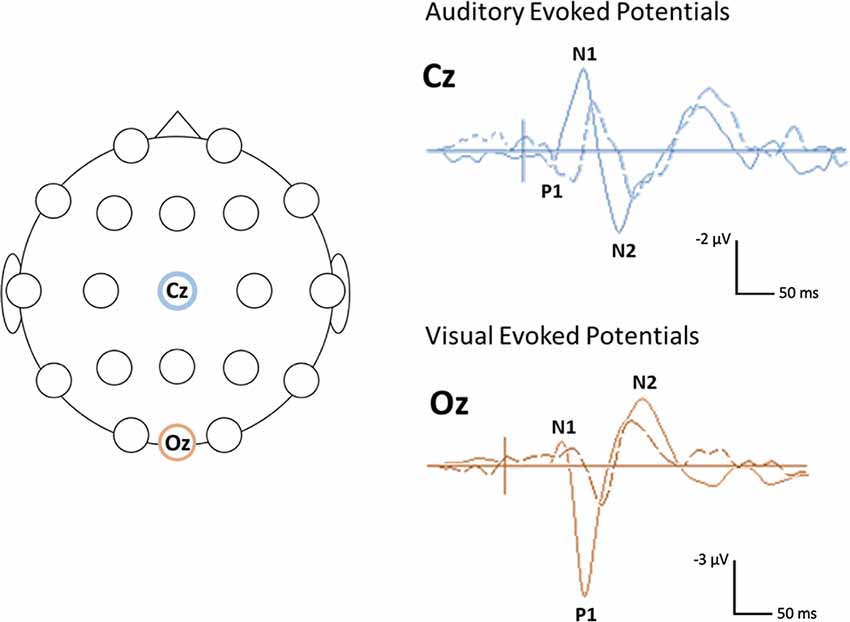
B. Event-Related Potentials (Endogenous Potentials)
In contrast, Event-Related Potentials (ERPs) are far more interesting for understanding cognition. These responses depend less on the physical nature of the stimulus and more on the context and meaning of the stimulus to the person. They are called endogenous (meaning "originating from within") because they reflect internal cognitive processes.
This is the core difference:
- A VEP tells you if the visual pathway is working.
- An ERP tells you what the person thought about what they saw.
To get a comprehensive understanding of ERPs, how they are measured, and what they mean, please watch the following video.
Event-Related Potentials (ERP) explained! | Neuroscience Methods 101
The video 'Event-Related Potentials (ERP) explained!' from the Psyched! channel provides an excellent and concise overview of what ERPs are, how they are elicited using paradigms like the 'oddball' task, and how the resulting components (like the P300) are named and interpreted.
Watch the entire video (from 00:48 to 04:18). Pay close attention to the concepts of signal averaging, the oddball paradigm, and the naming convention for ERP components (e.g., P300, N400).
As the video explained, ERP components like the P300 (a positive peak around 300ms after a rare, task-relevant stimulus) are powerful markers of cognitive processes like attention, surprise, and memory updating. For Neuraease, detecting such components could indicate that a user has just noticed an unexpected or salient event in their environment, which could be a valuable feature for your predictive models.
Test your understanding!
Imagine you are designing an experiment. In Condition 1, a subject sees a simple flashing checkerboard pattern. In Condition 2, the subject is shown a series of common words, but occasionally a rare, emotionally charged word appears that they are told to pay attention to.
- What type of potential would you primarily expect to measure in Condition 1?
- What type of potential would you be looking for in response to the rare emotional word in Condition 2?
- Why is signal averaging necessary for both?
Show answer
- Condition 1: You would measure a Visual Evoked Potential (VEP). This is a sensory (exogenous) response, tightly linked to the physical properties of the visual stimulus.
- Condition 2: You would look for an Event-Related Potential (ERP), specifically a component like the P300, in response to the rare, attended word. This is a cognitive (endogenous) response because it depends on the word's novelty and significance to the person, not just the physical act of seeing it.
- Signal averaging is necessary in both cases because the evoked/event-related potentials are very small in amplitude (microvolts) and are buried within the much larger spontaneous EEG activity. Averaging across many trials cancels out the random background EEG, allowing the time-locked potential to emerge from the noise.
3. Steady-State Evoked Potentials (SSEPs): The Brain in Rhythm
Finally, we have a special class of evoked potentials called Steady-State Evoked Potentials (SSEPs). These are elicited not by a single, discrete stimulus, but by a continuous, rhythmic stimulus.
Let's turn to a research paper that provides a very clear definition.
Noninvasive Brain–Computer Interfaces for Augmentative and Assistive Communication
This excerpt from a paper on Brain-Computer Interfaces (BCIs) clearly defines and contrasts the different signal types we're discussing. It's an excellent summary.
Read the section under 'A. Input modalities to the BCI'. Focus on the three bullet points that define Event Related Potentials, Volitional Cortical Potentials (which are a type of spontaneous EEG modulation), and especially Steady-State Evoked Potentials (SSEP).
The key idea for SSEPs is that if you present a stimulus at a certain frequency, the brain's corresponding sensory cortex will start to produce electrical activity at that exact same frequency (or its harmonics).
- Steady-State Visual Evoked Potential (SSVEP): Elicited by a light flickering at a constant rate (e.g., 15 Hz). The visual cortex will show a spike of activity at 15 Hz in the EEG power spectrum.
- Steady-State Auditory Evoked Potential (SSAEP): Elicited by a sound that is amplitude-modulated at a constant rate.
This principle is heavily used in high-speed BCIs. You can create an on-screen keyboard where each letter flickers at a unique frequency. When the user stares at the letter 'A' flickering at 12 Hz, the BCI detects a peak at 12 Hz in their EEG and knows which letter they want to type.
Conclusion
You can now parse the rich stream of EEG data into its constituent parts. You understand the fundamental difference between the brain's ongoing state and its specific responses to events.
Key Takeaways:
Let's summarize these concepts in a table:
| Signal Type | Eliciting Condition | Key Characteristic | Typical Application |
|---|---|---|---|
| Spontaneous EEG | No specific, time-locked event | Ongoing oscillations, analyzed in frequency bands (alpha, beta, etc.) | Sleep staging, monitoring arousal/relaxation |
| ERP | Discrete, often unpredictable event | Transient waveform (e.g., P300 peak) time-locked to the event | Cognitive research (attention, language) |
| SSEP | Rhythmic, periodic stimulus | Sustained oscillation at the stimulus frequency | High-speed Brain-Computer Interfaces (BCIs) |
Preview of the Next Lesson:
Now that we've categorized the different types of signals, our next step is to learn how to analyze the most common one: spontaneous EEG. We will dive into the powerful technique of spectral analysis using the Fast Fourier Transform (FFT). This will allow us to break down the continuous EEG signal into its core frequency bands (delta, theta, alpha, beta, gamma) and begin to correlate them with meaningful cognitive and emotional states—a process central to the goals of Neuraease.
Can't find a good explanation? Sign up and we'll make it for you
Sign up