
Welcome back. In the previous lesson, you calculated how a trader moves a constant-product pool along its curve: reserves determine the spot price, finite trades create price impact, and intervening trades can cause realized slippage.
Now take the other side of that market. A liquidity provider (LP) does not retain a fixed basket of the tokens originally deposited. Instead, the LP owns a percentage claim on the pool’s current reserves. When the relative market price changes and arbitrage trades rebalance the pool, the LP’s token quantities change automatically.
By the end of this lesson, you will be able to calculate those new token quantities, describe the resulting exposure, and compare the LP position with simply holding the original assets. The calculations assume a full-range, constant-product pool with fees temporarily ignored; the next lesson separates fee returns from this price-driven effect.
An LP owns a pool share, not fixed token balances
Suppose an ETH/USDC pool initially holds:
Its constant-product invariant is:
The spot price of ETH, expressed in USDC, is:
Assume you supplied of the pool’s liquidity. At the time you deposited, your claim corresponds to:
Crucially, this does not mean the contract earmarks those particular coins for you. You own a fractional claim:
where is your share of total pool liquidity. Whenever you withdraw, you receive that same fraction of whatever the pool holds at that moment:
So the calculation has two stages:
- determine the pool’s new reserves after its price has adjusted;
- multiply each reserve by your liquidity share.
This is the basic source of LP asset exposure: your ownership percentage can remain unchanged while the composition of your claim changes substantially.
Why an external price movement changes the pool
A price change on an external market does not magically rewrite an AMM’s reserves. The pool changes because traders, especially arbitrageurs, trade against any price gap.
Suppose ETH rises externally from to USDC. Initially, the AMM still offers ETH at a comparatively cheap internal price. An arbitrageur can buy ETH from the AMM and sell it elsewhere at the higher price. These swaps continue until the AMM price is close enough to the external price that the remaining difference no longer covers trading fees and transaction costs.
The relevant direction is easy to remember:
- If becomes more valuable relative to , arbitrageurs remove from the pool and add .
- The LP finishes with less of the appreciating asset and more of the other asset.
- If falls in price, the reverse happens: the pool accumulates more .
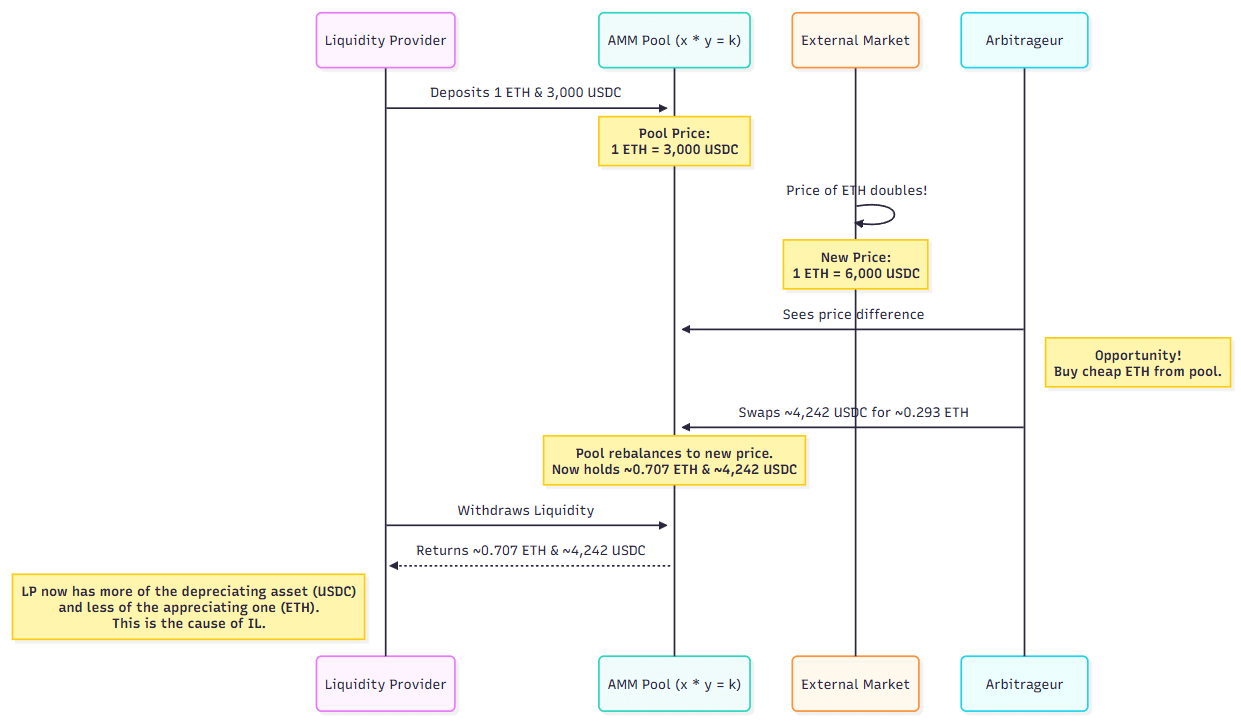
The arbitrageur earns the price discrepancy. The LP supplies the inventory from which that arbitrage profit is drawn. This is not necessarily a protocol malfunction; it is the economic function of an AMM.
What is Impermanent Loss in Crypto? (Animated + Examples)
Watch “What is Impermanent Loss in Crypto? (Animated + Examples)” from Whiteboard Crypto for a visual account of how arbitrage changes an LP’s token balances under both upward and downward ETH moves.
Watch a rising ETH price to see why the pool ends with less ETH and more stablecoins. Then watch a falling ETH price to confirm that the same mechanism works in reverse. Focus on the changing quantities in the pool before looking at the reported loss percentage.
Solve for the new reserve quantities
For this lesson, let:
- be the pool’s ETH reserve;
- be the pool’s USDC reserve;
- be the ETH price in USDC;
- be the constant product, ignoring fees.
The two equations governing the rebalanced pool are:
Substitute into the invariant:
Solving for the two new reserves at price gives:
These equations encode the LP’s changing exposure:
- A higher ETH price means falls: fewer ETH remain in the pool.
- A higher ETH price means rises: more USDC remains in the pool.
- The relationship is nonlinear because reserves vary with the square root of the price change.
The Uniswap documentation develops the same reserve equations from the constant-product invariant and then applies them to an LP position.
Read “Understanding Returns” from Uniswap Developers for a worked full-range LP example, including the reserve formulas and a comparison between providing liquidity and holding the deposited assets.
In the section “Why is my liquidity worth less than I put in?”, begin with the reserve calculation. Track how the pool price, invariant, and LP share determine the withdrawal amounts. Then continue through the definition and benchmarks, noting that the comparison is always against holding the original token quantities.
Express the change using a price ratio
Rather than recomputing every time, define the relative price change:
For example, if ETH rises from to USDC:
The pool reserve changes can now be written relative to their starting values:
Since your LP share is unchanged, your individual token quantities change by precisely the same ratios:
This is a useful shortcut. You do not need the entire pool size to find your new holdings if you know your initial position and the relative price change.
Worked calculation: ETH rises by 50%
Return to the pool with ETH and USDC, where you own of liquidity.
Initially:
Now ETH reaches:
The new pool ETH reserve is:
The corresponding USDC reserve is:
Check that both conditions hold:
Because you own of the pool, your withdrawal claim has become:
Your asset exposure changed as follows:
| Asset | At deposit | After ETH rises to 3,000 USDC | Change in units |
|---|---|---|---|
| ETH | ETH | ETH | ETH |
| USDC | USDC | USDC | USDC |
The LP did not lose ETH because of an explicit fee or a withdrawal penalty. The pool sold ETH to arbitrageurs while ETH was comparatively cheap in the AMM, and it received USDC in return.
In proportional terms:
So a increase in ETH’s relative price causes the LP to hold about fewer ETH units and more USDC units.
LP exposure is continuously rebalanced toward the underperformer
At the current pool price, a fee-free constant-product pool is always approximately half exposed to each asset by value.
At price , the USDC value of the ETH reserve is:
But because:
we have:
Therefore, ETH and USDC each represent half of the pool’s value at the prevailing price. The same is true of an LP’s proportional claim.
This produces a specific trading behavior:
- As ETH rises, the AMM sells ETH into the rising market and accumulates USDC.
- As ETH falls, the AMM buys ETH into the falling market and accumulates ETH.
- The position remains diversified, but it does so by systematically rebalancing into the relatively weaker asset.
That is why an LP position should not be thought of as simply “earning yield on two assets.” It is an inventory strategy with a built-in rebalancing rule.
A stablecoin pair such as USDC/DAI usually has small relative-price movements, so this rebalancing is limited. A volatile pair such as ETH versus a smaller token can experience much larger composition changes.
Compare the LP position with holding the original assets
To evaluate the price effect, compare the LP position with a benchmark: holding the assets you would have owned had you never deposited them.
In the ETH-rises-to-3,000-USDC example, simply holding the initial assets would leave you with:
At the new price, that portfolio is worth:
Your fee-free LP position is worth:
The LP position is worth less than the hold benchmark by approximately:
This relative shortfall is commonly called impermanent loss, although “impermanent” can be misleading. The shortfall disappears only if the relative price returns to its original level before you exit, assuming the simplified no-fee model. If you withdraw at the new price, the changed asset composition is realized.
For a price ratio , the fee-free relative performance versus holding is:
For the price ratio:
The negative sign means the LP underperformed holding by , before considering trading fees.
The direction changes the inventory, not the relative-loss magnitude
Now consider ETH falling from to USDC:
The pool, and therefore your position, becomes ETH-heavy:
| Asset | LP holdings after ETH falls to 1,000 USDC |
|---|---|
| ETH | ETH |
| USDC | USDC |
Compared with your initial ETH and USDC, you now own more ETH and less USDC. At the new price, the LP position is worth about USDC, while holding would be worth USDC.
The relative shortfall is again:
That is the same result as an ETH price doubling:
A doubling and a halving create the same fee-free underperformance relative to holding because their price ratios are reciprocals. But the inventory result is opposite:
- after a doubling, the LP has less ETH and more USDC;
- after a halving, the LP has more ETH and less USDC.
A repeatable LP-exposure workflow
When examining a full-range constant-product LP position, use this process.
-
Choose a price convention.
For example, define as USDC per ETH. Maintain that convention throughout. -
Record the initial pool reserves and your ownership share.
-
Obtain the new relative price.
-
Calculate new reserves.
Or use the ratios and to transform your initial token quantities directly.
-
Calculate the withdrawal claim.
-
Value the LP position and the hold benchmark at the same current price.
-
State the assumptions.
The basic calculation assumes the pool reaches the external market price, liquidity ownership is unchanged, and trading fees are ignored. Real pools include fees, protocol mechanics, and possibly other sources of return or loss.
Key takeaways
A constant-product LP owns a percentage of current reserves, not a fixed bundle of the originally deposited tokens.
- Arbitrage trades rebalance the AMM when its internal price diverges from the external market.
- If ETH appreciates relative to USDC, the pool and its LPs finish with less ETH and more USDC.
- If ETH depreciates, LPs finish with more ETH and less USDC.
- Given , the appreciating asset’s quantity changes by , while the other asset’s quantity changes by .
- A full-range constant-product LP remains roughly by current value, which means it systematically sells relative winners and accumulates relative losers.
- Impermanent loss measures the fee-free LP position’s value relative to holding the original assets:
Next, you will separate three components that are often wrongly merged into one “APY”: trading-fee income, impermanent loss, and token-incentive returns.
Can't find a good explanation? Sign up and we'll make it for you
Sign up