
Hello. In the previous lesson, you located Delphi in Phocis on Mount Parnassus, Athens in Attica near the port of Piraeus, and Sparta in the Eurotas valley of Laconia. Geography showed that these were very different places; this lesson explains an even more important difference in what kind of place each was.
Athens and Sparta were poleis: self-governing political communities with territories, citizens, laws, and armed forces. Delphi was a Panhellenic sanctuary: a sacred place dedicated to Apollo and shared by Greeks from many different poleis. The distinction will prevent a common mistake in comparisons: treating Delphi as though it were simply a third city-state equivalent to Athens or Sparta.
The key distinction: political community and shared sacred place
The Greek word polis is often translated “city-state,” but the English phrase can mislead if it makes us picture only a built-up city. A polis was a politically independent community. It normally included:
- an urban center and surrounding agricultural territory;
- a recognized citizen body;
- laws and institutions for collective decisions;
- religious cults associated with that community;
- the capacity to organize defense, war, diplomacy, and public finance.
The plural is poleis. Ancient Greece was not one unified nation-state. It was a world of many poleis, each with its own interests and identity, even though their inhabitants could recognize a wider Greek cultural world.
A Panhellenic sanctuary, by contrast, was a religious center whose significance extended across this divided Greek world. “Panhellenic” means “shared among Greeks.” Such a sanctuary could host pilgrims, sacred festivals, athletic contests, consultations with an oracle, and dedications from many communities. It did not turn all those visitors into members of one new political state.
The simplest formula is:
A polis organized citizens to govern a territory.
A Panhellenic sanctuary brought people from different poleis together around a god, ritual, and shared religious prestige.
This is a distinction of function, not simply size or architecture. A polis might have temples, sanctuaries, and festivals of its own. A sanctuary might contain monumental buildings and receive political delegations. Yet a temple within Athens remained part of the Athenian civic landscape, whereas Delphi became a place where Athenians, Spartans, Corinthians, island communities, and rulers from farther afield could all approach Apollo.
Reading: the polis and Panhellenic religion
Chapter 5: The Greek World from the Bronze Age to ...
Read this overview from Louis Pressbooks to establish the basic definition of a polis, then connect it to the wider Greek religious world. It gives Athens and Sparta as major examples of poleis and identifies Delphi's oracle as a particularly influential Panhellenic center.
In Section 5.5, “Geography and Topography,” read from the definition of polis through the end of the paragraph. Focus on the combination of independence, territory, government, laws, army, and patron cults. Then go to Section 5.9.2, “Greek Religion.” Begin at the paragraph starting “While many local cults” and read the Panhellenic discussion to the end of the subsection. Notice the contrast between a god worshipped as a patron of a particular polis and a cult site that attracted visitors from across the Greek world.
A useful caution follows from this reading. Religion existed in both types of place. Athens had Athena as its central civic deity; Sparta had its own local cults and religious practices; Delphi was sacred to Apollo. Therefore, “religious” versus “nonreligious” is not the contrast.
The contrast is between:
| Question | Polis | Panhellenic sanctuary |
|---|---|---|
| Who belongs? | A defined civic body, especially citizens | Visitors and dedicators from many communities |
| What is organized? | Government, law, territory, defense, civic life | Worship, oracle consultation, festivals, sacred offerings |
| What is the main identity? | Particular and political: Athenian, Spartan, Corinthian | Shared and religious: Greek communities honoring the same god |
| Does it have its own citizen army and sovereign government? | Yes, in the normal sense of a polis | No; this is not the sanctuary’s primary function |
| How does it relate to other Greek communities? | Negotiates, competes, allies, and fights as one community among others | Receives, connects, and displays the rivalries of those communities |
This table gives a framework, but ancient reality was never entirely neat. Sanctuaries needed personnel, regulations, buildings, land, and systems of protection. Delphi was located in Phocis and had a surrounding local community. Nonetheless, the Sanctuary of Apollo at Delphi was not the political equivalent of the Athenian or Spartan polis. Its authority was sacred and intercommunal rather than civic and territorial.
Athens and Sparta: two poleis, not identical poleis
Athens and Sparta were both poleis, but calling them both “city-states” must not erase their striking differences. The term names a shared basic political form; it does not imply identical government or social arrangements.
Athens as a polis
Athens was the political center of Attica, the territory surrounding it. Its citizens participated in a civic order that made laws, conducted public business, organized military service, raised revenues, and honored the gods through public cult. The details of its democratic institutions will come later, but the fundamental point is already clear: Athens had a body of citizens who could claim that the polis was their political community.
Athenian identity was therefore both local and political. An Athenian did not merely live near the Acropolis; he belonged, in a restricted legal sense, to a community that controlled Attica and acted in the Greek world as “the Athenians.”
Sparta as a polis
Sparta was likewise a polis, centered in Laconia in the southern Peloponnese. It had a citizen body, a distinctive system of government, military institutions, religious traditions, and control over territory. Its settlement pattern and political structure differed markedly from those of Athens: Sparta was not a compact, heavily monumental urban center in the Athenian manner, and its social system was exceptionally dependent on the labor of subordinate populations.
Those differences matter, but they do not make Sparta something other than a polis. Sparta could make collective decisions, send envoys, lead armies, form alliances, and represent Spartan interests in dealings with other Greek communities.
Thus we should use two levels of comparison:
- Athens and Sparta alike were independent political communities, or poleis.
- Athens and Sparta differed in institutions, territory, society, economy, and military organization.
Delphi stands at a different level. It was not a third polis matching them in that first comparison. Rather, it was a sacred meeting point at which poleis—including Athens and Sparta—could seek divine guidance and display their standing.
Delphi: Panhellenic does not mean politically unified
Delphi’s sanctuary lay on the slopes of Mount Parnassus, but its importance reached far beyond Phocis. Greeks regarded it as the site of Apollo’s oracle, delivered through the Pythia. Individuals and communities came there with questions; poleis could consult Apollo concerning matters with political consequences, including war and colonization.
The sanctuary also hosted the Pythian Games and accumulated dedications from across the Greek world. This combination made Delphi an arena of shared ritual, exchange, memory, and competition.
Archaeological Site of Delphi - UNESCO World Heritage Centre
Read UNESCO’s description of Delphi for a concise account of why the sanctuary was understood as a religious center of the ancient Greek world. It also connects Delphi’s mountain setting, oracle, pilgrims, and monumental buildings.
Read the opening description, then move to the “Brief synthesis” section. Read the sanctuary and pilgrims passage. Focus on two scales at once: Delphi was physically located in central Greece, but its religious influence and visitors extended across the Greek world. Finally, in the “Criterion” discussion, note the references to terraces, temples, treasuries, offerings, and the Pythian Games. These features show how a sacred landscape could gather monuments and visitors from many political communities without becoming one unified Greek state.
The idea that Delphi was the Greek world’s “navel,” or omphalos, was a religious claim expressed through myth. It did not mean Delphi lay at the geometric center of a map, and it did not mean that Delphi ruled Greece. Rather, it expressed its perceived sacred centrality: many Greek communities could regard Apollo’s sanctuary as important while continuing to be politically independent and often fiercely competitive.
Nor should “Panhellenic” be treated as a synonym for peaceful or politically neutral. Greek states competed intensely for prestige at Delphi, and conflicts could arise over the sanctuary’s control and protection. What made Delphi Panhellenic was that it was not merely the private religious possession of Athens, Sparta, or another one polis. Its significance crossed the boundaries that divided Greek political life.
Seeing the relationship: Athens at Delphi
The following reconstruction makes the distinction visible.
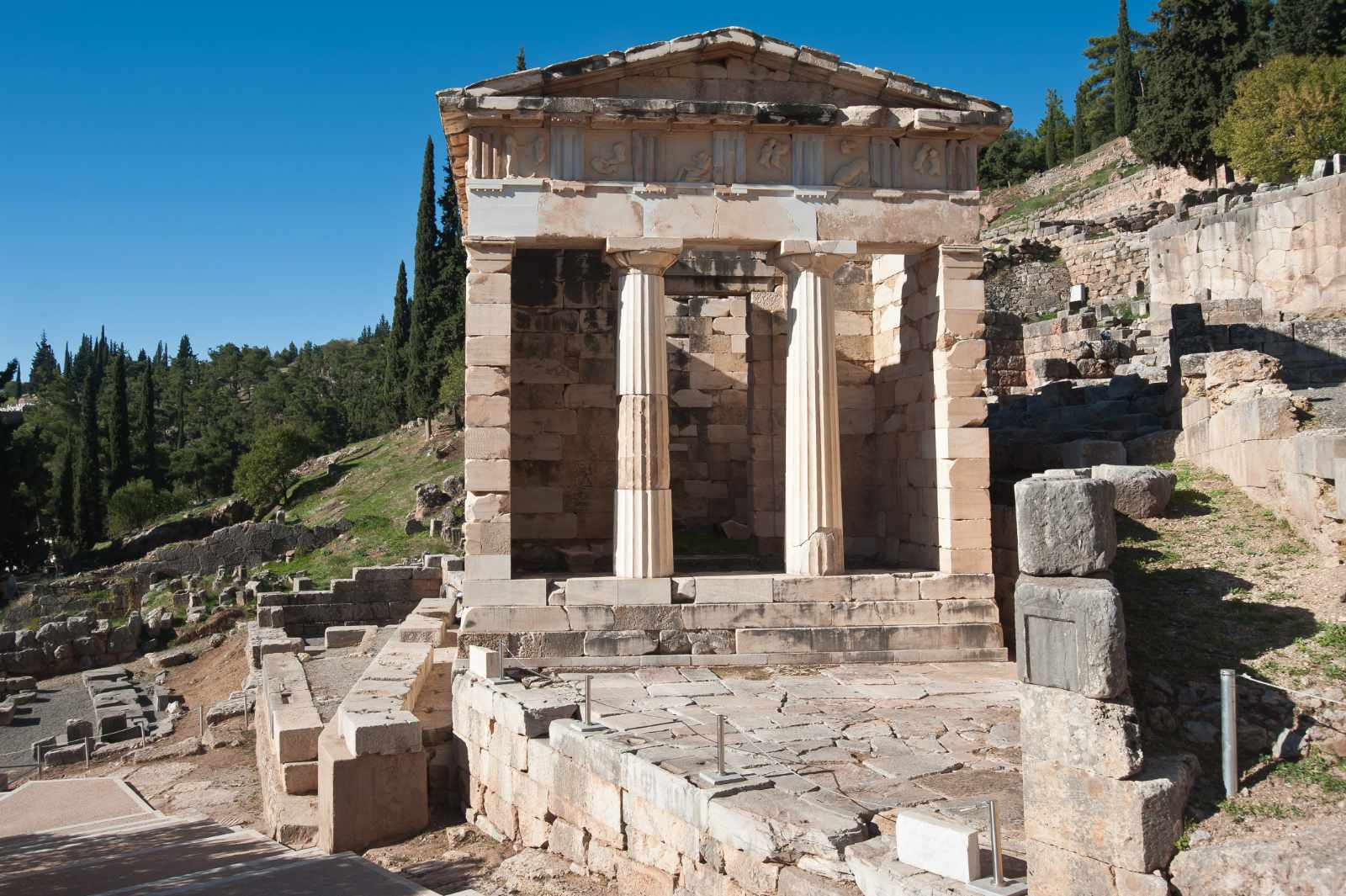
The Athenian Treasury was a small, temple-like building erected by Athens at Delphi to house offerings to Apollo. It is valuable evidence because it shows that the distinction between polis and sanctuary did not mean separation.
Athens could act as a polis by choosing, funding, and dedicating a building. Yet the treasury stood within a Panhellenic sanctuary, where visitors from other poleis would encounter it. The building communicated several things at once:
- religious devotion to Apollo;
- Athenian civic identity, since the dedication came from Athens;
- public prestige, because the monument occupied a visible sacred setting;
- competition among poleis, since other communities also constructed treasuries and offerings.
The treasury was therefore not an Athenian government building transplanted to Delphi. It did not mean that Athens owned Delphi. It was Athens’ presence within a shared sacred space.
Watch Smarthistory’s “Sanctuary of Apollo at Delphi” for a visual explanation of why Delphi was Panhellenic and how the treasuries made it a meeting place for competing poleis.
Watch the Panhellenic introduction first. Listen for the point that Delphi was not controlled as the sanctuary of a single polis and drew Greeks from many city-states. Then watch the treasury discussion. Focus on the difference between the sanctuary itself and the individual poleis that built dedications there. Use the reconstructed Athenian Treasury in the image above as your visual reference while the video explains its function.
This relationship can be stated precisely:
Athens was a polis that made a dedication at Delphi; Delphi was the Panhellenic sanctuary that received the Athenian dedication.
The same logic applies to Sparta and other Greek communities. A Spartan delegation at Delphi remained Spartan; it did not become part of a Delphic citizen body. The sanctuary created a setting in which political communities could meet the god, honor him, seek his oracle, and measure themselves against one another.
A reliable comparison method
When comparing Delphi, Athens, and Sparta, first ask: What is the primary unit being compared?
| Theme | Athens | Sparta | Delphi |
|---|---|---|---|
| Basic type | Polis | Polis | Panhellenic sanctuary |
| Core basis of authority | Civic and political community | Civic and political community | Sacred authority of Apollo and the oracle |
| Main territorial relationship | Center of Attica | Center of Spartan-controlled Laconia and wider territory | Sacred site in Phocis, significant to visitors from beyond Phocis |
| Membership | Athenian citizens, alongside other residents with differing status | Spartan citizen body, alongside other social groups | Pilgrims, envoys, priests, athletes, and dedicators from many communities |
| Main collective activities | Government, law, taxation, war, civic festivals | Government, law, military organization, civic religion | Oracle consultation, sacrifice, festivals, games, dedications |
| Relationship with the others | One competitor in the Greek world | One competitor in the Greek world | Shared sacred arena in which competitors appeared |
Three mistakes are especially worth avoiding:
-
“Delphi was another Greek city-state.”
Delphi had local inhabitants and a regional setting, but the Sanctuary of Apollo should not be analyzed as if it had the same basic political role as Athens or Sparta. -
“A polis was secular, while Delphi was religious.”
Greek poleis were deeply religious. Athens and Sparta each had public cults, festivals, sanctuaries, and patron deities. The difference is that Delphi’s cult mattered across polis boundaries. -
“Panhellenic means all Greeks were politically united.”
Greeks could share sanctuaries, myths, games, and language while living in separate, rival political communities. Panhellenism was a form of common cultural and religious connection, not a unified Greek government.
The short version is:
- Athens: a polis with a major civic, territorial, and maritime identity.
- Sparta: a polis with a major civic, territorial, and military identity.
- Delphi: Apollo’s Panhellenic sanctuary, where many poleis sought divine authority and displayed their own identities.
Conclusion
A polis was an independent political community: it possessed citizens, territory, laws, institutions, armed capacity, and civic cults. Athens and Sparta were both poleis, even though their political systems and societies differed profoundly.
A Panhellenic sanctuary was a sacred place shared across the Greek world. Delphi was the foremost example because of Apollo’s oracle, the Pythian Games, and the offerings and treasuries sent by many poleis. The Athenian Treasury captures the relationship clearly: Athens expressed its own civic prestige, but did so within a sanctuary that belonged symbolically to Greeks far beyond Athens.
In the next lesson, we return to geography and examine more closely how Attica’s terrain, resources, and access to the sea shaped the development of Athens.
Can't find a good explanation? Sign up and we'll make it for you
Sign up