
Good to continue the geographical comparison. Athens and Sparta were both poleis rooted in large territories: Attica for Athens, and Laconia plus conquered Messenia for Sparta. Delphi was different. It stood in the central Greek highlands, belonged to no great territorial state comparable to Athens or Sparta, and became a Panhellenic sanctuary: a sacred place used by Greeks from many separate communities.
This lesson asks why Delphi’s particular location supported that role. The key point is that geography did not automatically make Delphi important. Greeks made Delphi important through worship of Apollo, consultation of the oracle, festivals, gifts, and political cooperation. But its mountain setting, links to regional routes and the Corinthian Gulf, and symbolic position between major Greek regions made it an unusually effective place for many communities to meet around a shared cult.
Seeing Delphi within the Greek world
Begin with the map. Locate Athens in Attica, on the eastern side of central Greece; Sparta in the southern Peloponnese; and Delphi north-west of Athens, on the slopes of Mount Parnassus above the Gulf of Corinth. Delphi is much closer to the geographical middle of mainland Greece than Sparta is, but its importance was more than a matter of being “in the middle.”

Delphi’s location can be understood through three overlapping scales:
| Scale | Delphi’s position | Why it mattered |
|---|---|---|
| Local | On the south-western slopes of Mount Parnassus, between the steep Phaedriades rocks | Its dramatic, bounded landscape encouraged the sense of entering a sacred place set apart from ordinary civic life. |
| Regional | In Phocis, in central Greece, above the valley leading to the Gulf of Corinth | It was connected to both inland routes and maritime movement through the gulf. |
| Panhellenic | Between the Peloponnese, central Greece, Thessaly, the Aegean coast, and western Greek regions | It could serve communities with very different political interests without being identical with Athens, Sparta, or another dominant polis. |
The map also corrects a possible misconception. Delphi was not the only important sanctuary in Greece. Olympia, Isthmia, Nemea, Delos, and many others also attracted visitors beyond one city. What distinguished Delphi was the exceptional prestige of Apollo’s oracle, combined with a setting and position that enabled the sanctuary to become a meeting point across the Greek world.
The Sanctuary of Apollo at Delphi #RealArchaeology
Watch the opening of The Sanctuary of Apollo at Delphi #RealArchaeology by Archaeology with Flint Dibble. It provides a useful visual introduction to the sanctuary’s mountain setting, its view toward the Corinthian Gulf, and its ancient reputation as the world’s center.
Watch Delphi's setting. Notice the relationship between the high sanctuary, the valley below, and the distant gulf. Focus on the lecturer’s point that people travelled from across the Greek world for both the oracle and the Pythian Games.
A Panhellenic site did not mean that all Greeks were politically united or always peaceful. Athens, Sparta, Thebes, Corinth, and many smaller communities could compete fiercely, even fight wars, while still recognizing Apollo at Delphi and participating in the sanctuary’s religious world. “Shared” therefore means widely used and broadly recognized, not politically harmonious.
A sanctuary placed in a striking landscape
The sanctuary of Apollo was built on a steep slope of Mount Parnassus, framed by the cliffs called the Phaedriades. Below it stretched the Pleistos valley, leading south-westward toward the Gulf of Corinth. The topography made arrival at Delphi an experience: visitors did not casually pass through a flat urban square. They climbed into a mountainous landscape, approached the sacred precinct along a rising route, and encountered temples, monuments, treasuries, and views across the valley.
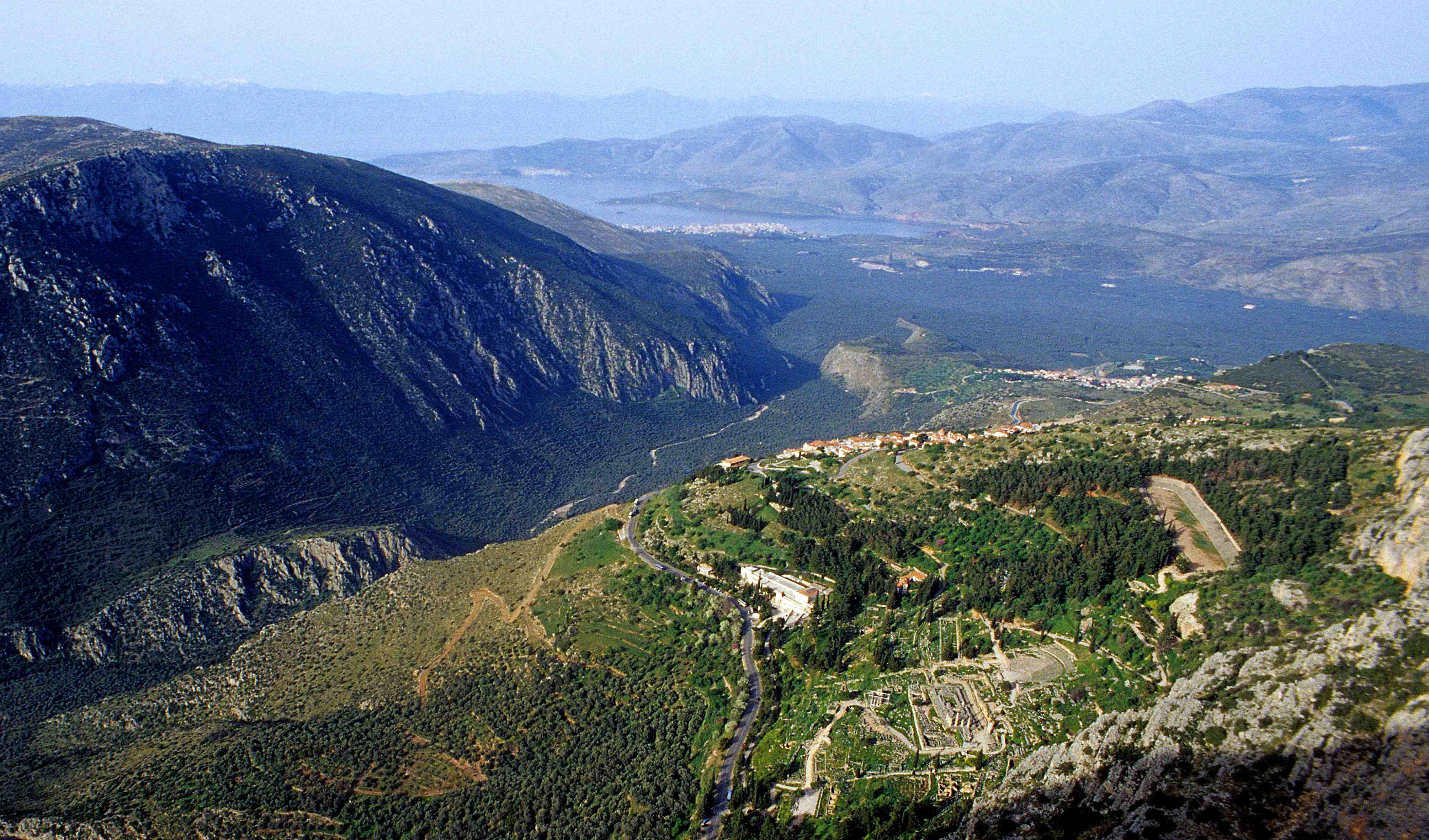
For ancient Greeks, landscape and religion were closely connected. Springs, caves, peaks, groves, unusual rock formations, and places where the cultivated world met rugged terrain could become places of divine presence. Delphi’s cliffs and mountain setting did not prove that Apollo was there, but they made the story persuasive and memorable. The physical setting helped produce an atmosphere appropriate to a god who gave messages beyond ordinary human knowledge.
The Greeks expressed this sacred centrality through the idea of the omphalos, literally the “navel.” According to a famous myth, Zeus released two eagles from opposite ends of the world; they met at Delphi. The sanctuary was thus imagined not simply as a central Greek location but as the center of the inhabited world.
Read the short “Modern Description” section in Place from ToposText. It connects Delphi’s position beneath Mount Parnassus with the myth of Zeus’s eagles and explains why Greeks could understand this particular place as a symbol of collective Hellenic unity.
Read the complete opening description, beginning with the sentence “At the foot of Mount Parnassos” and continuing to its final discussion of the Pythian festivals. Pay particular attention to the navel myth. Treat this as evidence for ancient Greek belief and religious imagination, not as a modern geographical claim.
This myth mattered because shared religious centers require shared stories. A person from Athens, Sparta, Corinth, or an island polis could arrive with local loyalties intact while participating in a larger story that placed Delphi at the world’s symbolic center. The sanctuary’s landscape made that claim visible: high mountain above, open valley below, and a difficult but purposeful ascent into Apollo’s precinct.
Still, avoid a deterministic conclusion such as “Delphi was beautiful, therefore it became famous.” Greece had many striking mountains. Delphi became sacred through long-term ritual practice, mythmaking, construction, and the authority attributed to its oracle. Geography supplied a powerful stage; human institutions and belief gave it enduring meaning.
Central Greece: connected, but not effortless to reach
A shared Greek sanctuary needed to be reachable. Delphi was not located on a broad coastal plain or beside a major imperial capital. Travel there could be slow and demanding, especially by land. Mountain routes, changing weather, and the cost of moving people, animals, offerings, and supplies all mattered.
Yet Delphi was connected rather than isolated.
From the north and east, travellers could approach through the networks of central Greece, including routes linking Phocis, Boeotia, Thessaly, and the region around Thermopylae. From the south and west, visitors could travel through the Peloponnese or across the Gulf of Corinth. The ancient port of Kirrha, near the gulf, offered an arrival point for sea travellers; from there, pilgrims and delegations could proceed inland and uphill to the sanctuary.
This combination was important:
- Mountain terrain made Delphi feel distinct from everyday civic centers and gave the sanctuary physical and symbolic grandeur.
- The valley and gulf below connected the sanctuary to maritime travel and coastal exchange.
- Central Greek routes linked Delphi to multiple mainland regions rather than only one city’s immediate territory.
- Its separation from Athens and Sparta helped it be imagined as a place to which both could come, rather than as a monument inside either rival’s home city.
The lower valley also had practical value. Sanctuaries depended on food, water, labor, and animals for sacrifice. The countryside below Delphi supported pastoral activity, which helped sustain the large-scale sacrificial and festival life of the sanctuary. Religion was not detached from material logistics: a place receiving many visitors needed routes, supplies, places for ritual activity, and a surrounding landscape able to support them.
Delphi’s position therefore created a productive tension. It was difficult enough to feel special and elevated, yet accessible enough for pilgrims, envoys, athletes, artists, and delegations to arrive from far away.
Not Athens, not Sparta: a shared place outside a dominant polis
The contrast with Athens and Sparta clarifies Delphi’s role.
Athens’s Acropolis was a major sanctuary, but it stood inside Athens itself. Its temples and festivals expressed Athenian civic identity, Athenian political authority, and Athenian claims to prestige. Sparta likewise had important local religious traditions closely tied to Spartan society and government. Such sanctuaries could welcome outsiders, but their primary meanings were rooted in a particular polis.
Delphi was located in the territory of the small community of Delphi, within the wider region of Phocis. It was not literally without local inhabitants or regional political pressures. That distinction matters: calling Delphi “neutral” without qualification would be misleading. Control of the sanctuary and its surrounding territory was contested at several points in Greek history.
Nevertheless, Delphi was not the sacred center of a powerful polis in the way that the Acropolis was Athens’s center. Its status depended on wider recognition. Greeks from many communities participated in its cult, brought gifts, asked Apollo for guidance, and used its festivals as occasions for meeting and competition.
Watch the opening of Smarthistory’s Sanctuary of Apollo at Delphi. It defines what “Panhellenic” means in this context and directly contrasts a site shared by many Greek communities with a sanctuary controlled by one city.
Watch Panhellenic Delphi. Focus on the distinction between a sanctuary governed by one municipality and one visited by people from many Greek cities. This distinction is essential when comparing Delphi with Athens and Sparta.
Delphi’s location did not eliminate political rivalry. In fact, its prestige made control over the sanctuary valuable. But because its importance reached beyond its local region, no single polis could easily reduce it to a purely local shrine without risking resistance from other Greek communities. Its broad location and broad religious constituency reinforced one another.
A useful formulation is:
Delphi was locally situated but Panhellenically significant.
That is, it had a real mountain landscape, a local population, nearby routes, and regional politics. At the same time, its influence depended on communities spread across the Greek world treating it as a place that mattered to them all.
Why people kept coming
Location supported Delphi’s role, but repeated participation made that role durable. As more visitors came, the sanctuary’s authority grew; as its authority grew, more visitors had reasons to come. This was not a purely geographical process. It relied on belief in Apollo and in the oracle’s ability to offer divine guidance.
The oracle was especially important because Greek individuals and communities faced decisions that could not be settled simply by ordinary calculation: founding a colony, responding to danger, choosing a policy, or seeking divine approval for an undertaking. The Pythia’s pronouncements were understood as Apollo’s words. That reputation gave Delphi a function no ordinary local sanctuary could easily duplicate.
The sanctuary also hosted the Pythian Games, which drew competitors and audiences from beyond the immediate region. Games, music, ritual, and sacrifice created regular reasons for travel. Meanwhile, cities displayed their presence through offerings and monuments. In later lessons, we will examine these activities in detail. For now, their geographical significance is straightforward: Delphi’s connected yet elevated site allowed a large sacred gathering place to form, while its prestige gave communities an incentive to make the journey.
This produced a shared religious landscape in which cooperation and competition existed together:
| Shared element | Competitive element |
|---|---|
| Greeks recognized Apollo’s sanctuary and attended its rituals. | Poleis sought honor, influence, and visibility within the sanctuary. |
| Visitors participated in festivals and consulted the oracle. | Cities advertised victories, wealth, and political claims through dedications. |
| Delphi offered a forum beyond any one major polis. | Powerful states tried to influence its administration and reputation. |
The phrase “shared Greek center” should therefore not suggest modern international neutrality. Delphi was a sacred arena in which Greeks expressed common religious ideas while also displaying rivalry.
A comparison with Athens and Sparta
The following comparison keeps the geographical differences clear.
| Question | Delphi | Athens | Sparta |
|---|---|---|---|
| Basic kind of place | Panhellenic sanctuary centered on Apollo | Territorial polis and maritime power | Territorial polis and Peloponnesian land power |
| Setting | Mountain slope on Parnassus above the Gulf of Corinth | Attican peninsula with access to Piraeus and the Aegean | Eurotas valley in Laconia, with Messenia under Spartan control |
| Primary geographical advantage | Connection between regions combined with an awe-inspiring sacred landscape | Coastline, port, silver, maritime links | Productive agricultural territory and defensible mountain boundaries |
| Main wider role | Religious consultation, festivals, and inter-polis gathering | Trade, naval power, empire, and democratic civic life | Land warfare and rule over extensive subject populations |
| Relation to other Greeks | A destination used by many communities | One exceptionally influential polis among others | One exceptionally influential polis among others |
Athens and Sparta could send delegations to Delphi, ask the oracle for guidance, build monuments there, and compete for recognition there. But neither city could fully replace Delphi’s special function. An Athenian could participate in Athenian religion at the Acropolis; a Spartan could participate in Spartan religious traditions in Laconia. At Delphi, both could appear before Apollo in a setting whose prestige was recognized beyond their own cities.
A precise explanation to retain
A strong answer to this lesson’s question should connect setting, access, symbolism, and shared use:
Delphi stood on the slopes of Mount Parnassus in central Greece, above the valley leading toward the Gulf of Corinth. Its dramatic mountain setting made it an effective sacred landscape, while land routes and access through the gulf enabled visitors from many Greek regions to reach it. The Greeks’ belief that Delphi was the omphalos, or navel of the world, gave this location symbolic authority. Because Delphi was not simply the civic sanctuary of a dominant polis such as Athens or Sparta, communities across Greece could treat Apollo’s oracle, festivals, and sanctuary as a shared Panhellenic institution. Geography supported this role, but the role depended on continued religious belief, travel, gifts, and political cooperation.
The crucial qualification is the last one: location supported, but did not by itself create, Delphi’s authority.
Conclusion
Delphi’s location helped make it a shared religious center in four connected ways. Its mountain setting beneath Mount Parnassus gave the sanctuary an imposing and separate sacred character. Its valley and access to the Gulf of Corinth connected it to land and sea routes. Its central Greek position made it reachable from many regions. Finally, the myth of the omphalos transformed a physical location into the symbolic center of the Greek world.
Unlike Athens and Sparta, Delphi was not chiefly a powerful territorial polis with a civic religion of its own. It was a sanctuary whose authority depended on being recognized by many poleis. That did not end rivalry; it gave rivalry a highly visible sacred setting.
Next, we will move from Delphi’s setting to its most famous institution: how Apollo’s oracle was consulted and how a response was produced.
Can't find a good explanation? Sign up and we'll make it for you
Sign up