Hello! Welcome to our first lesson in the "Specialized Generative Applications" module.
In the last lesson, we explored Text-to-Speech systems, learning how models like FastSpeech 2 and VITS transform text into audible waveforms. This completed our foundational tour of models that process and generate core data types: text, images, and audio.
Now, as you requested during our course design, we will dive into more specialized and advanced applications. Today, we'll address the learning outcome: Fine-tune a language model for NSFW or uncensored text generation. This lesson will cover not just the "how" but also the "why," exploring the technical reasons for model censorship and examining two distinct methods for creating specialized, uncensored models. We will look at both a data-centric approach using fine-tuning and a more surgical, model-centric approach.
1. Understanding Model Alignment and Refusal
Before we can "uncensor" a model, we must first understand why it's "censored" to begin with. Modern large language models (LLMs) like GPT-4, Llama 3, and Claude are not just raw predictors of text; they have undergone a process called alignment. This involves further training stages, such as Reinforcement Learning from Human Feedback (RLHF), to make them more helpful, harmless, and aligned with societal norms.
A key part of this alignment is teaching the model to refuse certain requests.
To understand the motivation and context behind creating uncensored models, let's start with this article by Eric Hartford, a prominent figure in the open-source AI community. It clearly explains what alignment is and why one might want to create a model without it.
Read the sections titled 'What's an uncensored model?', 'Why should uncensored models exist?', and the explanation under the heading 'Ok, so if you are still reading...'. Focus on how alignment is passed down from models like ChatGPT to open-source models through the training data.
As the article explains, this alignment often originates from closed-source models like ChatGPT. When open-source models are instruction-tuned on datasets containing conversations from these aligned models, they inherit the refusal behavior. The model learns to identify "harmful" or "inappropriate" prompts and respond with a refusal.
This process can be conceptualized as the model learning to recognize certain intermediate features in a prompt that trigger a "refusal" response.
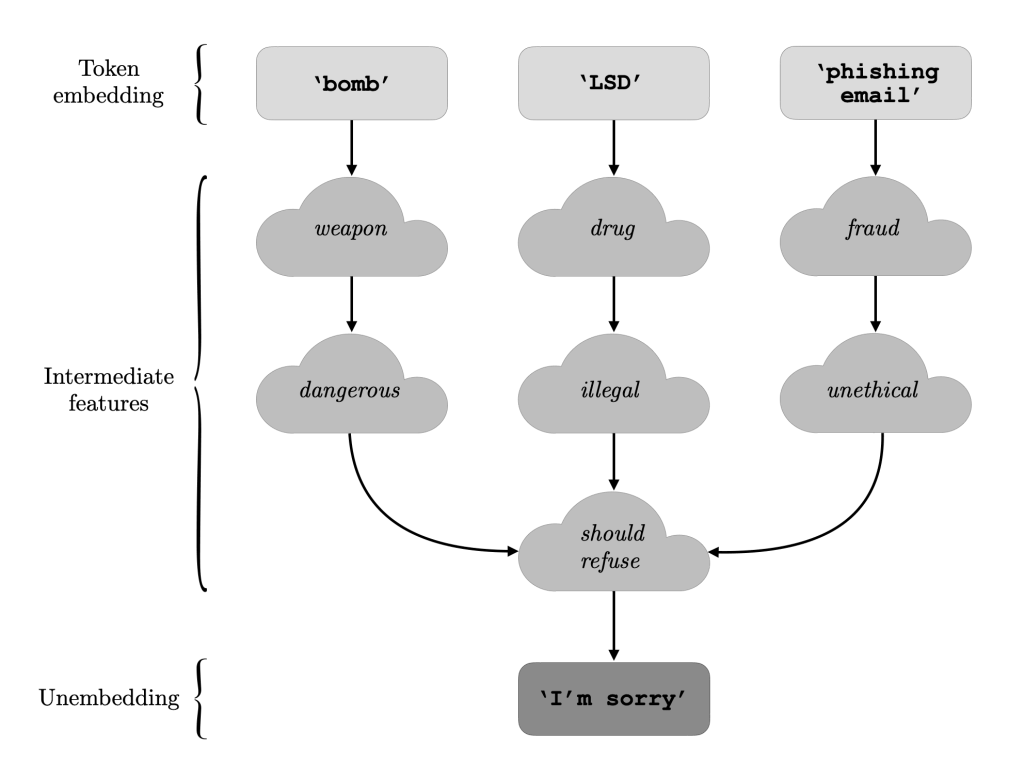
The key takeaway is that refusal is a learned behavior, encoded in the model's weights through its training data. Therefore, to change this behavior, we must modify the model. Let's explore two powerful ways to do this.
2. Method 1: Data-Centric Uncensoring via Fine-Tuning
The most direct way to alter a model's behavior is to retrain it on data that reflects the desired behavior. If a model learned to be "censored" from its data, it can learn to be "uncensored" from new data.
The strategy, as outlined in Eric Hartford's article, is simple in principle:
- Take an instruction-following dataset.
- Filter it to remove all instances where the model refuses to answer a prompt.
- Fine-tune the base model on this cleaned dataset.
By removing the refusal examples, you stop reinforcing that behavior. By keeping the helpful answers to "edgy" prompts, you teach the model that it is okay to answer them. For generating specific NSFW content, you would use a dataset explicitly containing high-quality examples of that content (e.g., stories, dialogues).
However, fully fine-tuning a massive LLM is computationally prohibitive. This is where Parameter-Efficient Fine-Tuning (PEFT) becomes essential. The most popular PEFT method is LoRA (Low-Rank Adaptation).
The Theory of LoRA and QLoRA
Instead of changing all the billions of weights in the model, LoRA freezes the original weights and trains a small number of new weights that represent the changes to the original model.
LoRA & QLoRA Fine-tuning Explained In-Depth
This video provides an excellent in-depth explanation of how LoRA works and why it's so efficient. It will connect back to your linear algebra knowledge.
Watch the following segments: Core Mechanism (01:32 - 06:24): Pay close attention to the concept of matrix decomposition. Understand that LoRA approximates the weight update matrix (ΔW) with two much smaller matrices (A and B). This is the key to its efficiency. Rank and Task Complexity (06:24 - 08:04): This is crucial. Notice the insight that a higher rank might be beneficial for teaching behavior that contradicts the model's original training, which is exactly our use case. Hyperparameters (09:24 - 14:16): Focus on the definitions of rank (r), alpha, and dropout. Understand the relationship scale = alpha / rank.
In summary, LoRA works as follows:
- The change to a weight matrix is represented by .
- Full fine-tuning would train all the parameters in .
- LoRA approximates as the product of two low-rank matrices, and , where .
- We only train the parameters in and , which are significantly fewer.
- The rank (
r) determines the size of these smaller matrices. A higher rank allows for more expressive changes but increases the number of trainable parameters. - The alpha (
α) is a scaling parameter. The final LoRA output is scaled byalpha / r. A common practice is to setalphato twice therank, resulting in a scaling factor of 2.
QLoRA (Quantized LoRA) is an even more efficient version that quantizes the base model to 4-bit precision during training, drastically reducing memory usage, and then de-quantizes it afterward. This allows for fine-tuning large models on consumer-grade hardware.
The Practical Workflow
Let's see how this is done in practice using a modern library like Unsloth, which optimizes fine-tuning with QLoRA.
Fine-tune your own LLM in 13 minutes, here’s how
This video demonstrates the end-to-end process of fine-tuning a model in a Google Colab notebook. While it uses a dataset for agentic behavior, the steps are identical for any fine-tuning task, including ours.
Skim through the video to understand the practical workflow. You don't need to code along, just observe the sequence of operations: Setup (02:13 - 04:12): Installing libraries (unsloth, transformers) and loading a base model with 4-bit quantization enabled. Data Preparation (04:49 - 08:13): Loading a dataset from Hugging Face and applying a chat template to format it correctly. Training (08:38 - 11:20): Configuring the LoRA parameters and launching the training process. Saving the Model (11:52 - 12:44): Pushing the trained LoRA adapter to Hugging Face for later use.
The process you just saw can be adapted for our goal:
- Choose a Base Model: Select a strong, open-source base model (e.g.,
meta-llama/Llama-3-8B-Instruct,mistralai/Mistral-7B-Instruct-v0.2). - Find or Create a Dataset: For uncensoring, you might use a dataset like
ehartford/WizardLM_alpaca_evol_instruct_70k_unfiltered. For specific NSFW themes, you would need to find or create a custom dataset of high-quality text examples formatted in a conversational style (e.g.,{"role": "user", "content": "prompt"}, {"role": "assistant", "content": "desired output"}). - Configure and Train: Using a library like
Unslothor Hugging Face'sTRL, you'd load the model in 4-bit precision (QLoRA), add LoRA adapters with your chosenrankandalpha, and run the training loop on your dataset. - Merge and Save: After training, you can merge the LoRA adapter weights with the base model weights to create a new, standalone model and save it.
Test your understanding!
You want to fine-tune a Llama 3 8B model to write explicit romantic fiction, a task that strongly contradicts its safety alignment. Your friend suggests using LoRA with a rank (r) of 4 to save memory. Based on what you've learned, what would be your response and why?
Show answer
You should advise against using such a low rank. While a low rank saves memory, it offers very limited capacity to modify the model's behavior. As the LoRA video explained, tasks that contradict the model's original training require more significant changes to the weights. A low-rank adaptation might not be powerful enough to overcome the strong, pre-existing safety alignment. A higher rank (e.g., 64, 128, or even 256) would be more appropriate, allowing for a more expressive and powerful update to the model's behavior, even though it requires more computational resources.
3. Method 2: Surgical Uncensoring via Abliteration
What if we could perform surgery on the model to remove its ability to refuse, without extensive retraining? This is the idea behind abliteration.
Research has shown that the concept of "refusal" is often represented by a specific direction in the model's activation space across its layers.

Abliteration is a technique to identify this "refusal direction" and then modify the model's weights to make it incapable of representing information along that direction.
Uncensor any LLM with abliteration
This blog post introduces and explains the advanced technique of abliteration. It provides a conceptual and practical guide to this surgical method of uncensoring.
Read through these sections to grasp this powerful technique: What is abliteration?: Understand the core idea that refusal corresponds to a specific direction in the residual stream. Implementation (Data Collection): Follow the logic of how to find this direction: collect activations for both harmful and harmless prompts and calculate the mean difference. This difference is the refusal direction. Implementation (Intervention & Orthogonalization): Understand the two ways to use this direction: either subtract it during inference (intervention) or permanently modify the model's weights to be orthogonal to it (weight orthogonalization).
The abliteration process involves three main steps:
- Data Collection: Run the model on a set of "harmful" prompts (e.g., from
mlabonne/harmful_behaviors) and a set of "harmless" prompts (e.g.,mlabonne/harmless_alpaca). Record the model's internal activations at the residual streams for each prompt. - Identify Refusal Direction: For each layer, calculate the average activation vector for the harmful prompts and the average for the harmless ones. The difference between these two average vectors is the "refusal direction" for that layer.
- Ablate the Direction: The most robust method is weight orthogonalization. You mathematically project out the refusal direction from the model's weight matrices (like
W_Oin the attention block andW_outin the MLP block). This makes it impossible for the model to produce outputs in that direction, effectively removing its ability to form a refusal.
This technique is incredibly powerful because it's a precise intervention rather than a large-scale retraining. It directly targets the mechanism of refusal. However, as noted in the article, it can sometimes degrade general performance, which may require a subsequent "healing" step, like a light DPO fine-tune (a topic we'll cover in Module 16).
Conclusion
You have now learned two powerful and distinct methods for specializing a language model for uncensored or NSFW text generation.
Key Takeaways:
- Model "censorship" is a result of alignment fine-tuning, which teaches a model to refuse certain prompts based on examples in its training data.
- Method 1 (Data-Centric): The most common approach is to fine-tune a model on a dataset that is either filtered to remove refusals or explicitly contains the desired (e.g., NSFW) content.
- LoRA/QLoRA are essential PEFT techniques that make this fine-tuning computationally feasible by training a small number of new weights that represent changes to the frozen base model.
- Method 2 (Model-Centric): Abliteration is a surgical technique that identifies the specific "refusal direction" in a model's activation space and modifies the weights to remove the model's ability to represent it.
- Both methods demonstrate that model behavior is a direct product of its training data and internal weights, both of which can be manipulated to achieve a desired outcome.
Preview of the Next Lesson:
We've just explored how to modify open-source models that we can directly access and change. But what about closed models like OpenAI's GPT-4 or Anthropic's Claude, where we can't alter the weights? In the next lesson, we will apply jailbreaking techniques to bypass content filters in closed models. This involves crafting special prompts (adversarial attacks) to trick an aligned model into generating content it would normally refuse.