
Hello again. In the previous lesson, you built the link from an approved requirement to its verification method, acceptance criterion, and objective evidence. That traceability is only trustworthy if the requirement’s source is itself controlled. A statement such as “meet ISO,” “per customer requirement,” or “use FMEA” is not a usable engineering input until the team has identified exactly which document applies, which revision is governing, why it applies, and what evidence it demands.
This lesson builds that control mechanism: a standards register for the assumed EDV program. You will distinguish regulations, technical standards, management-system standards, customer-specific requirements, customer engineering documents, and automotive core tools—without treating them as interchangeable. The register will become the authoritative source index for the RTM, DFMEA, DVP&R, drawings, supplier deliverables, and later release records.
Why a standards register is more than a list of documents
A shared folder containing PDFs titled “ISO,” “IATF,” and “Customer Specs” is not document control. It cannot answer the questions that matter at a design review or audit:
- Is this document legally mandatory, contractually required, or merely useful guidance?
- Does it apply to this component, program phase, target market, or supplier?
- Which edition, amendment, or customer release is the governing one?
- Does it impose a product requirement, a test method, a quality-system expectation, or a required deliverable?
- What objective evidence will show that the team has applied it?
- Who must assess a revision change, and which baselines may be affected?
A controlled standards register is a deliberately maintained database or spreadsheet that answers those questions. It does not reproduce copyrighted standards or replace the standards themselves. Instead, it records controlled metadata, access location, applicability decisions, relevant clauses, and evidence expectations.
The register’s fundamental claim is modest but powerful:
Every external or internal source that affects the product or development process has a known owner, a declared applicability decision, a known revision state, and a planned evidence route.
This is particularly important in automotive work because the word requirement is used for several very different things.
| Source class | What it is | Typical authority | Example outcome |
|---|---|---|---|
| Regulation | A legal requirement imposed by a government authority | Government regulator | A vehicle or product must satisfy a legally applicable safety or environmental rule in its target market. |
| Technical standard | A consensus document defining terminology, requirements, methods, or practices | ISO, IEC, SAE, ASTM, national body | A test method, material property, ingress code, or drawing convention is defined consistently. |
| Management-system standard | Requirements for how an organization manages quality processes | ISO, IATF | The organization controls documents, suppliers, change, records, audit, and improvement. |
| Customer-specific requirement (CSR) | A customer’s supplemental quality-system or supplier requirement | OEM or customer | A supplier follows a customer’s required quality process, portal, format, retention rule, or approval route. |
| Customer engineering requirement | Product- or program-specific technical input | Customer engineering or program team | A package envelope, environmental target, material grade, interface condition, or validation requirement is imposed. |
| Automotive core tool | A structured method used to plan, analyse, control, or approve quality | AIAG, VDA, customer | The team performs DFMEA, develops a Control Plan, evaluates measurement systems, or submits PPAP evidence. |
| Internal procedure or lesson learned | The organization’s own controlled method or retained knowledge | Your organization | A release checklist, FMEA template, CAD naming rule, or design-review process is followed. |
A useful rule is:
- A regulation can create a legal obligation.
- A standard can become mandatory when a regulation, contract, customer document, or internal procedure invokes it.
- A CSR adds customer-specific obligations to the applicable quality-management system.
- A core tool is generally a method or framework, not a physical-product performance standard.
- A customer engineering document can set direct product requirements and may invoke all of the above.
For the simulated EDV work, do not label Rivian or Amazon requirements as real unless you have an actual controlled source. Until then, call them program assumptions, assign them an owner and confidence level, and keep them visibly separate from approved customer requirements.
The quality-system layer and the product-compliance layer
The following ISO 9001 model is helpful because it shows the quality management system as a process-oriented, Plan-Do-Check-Act framework. It is not an APQP chart, a PPAP checklist, or a component test standard.

At a high level:
- ISO 9001 establishes general quality-management-system requirements.
- IATF 16949 adds automotive-sector quality-management-system requirements to the ISO 9001 foundation.
- Customer-specific requirements supplement or interpret the applicable IATF and customer quality expectations.
- APQP, PPAP, FMEA, Control Plans, SPC, and MSA provide structured methods and records used to plan, demonstrate, and control product and process quality.
- Product standards and regulations govern particular characteristics, test methods, performance conditions, or legal obligations.
The distinction matters because an ECU housing can pass an ingress test while its development process still lacks controlled records, approved changes, or a traceable Control Plan. Conversely, a team can maintain a well-audited quality system while still failing to demonstrate that the enclosure survives the required installed environmental exposure. Both the product and its development evidence need control.
Treat customer-specific requirements as controlled overlays
A CSR is not simply another standard in a list. It is a customer-owned overlay: it tells an organization how that specific customer expects relevant QMS requirements, supplier activities, records, approvals, or communication to be handled.
The Stellantis CSR document is a useful public example of this relationship. It explicitly describes a broader customer quality-requirements source and a CSR document focused on the portions most relevant to IATF auditing. It also illustrates the kind of evidence an auditor may seek: analysis of the current customer requirements, special-characteristic flow-down, FMEA records, Control Plans, PPAP status, and documented change-risk assessment.
[PDF] Stellantis Customer-Specific Requirements for use with IATF 16949
Read this public Stellantis example as a model for classifying and controlling customer-specific requirements, not as a requirement applicable to the simulated EDV program.
On page 3, read the introductory discussion beginning the CSR structure. Focus on the distinction between the full customer quality-requirements source and the audit-focused CSR selection. Then go to page 9, under “8.5.6.1 Control of changes — supplemental.” Read the change-control expectations. Notice that the customer does not merely request a changed part; it expects documented classification, impact assessment, validation, and PPAP consequences.
The register should therefore never say merely:
“Customer CSR — applicable.”
Instead, it should record:
- the exact customer document title and identifier;
- the customer release, issue date, and effective date;
- the program, customer, supplier tier, plant, or commodity to which it applies;
- the relevant clause or section;
- whether it is an interpretation, supplemental requirement, required format, or mandatory customer system;
- the evidence expected;
- the person responsible for monitoring the customer source for updates.
A public CSR from Ford or Stellantis is useful for learning, but it is not a substitute for actual requirements from a different customer. In this course, do not infer a Rivian or Amazon CSR from another OEM’s document.
The following brief audit simulation reinforces the operational point: a company needs a defined way to receive, review, communicate, implement, and audit CSR changes—not just a folder where the files are stored.
IATF 16949 audits | How do I: Audit Customer Specific Requirements (CSRs) with Management
“IATF 16949 Audits: How Do I Audit Customer Specific Requirements with Management?” from IATF 16949 Auditing shows the revision-control and audit questions that a CSR process must withstand.
Watch revision control to see the weakness in relying on informal notification rather than confirming that process owners reviewed and implemented changes. Then watch audit sampling for the expectation that applicable CSRs are included in QMS processes and audit activities.
The automotive core tools: linked methods, not six interchangeable standards
The familiar automotive “core tools” are often grouped together because they create connected quality evidence. That grouping is useful, but it can hide their different purposes.
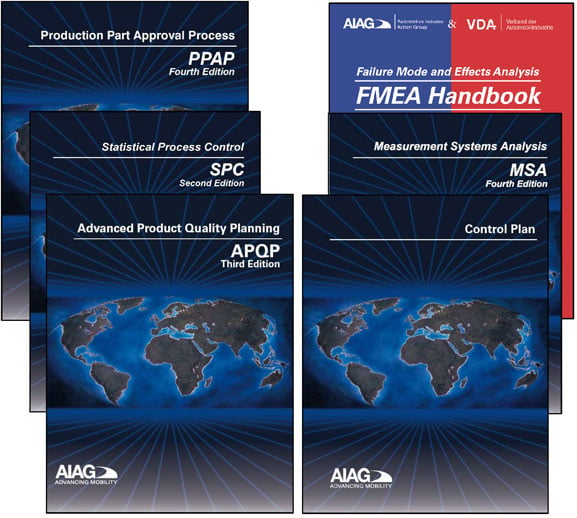
A practical classification looks like this:
| Core tool | Primary purpose | Main question it answers | Typical evidence |
|---|---|---|---|
| APQP | Plans product-quality development across phases and gates | “Have we completed the necessary planning and readiness work?” | Timing plan, gate reviews, deliverable status, open-risk log |
| DFMEA / PFMEA | Anticipates design or manufacturing failure mechanisms and prioritizes action | “How could intended function fail, and what will we do about it?” | FMEA study, action records, linked special characteristics |
| Control Plan | Defines controls used to maintain manufacturing-process and product conformance | “What will be controlled, how, how often, and what happens when it is out of control?” | Control Plan, reaction plan, inspection instructions |
| MSA | Assesses whether measurement results are adequate for their intended decisions | “Can our measurement system distinguish meaningful variation?” | Gauge study, bias, linearity, stability, or GR&R record |
| SPC | Uses statistical methods to understand and control process variation | “Is the process stable and capable of meeting its requirement?” | Control charts, capability studies, reaction records |
| PPAP | Collects and submits evidence that production-intent parts and processes meet agreed requirements | “Is this supplier process ready for approved production?” | PSW and the customer-required PPAP package |
For example, a DFMEA is not a Control Plan. The DFMEA considers potential design failure modes, causes, effects, and design actions. The Control Plan defines recurring controls for production. They should be linked where special characteristics or prevention and detection controls flow from design risk into manufacturing, but each remains its own controlled record.
The AIAG-VDA FMEA method makes this especially clear: it begins with planning, scope, and intended functions before it evaluates failures and actions. The FMEA Handbook should therefore be registered as a risk-analysis methodology with required output records—not as an ECU environmental specification.
AIAG & VDA FMEA Handbook and SAE J1739 FMEA Analysis – What You Need to Know | Plexus International
In Plexus International’s “AIAG & VDA FMEA Handbook and SAE J1739 FMEA Analysis,” this segment gives a concise explanation of the AIAG-VDA FMEA workflow and why its output includes evidence-backed optimization actions.
Watch the seven steps. Focus on the distinction between risk analysis and optimization, and on the final documentation of results. In your register, capture the handbook as the source for the method and expected FMEA evidence, rather than misclassifying it as a component-performance standard.
A register can therefore identify the AIAG-VDA FMEA Handbook with an applicability statement such as:
Applicable to all design-responsible molded components in the simulated program as the selected DFMEA method. Evidence required: controlled DFMEA study, action-priority decisions, action evidence, and links to special characteristics, validation activities, and relevant control measures.
That entry is far more actionable than “FMEA required.”
Design the standards register around decisions and evidence
A register needs enough fields to be auditable, but not so many that it becomes an abandoned administrative task. Use one row per controlled source document. Where a document has several independently applicable clauses, record the document once and reference the applicable clauses in a linked applicability assessment or a clearly separated clause field.
Organize the register into three groups of fields.
1. Identity and ownership
| Field | What to record |
|---|---|
| Register ID | Stable identifier, such as STD-ENV-001, REG-US-001, CSR-SIM-001, or CT-FMEA-001 |
| Classification | Regulation, technical standard, QMS standard, CSR, customer engineering document, core tool, or internal procedure |
| Document identifier and title | Full title, publisher document number, part number, and edition where available |
| Issuing body | For example, ISO, IEC, AIAG, VDA QMC, IATF, NHTSA, customer engineering, or internal quality |
| Document owner | The internal engineer, quality representative, regulatory lead, or supplier-quality owner responsible for the applicability decision |
| Controlled source location | Approved subscription, customer portal, PLM object, controlled intranet record, or contractual source—not an uncontrolled downloaded copy |
| Copyright/access status | Licensed, customer portal access, pending access, publicly available, or reference-only |
2. Applicability and revision control
| Field | What to record |
|---|---|
| Purpose | What the document governs: product performance, test method, QMS, drawing convention, supplier approval, risk analysis, and so on |
| Scope | Product families, processes, markets, lifecycle phase, supplier tier, or organizational functions covered |
| Applicability verdict | Applicable, partially applicable, not applicable, candidate pending review, or superseded |
| Applicability rationale | Why it applies or does not apply, including target market, declared customer contract, component type, or program assumption |
| Applicable clauses / sections | Specific clauses, tests, tables, or deliverable sections relevant to this program |
| Source revision | Edition, revision, amendment, release date, and effective date where stated |
| Revision status | Current verified, baselined for program, change under assessment, obsolete, or revision unknown |
| Last review and next review | Date checked, reviewer, and scheduled or event-based next review |
| Change impact route | Which records must be assessed if the source changes: requirements, CAD, drawing, DVP&R, DFMEA, supplier documents, or PPAP package |
3. Implementation and evidence
| Field | What to record |
|---|---|
| Derived requirement IDs | Links to the requirement register and RTM |
| Required evidence | Specific controlled artifacts expected to demonstrate implementation or compliance |
| Verification method | Inspection, analysis, demonstration, test, audit, document review, or a defined combination |
| Responsible function | Design engineering, quality, supplier quality, manufacturing, test laboratory, regulatory, or program management |
| Supplier flow-down | Whether the requirement must be communicated to a Tier 1 or lower-tier supplier |
| Maturity / status | Planned, in development, evidence under review, accepted, open gap, waived, or superseded |
| Open issue / ECO reference | Links to gaps, supplier issues, deviations, assumptions, or engineering changes |
The required evidence field is crucial. It should state the type of evidence that must exist, not an unhelpful phrase such as “documentation available.”
For instance:
| Weak entry | Stronger controlled entry |
|---|---|
| “ISO 16750 compliance” | “Approved environmental DVP&R, as-run test procedure, sample configuration record, laboratory report, result review, and RTM closure against the applicable agreed test conditions.” |
| “IATF applies” | “Controlled document process, design and development records, supplier controls, audit records, change-control records, nonconformance records, and management-review evidence within the simulated QMS.” |
| “FMEA completed” | “Released DFMEA excerpt using selected method, action decisions, evidence supporting completed actions, special-characteristic links, and review approval.” |
| “PPAP required” | “Customer-required submission level confirmed; PSW or equivalent approval evidence, dimensional results, material evidence, process-flow and Control Plan records, MSA/SPC evidence as applicable, and customer disposition.” |
A practical revision-control model
“Latest revision” can be unsafe language. A document may have a newer edition available, while the customer contract, program baseline, or certification scope still identifies a specific revision. Your register should therefore keep three distinct facts:
-
Document revision available
The most recent revision that the organization has verified through the approved source. -
Program baseline revision
The revision approved for use on this defined program baseline. -
Assessment status
Whether a newer revision has been assessed for impact, adopted, deferred, or found not applicable.
For example, an entry could read:
| Field | Example |
|---|---|
| Source revision | “Edition/revision as verified from controlled source [TBD]” |
| Program baseline | “Baseline B01, approved for simulated ECU concept phase” |
| Current-source check | “Checked 2026-04-18; update review required before design freeze” |
| Status | “Candidate pending licensed-source verification” |
| Change impact | “Assess RTM, ingress DVP&R, enclosure drawing notes, supplier RFQ, and DFMEA if technical requirements change” |
This approach prevents two opposite errors:
- assuming that an old downloaded PDF remains acceptable forever; and
- silently applying a new revision without assessing its effects on work already planned, tested, or released.
For the course, you may not own licensed copies of every ISO, IEC, AIAG, or SAE document. Record that honestly. A status such as “candidate; source and revision pending access verification” is professionally stronger than inventing a clause, date, or test condition.
An initial simulated EDV standards-register extract
The following table is an assumption-based training example. It does not state the actual requirements, target market, contracts, vehicle specifications, or supplier obligations of Rivian or Amazon. Items marked [TBD] require controlled-source access and program approval before release use.
| ID | Class and issuer | Purpose and likely scope | Applicability decision | Revision status | Required evidence |
|---|---|---|---|---|---|
QMS-001 | QMS standard; ISO | General quality-management-system requirements across the organization | Applicable to the simulated program’s QMS framework | ISO 9001:2015 recorded; current-source review required at program start | Document-control procedure, internal-audit records, design records, nonconformance and improvement evidence |
QMS-002 | Automotive QMS standard; IATF | Automotive supplements used with ISO 9001 for relevant production and service-part organizations | Applicable as the simulated automotive QMS framework; actual certification scope is not assumed | IATF 16949:2016 recorded; licensed-source status [TBD] | Design planning, supplier controls, documented information, change management, audit, and retention evidence |
CT-APQP-001 | Automotive core tool; AIAG | Structured product-quality planning and development readiness | Applicable to all three course projects as the planning framework | Handbook edition must be verified against program/customer expectation | Timing plan, gate deliverables, risk log, cross-functional reviews |
CT-FMEA-001 | Automotive core tool; AIAG and VDA | DFMEA and PFMEA methodology for systematic failure analysis and risk optimization | Applicable to design-responsible project components | Selected handbook baseline [TBD] | DFMEA/PFMEA, action evidence, special-characteristic links, review approval |
CT-PPAP-001 | Automotive core tool; AIAG | Production-part approval evidence and submission process | Applicable only when production-intent supplier approval is in scope | Customer-required PPAP edition and submission level [TBD] | PPAP plan, PSW or equivalent, dimensional/material/test records, Control Plan, MSA/SPC records as applicable |
STD-GDT-001 | Technical standard system; ISO GPS | Establishes the declared drawing and tolerancing framework | Candidate for all released drawings if ISO GPS is selected rather than ASME Y14.5 | Exact standards and editions to be baselined before drawing release | Drawing convention plan, datum strategy, GD&T application, inspection approach |
STD-ENV-001 | Technical standard; ISO | Environmental conditions and testing for road-vehicle electrical/electronic equipment | Candidate for ECU requirements only; applicable parts and conditions must be selected deliberately | Relevant part and edition [TBD] | Requirements allocation, DVP&R entries, test procedure, laboratory report, configuration record |
STD-IP-001 | Technical standard; ISO or IEC | Ingress-protection classification and test conditions | Candidate for ECU enclosure only if an approved ingress target invokes it | Selected code, standard, and revision [TBD] | Installed-configuration test procedure, conditioning record, test report, post-test inspection and functional checks |
REG-US-001 | Regulation; U.S. authority [TBD] | U.S.-market vehicle or interior-material compliance, where applicable | Candidate only after target market and vehicle/component applicability are declared | Regulatory source and effective version to be verified | Applicability assessment, test plan, accredited or suitable test evidence, compliance record |
CSR-SIM-001 | Simulated customer requirement; program authority | Defines course-specific deliverable format, EDV assumptions, review gates, and PLM evidence | Applicable to this learning program only; not a real OEM CSR | Revision A, controlled in the course project record | Approved assumptions log, design-review package, traceability, release and ECO records |
INT-PLM-001 | Internal procedure; simulated engineering organization | Defines part numbering, document metadata, release state, approval, baseline, and ECO conventions | Applicable to every project artifact | Revision A; change-controlled within project workspace | Part and document register, revision history, approval record, EBOM/MBOM reconciliation, ECO links |
Notice what this extract does not do:
- It does not claim that every ISO or IEC standard applies to every component.
- It does not convert a possible U.S. regulation into a confirmed requirement without a target-market decision.
- It does not treat a public Stellantis or Ford CSR as a requirement for the simulated EDV program.
- It does not claim that an FMEA Handbook is the same thing as IATF 16949.
- It does not hide missing source access behind invented clause references.
That caution is a design-strength, not a weakness. Early in a real program, many sources are candidates. The job is to close uncertainty through ownership, evidence, and approved decisions.
Connect the register to your RTM and PLM records
The standards register is the source-control layer; the RTM is the requirement-to-verification layer. Keep them separate but linked.
| Record | Main purpose | Example link |
|---|---|---|
| Standards register | Determines whether a source applies and what evidence it expects | STD-IP-001 identified as applicable to ECU ingress verification |
| Requirements register | Converts an applicable source into an approved, measurable product or process requirement | ECU-ENV-001 defines the approved installed ingress requirement |
| RTM / DVP&R | Plans and records how the requirement will be verified | VFY-ECU-ENV-001-T01 defines the test configuration and pass criteria |
| DFMEA | Evaluates how the intended function may fail and what actions reduce risk | Gasket displacement or sealing-land distortion linked to ECU-ENV-001 |
| Drawing / CAD / BOM | Defines the released configuration being built and checked | Gasket groove, compression stops, gasket part number, material callout |
| PLM baseline / ECO | Preserves configuration and assesses the impact of change | A gasket-material change triggers review of the applicable requirement, test evidence, DFMEA, drawing, and PPAP impact |
This connection avoids a common mistake: writing “ISO 20653 compliant” on a drawing or slide without an approved requirement, a declared applicable code, an installed test configuration, and controlled test evidence.
Build the first controlled register for this course
Create a workbook, database, or controlled Onshape-adjacent template named:
EDV_Program_Standards_and_Source_Register
Use at least these tabs or linked tables:
-
Source Register
One row per standard, regulation, CSR, customer document, core tool, or internal procedure. -
Applicability Assessments
One row per source–component pairing. A standard may apply to the ECU but not the door trim; a flammability source may apply to interior trim but not an underhood housing. -
Revision and Change Log
Records source updates, review dates, impact assessments, disposition, and resulting changes to requirements or deliverables. -
Evidence Index
Links required evidence to controlled files, PLM records, CAD versions, DVP&R reports, supplier submissions, and approval records.
Use stable IDs. Do not encode revisions into the ID.
| Object | Example stable ID |
|---|---|
| Source-document register entry | STD-ENV-001 |
| Requirement derived from it | ECU-ENV-001 |
| Verification activity | VFY-ECU-ENV-001-T01 |
| Evidence report | TR-ECU-ING-001 |
| Applicability assessment | APP-ECU-STD-ENV-001 |
| Change assessment | CIA-STD-ENV-001-002 |
| Engineering change | ECO-ECU-002 |
For your first baseline, populate at least:
- ISO 9001 and IATF 16949 as the selected simulated QMS foundation;
- APQP, PPAP, AIAG-VDA FMEA, Control Plan, MSA, and SPC as separately classified core tools;
- a declared ISO GPS or ASME Y14.5 drawing-system candidate;
- ECU environmental and ingress-protection source candidates;
- interior-trim flammability source candidates for the future door-trim and HVAC projects;
- the simulated customer/program requirements document;
- the internal simulated PLM, design-review, change-control, and supplier-interface procedures.
For each entry, write an applicability verdict. “Not applicable” is an acceptable and valuable outcome, provided the rationale is credible and approved. For example:
Not applicable to ECU housing: interior-trim flammability test method. Rationale: source is retained for future interior door-trim and HVAC-outlet assessment; ECU placement and material scope require separate confirmation.
A review checklist for each register update
Before baselining a register revision, review these questions:
- Is the document correctly classified as regulation, standard, CSR, core tool, engineering requirement, or internal procedure?
- Is the issuing body identified correctly?
- Does the title, identifier, edition, release date, and effective date match the approved source?
- Has applicability been decided for each relevant component and lifecycle phase?
- Does the rationale state why, rather than simply saying “required”?
- Are the specific clauses, tests, deliverables, or methods that matter identified?
- Is the expected evidence explicit and linked to a responsible function?
- Is an inaccessible or unverified source visibly marked as such?
- Has a newer revision been assessed rather than silently substituted?
- Does a revision change trigger a documented impact assessment of requirements, CAD, drawings, DVP&R, DFMEA, suppliers, and release status?
A controlled standards register is the disciplined boundary between vague references and usable engineering obligations. It distinguishes laws from standards, standards from customer overlays, and core-tool methods from product-performance requirements. It also makes revision status, applicability, ownership, and evidence visible before the team relies on an external source.
For the simulated EDV program, keep real public documents, customer-specific inputs, internal procedures, and engineering assumptions clearly separated. This will make your later requirements baseline and verification records credible—and will make change impact much easier to manage.
Next, you will map ISO 9001, IATF 16949, customer-specific requirements, APQP, PPAP, Control Plans, and AIAG-VDA FMEA to simulated development gates and deliverables without confusing their different roles.
Can't find a good explanation? Sign up and we'll make it for you
Sign up