
Hello! Welcome to the fourth lesson in our module on Inter-Service Communication Patterns.
In our previous lessons, we've explored different ways for services to communicate, from declarative synchronous calls with OpenFeign to high-performance asynchronous calls with WebClient. However, in all our examples, we relied on hardcoded URLs like http://localhost:8081. As we briefly discussed, this approach is not viable in a production microservices environment.
Today, we address a fundamental question: How do services find each other in a dynamic, distributed system? By the end of this lesson, you will be able to explain the role of a service registry and compare client-side vs. server-side discovery patterns. This is a core system design concept frequently tested in interviews for mid-senior roles.
1. The Problem: The Unreliability of Static Addresses
In a microservices architecture, especially one deployed on the cloud or using containers, service instances are ephemeral.
- Dynamic Scaling: Services scale up or down based on load, meaning new instances are created and old ones are destroyed.
- Failures: Instances can crash and be restarted, often with a new IP address and/or port.
- Deployments: Rolling updates and other deployment strategies constantly replace old instances with new ones.
Hardcoding network locations in this environment leads to fragile systems that require constant manual reconfiguration and are prone to failure.
To get a clear picture of why this is a critical problem, let's watch a short video.
Master Service Discovery in Microservices | Eureka and Java Spring Boot
The video 'Master Service Discovery in Microservices' by ByteMonk starts by perfectly illustrating why static addresses fail in a microservices architecture.
Watch the first minute of the video (00:00 - 01:03). Focus on how the dynamic nature of microservices makes hardcoding unworkable and introduces the concept of Service Discovery as the solution.
2. The Solution: The Service Registry
As the video introduced, the solution is Service Discovery. The central component that enables service discovery is the Service Registry.
Think of the Service Registry as a "phone book" or a DNS service specifically for your microservices. It's a highly available database that maintains a real-time list of all available service instances.
Service Discovery | System Design
The article 'Service Discovery | System Design' from Algomaster.io provides a concise and well-structured explanation of the Service Registry. Let's read the key sections.
Read the section titled 'Service Registry'. Pay attention to: The kind of information stored in the registry (name, address, health status, metadata). The two main registration patterns: Self-Registration (the service instance is responsible for registering itself) and Third-Party Registration (an external component handles registration).
The core loop of service discovery involves two key actions:
- Registration: When a service instance starts up, it registers itself with the service registry, providing its network location (IP and port) and a logical service name (e.g.,
payment-service). - Health Checking: The service instance periodically sends a "heartbeat" to the registry to signal that it is still alive and healthy. If the registry stops receiving heartbeats from an instance, it removes that instance from its list of available services, preventing traffic from being routed to a dead or unresponsive instance.
Now that we have a central, up-to-date directory of services, how do client services use it? This is where the two main discovery patterns come into play.
3. Pattern 1: Client-Side Discovery
In the client-side discovery pattern, the client service takes on the responsibility of discovering and selecting a service instance. The workflow is as follows:
- The client queries the service registry, asking, "Where can I find
payment-service?" - The registry responds with a list of all healthy instances for
payment-service. - The client then uses a load-balancing algorithm (e.g., Round Robin, Random) to select one instance from the list.
- The client makes a direct network request to the selected instance.
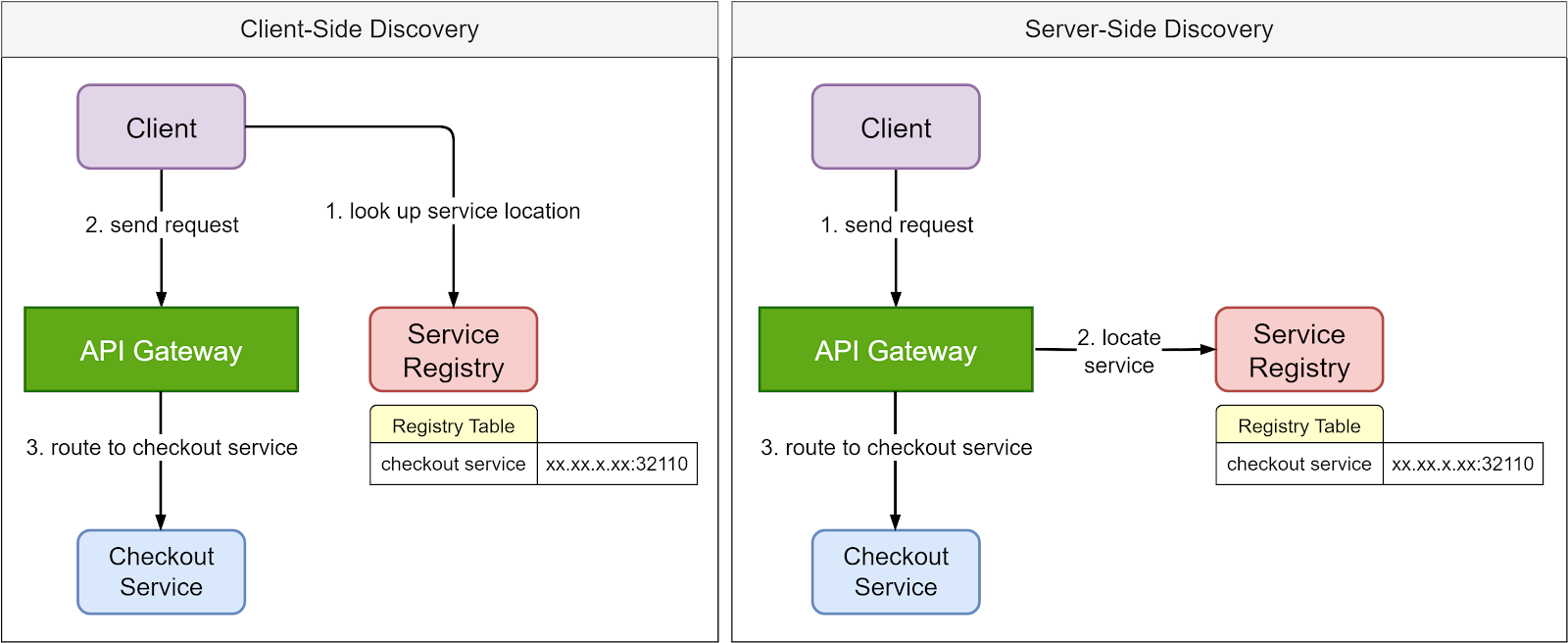
To make this process efficient, the client typically caches the registry information locally and refreshes it periodically, avoiding a query to the registry for every single request.
Java Microservices Concept Walkthrough - Service Discovery and Registration | Spring Cloud Eureka #5
The video 'Java Microservices Concept Walkthrough' from Selenium Express provides a great analogy-driven explanation of client-side discovery.
Watch the segment from 20:30 to 31:21. The speaker uses an analogy of looking up a number in a phone directory to explain the client-side discovery flow. Focus on how the client becomes 'smart' by querying the registry, caching the results, and performing its own load balancing.
Key Characteristics:
- Pros:
- Fewer network hops: The client calls the target service directly, resulting in lower latency.
- High flexibility: The client has full control over the load-balancing strategy (e.g., it can make intelligent choices based on metadata like instance version or geographic location).
- Simpler infrastructure: Only a service registry is required.
- Cons:
- Client complexity: The discovery logic must be implemented within the client service. This couples the client to the service registry.
- Language-dependent: You need to provide and maintain a client-side discovery library for every programming language and framework used in your system.
- Stale cache: The client's local cache of service instances can become outdated, though this is mitigated by health checks and refresh mechanisms.
In the Spring Ecosystem: This pattern is famously implemented by Netflix Eureka (the Service Registry) and Spring Cloud LoadBalancer (the client-side load-balancing library). You enable this in your Spring Boot application by annotating a RestTemplate or WebClient.Builder bean with @LoadBalanced. This "magically" intercepts calls made with a logical service name (e.g., http://payment-service/charge) and resolves it using the registry.
4. Pattern 2: Server-Side Discovery
In the server-side discovery pattern, the client is simplified. It doesn't know or care that there are multiple instances of a service. The discovery logic is offloaded to a dedicated infrastructure component, typically a router or load balancer.
The workflow is:
- The client makes a request to a single, stable network endpoint (e.g.,
api.my-company.com/payment-service). - This endpoint is managed by a router/load balancer.
- The router queries the service registry to get the list of healthy instances for
payment-service. - The router selects an instance using its configured load-balancing algorithm and forwards the request.
Looking back at the diagram, the right side shows this server-side flow where the API Gateway handles the interaction with the Service Registry.
Master Service Discovery in Microservices | Eureka and Java Spring Boot
Let's return to the ByteMonk video for a clear explanation of server-side discovery.
Watch the segment on Server-Side Discovery from 02:45 to 03:33. Notice how the client is simpler and the load balancer abstracts away the discovery process.
Key Characteristics:
- Pros:
- Simple clients: The client just makes a standard HTTP request to a URL. No discovery logic is needed.
- Language-agnostic: Since the client is simple, this pattern works for any service, regardless of language or framework.
- Centralized control: Load balancing, routing rules, and other policies are managed centrally at the router level.
- Cons:
- Extra network hop: Every request must go through the router/load balancer first, which can add latency.
- Potential bottleneck: The router itself can become a single point of failure or a performance bottleneck if not properly scaled and managed.
- More infrastructure: Requires deploying and maintaining an additional component (the router/load balancer).
In the Cloud-Native Ecosystem: This is the default pattern in platforms like Kubernetes. A Kubernetes Service provides a stable IP and DNS name that acts as the router, automatically load-balancing traffic across the underlying Pods (containers). Cloud providers' load balancers like AWS ELB/ALB also implement this pattern. An API Gateway like Spring Cloud Gateway also functions as a server-side discovery router.
5. Comparing the Patterns: An Interview Perspective
For your interviews, being able to articulate the trade-offs between these two patterns is critical. It demonstrates a deep understanding of system design principles.
Service Discovery | System Design
The Algomaster.io article provides a perfect,-at-a-glance comparison table that summarizes these trade-offs.
Carefully study the table in the 'Comparing Discovery Patterns' section. Then, read the 'Interview Insight' just below it. This is exactly the kind of analysis expected in a senior-level interview.
Here is the key trade-off in a nutshell:
Client-side discovery trades higher client complexity for lower infrastructure complexity and potentially lower latency. Server-side discovery trades an extra network hop and more infrastructure for simpler, language-agnostic clients.
Test your understanding!
You are designing a microservices architecture for a large financial institution. You have two main groups of services:
- A set of core backend services, all written in Java with Spring Boot, that handle critical business logic and communicate with each other extensively. Performance and low latency are paramount.
- A collection of auxiliary services and front-end applications written in various languages (Node.js, Python, Java) that consume data from the core services.
Which discovery pattern would you recommend for communication between the core Java services, and which pattern would you recommend for how the auxiliary/front-end services find the core services? Justify your choices.
Show answer
-
For internal communication between core Java services: Client-side discovery is the stronger choice.
- Justification: Since all services are on the same tech stack (Spring Boot), the cost of implementing the client-side logic is low—it's handled by libraries like Spring Cloud LoadBalancer. The primary benefit is performance; by eliminating the extra network hop of a central router, you reduce latency for the high-volume, critical internal traffic. The development teams have full control over sophisticated load-balancing strategies if needed.
-
For external communication from auxiliary/front-end services: Server-side discovery is the better pattern.
- Justification: This group of clients is polyglot (multiple languages). Implementing and maintaining discovery client libraries for each language would be a significant burden. A server-side approach, likely through an API Gateway, provides a single, stable, language-agnostic entry point. This simplifies the clients and centralizes concerns like authentication, rate limiting, and routing logic, which is ideal for traffic coming from outside the core service mesh.
Conclusion
You now have a solid theoretical foundation for service discovery, one of the most important patterns in microservices architecture. You understand that hardcoding service locations is not scalable and that a Service Registry is the solution. Most importantly, you can now analyze and compare the two dominant discovery patterns.
Key Takeaways:
- Service Registry: A dynamic "phone book" for your services that tracks healthy instances through registration and heartbeats.
- Client-Side Discovery: The client is "smart." It queries the registry and performs load balancing. It's fast but adds complexity to the client. (e.g., Eureka + Spring Cloud LoadBalancer).
- Server-Side Discovery: The client is "dumb." It talks to a router, which handles discovery and load balancing. It's simpler for the client but adds a network hop and requires more infrastructure. (e.g., Kubernetes Services, API Gateways).
- The Trade-Off: The choice between them hinges on your system's specific needs regarding performance, client language diversity, and operational complexity.
Next Up
In our next lesson, we will put the server-side discovery pattern into practice. We will implement an API Gateway using Spring Cloud Gateway for routing, rate limiting, and request transformation. You'll see firsthand how an API Gateway can act as the single entry point to our system and intelligently route requests to the correct downstream services, without the client needing to know their locations.
Can't find a good explanation? Sign up and we'll make it for you
Sign up