
Hello! Welcome back to our exploration of advanced audio models.
In the last lesson, we contrasted cascaded and direct architectures for Speech-to-Speech Translation (S2ST). We concluded that while cascaded systems are modular, they suffer from error propagation, high latency, and an inability to transfer paralinguistic information. Direct, end-to-end models promise to solve these issues by creating a unified system that maps source speech to target speech.
Today, we'll stop talking in abstractions and dive into the concrete architecture of one of the most significant direct S2ST models available: Meta's SeamlessM4T. Our goal is to explain the architecture of a direct S2ST model, such as Meta's SeamlessM4T, to understand how these complex, multi-component systems are designed and how they function.
1. SeamlessM4T: A Unified Model for Multimodal Translation
SeamlessM4T stands for Massively Multilingual and Multimodal Machine Translation. As the name implies, it's not just an S2ST model. It's a single, unified system designed to handle a wide array of translation tasks:
- Speech-to-Speech Translation (S2ST)
- Speech-to-Text Translation (S2TT)
- Text-to-Speech Translation (T2ST)
- Text-to-Text Translation (T2TT)
- Automatic Speech Recognition (ASR)
Joint speech and text machine translation for up to 100 languages
The original paper provides a high-level summary of the model's capabilities and its significant performance gains over traditional cascaded systems.
Please read the abstract and the 'Main' section of the paper. Focus on the breadth of tasks SeamlessM4T supports and its stated goal of addressing the shortcomings of cascaded systems, particularly for low-resource languages.
The core innovation is the UNITY framework, which allows these disparate tasks to be handled by a single, jointly trained model. Let's look at the architectural blueprint.
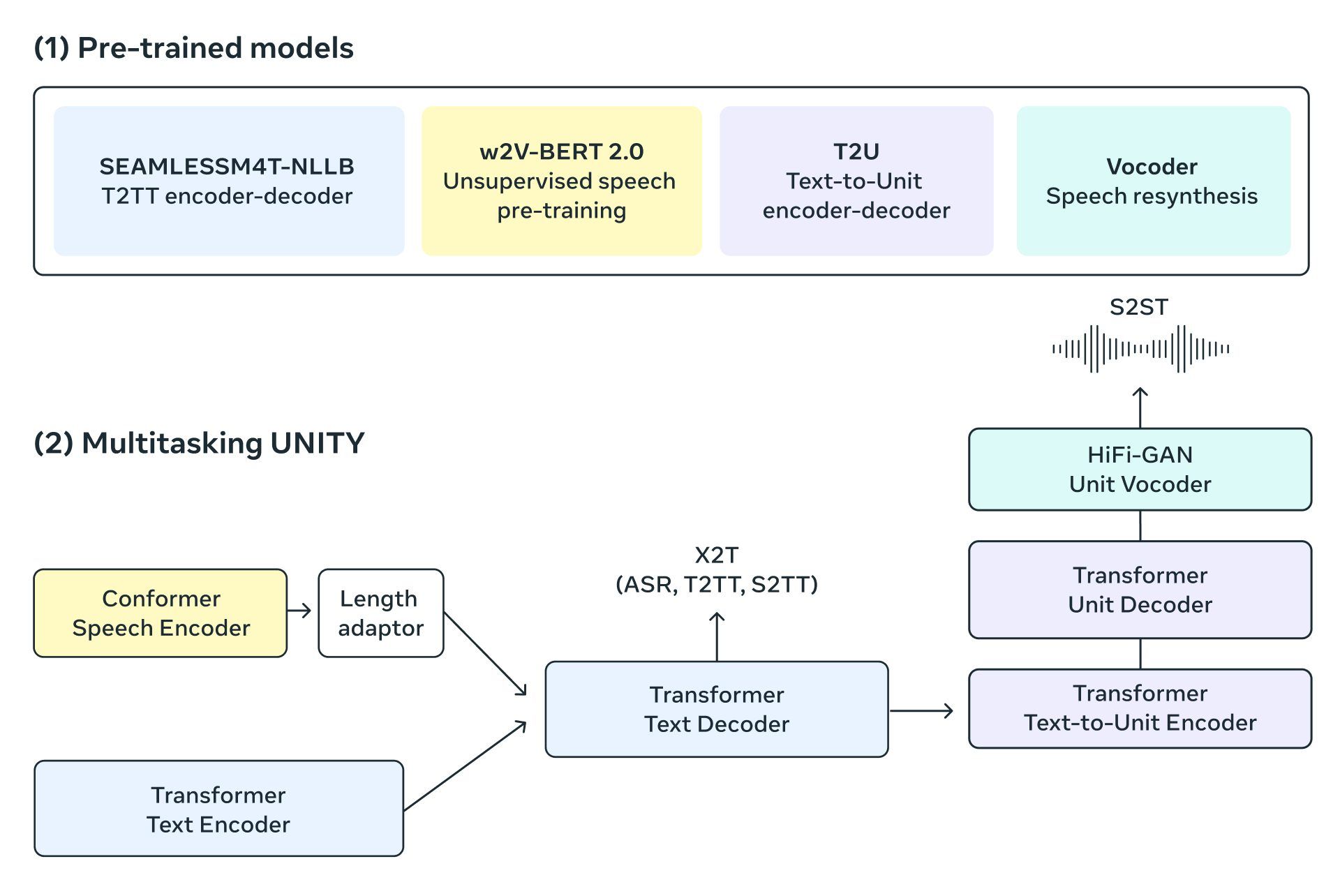
This diagram looks complex, so we'll break it down piece by piece, following the data flow for an S2ST task.
2. Deconstructing the S2ST Pipeline in SeamlessM4T
SeamlessM4T's "direct" S2ST is not a single, monolithic network. Instead, it's a carefully orchestrated pipeline of specialized components that are trained jointly. It uses a two-pass decoding strategy:
- First Pass: Translates the source speech into target text.
- Second Pass: Generates target speech from this translated text, but crucially, via an intermediate acoustic representation, not a standard Text-to-Speech model.
Let's trace the journey of an audio signal through this system.
Component 1: The Speech Encoder (w2v-BERT 2.0)
The first step is to convert the raw input audio waveform into a meaningful sequence of vector representations. SeamlessM4T uses a powerful, pre-trained speech encoder called w2v-BERT 2.0.
This model is conceptually similar to wav2vec 2.0, which you studied in Module 7. It's trained in a self-supervised manner on a massive amount of unlabeled audio.
Seamless: In-Depth Walkthrough of Meta's New Open-Source Suite
This blog post gives a clear, concise breakdown of how w2v-BERT 2.0 works. Understanding this is key to grasping how SeamlessM4T 'listens' to audio.
Read the section detailing w2v-BERT 2.0's architecture. Pay attention to the two self-supervised objectives: the Contrastive Module and the Masked Prediction Module. This dual-task approach helps the model learn rich representations of speech.
The output of the speech encoder is a sequence of embeddings. However, speech signals have a very high temporal resolution (e.g., 50 frames per second), leading to very long sequences. This is computationally expensive for the subsequent Transformer layers. To solve this, a Length Adapter is used to downsample the sequence, making it more manageable.
Component 2: The Text Decoder (NLLB Decoder - First Pass)
The downsampled speech embeddings are then fed into a text decoder. This decoder comes from Meta's NLLB (No Language Left Behind) model, a state-of-the-art multilingual machine translation system.
In this first pass, the NLLB decoder performs Speech-to-Text Translation (S2TT). It takes the speech representations and autoregressively generates the corresponding translated text.
- Input: Speech embeddings from the Length Adapter.
- Output: A sequence of text tokens in the target language.
This step provides the textual content for the translation.
Component 3: The Text-to-Unit (T2U) Model (Second Pass)
This is where SeamlessM4T's architecture truly departs from a simple cascaded system. Instead of feeding the translated text into a standard TTS model, it uses a Text-to-Unit (T2U) model.
The goal of the T2U model is to convert the text sequence into a sequence of discrete acoustic units.
What are acoustic units?
You can think of them as a learned, universal "phonetic alphabet" for the machine. As described in the SeamlessM4T paper, these units are created by taking a large multilingual audio dataset, extracting deep features (using a model like XLS-R), and then applying k-means clustering to find a vocabulary of representative sound centroids. An audio waveform can then be represented as a sequence of these discrete unit IDs. You've encountered a similar concept with EnCodec in our VALL-E lesson.
Joint speech and text machine translation for up to 100 languages
The original paper explains how these units are derived and used.
Read the subsection 'Multilingual discrete acoustic units' within the 'Modelling' section. This explains the process of using k-means to create a unit vocabulary from continuous speech representations.
The T2U model in SeamlessM4T v2 is a non-autoregressive Transformer. It's highly optimized to predict the sequence of acoustic units from the input text, including predicting the duration of each unit. This non-autoregressive nature significantly speeds up inference.
- Input: Translated text from the NLLB decoder.
- Output: A sequence of discrete acoustic unit IDs.
Component 4: The Vocoder (HiFi-GAN)
The final step is to convert the sequence of discrete acoustic units back into a continuous audio waveform. For this, SeamlessM4T employs a HiFi-GAN vocoder.
You'll remember HiFi-GAN from our TTS module. It is a Generative Adversarial Network specifically designed for high-fidelity speech synthesis from an intermediate representation. Its generator uses transposed convolutions to upsample the unit sequence to the final audio sampling rate, while multi-scale and multi-period discriminators ensure the output sounds realistic and free of artifacts.
- Input: A sequence of discrete acoustic unit IDs from the T2U model.
- Output: The final, translated audio waveform.
3. The Full Picture and Why It's Better
Let's summarize the complete S2ST workflow:
- Listen: Raw audio enters
w2v-BERT 2.0and aLength Adapterto produce a manageable sequence of speech embeddings. - Translate to Text (Pass 1): The
NLLB Decodertranslates the speech embeddings into target language text. - Translate to Units (Pass 2): The
T2U Modelconverts this target text into a sequence of discrete acoustic units. - Synthesize (Vocode): The
HiFi-GANvocoder transforms the acoustic units into the final audio waveform.
This diagram from the TowardsDataScience article neatly summarizes the flow: speech/text input is processed by w2v-BERT/NLLB-encoder, translated by the NLLB-decoder, converted to units by the T2U model, and finally synthesized into audio by HiFi-GAN.
So, why is this better than a simple ASR → MT → TTS cascade?
- Joint Optimization: Although it has multiple components, the entire system is fine-tuned end-to-end within the UNITY framework. This allows the components to co-adapt, reducing the error propagation we discussed in the previous lesson.
- Superior Performance: This architecture has proven to be more accurate. By avoiding a hard dependency on a separate ASR system and using a specialized T2U->Vocoder pipeline, it achieves higher quality translations.
- Robustness: The model is more resilient to real-world conditions like background noise.
The performance gains are not just theoretical. The SeamlessM4T paper provides hard data.
Joint speech and text machine translation for up to 100 languages
Let's look at the empirical evidence. The paper's results section directly compares SeamlessM4T's performance to strong cascaded baselines.
Review the section 'Comparison with cascaded approaches for speech translation' and look at Table 3. Notice the BLEU and ASR-BLEU scores. For example, on S2ST, SeamlessM4T-V2 achieves a score of 29.7 (X-eng) compared to the best cascaded system's 23.7, a massive improvement.
This data demonstrates that by moving to a more integrated, though complex, architecture, direct S2ST models like SeamlessM4T have decisively surpassed the quality of traditional cascaded systems.
Conclusion
In this lesson, we demystified the architecture of a state-of-the-art direct S2ST model, SeamlessM4T. We saw that it's a sophisticated, multi-component system unified under a single training framework.
Key Takeaways:
- SeamlessM4T is a unified, multitasking model that performs S2ST using a two-pass decoding process (speech → text → units → speech).
- Its architecture combines powerful pre-trained components: a w2v-BERT 2.0 speech encoder, an NLLB text decoder, a non-autoregressive Text-to-Unit (T2U) model, and a HiFi-GAN vocoder.
- The use of discrete acoustic units as an intermediate representation is a key design choice that bridges the gap between the text and speech domains while avoiding the limitations of a full TTS model.
- By being trained in an end-to-end fashion, the model mitigates error propagation and significantly outperforms older cascaded architectures in both translation quality and robustness.
Preview of the Next Lesson:
We've now covered the theory behind S2ST architectures, from the high-level trade-offs to the low-level components of a specific model. In the next lesson, we'll switch from theory to practice. You will run a speech-to-speech translation task using a pre-built recipe from a toolkit like Fairseq or ESPnet-ST, getting hands-on experience with these powerful systems.