
Hello and welcome back.
In our previous lesson, we explored the architectures of groundbreaking multimodal models like AudioPaLM and Qwen-Audio. We saw how they ingeniously integrate text-based LLMs to process and generate audio, overcoming many limitations of older, cascaded systems. You now have a solid understanding of the current state-of-the-art.
However, as a future researcher and developer, it's equally important to look beyond what's possible today and understand the frontiers of the field. This lesson is dedicated to exactly that. We will discuss the significant open challenges and promising future directions in audio language modeling, focusing specifically on the hurdles of long-form generation and achieving true expressiveness. This will provide you with a map of the problems that the next generation of audio AI researchers—yourself included—will be working to solve.
1. The Landscape of Challenges
The progress in audio language models has been astonishingly fast, but this rapid development has also illuminated a host of complex challenges. These range from fundamental data issues and architectural limitations to critical ethical concerns.
To get a comprehensive, research-level overview of these challenges, we will ground our discussion in a recent survey paper that synthesizes the state of the field.
[PDF] Sparks of Large Audio Models: A Survey and Outlook
We'll start by reading the introduction and the main challenge overview from the paper "Sparks of Large Audio Models: A Survey and Outlook". This will set the stage by introducing the scope of problems we'll be discussing.
Please read the 'Abstract' and the introductory paragraphs of 'Section 4: CHALLENGES AND OUTLOOK'. This will give you a high-level map of the topics we'll explore in this lesson.
As the paper outlines, the challenges are multifaceted. We can group them into several key themes, which we'll explore one by one.
2. Challenge 1: The Foundation - Data, Scale, and Cost
The "large" in Large Audio Models (LAMs) refers to both their parameter count and the immense datasets they are trained on. This scale is the source of their power, but also a major challenge.
- Computational Cost: Training a model like Google's AudioPaLM requires computational resources on the order of tens of thousands of GPUs, costing millions of dollars. This creates a significant barrier to entry for academic research and smaller organizations, concentrating cutting-edge development within a few large tech companies.
- Data Quality: These models are trained on vast, often unfiltered, datasets scraped from the internet. This introduces several problems that can degrade performance and introduce risk.
Let's dive deeper into these foundational issues by reading the relevant sections of the survey paper.
[PDF] Sparks of Large Audio Models: A Survey and Outlook
The following sections of the "Sparks of Large Audio Models" paper detail the immense costs and the subtle but critical issues related to data quality.
Read Section 4.1 ('Data Issues') and Section 4.3 ('Computational Cost and Energy Requirements'). As you read, consider: How 'doppelganger data' could lead to overfitting or memorization. The difficulty of preventing 'data contamination' (evaluation data leaking into the training set). The privacy risks associated with models memorizing Personally Identifiable Information (PII). The direct link between the model size/cost and its environmental impact.
These issues of cost and data hygiene are fundamental. Research into more efficient training methods and better data curation techniques is crucial for democratizing access and building more reliable models.
3. Challenge 2: Long-Form Generation and Context Windows
One of the most significant architectural hurdles for audio language models is handling long sequences. Audio is incredibly dense with information.
To refresh your memory on this, recall the comparison from the Speech LLMs video from the previous lesson: one minute of speech might be ~150 text tokens, but it can easily be 2,400+ audio feature vectors for a model like Whisper. This sequence length explosion poses a major problem for the standard Transformer architecture, whose self-attention mechanism has a computational and memory cost that scales quadratically with the sequence length ().
This makes generating or analyzing long-form audio, like a full podcast or an audiobook chapter, computationally prohibitive and prone to losing context over time.
[PDF] Sparks of Large Audio Models: A Survey and Outlook
The "Sparks of Large Audio Models" survey discusses this exact problem and points towards potential solutions.
Read Section 4.4, 'Limited context length'. Pay attention to the three categories of techniques proposed to address this challenge: efficient attention mechanisms, length generalization, and Transformer alternatives.
Maintaining coherence, speaker consistency, and narrative structure over long durations is a key area of future work. Techniques like sliding window attention, sparse attention, or even entirely new architectures that are more efficient at modeling long sequences will be critical breakthroughs.
4. Challenge 3: Expressiveness and Paralinguistic Control
While models like VALL-E and AudioPaLM are impressive at preserving a speaker's voice, they offer very limited control over the paralinguistic aspects of the generated speech. Expressiveness is not just about mimicking a voice; it's about conveying emotion, intent, and subtle prosodic nuances.
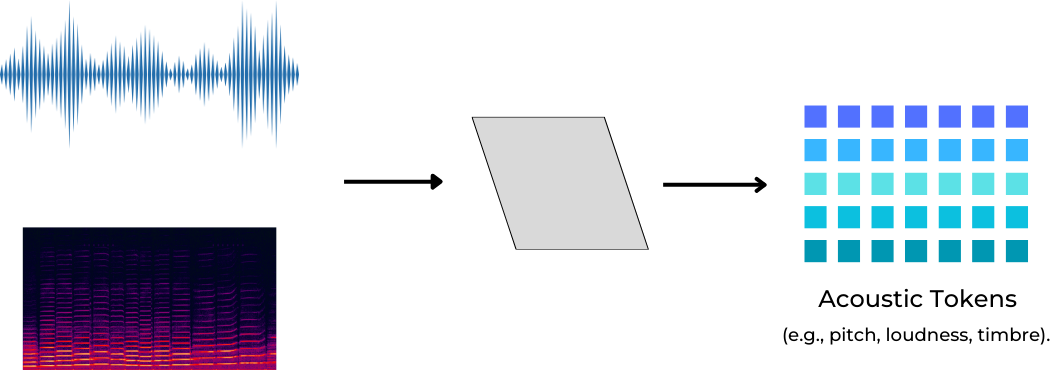
Current models can generate speech that sounds natural, but generating the same sentence with a happy, sad, or angry tone on command remains largely an unsolved problem.
[PDF] Sparks of Large Audio Models: A Survey and Outlook
This is highlighted as a major frontier in the "Sparks of Large Audio Models" survey.
Please read Section 4.5, 'Understanding Paralinguistic Information'. Note how the paper frames the ability to comprehend and generate emotions as 'the next substantial stride' in the evolution of these models.
Future work will likely involve developing new ways to condition the generation process on explicit style prompts, emotion embeddings, or other control signals, moving beyond simple text prompts. This is essential for applications like expressive audiobooks, emotionally responsive virtual assistants, and character voices in gaming.
5. Challenge 4: The Building Blocks - Tokenization and Training
The challenges aren't just high-level; they extend down to the very components of these models. Two areas are particularly ripe for research:
5.1 The Tokenization Trilemma
As we've discussed, there is an inherent trade-off between different token types.
- Semantic tokens (from HuBERT, etc.) are good for content but bad for acoustic quality.
- Acoustic tokens (from EnCodec, etc.) are good for quality but can struggle with content accuracy (e.g., mumbling).
Finding the right balance, or developing a new tokenization scheme that captures both aspects effectively, is a key research problem.
[PDF] Recent Advances in Speech Language Models: A Survey
The survey paper "Recent Advances in Speech Language Models" provides a concise discussion of this trade-off and the strategies being explored to mitigate it.
Read 'Appendix C: Discussion on Different Discrete Features' and 'Appendix D: Discussion on Speech-Text Representation Alignment'. These sections explain the trade-offs in token choice and the challenges in aligning speech with text representations to get the best of both worlds.
5.2 True End-to-End Training
Many of the current "multimodal" models are actually pre-trained components that are "stitched" together and fine-tuned. For example, in the Qwen-Audio architecture we saw, the Whisper encoder and Qwen LLM are largely frozen. A truly unified model would be trained end-to-end, allowing gradients to flow from the final audio output all the way back to the initial audio encoder.

[PDF] Recent Advances in Speech Language Models: A Survey
This idea of moving towards fully end-to-end systems is highlighted as a key future direction.
Read Section 6.2, 'End-to-End Training'. Consider why this approach might yield better performance compared to stitching together separately optimized components.
6. Challenge 5: Reliability, Safety, and Ethics
Finally, as these models become more powerful and human-like, the challenges related to their reliability and ethical deployment become paramount.
To begin, let's watch a short video segment that frames the ethical problem.
Text-to-Speech & Voice Cloning Course: Neural TTS Revolution
Valerio Velardo from The Sound of AI discusses the primary ethical challenge: AI-generated speech is becoming indistinguishable from human speech.
Watch the clip from 00:35:11 to 00:37:45. The speaker discusses the implications of voice clones reaching a point of realism where they can be used for fraud and misinformation.
This leads to several specific research challenges:
- Hallucination: Models can generate factually incorrect content, just like text LLMs. In audio, this could manifest as mispronounced names, incorrect facts spoken with a confident tone, or even random noise.
- Prompt Sensitivity: The output can be highly sensitive to small, imperceptible changes in the input prompt, leading to brittleness and unpredictable behavior.
- Safety and Ethics: The potential for misuse in creating deepfakes, spreading disinformation, or perpetuating biases found in the training data is enormous. Developing robust detection methods, watermarking techniques, and safety guardrails is a critical and ongoing area of research.
[PDF] Sparks of Large Audio Models: A Survey and Outlook
For a deeper look into these issues from a research perspective, let's return to our survey papers.
Read Section 4.6 ('Prompt Sensitivity'), 4.7 ('Hallucination'), and 4.8 ('Ethics'). This will provide a structured overview of these critical safety and reliability challenges.
Conclusion
In this lesson, we have surveyed the major challenges and future directions that define the research frontier in audio language modeling. Far from being a solved field, it is brimming with difficult and fascinating open questions.
Key Takeaways:
- Scale and Data: The immense computational cost is a major barrier, and ensuring the quality and safety of massive training datasets is a persistent challenge.
- Long-Form Generation: The quadratic complexity of Transformers makes handling long audio sequences a core architectural problem, requiring innovations in efficient attention or new model designs.
- Expressiveness and Control: Moving beyond simple voice mimicry to allow for fine-grained control over emotion, prosody, and style is a key frontier for making generated audio truly useful and engaging.
- Core Components: Fundamental research continues on improving audio tokenization to better balance semantic content and acoustic fidelity, and on developing truly end-to-end training regimes.
- Ethics and Safety: As models become more powerful, developing safeguards against misuse (deepfakes, bias, privacy violations) and improving model reliability (reducing hallucination) are paramount.
These challenges represent exciting opportunities for future research and development. Addressing them will be the focus of the field for years to come.
Preview of the Next Module:
We've just discussed how large and computationally expensive these state-of-the-art models are. This provides the perfect motivation for our next module, Module 11: Model Optimization for Deployment. We will shift our focus from building ever-larger models to the practical engineering task of making them smaller, faster, and more efficient, so they can be deployed in real-world applications. Our first lesson will cover knowledge distillation and quantization.