
Hello! Welcome back to our course on Audio AI.
In our last lesson, we explored how models like AudioLM apply the language modeling paradigm to audio generation. We saw that by converting continuous waveforms into discrete tokens with a neural codec, we can use a standard decoder-only Transformer to generate coherent audio continuations. This set the stage for thinking about audio as a language.
Today, we'll take that concept a step further to address our learning outcome: Explain the mechanics of in-context learning for audio generation in models like VALL-E.
We'll dissect how VALL-E leverages the same token-based approach not just to continue audio, but to perform zero-shot Text-to-Speech (TTS). This means it can synthesize speech in a specific voice after hearing only a few seconds of it, all without any fine-tuning. This capability, known as in-context learning (ICL), is what allows large language models like GPT-3 to perform new tasks based on examples provided in a prompt, and VALL-E brings this power to the audio domain.
1. The VALL-E Paradigm: TTS as Conditional Language Modeling
Traditional TTS systems, like Tacotron 2, typically operate in two stages:
- An acoustic model predicts a mel-spectrogram from the input text.
- A vocoder synthesizes a waveform from that mel-spectrogram.
This pipeline involves regressing to a continuous representation (the spectrogram). VALL-E introduces a fundamental shift.
Neural Codec Language Models are Zero-Shot Text to Speech Synthesizers
To understand this shift, let's start with the original VALL-E paper. The introduction and Figure 1 clearly lay out the new paradigm.
Please read the 'Abstract' and 'Introduction' sections of the paper. Pay close attention to Figure 1. Notice how VALL-E replaces the phoneme → mel-spectrogram → waveform pipeline with a phoneme → discrete code → waveform pipeline. This reframes TTS as a conditional language modeling task.
As the paper states, VALL-E treats TTS as a conditional language modeling task. Instead of predicting a spectrogram, it predicts the discrete audio tokens from a neural codec (like EnCodec). The key innovation is what it conditions on:
- A Phoneme Prompt: The target text to be synthesized, converted into a sequence of phonemes. This provides the content.
- An Acoustic Prompt: A short, 3-second recording of an unseen speaker. This provides the voice characteristics (speaker identity, prosody, emotion, and even the acoustic environment).
The model's goal is to generate the audio codec tokens for the phoneme prompt, but in the voice of the acoustic prompt.
2. The Mechanics of In-Context Learning
Let's look at how these prompts are used to achieve in-context learning. The magic lies in how the model uses the acoustic prompt during inference.
Text-to-Speech & Voice Cloning Course: Neural TTS Revolution
The YouTuber Valerio Velardo provides an excellent high-level overview of the VALL-E workflow, which clearly illustrates the role of the two prompts.
Watch this segment from 32:21 to 35:04. The diagram and explanation show how the text prompt (phonemes) and the acoustic prompt (3-second clip) are processed. Focus on the fact that the acoustic prompt is first encoded into discrete tokens by a codec before being fed into the language model.
As the video explains, the 3-second audio prompt is not used to update the model's weights. Instead, it's passed through the neural codec's encoder to get a sequence of discrete tokens. These tokens act as a conditioning signal or prefix for the language model during generation.
The model has been trained on a massive dataset (60,000 hours of speech from over 7,000 speakers) and has learned to associate certain patterns in acoustic tokens with specific speaker identities. During inference, when it sees the acoustic tokens from the prompt, it "understands" the target voice's characteristics and applies them to the new sequence of tokens it generates for the target text. This is the essence of in-context learning for audio.
3. VALL-E's Hierarchical Architecture
To make this process both high-quality and efficient, VALL-E uses a hierarchical architecture with two different types of Transformer models. This design is motivated by the structure of the residual vector quantizer (RVQ) in the audio codec.
Recall that in an RVQ, the first quantizer captures the most important, coarse information, while subsequent quantizers model the residual error, capturing finer and finer acoustic details.
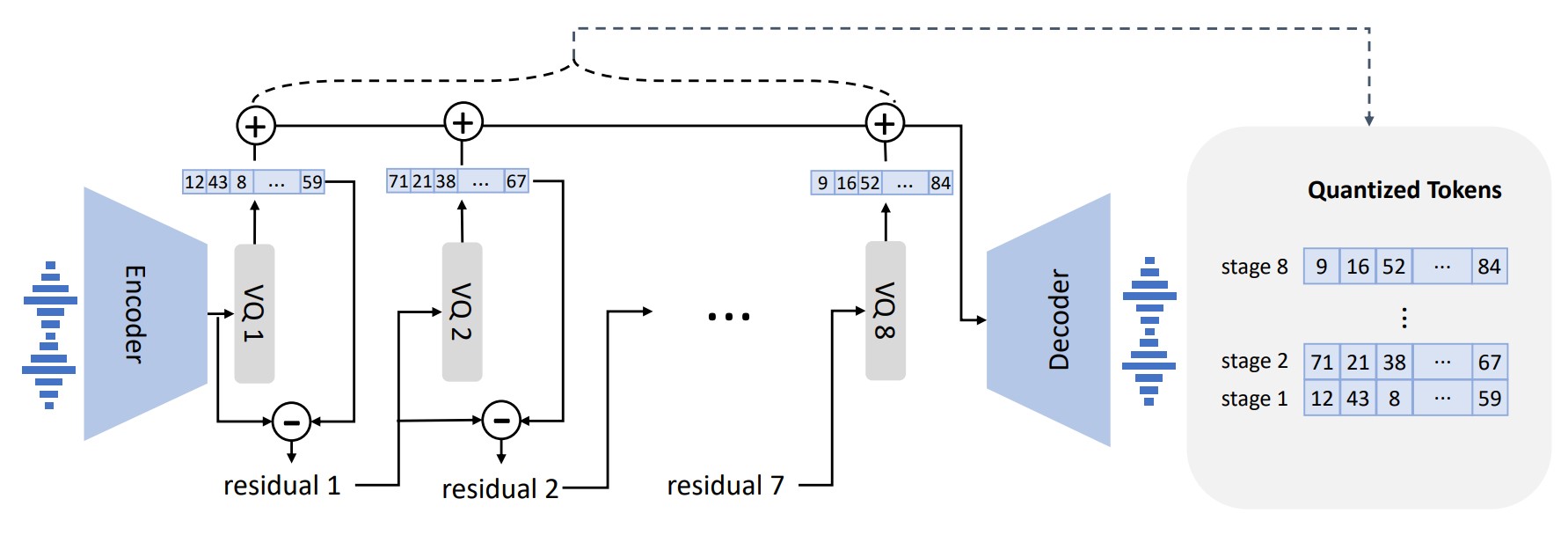
VALL-E leverages this hierarchy by using two models:
- An Autoregressive (AR) Model: This model predicts the tokens from the first quantizer only. It is a decoder-only Transformer that generates tokens one by one. This is crucial because the first-level tokens determine fundamental properties like speaker identity and, critically, the overall duration of the synthesized speech.
- A Non-Autoregressive (NAR) Model: This model predicts the tokens for the remaining quantizers (2 through 8). Since the length is already determined by the AR model, the NAR model can predict all tokens for a given level in parallel, which is much faster than autoregressive generation.

Let's formalize this with the mathematics from the paper.
Neural Codec Language Models are Zero-Shot Text to Speech Synthesizers
The paper's 'Methodology' section provides the technical details of this AR/NAR structure. This will satisfy your interest in the underlying math and theory.
Please read sections 4.1 (Problem Formulation) and 4.2 (Training). In 4.1, understand how TTS is formulated as a conditional probability p(C|x, Č), where C are the target codes, x is the phoneme prompt, and Č is the acoustic prompt. In 4.2, focus on Equation (3), which formally splits the generation into an AR part for the first codebook (c_{:,1}) and an NAR part for the rest (c_{:,j∈[2,8]}). Note how the NAR model is conditioned on the phoneme prompt (x), the full acoustic prompt (Č), and the codes from all previous layers (c_{:,<j}).
The overall probability of generating the target code matrix given the phoneme prompt and acoustic prompt is factored as:
This combination provides a smart trade-off: the AR model offers the flexibility needed to determine speech rhythm and duration, while the NAR model provides the speed for generating the fine acoustic details.
4. Inference: Putting It All Together
Now we can trace the full inference process, which is where the in-context learning truly happens.
Neural Codec Language Models are Zero-Shot Text to Speech Synthesizers
Section 4.3 of the paper describes the inference process and explicitly connects it to in-context learning. This is the culmination of everything we've discussed.
Read section 4.3 (Inference: In-Context Learning via Prompting). This section details exactly how the phoneme and acoustic prompts are constructed and used by the AR and NAR models to generate speech for an unseen speaker.
The step-by-step process is as follows:
-
Prompt Preparation:
- The target text is converted to a phoneme sequence, which becomes the phoneme prompt.
- The 3-second speaker recording is passed through the neural codec's encoder, yielding the multi-level acoustic prompt tokens .
-
AR Generation (Coarse Tokens):
- The AR model receives the phoneme prompt and the first level of the acoustic prompt tokens, , as a prefix.
- It then autoregressively generates the sequence of first-level tokens for the target text, continuing from the acoustic prefix. This generation is guided by the voice characteristics captured in the prefix.
-
NAR Generation (Fine Tokens):
- The NAR model is invoked iteratively for each remaining quantizer level .
- To predict level , it is conditioned on:
- The phoneme prompt .
- The entire acoustic prompt (all 8 levels).
- All previously generated token levels .
- It generates all tokens for level in parallel.
-
Waveform Synthesis:
- The complete stack of generated tokens is fed into the neural codec's decoder.
- The decoder synthesizes the final audio waveform, which has the content of the phoneme prompt and the voice of the acoustic prompt.
The effectiveness of this is not just theoretical. An ablation study in the paper (Table 5) shows that removing the acoustic prompt causes the speaker similarity score to plummet, confirming that the prompt is "extremely crucial for speaker identity." You can also see this in practice in open-source implementations.
PyTorch implementation of VALL-E
This unofficial PyTorch implementation of VALL-E gives a concrete example of the inference command.
Scroll down to the 'step3 inference' command. Notice the arguments --audio-prompts and --text. This is the practical application of providing the acoustic and text prompts we've been discussing.
Conclusion
In this lesson, we demystified the mechanics of in-context learning in VALL-E. By reframing TTS as a conditional language modeling task on discrete audio tokens, VALL-E can leverage prompts to guide generation in a zero-shot manner.
Key Takeaways:
- TTS as Conditional LM: VALL-E models Text-to-Speech as generating discrete audio codec tokens, conditioned on both a text (phoneme) prompt and an audio (acoustic) prompt.
- In-Context Learning via Prompting: The model clones a voice by using the codec tokens from a short audio clip as a conditioning signal or prefix during inference. This guides the generation without requiring any model fine-tuning.
- Hierarchical AR/NAR Architecture: VALL-E uses an autoregressive (AR) model to generate the first, coarse layer of tokens (determining structure and length) and a non-autoregressive (NAR) model to generate the remaining, fine-detail tokens in parallel for efficiency.
- The Power of Scale: VALL-E's remarkable ICL ability is an emergent property that stems from its training on a massive and diverse dataset of 60,000 hours of speech.
Preview of the Next Lesson:
We have now seen how language models can generate audio from scratch (AudioLM) and from text prompts (VALL-E). In the next lesson, we will explore another exciting frontier: Speech-to-Speech Translation (S2ST). We will compare older, cascaded systems (which chain ASR, Machine Translation, and TTS models) with modern, end-to-end approaches like Meta's SeamlessM4T, analyzing their respective trade-offs and architectures.