
Hello! Welcome to your fifth lesson.
In our previous lessons, we've established the geographical, cultural, and historical stage for Colombia's myths. Most recently, we explored oral tradition—the living, breathing vehicle through which this knowledge has been passed down for centuries.
Introduction
Today, we move from the "how" of transmission to the "what" of belief. This lesson addresses the final learning outcome of our foundational module: to recognize common themes in indigenous Colombian cosmologies, such as duality, nature spirits, and origin stories.
We will explore three fundamental pillars that support the mythological worldview of many Colombian indigenous cultures. Understanding these recurring themes is essential for your goal of illustrating these myths. They are the conceptual and emotional DNA of the stories. By grasping these core ideas, you can move beyond depicting a single narrative to visually capturing the very essence of a worldview.
This lesson will serve as a bridge, synthesizing the broad context we've built and preparing us for a deep dive into specific cultures, starting with the Muisca in our next module.
1. Origin Stories: The Beginning of the World and Its People
Every culture has a story about where it came from. These origin myths, or cosmogonies, are more than simple creation tales. They establish the fundamental order of the universe, explain a people's place within it, and often provide the charter for their laws and social structures.
The Muisca, whose territory we will explore in detail soon, have several foundational origin stories that were preserved through oral tradition.
Let's return to the video 'The Muisca People of Colombia' to look at two key origin myths. One explains the creation of a natural landmark, and the other explains the origin of the Muisca people themselves.
Please watch the following clips: Bochica and the Tequendama Falls (09:20 - 10:06): Pay attention to how the hero Bochica's actions physically shape the landscape, creating the famous Tequendama Falls. Bachué, Mother of the Muisca (10:06 - 11:03): Notice how Bachué emerges from a natural feature (Lake Iguaque), populates the earth, and teaches her children—the Muisca—how to live.
These two stories perfectly illustrate the function of origin myths:
- Explaining the Landscape: The story of Bochica is an etiological myth—it explains the origin of a specific feature of the natural world. For the Muisca living on the Bogotá savanna, the dramatic Tequendama Falls was a place of immense power, and this story gave it meaning.
- Establishing Identity and Law: The myth of Bachué is a creation myth for the people themselves. It establishes the sacred Lake Iguaque as their point of origin and frames Bachué not just as a progenitor, but as a law-giver who taught the Muisca how to farm, hunt, and worship.
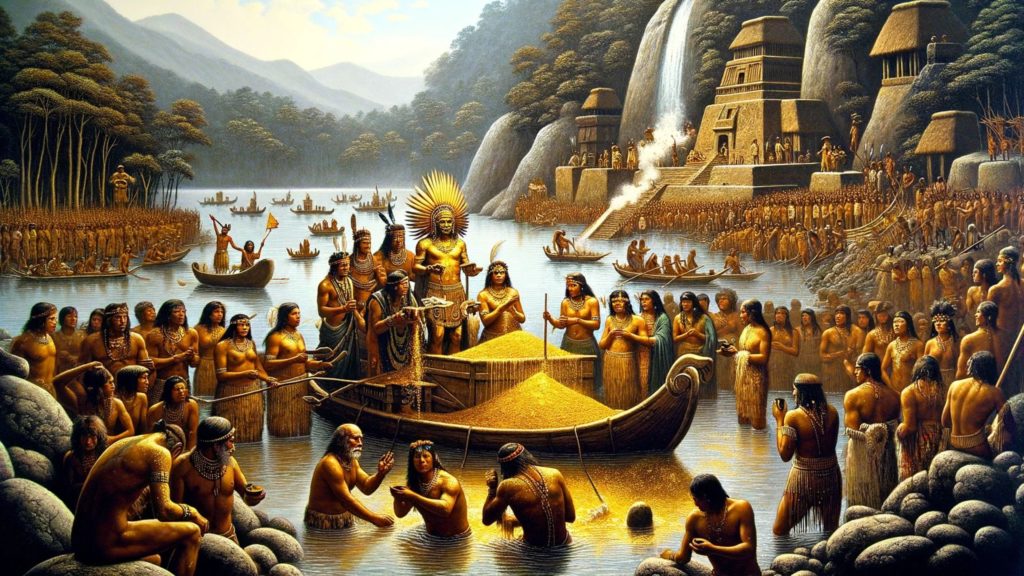
These stories connect people directly to their land, making the landscape a living narrative of their history. The famous ritual of El Dorado, depicted below, is itself a form of renewal, a cyclical re-enactment of creation where a new leader affirms the connection between the people, their sacred lake, and the cosmos.
2. Nature Spirits: The World is Alive
A theme intimately linked to origin stories is the belief that the natural world is not inert, but filled with consciousness and spirit. Mountains, rivers, lakes, animals, and celestial bodies are often seen as deities, ancestors, or living beings with their own agency.
The Muisca, for example, venerated the sun and moon as primary deities.
In the same video on the Muisca, the narrator introduces their most important deities.
Please watch the clip from 08:45 to 09:20. Note the roles of Sua (the sun god) and Chía (the moon goddess) and their importance to the different Muisca confederations.
While the Muisca personified these forces as gods like Sua and Chía, other cultures, like the Kogi and Wiwa of the Sierra Nevada de Santa Marta, perceive the entire landscape as a single, interconnected, living being.
The Koguis of Colombia & The Wiwa of Colombia
To understand this profound connection to nature, let's read about the worldview of the Kogi and Wiwa people. They are the descendants of the Tairona civilization and see themselves as guardians of the planet.
From the article 'The Koguis of Colombia', please read the section 'The Sierra Nevada de Santa Marta: A Microcosm of the Planet' (under 'Introduction – The Heart of the World'). Focus on how they see the mountain range as the 'Heart of the World' and a sacred body.
The Wiwa of Colombia: Indigenous People of the Sierra ...
The neighboring Wiwa people share a similar cosmology.
From the article 'The Wiwa of Colombia', please read the short section 'The Sierra as a Sacred Body' (under 'The Wiwa Worldview – The Law of Origin'). Notice the direct correspondence between the mountain's features and the human body.
This concept of a living, breathing earth is a powerful theme across many Colombian cultures. It’s not just that spirits live in nature; nature is spirit. This idea is captured in many folkloric figures, like the Madre Monte (Mother Mountain or Mother Forest), a spirit who protects nature and punishes those who harm it.

3. Duality: The Principle of Complementary Balance
The final core theme we'll explore is duality. Unlike the good-versus-evil dualism common in some Western traditions, this principle is about complementary pairs. Light and dark, sun and moon, masculine and feminine, and spirit and matter are not seen as opposing forces in conflict, but as two essential halves of a single, harmonious whole.
We've already seen a hint of this with the Muisca's sun god (Sua) and moon goddess (Chía). This concept is even more explicit in the worldview of the Sierra Nevada peoples.
The Koguis of Colombia – Complete Article
The Kogi article we looked at earlier has an excellent explanation of this principle.
Please return to the article 'The Koguis of Colombia' and read the subsection 'The Great Mother and the Origin of Life' (under 'The Worldview – Understanding “Aluna”'). Focus on the paragraph that begins 'A fundamental principle woven into this creation is duality.'
This principle of balanced duality manifests in many ways:
- Cosmology: The sun (masculine) and moon (feminine) are a classic pair.
- Social Structure: The Kogi and Wiwa have distinct but complementary roles for men and women, and their ceremonial houses often reflect this duality.
- Spiritual Practice: The Kogi man's poporo is a physical symbol of this principle: the gourd represents the feminine (womb), and the stick represents the masculine.
This theme is about achieving balance and harmony, not victory. The goal is to ensure the two halves of the whole remain in equilibrium. This is a subtle but profound concept that underpins the ethical and philosophical systems of these cultures.
Conclusion
In this lesson, we have identified three of the most important and recurring themes in Colombian indigenous cosmology. These are the conceptual tools you can use to understand and interpret the myths you will encounter.
Key Takeaways:
- Origin Stories: These myths explain the creation of the world, people, and landscape, grounding a culture's identity and laws in their specific environment.
- Nature Spirits: The natural world is perceived as a living, conscious entity, with features like mountains, rivers, and celestial bodies acting as deities or sacred beings.
- Duality: The universe is structured around complementary pairs (sun/moon, male/female) that must be kept in harmonious balance, rather than being seen as opposing forces.
These themes are deeply interwoven. An origin story often explains the creation of the nature spirits and the dualistic principles that govern them. Together, they form a cohesive and elegant worldview.
Preview of the Next Lesson:
We have now completed Module 1, having built a strong foundation in the geography, history, oral traditions, and core mythological themes of pre-Columbian Colombia.
In the next lesson, we will begin Module 2 and embark on our first deep dive into a specific culture: the Muisca. We will start by describing their location in the Cundiboyacense highlands and their unique social and political organization, setting the stage for exploring their rich mythology in greater detail.
Can't find a good explanation? Sign up and we'll make it for you
Sign up