
Welcome back. In the last lesson, prefix sums turned repeated range work into a subtraction between two boundaries. This lesson uses a different way to make a global problem local: sort intervals, then scan once.
Intervals appear constantly in backend work: maintenance windows, reservation slots, time-based entitlements, address ranges, batch-processing windows, and compacted event ranges. In an interview, the code is short; the differentiator is explaining why sorting by start time makes a one-pass merge correct.
By the end, you will be able to merge all overlapping closed intervals, state the overlap rule precisely, justify the sort order, and implement the solution safely in Java.
1. Define the interval contract before coding
Assume each input interval is a closed range:
For closed intervals, both endpoints are included. Therefore, intervals overlap when the next interval begins at or before the current interval ends:
For example:
- and overlap, so their merge is .
- and also overlap: both include
4, so their merge is . - and do not overlap.
The target is the minimum set of non-overlapping intervals that covers exactly the union of all input intervals.
Consider:
[[1, 3], [2, 6], [8, 10], [15, 18]]
The result is:
[[1, 6], [8, 10], [15, 18]]
We must not return [1, 18]: that would incorrectly claim that the gap between 6 and 8, and the gap between 10 and 15, are covered.
A domain detail worth stating in interviews
The condition depends on interval semantics.
| Interval meaning | Do [1, 3] and [3, 5] merge? | Merge condition |
|---|---|---|
| Closed ranges | Yes | nextStart <= currentEnd |
| Half-open time ranges | No | nextStart < currentEnd |
| Business-defined “adjacent windows should combine” | Usually yes | Explicitly define the rule |
For the standard Merge Intervals problem, use closed intervals and merge touching endpoints.
2. Why sorting by start time is the key decision
Without sorting, overlaps may be far apart:
[[6, 10], [1, 4], [7, 9], [2, 5]]
If you compare only neighboring input elements, you would miss that [1, 4] overlaps [2, 5], and [6, 10] contains [7, 9].
Sorting by start time produces:
[[1, 4], [2, 5], [6, 10], [7, 9]]
Now, every interval that could join the current merged group appears before intervals that start beyond that group’s end. This lets us maintain one active, “growing” interval.
Merge Overlapping Intervals | Brute, Optimal with Precise TC analysis
Watch “Merge Overlapping Intervals | Brute, Optimal with Precise TC analysis” by take U forward for a visual walkthrough of the one-pass strategy and its implementation structure.
Watch the one pass to see how each sorted interval is compared only with the last merged interval. Then watch the implementation for the concise result-list formulation. Focus on the two cases: creating a new merged interval when there is a gap, and extending the existing interval with the larger end.
The sorting decision is not arbitrary. Sorting by start gives a useful guarantee:
When the next interval starts after the current merged end, no later interval can overlap the current merged interval, because every later interval starts even further to the right.
That is exactly when it becomes safe to finalize the current interval.
56. Merge Intervals - In-Depth Explanation
Read AlgoMonster’s explanation to reinforce why start-time ordering converts a global overlap problem into adjacent local comparisons, and to review the two boundary mistakes that commonly appear in interviews.
In the “Intuition” subsection, read the core reasoning. Then, in “Common Pitfalls,” read the first three numbered pitfalls, especially the discussion of touching endpoints and contained intervals. Connect each pitfall to the condition and endpoint update used in the Java implementation below.
Why not sort by end time?
Sorting by end time does not support the same simple scan.
Take:
[[1, 10], [2, 3], [4, 5]]
Sorted by end time:
[[2, 3], [4, 5], [1, 10]]
A left-to-right scan might decide that [2, 3] and [4, 5] are separate before it encounters [1, 10], which overlaps both. The decision to emit [2, 3] was premature.
Sorting by start time avoids this failure: an early interval with a long end expands the active merged range before later-starting intervals are considered.
Does the tie-breaker matter?
No special tie-breaker is required for correctness. Sort by start time only.
If two intervals share a start, they necessarily overlap:
[2, 4], [2, 8]
The merge rule retains the larger endpoint, giving [2, 8]. Sorting secondarily by end can be fine, but it is not needed.
3. The one-pass merge algorithm
After sorting, maintain one interval:
current = [currentStart, currentEnd]
For each next interval [nextStart, nextEnd], there are only two cases.
Case 1: It overlaps the current merged interval
If:
the ranges overlap or touch. Keep the earlier start and extend only as far as needed:
Using max is essential. Consider:
current = [1, 10]
next    = [2, 5]
The next interval is already fully contained. Replacing currentEnd with 5 would incorrectly shrink the range. The correct merged interval remains:
[1, 10]
Case 2: It does not overlap
If:
there is a real gap. The active interval is complete, so:
- Add it to the result.
- Start a new active interval using the next interval.
At the end of the scan, add the final active interval. This final append is a frequent source of bugs.
4. Trace a complete example
Use this unsorted input:
[[6, 10], [11, 15], [2, 5], [1, 4], [7, 9]]
After sorting by start:
[[1, 4], [2, 5], [6, 10], [7, 9], [11, 15]]
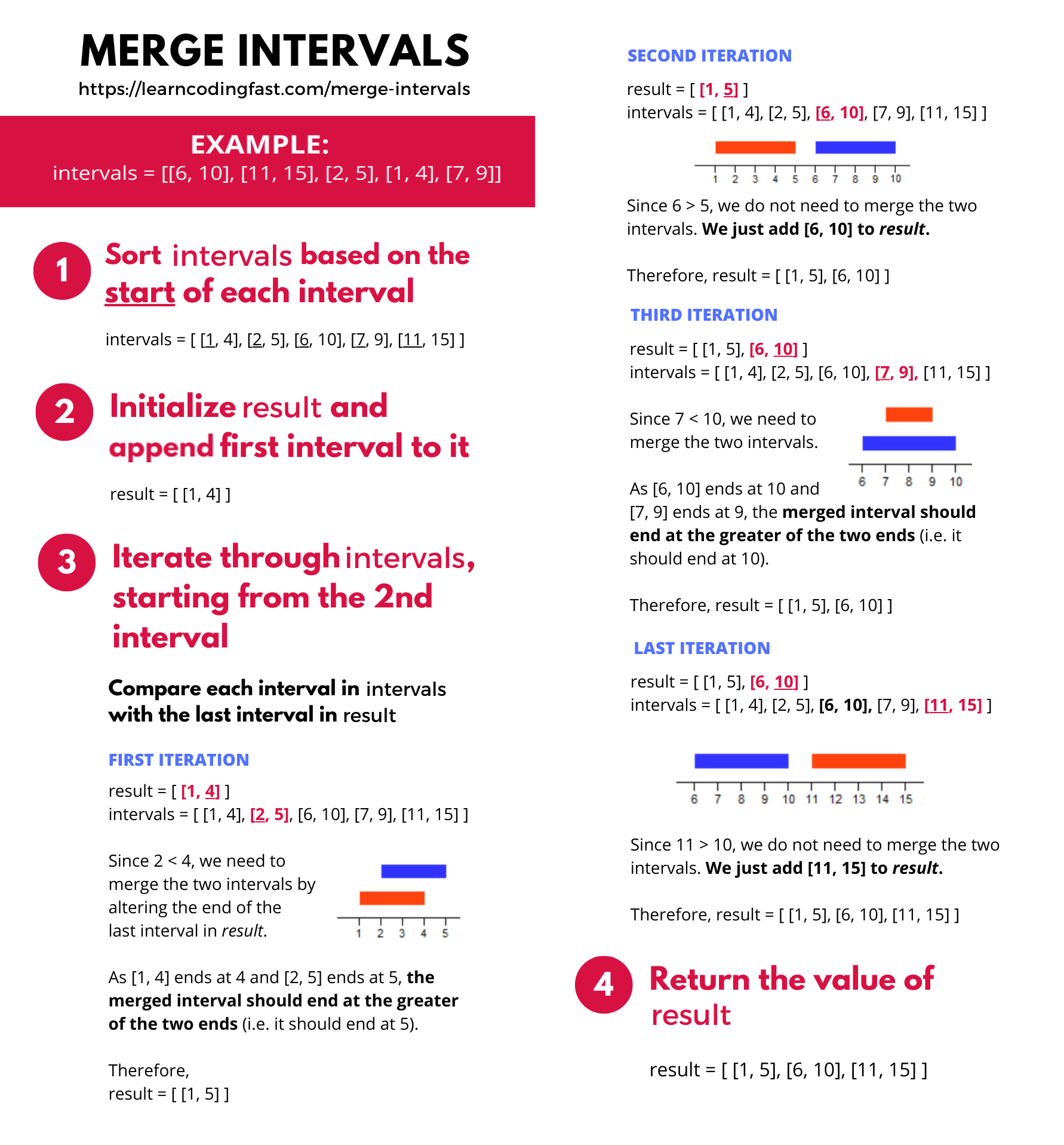
Now trace the scan:
| Next interval | Active interval before comparison | Decision | Active interval / result afterward |
|---|---|---|---|
[1, 4] | none | Initialize active interval | Active: [1, 4] |
[2, 5] | [1, 4] | 2 <= 4, merge | Active: [1, 5] |
[6, 10] | [1, 5] | 6 > 5, gap | Result: [[1, 5]]; Active: [6, 10] |
[7, 9] | [6, 10] | 7 <= 10, merge | Active remains [6, 10] |
[11, 15] | [6, 10] | 11 > 10, gap | Result: [[1, 5], [6, 10]]; Active: [11, 15] |
| end of input | [11, 15] | Append final active interval | [[1, 5], [6, 10], [11, 15]] |
Notice the containment case at [7, 9]: it overlaps [6, 10], but does not expand it.
5. Correctness: the invariant behind the scan
For a Principal-level interview, a brief correctness argument makes your explanation more credible than merely narrating code.
After processing each sorted interval, maintain this invariant:
The result contains finalized, mutually non-overlapping merged intervals. The active interval represents the complete union of the current connected group of overlapping intervals seen so far.
Why does each decision preserve the invariant?
- If
nextStart <= currentEnd, the next interval belongs to the same connected group. UpdatingcurrentEndto the maximum of both ends preserves the union of that group. - If
nextStart > currentEnd, the active interval cannot overlap the next interval. - Because input is sorted by start time, all future intervals begin at or after
nextStart, which is also greater thancurrentEnd. - Therefore, no future interval can overlap the active interval. It is safe to finalize it.
This is the full justification for sorting by start time. Sorting creates the monotonic fact that makes “emit when a gap appears” safe.
6. Java implementation
This version preserves the caller’s top-level input order by sorting a shallow copy. It assumes each interval contains exactly two valid endpoints and that:
import java.util.ArrayList;
import java.util.Arrays;
import java.util.Comparator;
import java.util.List;
import java.util.Objects;

public final class IntervalMerger {

    private IntervalMerger() {
    }

    public static int[][] merge(int[][] intervals) {
        Objects.requireNonNull(intervals, "intervals must not be null");

        if (intervals.length == 0) {
            return new int[0][];
        }

        // Copy the outer array so sorting does not reorder the caller's input.
        int[][] sorted = intervals.clone();
        Arrays.sort(sorted, Comparator.comparingInt(interval -> interval[0]));

        List<int[]> merged = new ArrayList<>();

        int currentStart = sorted[0][0];
        int currentEnd = sorted[0][1];

        for (int i = 1; i < sorted.length; i++) {
            int nextStart = sorted[i][0];
            int nextEnd = sorted[i][1];

            if (nextStart <= currentEnd) {
                currentEnd = Math.max(currentEnd, nextEnd);
            } else {
                merged.add(new int[] {currentStart, currentEnd});
                currentStart = nextStart;
                currentEnd = nextEnd;
            }
        }

        // The final active interval has not yet been emitted.
        merged.add(new int[] {currentStart, currentEnd});

        return merged.toArray(new int[0][]);
    }
}
A few representative checks:
merge(new int[][] {
    {1, 3}, {2, 6}, {8, 10}, {15, 18}
});
// [[1, 6], [8, 10], [15, 18]]

merge(new int[][] {
    {1, 4}, {4, 5}
});
// [[1, 5]]

merge(new int[][] {
    {1, 10}, {2, 3}, {4, 5}
});
// [[1, 10]]

merge(new int[][] {});
// []
Complexity
For intervals:
| Component | Time | Space |
|---|---|---|
| Sorting by start | Depends on the sorting implementation | |
| One merge scan | beyond output | |
| Total | output in the worst case |
If all intervals are disjoint, the output contains intervals, so output space is .
This implementation also makes an top-level array copy to avoid reordering the caller’s input. In a coding interview, you can sort intervals in place unless the prompt requires input preservation; simply state the choice.
7. Common interview mistakes
Treating touching intervals as separate
For the standard closed-interval problem, this is wrong:
if (nextStart < currentEnd)
It fails for:
[1, 4], [4, 5]
Use:
if (nextStart <= currentEnd)
unless the prompt explicitly defines half-open ranges.
Assigning the new end directly
This is wrong:
currentEnd = nextEnd;
It breaks containment:
[1, 10], [2, 5]
Always use:
currentEnd = Math.max(currentEnd, nextEnd);
Forgetting the final interval
The active interval is only appended when a later gap appears. The final one has no later interval to trigger that action, so append it after the loop.
Comparing against only the original previous interval
The comparison must use the current merged end, not merely the end of the previous raw input interval. Chained overlaps demonstrate why:
[1, 3], [2, 4], [4, 7]
The third interval overlaps the merged range [1, 4], even though it may not be handled correctly if you fail to update the active endpoint.
8. An interview-ready explanation
A concise explanation can sound like this:
“I’ll sort intervals by start time. After sorting, all intervals that can belong to the same connected overlapping group appear consecutively. I maintain the current merged interval. If the next interval starts at or before the current end, the intervals overlap, so I extend the end using
max. Otherwise there is a gap; because all later starts are at least as large as this one, no future interval can overlap the current one, so I append it and begin a new group. Sorting dominates the runtime, so the total is , followed by an scan.”
Before coding, explicitly state:
- whether intervals are closed or half-open;
- whether touching endpoints merge;
- whether mutating input through in-place sorting is acceptable;
- how empty input should be handled.
That small amount of clarification prevents the most common correctness errors.
Key takeaways
- Sort intervals by start time, not by end time.
- After sorting, compare each interval only with the current merged interval.
- For closed intervals, merge when:
- When merging, update the boundary with:
- When
nextStart > currentEnd, the current interval is final because all remaining intervals start even later. - The overall complexity is , dominated by sorting.
Next, you will apply the same “identify a monotonic structure, then search efficiently” mindset to binary search on a monotonic answer space.
Can't find a good explanation? Sign up and we'll make it for you
Sign up