
Bonjour. Following the previous listening baseline, we now test the same essential skill in reading: locating literal facts quickly and accurately. At TCF Canada level, this becomes important for notices, emails, advertisements, forms, and longer texts. Today’s version is deliberately beginner-friendly: you will identify names, nationality, study/work information, a date, and address details without translating every sentence.
This is still a diagnostic, not a lesson to memorize. Work without a dictionary, translator, or AI assistance. Exact copying is preferable for names, dates, and addresses; do not try to “improve” the French.
What to scan for
When a text contains personal information, your eye should search for stable visual signals: capital letters in names, numbers in dates and addresses, and familiar labels.
| French label | Arabic | English | What to look for |
|---|---|---|---|
| prénom | الاسم الأول | first/given name | Cindy, Lolita, etc. |
| nom | اسم العائلة | family name / surname | SERGENT, Rami, etc. |
| nationalité | الجنسية | nationality | française, marocain, canadienne |
| date de naissance | تاريخ الميلاد | date of birth | day + month + year |
| adresse | العنوان | address | number, street, postal code, city |
| code postal | الرمز البريدي | postal code | a code of numbers/letters |
| téléphone | رقم الهاتف | telephone number | groups of digits |
| courriel | البريد الإلكتروني | an address containing @ | |
| profession / fonction | المهنة / الوظيفة | profession / job title | dentist, student, receptionist, etc. |
Two distinctions matter from the beginning:
- Prénom is the given name; nom is the family name. French forms often place nom before prénom.
- A nationality is not the same as a country: France is a country, while française means “French” for a woman.
For the diagnostic, do not worry about why words change form. Your job is simply to recognize and retrieve information.
Visual warm-up: reading a contact form
Study the contact-details form below for about two minutes. Notice how the same information can be presented as labeled boxes rather than full sentences.
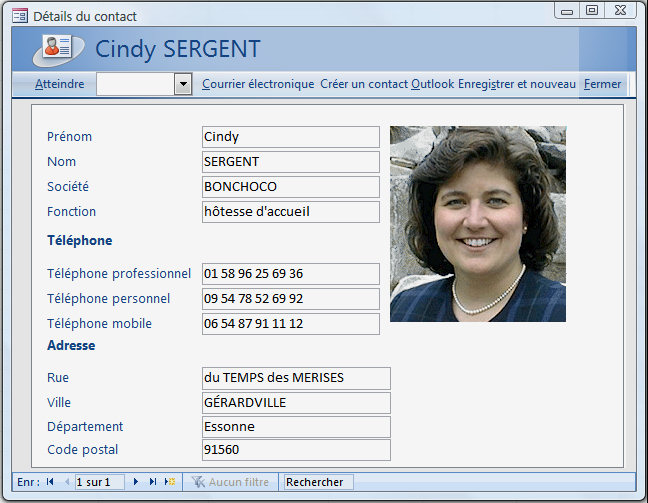
In this form:
- Cindy is the prénom and SERGENT is the nom.
- hôtesse d’accueil is the fonction, meaning a reception host/receptionist.
- The three numbers are different types of telephone contact: professional, personal, and mobile.
- Rue, Ville, and Code postal together form the address.
This is a French interface, so it includes département, an administrative area in France. Do not treat it as a model for a Canadian address; here it is only recognition practice.
Use a scanning habit:
- Read the question first.
- Find the matching label or visual clue.
- Copy the answer exactly.
- Check that you did not confuse a name, number, or place with a nearby item.
Baseline reading: Lolita’s profile
Read the following dialogue once from beginning to end. On a second read, scan only for the information requested in the questions below. It contains some grammar you have not studied yet; ignore what you cannot understand and focus on factual anchors.
Faire connaissance : identité et questions personnelles - Bonjour de France
Read the presentation dialogue “Faisons connaissance” from Bonjour de France. It is useful because it embeds identity, nationality, birth, residence, address, studies, and work information in a realistic first-meeting conversation.
In the subsection “Faisons connaissance,” read the complete dialogue beginning with the first question, “Comment t'appelles-tu ?”, and ending with “Tu es vraiment courageuse !” On your first pass, underline names and numbers; on your second, locate the sentence that answers each question below. In the latter part, use the concluding exchange to review the address and study/work details. Do not use the website’s quiz or any translation tool.
Questions
Answer in French where possible. You may copy the wording directly from the text. For every answer, add:
- C = confident
- G = guess
- ? = I could not find it
-
What is the woman’s official first name?
ما اسمها الأول الرسمي؟ -
What name do her family and friends use?
بماذا تناديها عائلتها وأصدقاؤها؟ -
What is her nationality?
ما جنسيتها؟ -
What is her date of birth? Copy the full date.
ما تاريخ ميلادها؟ انسخ التاريخ كاملاً. -
In which city was she born?
في أي مدينة وُلِدت؟ -
Give her address as completely as possible: street number, street name, and neighbourhood.
اكتب عنوانها بأكبر قدر ممكن من التفاصيل: الرقم، اسم الشارع، والحي. -
What does she study?
ماذا تدرس؟ -
Where does she work?
أين تعمل؟ -
How many hours per week does she work?
كم ساعة تعمل في الأسبوع؟ -
Which category was hardest to retrieve: name, nationality, date, address, occupation, or number? Why?
Accuracy rules for personal details
When you extract contact or identity details, precision is meaning. One incorrect digit in a phone number, one missed accent in a name, or one swapped field can make a form unusable.
For this baseline, classify any uncertainty rather than hiding it:
| If the problem was… | Mark it mentally as… | Example |
|---|---|---|
| You could see the information but did not know a word | Vocabulary gap | You see quartier but do not know it means neighbourhood. |
| You understood the word but copied the wrong nearby detail | Scanning error | You give the district instead of the street. |
| You found the information but changed or omitted a digit | Detail-accuracy error | You write 1976 instead of 1975. |
| You could not locate the relevant sentence | Text-navigation error | You do not know where work information appears. |
For Arabic speakers, a useful caution is that Arabic names and addresses can have several components, while French forms often force a strict split between nom and prénom. When you later complete real Canadian forms, follow the form’s labels exactly and use the spelling shown in your official identity documents.
Response format
Reply with your answers only. Do not look up unknown vocabulary before answering.
1. ______ — C/G/?
2. ______ — C/G/?
3. ______ — C/G/?
4. ______ — C/G/?
5. ______ — C/G/?
6. ______ — C/G/?
7. ______ — C/G/?
8. ______ — C/G/?
9. ______ — C/G/?
10. ______

Time taken: ___ minutes
Dictionary / translator / AI used: no / yes
Key takeaway and next step
A beginner reader does not need to understand every French word to retrieve essential information. The core method is to recognize the requested category, scan for names and numerical patterns, and copy the relevant detail accurately.
After you send your answers, I will score the baseline separately for names, nationality, dates, occupation, contact/address details, and numbers. We will then use the result in your initial dashboard and error log, before moving to your unaided speaking baseline.
Can't find a good explanation? Sign up and we'll make it for you
Sign up