
Introduction
Welcome to our final lesson on the great Rationalists. In our previous session, we examined Leibniz's Principle of Sufficient Reason (PSR), the powerful idea that everything in the universe must have a reason why it is so and not otherwise. We saw how Leibniz used this principle to argue for the existence of God, to establish the identity of indiscernibles, and to define the nature of space and time.
A core implication of the PSR is that reality must be fundamentally intelligible. This applies not just to grand cosmic questions but to the very nature of the objects we encounter every day. The existence of a table, a rock, or even your own body is a contingent fact that demands a sufficient reason. Today, we will follow this line of reasoning to its ultimate and astonishing conclusion.
Our learning outcome is to reconstruct Leibniz's argument for monads as the fundamental substances. We will investigate why Leibniz believed matter and extension could not be the ultimate reality, and then build the argument for why the universe must, at its most basic level, be composed of an infinity of simple, indivisible, non-physical, soul-like entities he called "monads."
1. The Problem with Matter: Why Substance Must Be a "True Unity"
Our common-sense view, and the view of many early modern scientists, was that the world is fundamentally composed of matter—tiny, extended particles. Leibniz, however, launches a powerful attack on this idea. For him, matter simply cannot qualify as a true substance.
His argument rests on a deep metaphysical principle he inherited from scholastic philosophy: to be a real being is to be truly one being. A true substance must possess a genuine, indivisible unity.
The Stanford Encyclopedia of Philosophy provides an exceptionally clear analysis of why Leibniz rejected the idea of material substance. This reading will walk you through the core of his negative argument.
Please read the two sections under the heading '1. Matter and Thought'. Start with the paragraph that begins: 'Leibniz's opposition to Cartesian dualism...'. Continue through the next section, which starts: 'According to Leibniz, bodies (qua material) are aggregates...'. Focus on understanding this chain of reasoning: Why must a true substance be 'truly one' (i.e., simple and indivisible)? Why does matter, being extended, fail this test? What is the difference between a substance and an 'aggregate'?
Let's break down the argument from the reading:
- Substance requires "True Unity": Leibniz's axiom is that "what is not truly one being is not truly one being either." This means that to be a fundamental, independent reality (a substance), a thing cannot be a collection of other things. It must be genuinely simple and indivisible.
- Matter is Infinitely Divisible: Anything that is extended in space, no matter how small, can always be divided further, at least in thought. If you have a block of wood, you can cut it in half. You can cut those halves in half, and so on. There is no logical point at which this process must stop. Extension implies divisibility.
- Conclusion: Matter is not a Substance: Since matter is essentially divisible, it lacks the "true unity" required of a substance. It is merely an aggregate—a collection or heap of other things. A pile of sand isn't a single thing; its reality is just the reality of the individual grains.
Leibniz therefore concludes that the physical world we perceive—the world of extended, divisible bodies—cannot be the ultimate reality. It is what he calls a "well-founded phenomenon." It appears to us as real, but its reality must be grounded in something more fundamental that is not divisible.
2. The Argument for Simple Substances (Monads)
If matter is just a collection, a "phenomenon," then the PSR demands we find the sufficient reason for its existence and reality. The reality of a composite thing must derive from the reality of its constituents. This leads us to Leibniz's positive argument for the true atoms of nature.
Let's first turn to Leibniz's own concise formulation of his system.
[PDF] The Principles of Philosophy known as Monadology
We will now read the opening paragraphs of Leibniz's own 'Monadology,' where he lays out the core argument for the existence of simple substances.
Please read paragraphs 1 through 7. Pay close attention to how Leibniz moves from the existence of 'composites' to the necessity of 'simples.'
To see this argument presented in a more modern, step-by-step fashion, let's watch a short video that walks through the same line of reasoning.
This video provides a very clear reconstruction of Leibniz's argument from composition, explaining why the existence of complex objects necessitates the existence of simple ones.
Watch the video from the beginning to 2:45. Focus on the idea that the existence of an 'aggregate' is dependent on the existence of its parts, and why this chain of dependency must end somewhere.
Combining these sources, we can reconstruct the argument as follows:
- Composites Exist: We observe that the world is full of composite things (aggregates).
- The Reality of a Composite Depends on its Parts: The reality of any composite thing is derived from the reality of the simpler things that compose it. A car is only real because its engine, chassis, and wheels are real.
- Infinite Regress is Impossible: This chain of dependency cannot go on forever (composites of composites of composites...). The PSR requires an ultimate reason. For a composite to be real, it must ultimately be made of constituents that are not composite.
- Therefore, Simple Substances Must Exist: The buck must stop somewhere. The ultimate constituents of reality must be truly simple substances—things with no parts.
These simple, partless substances are what Leibniz calls monads (from the Greek monas, meaning "unit"). They are the "true atoms of nature."
3. The Nature of Monads
We have now established that monads must exist. But what are they like? We can deduce their primary characteristics from the argument we just reconstructed.
- Simple: By definition, they have no parts. This means they also have no extension, no shape, and are indivisible. They are metaphysical points, not physical ones.
- Indestructible: Since they have no parts, they cannot be destroyed by natural means (i.e., by being broken apart or disassembled). They can only be created or annihilated supernaturally, by God.
- "Windowless": This is one of Leibniz's most famous and counter-intuitive claims. Since a monad has no parts, there is no way for anything from the outside to enter it or influence its internal state. As Leibniz puts it in the Monadology, "monads have no windows through which anything could come in or go out." All changes in a monad must arise from a purely internal principle.
- Perceptual and Appetitive: If monads are not physical, what are their properties? Leibniz concludes their states must be analogous to mental states. He calls the internal state of a monad a perception, which he defines as the representation of the many (the outside universe) within the one (the simple monad). The internal force or principle that drives the change from one perception to the next is called appetition (or appetite). Every monad, from the simplest one that makes up a rock to the dominant one that is your soul, is characterized by a continuous unfolding of perceptions, driven by its internal appetite.
This short video segment explains these last two points clearly.
Now that we know monads must exist, let's explore their strange nature. This video explains why they must have unique properties and what those properties are.
Watch the video from 2:32 to 9:00. Focus on the concepts of 'windowless' monads and how Leibniz identifies their properties with 'perceptions'. Note the important distinction between simple 'perception' and conscious 'apperception'.
Conclusion
In this lesson, we have followed Leibniz's rigorous rationalist argument from the simple observation of composite objects to one of the most unique metaphysical systems in history. By applying the Principle of Sufficient Reason, he argued that the material world of extension cannot be the ultimate reality and must instead be grounded in an infinite number of simple, non-physical, soul-like substances: the monads.
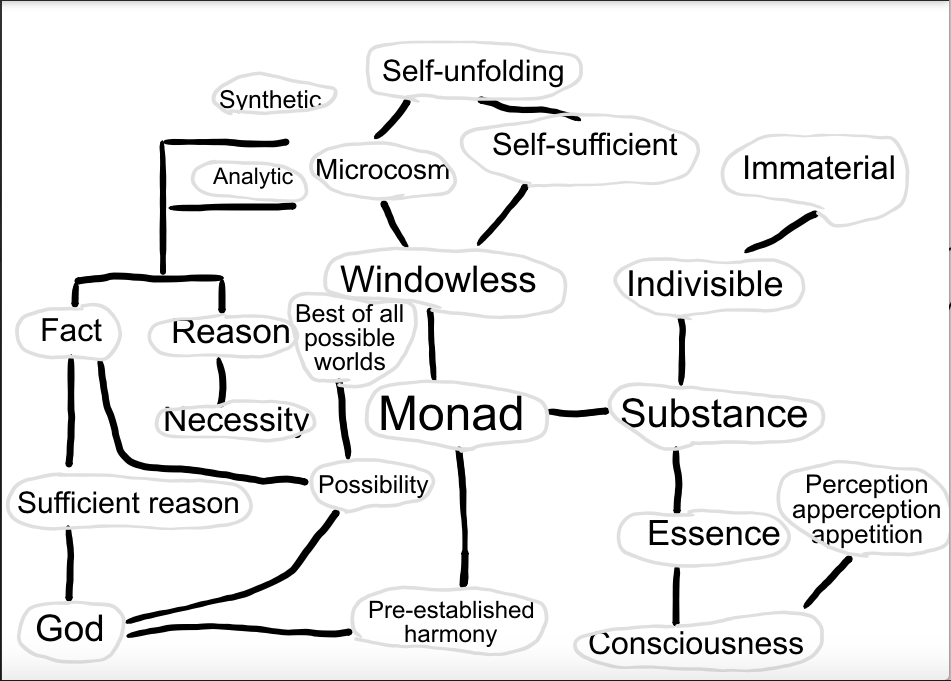
Key Takeaways:
- For Leibniz, a true substance must be a "genuine unity," meaning it must be simple and indivisible.
- Matter, being extended, is infinitely divisible. Therefore, it is not a substance but an aggregate or a "well-founded phenomenon."
- The PSR demands that the reality of these aggregates be grounded in true, simple substances, which Leibniz calls monads.
- Monads are the fundamental constituents of reality. They are unextended, indestructible, and "windowless," meaning all their changes come from an internal principle.
- The properties of monads are not physical but mentalistic: perception (the representation of the universe) and appetition (the drive to change perceptions).
Preview of the Next Lesson:
We have now concluded our survey of the three great early modern Rationalists—Descartes, Spinoza, and Leibniz. Each, in his own way, attempted to build a complete picture of reality using reason as the primary tool. We will now pivot to an entirely different philosophical tradition: Empiricism. In our next lesson, we will begin with John Locke and his foundational assault on the very idea of innate knowledge. Locke's argument that the mind is a tabula rasa (blank slate) will set the stage for the great debate between rationalism and empiricism that defined modern philosophy.
Can't find a good explanation? Sign up and we'll make it for you
Sign up