Hello! Welcome to the next lesson in our module on Resilience and Failure Handling Patterns.
In our previous session, we implemented the Circuit Breaker pattern using a client-side library, Resilience4j. We saw how this "white-box" approach embeds resilience logic directly into the application, offering fine-grained control and the ability to define sophisticated, application-aware fallback mechanisms.
Today, we explore a fundamentally different strategy: moving resilience logic out of the application and into the infrastructure layer. This is the "black-box" approach, commonly implemented using a service mesh. Our focus will be on Envoy, a high-performance proxy that is a core component of many service meshes like Istio.
This lesson directly addresses the learning outcome: Configure circuit breaking in a service mesh proxy (e.g., Envoy) and analyze the trade-offs versus a library-based approach. By the end, you will understand how Envoy implements circuit breaking and be able to make informed decisions about which approach—library or service mesh—is better suited for different scenarios in a distributed architecture.
1. The Service Mesh Approach to Resilience
A service mesh provides a dedicated infrastructure layer for managing service-to-service communication. It typically works by deploying a proxy, known as a "sidecar," alongside each service instance. All network traffic to and from the service is routed through this proxy.
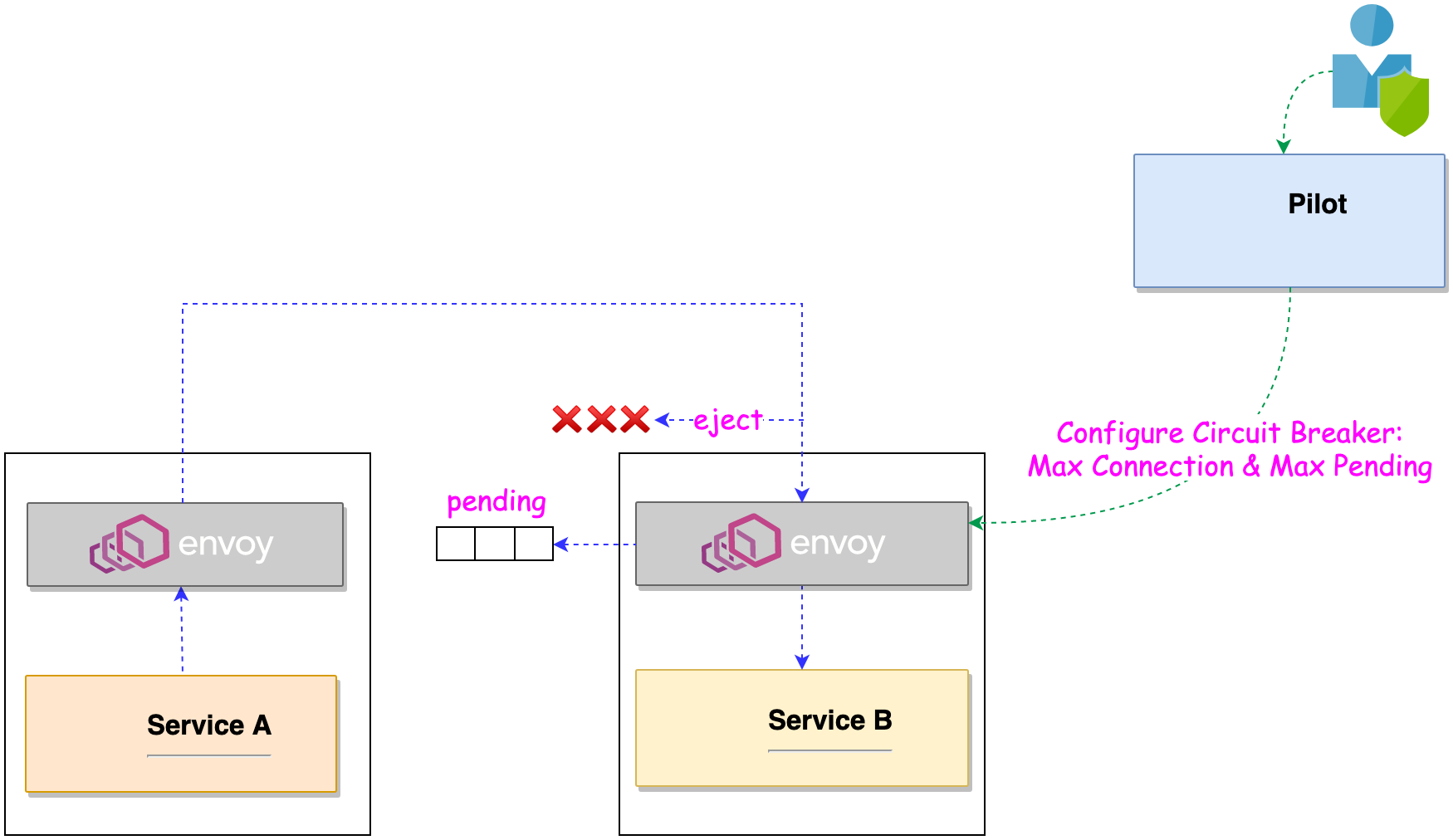
This architecture makes the sidecar proxy the ideal location to implement resilience patterns. Since the proxy sees all requests and responses, it can enforce policies like retries, timeouts, and circuit breaking without the application code needing to be aware of them. This decouples resilience from business logic.
To understand how a service mesh like Istio uses Envoy to implement circuit breaking, please read the following introduction.
Microservices Circuit-Breaker Pattern Implementation: Istio ...
This article, 'Microservices Circuit-Breaker Pattern Implementation' from Exoscale, introduces the concept of a service mesh and explains how Istio provides circuit breaking as a 'black-box' solution.
Please read the sections 'The Circuit-breaker Pattern' for a quick refresher, and 'The Istio Circuit Breaker'. Focus on how the Envoy proxy intercepts calls and enables the pattern to operate in a 'black-box way'.
2. Configuring Circuit Breaking in Envoy
Unlike the state machine (CLOSED, OPEN, HALF_OPEN) we saw with Resilience4j, Envoy's circuit breaking is a combination of several mechanisms that achieve a similar outcome: preventing a client from overwhelming a failing service.
Envoy's circuit breaking primarily operates at two levels:
- Connection and Request Limiting: Setting hard limits on the number of concurrent connections and pending requests to an upstream service.
- Outlier Detection: Actively monitoring hosts in a service cluster and temporarily ejecting unhealthy ones from the load-balancing pool.
Let's examine the specific configuration for each. The following resource provides a practical, hands-on guide.
Microservices Patterns With Envoy Sidecar Proxy, Part I
The blog post 'Microservices Patterns With Envoy Sidecar Proxy, Part I' by Christian Posta provides a clear, practical demonstration of Envoy's circuit breaking features. We will use it to understand the configuration details.
First, read the introduction ('Part I - Circuit Breaking with Envoy Proxy') to understand the demo setup. Then, carefully study the 'circuit_breakers' JSON configuration block and the explanation of the max_connections, max_pending_requests, and max_retries parameters.
As you read, note that Envoy's configuration is declarative. You define the desired state in a configuration file (e.g., JSON or YAML), and Envoy enforces it.
The key parameters within the circuit_breakers object for a cluster are:
max_connections: The maximum number of connections Envoy will establish to all hosts in the upstream cluster. If this limit is reached, theupstream_cx_overflowcounter is incremented, and the connection attempt fails.max_pending_requests: The maximum number of requests that will be queued while waiting for a connection. This is crucial for preventing request queues from growing indefinitely. If this limit is hit, theupstream_rq_pending_overflowcounter is incremented, and the request fails immediately with a503 Service Unavailableerror.max_retries: The maximum number of retries that can be outstanding to a cluster at any given time. This acts as a quota to prevent retry storms from overwhelming an already struggling service.
Practical Demonstration: Limiting Connections and Requests
The resource you just reviewed includes a hands-on demo. Let's walk through the key experiments to see these parameters in action. The author uses a simple client application that makes calls to an upstream service through an Envoy sidecar.
Please read through the following sections to see how these limits are tested and verified.
Microservices Patterns With Envoy Sidecar Proxy, Part I
These sections of the blog post demonstrate the effect of the max_connections and max_pending_requests settings.
Read the sections 'max_connections' and 'max_pending_requests'. Pay close attention to how the author changes the client's behavior (e.g., number of threads) to trigger the circuit breaker and then inspects Envoy's statistics (upstream_rq_pending_overflow) to verify that the breaker tripped.
This practical approach of "configure, test, verify stats" is fundamental to operating systems with a service mesh. The observability provided by Envoy's statistics is critical for understanding system behavior under stress.
Outlier Detection: Ejecting Unhealthy Hosts
Connection and request limiting protects a service from being overwhelmed. Outlier detection is the mechanism that corresponds more closely to the "opening the circuit" concept from our previous lesson. It identifies and temporarily removes failing hosts from the load-balancing pool.
This is configured via the outlier_detection object in the cluster definition.
Microservices Patterns With Envoy Sidecar Proxy, Part I
This final section of the blog post explains and demonstrates outlier detection, Envoy's mechanism for ejecting failing hosts.
Read the section 'What about when services go down completely?'. Focus on the outlier_detection configuration parameters (consecutive_5xx, max_ejection_percent) and the experiment that shows a host being ejected after consecutive 5xx errors. Note the verification step using the outlier_detection.ejections_total statistic.
Key outlier_detection parameters include:
consecutive_5xx: The number of consecutive 5xx responses required to eject a host.interval: The time interval for periodic health checks.base_ejection_time: The base duration for which a host is ejected.max_ejection_percent: The maximum percentage of hosts in the cluster that can be ejected. This is a safeguard to prevent cascading failures if a widespread outage causes all hosts to appear unhealthy.
In essence, Envoy's circuit breaking is a two-level defense: outlier detection removes sick hosts from rotation, while connection/request limits provide a bulkhead against traffic spikes for the remaining healthy hosts.
3. Analysis of Trade-offs: Library vs. Service Mesh
Now that we've seen both the library-based ("white-box") and service mesh ("black-box") approaches, we can analyze their trade-offs. The choice is not about which is "better" but which is more appropriate for a given context. Your experience as an engineering manager makes this strategic decision-making process particularly relevant.
The following article provides a direct comparison.
Microservices Circuit-Breaker Pattern Implementation: Istio ...
This section of the Exoscale article directly compares the two approaches we've discussed, framing it as 'Istio vs. Hystrix'.
Please read the sections 'Configuring The Istio Circuit Breaker', 'The Hystrix Circuit Breaker', and 'Istio vs Hystrix: battle of circuit breakers'. Focus on the final comparison, which summarizes the pros and cons of each approach.
Let's synthesize this comparison into a structured table.
| Feature | Library-Based (e.g., Resilience4j) | Service Mesh (e.g., Envoy/Istio) |
|---|---|---|
| Approach | White-box: Application-aware | Black-box: Application-agnostic |
| Granularity & Control | High. Can trigger custom fallback logic (e.g., return from cache, call another service, return a default object). | Low. Fallback is typically just "fail fast" (e.g., return HTTP 503). More complex logic is not possible at the proxy level. |
| Implementation | Code-level integration. Requires language-specific libraries (Java, Go, etc.). Changes require application redeployment. | Infrastructure-level configuration (YAML/JSON). Language-agnostic. Can be updated dynamically without redeploying the application. |
| Consistency | Depends on developer discipline. Can lead to inconsistent implementations across different services. | Enforced centrally by the control plane. Ensures uniform resilience policies across the entire mesh. |
| Performance | In-process call. Very low overhead. | Adds an extra network hop (service -> sidecar -> destination). Introduces a small amount of latency for every call. |
| Operational Overhead | Adds complexity to the application codebase and build dependencies. | Adds complexity to the infrastructure. Requires deploying and managing the service mesh control plane and sidecars. |
| Best For... | Scenarios requiring sophisticated, business-logic-aware fallbacks. | Enforcing baseline resilience policies uniformly across many services, especially in a polyglot environment. |
As the article concludes, the two approaches are not mutually exclusive. A common and robust strategy is to use the service mesh for a baseline level of resilience (e.g., basic connection limits, retries, and outlier detection) and then use a library-based circuit breaker for critical services that require more sophisticated fallback logic.
Conclusion
In this lesson, we have explored the infrastructure-centric approach to circuit breaking using an Envoy proxy within a service mesh. We've seen how it differs from the library-based approach and learned how to configure Envoy's mechanisms for connection limiting and outlier detection.
Key Takeaways:
- Envoy's Approach: Circuit breaking in Envoy is achieved through a combination of
circuit_breakers(limiting connections and pending requests) andoutlier_detection(ejecting unhealthy hosts). - Black-Box vs. White-Box: The service mesh provides a "black-box," language-agnostic solution that enforces policies at the infrastructure level. This contrasts with the "white-box," application-aware control offered by libraries.
- A Strategic Trade-off: The choice between these two patterns involves trading off implementation simplicity and governance (service mesh) against granular control and performance (library). There is no single right answer; the optimal choice depends on the specific requirements of the service and the organization's operational model.
Preview of the Next Lesson
Both retries and circuit breakers are patterns that manage the interaction between services. Our next topic, the Bulkhead pattern, focuses on a different aspect of resilience: isolating failures within a service to prevent them from taking down the entire application. We will learn how to implement the Bulkhead pattern to isolate resource pools and contain the blast radius of failures.