
Hello! Welcome back to our course.
In the last lesson, we established a robust toolkit for evaluating synthesized speech, covering both subjective methods like Mean Opinion Score (MOS) and objective metrics like PESQ, STOI, and modern model-based predictors. Now, we'll put that knowledge to work to answer one of the most fundamental questions in model development: "How does the data I use affect my model's performance?"
This lesson directly addresses the learning outcome: Analyze the impact of dataset size and quality on voice cloning performance. We will dissect this into two primary dimensions:
- Dataset Size (Quantity): How much audio data is enough? We'll explore the concept of diminishing returns in both fine-tuning and zero-shot cloning scenarios.
- Dataset Quality: What makes a "good" dataset? We'll investigate how factors like acoustic noise, speaker similarity, and transcript accuracy influence the final output.
Understanding these trade-offs is not just an academic exercise; it's a critical skill for any researcher or developer aiming to build high-performing, efficient audio AI systems.
1. The Impact of Dataset Size (Quantity)
It's a common belief in machine learning that "more data is better." While generally true, the relationship between data quantity and model performance is more nuanced, especially in voice cloning. The key concepts to understand are diminishing returns and the difference between fine-tuning and zero-shot reference audio.
- Fine-tuning involves updating the model's weights using a speaker's data. This requires a larger dataset, typically measured in minutes or hours, to meaningfully adjust the model's parameters towards a new voice without overfitting.
- Zero-shot cloning uses a short audio clip (a reference) to generate a speaker embedding on-the-fly, which conditions a pre-trained model to produce the target voice. This does not involve weight updates and requires very little data, typically a few seconds.
1.1 Zero-Shot Cloning: The Law of Diminishing Returns
For zero-shot models like XTTS, the most significant performance gains come from the first few seconds of reference audio. After a certain point, adding more data provides marginal benefits and can even be slightly detrimental.
To see this principle in action, we will analyze a Master's thesis that systematically evaluated the XTTS-v2 model by varying the reference audio duration.
Zero-Shot Voice Cloning with Minimal Data: Impact of Reference ...
This thesis, 'Zero-Shot Voice Cloning with Minimal Data', is a perfect case study for our learning outcome. It uses the evaluation metrics we learned in the previous lesson (MOS, Speaker Cosine Similarity, MCD) to measure the impact of reference audio duration.
Please read the following sections of the PDF: Abstract (Page 4): This will give you a high-level summary of the entire study. Section 5: Results (Pages 23-27): This is the core of the study. Pay close attention to Figures 2 and 3, which show how objective metrics (SECS, MCD) and subjective scores (MOS-N, S-MOS) change with reference duration. Relate these graphs back to the concepts we learned in the last lesson. Section 6: Discussion (Pages 28-30): Read sections 6.1 and 6.2, which interpret the results and validate the hypotheses about diminishing returns. Section 7.1: Summary of Findings (Page 34): This provides a concise summary of the key takeaways. \nFocus on how performance metrics change as the audio duration increases from 1s to 3s, 6s, 10s, 20s, and 40s.
The key findings from this paper beautifully illustrate the principle of diminishing returns:
- Initial Gains are Massive: The jump in quality from 1 second to 6-10 seconds of audio is substantial. At 1s, the voice is often generic; by 6s, it becomes clearly recognizable.
- A Performance Plateau: Beyond 10-20 seconds, both objective and subjective metrics begin to plateau. The improvement from 20s to 40s of audio is negligible.
- Optimal Range: For XTTS-v2, this suggests a practical "sweet spot" of 6-10 seconds for high-quality results and a near-optimal point around 20 seconds. Providing more data is often unnecessary.
- Too Much Can Hurt: The study even hints that excessively long or varied reference audio (especially from concatenated files) can introduce slight inconsistencies, as the model averages the prosody, potentially making the output slightly less stable than a clone from a single, clean 20-second clip.
1.2 Data Requirements Across Different Models
The amount of data needed also varies significantly depending on the model architecture and training paradigm. The following video provides some useful rules of thumb for different popular TTS systems.
The Secrets Behind Voice Cloning & AI Covers
The video 'The Secrets Behind Voice Cloning & AI Covers' by bycloud gives a practical overview of different models and their typical data requirements. This will help contextualize the academic findings from the previous resource.
Watch the specified sections to get a sense of the data quantities used in practice. Tacotron 2 & Tortoise TTS (02:29 - 03:24): Note the data requirements (hours vs. minutes) and training times for these fine-tuning-based models. ElevenLabs vs. RVC (10:03 - 10:49): Compare the data needed for 'instant' vs. 'professional' cloning. Example of a high-quality model (12:10 - 12:45): The narrator reveals his voice is cloned using a model trained on 4 hours of his voice data. Final comparison (14:52 - 15:21): A summary of the effort vs. quality trade-off.
From these resources, we can summarize the general landscape of data quantity:
| Method | Model Example | Typical Data Amount | Paradigm |
|---|---|---|---|
| Zero-Shot Cloning | XTTS-v2, VALL-E | 3 - 20 seconds | Reference Prompting |
| Light Fine-tuning | Tortoise-TTS | ~30 minutes | Weight Update (Adaptation) |
| Deep Fine-tuning | SpeechT5, Tacotron 2 | 15 minutes - 3+ hours | Weight Update (Adaptation) |
| Professional Cloning | ElevenLabs Pro, RVC | 30 minutes - 4+ hours | Weight Update (Adaptation) |
This table makes it clear: the choice of method depends entirely on the application's trade-off between data availability, desired quality, and engineering effort.
2. The Impact of Dataset Quality
Dataset quality is arguably more critical than quantity. The adage "garbage in, garbage out" is especially true for generative models that learn to mimic the fine-grained characteristics of the input data.
A high-quality dataset for voice cloning excels in several dimensions:
2.1 Acoustic Quality
This refers to the physical properties of the audio recording itself.
- Low Noise: Minimal background noise (e.g., hiss, hum, cars, other people talking). High Signal-to-Noise Ratio (SNR) is crucial.
- No Reverberation: Recorded in a non-echoy room.
- No Clipping: The audio was not recorded so loudly that the waveform peaks are "clipped," causing distortion.
- Sufficient Bandwidth: A sample rate of at least 16 kHz, and often 22.05 kHz or 24 kHz for modern TTS models, is required to capture the necessary frequency detail.
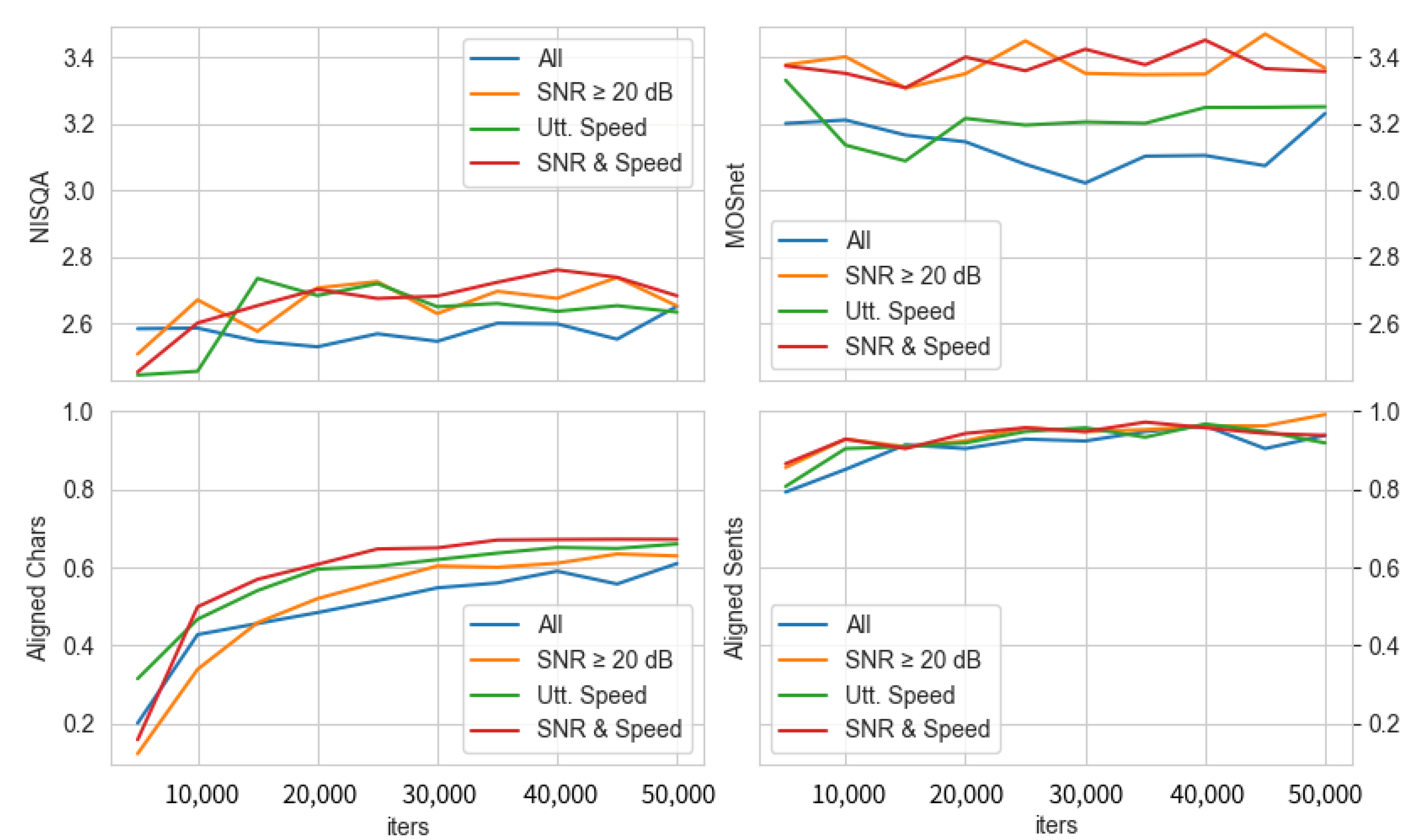
The image below shows the results of an experiment where a TTS model was trained on different filtered versions of a dataset. Notice how filtering for high SNR and optimal speaking speed consistently leads to better evaluation scores.
2.2 Content and Speaker Quality
This refers to the characteristics of the speech within the recording.
- Prosodic Variety: The reference audio should contain natural variations in pitch, rhythm, and volume. A monotonous recording will lead to a monotonous synthetic voice.
- Phonetic Coverage: For fine-tuning, the dataset should ideally contain all the phonemes (basic sound units) of the target language.
- Speaker Consistency: All audio clips must be from the exact same speaker in a similar acoustic environment and vocal style. Mixing speakers or styles will confuse the model.
2.3 Training Data Similarity (An Advanced View)
For a research-focused perspective, consider this: when you train a multi-speaker model from scratch or fine-tune it, does the similarity of the training speakers to your target speaker matter?
A study from the 2023 ISCA Speech Synthesis Workshop investigated this very question.
Voice Cloning: Training Speaker Selection in Limited Multi-Speaker ...
The paper 'Voice Cloning: Training Speaker Selection in Limited Multi-Speaker Corpus' explores a subtle aspect of dataset quality. I'll summarize the key findings for you, as it's a dense research paper.
You don't need to read this paper in detail, but I want you to understand its main conclusion. The researchers trained models on different subsets of a 14-speaker corpus: one subset with the 5 speakers most similar to the target voice, and one with the 5 speakers most dissimilar. They then evaluated the cloned voice.
The key finding of the paper Voice Cloning: Training Speaker Selection... was:
Training on speakers who are acoustically similar to your target voice leads to a better clone in terms of speaker similarity.
This effect was more pronounced for speaker-encoding methods than for fine-tuning (speaker adaptation). This implies that for optimal performance in a low-resource setting, curating your training set not just for acoustic quality but also for relevance to the target can provide an edge.
3. Synthesis: The Interplay of Size and Quality
In any practical project, you must balance size and quality. Here are the key takeaways:
- Quality First: A small, clean, high-quality dataset is almost always preferable to a massive, noisy, and inconsistent one. The cost of data cleaning and filtering often provides a higher return on investment than simply collecting more raw data.
- Know Your Paradigm:
- For zero-shot cloning, focus on getting a single, high-quality 10-20 second clip. Recording it yourself in a quiet room is better than extracting a 2-minute clip from a noisy podcast.
- For fine-tuning, you need both quality and sufficient quantity (e.g., 30+ minutes). Here, the time spent filtering a large corpus down to its highest-quality subset is crucial.
- Data Cleaning is Part of the Job: As seen in the fine-tuning video tutorial, practical steps like text normalization (lowercasing, removing punctuation) and character replacement are essential parts of preparing a high-quality dataset.
Fine-tune Text-to-Speech Models for any Language: Introduction to TTS
Let's briefly revisit the practical data cleaning steps shown in the fine-tuning tutorial from a few lessons back. This reinforces the importance of data quality beyond just the audio.
Briefly re-watch the section from 00:13:53 to 00:15:26. Notice the steps taken to normalize text and replace special language-specific characters. This is a crucial part of ensuring dataset quality for fine-tuning.
Conclusion
You have now analyzed the critical impact of dataset characteristics on voice cloning performance. This moves us from simply using models to strategically thinking about how to train and condition them for optimal results.
Key Takeaways:
- Quantity has Diminishing Returns: For zero-shot cloning, the most significant gains are in the first 10 seconds of reference audio, with performance plateauing around 20 seconds.
- Quality is Multi-faceted: High quality means good acoustics (high SNR, no reverb), rich content (prosodic variety), and, for fine-tuning, accurate transcripts.
- Quality Over Quantity: Investing in data cleaning and curation often yields better results than simply increasing dataset size.
- Similarity Matters: In limited-data scenarios, training on speakers acoustically similar to your target can improve the final voice clone's similarity.
Preview of the Next Lesson:
Having explored how we represent and generate speech audio, primarily through mel-spectrograms, we are now ready to take a leap toward the cutting edge of audio generation. In our next lesson, we will begin our module on Audio Language Models. The first step will be to explain how neural audio codecs like SoundStream or EnCodec discretize audio waveforms into a sequence of tokens. This is the foundational technique that allows us to treat audio like a language, enabling the application of powerful Transformer-based language models to generate audio directly.