
Hello. In the previous lesson, you used invariants and trace tables to find off-by-one and state-maintenance errors. Those same tools now become part of your interview narration: rather than merely saying that code works, you can explain what each state represents, walk through a revealing example, and respond precisely when an interviewer probes a decision.
This concludes the Coding Interview Foundations module. The goal is not to deliver a memorized monologue. It is to make your completed Java solution easy to evaluate: the interviewer should be able to follow the contract, the core idea, the correctness argument, complexity, and tests without having to extract them through repeated prompts.
Treat explanation as part of the solution
A correct program that an interviewer cannot follow is difficult to assess confidently. Coding interviews evaluate communication alongside problem solving and implementation. Strong communication is not constant talking for its own sake; it is organized, relevant narration at the moments where the interviewer needs evidence.
How candidates are evaluated in coding interviews at top tech companies | Tech Interview Handbook
Read the Tech Interview Handbook’s communication rubric to see the specific signals interviewers use when judging a candidate’s reasoning.
In “Detailed explanation of each evaluated criteria,” read subsection “1. Communication.” Focus on the listed signals and the difference between a response that is merely adequate and one that is easy to follow without prompting. Start at the communication signals and rubric.
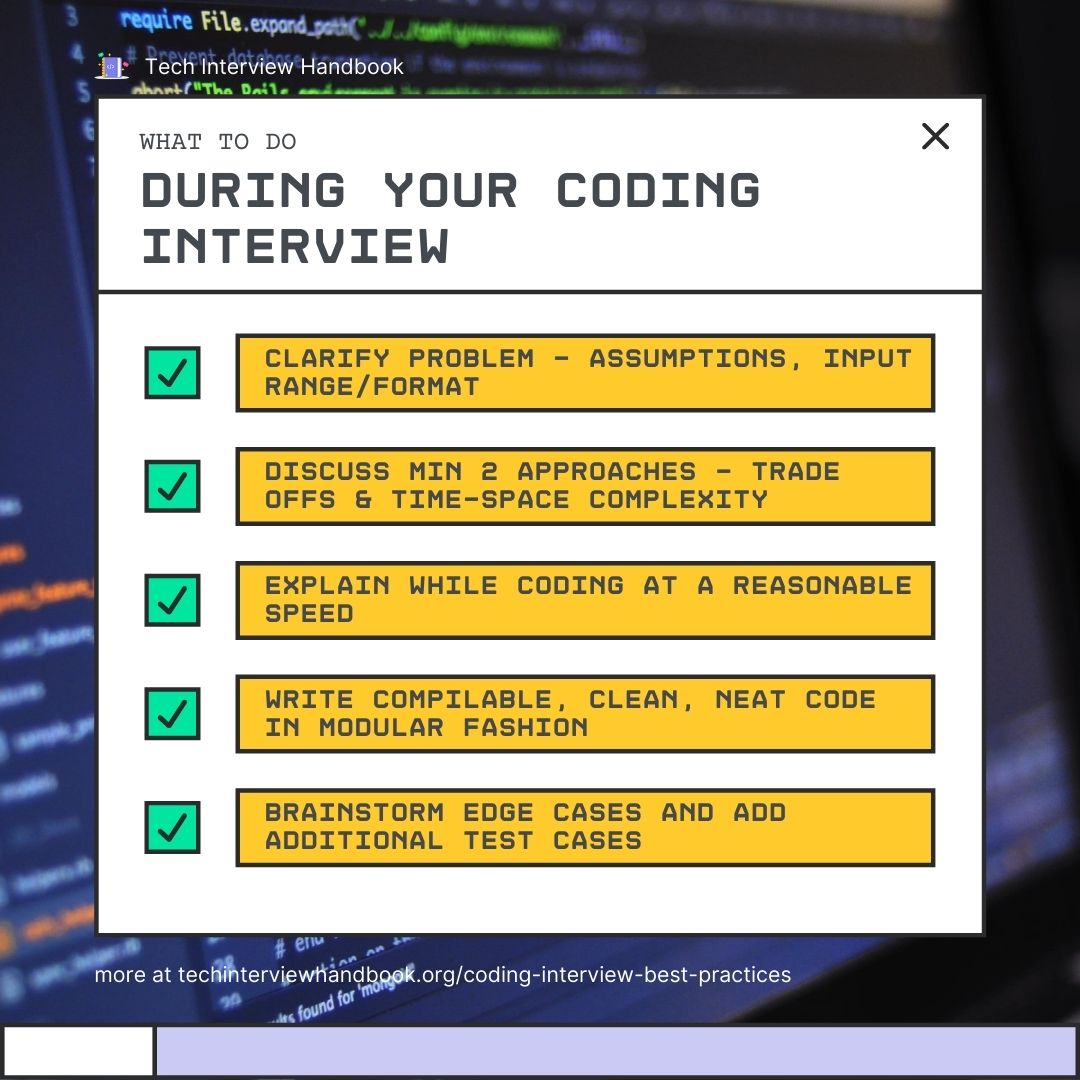
A useful mental model is that your explanation supplies a compact audit trail. By the end, the interviewer should know:
-
What contract you are implementing.
Inputs, outputs, assumptions, and behavior on boundary cases. -
Why this approach fits.
The data structure or algorithmic pattern, plus its most relevant alternative. -
What the changing state means.
In particular, the invariant or rule that keeps the algorithm correct. -
Why the result is correct.
A concise argument, not just “I tested it.” -
What it costs.
Time and auxiliary space, including whether the claim is average-case. -
How you checked it.
One ordinary example and the boundary cases most likely to expose a defect.
Notice the order. Start with the high-level idea, then descend into code only when needed. Reading line by line from the first declaration is usually a weak opening because it forces the interviewer to infer the algorithm’s purpose from syntax.
A concise explanation of a completed Java solution
Consider a standard formulation of Two Sum:
Given an integer array
numsand an integertarget, return the indices of any two distinct elements whose values sum totarget. If no pair exists, return an empty array.
Here is a completed Java implementation. Assume the usual imports for Map and HashMap.
static int[] twoSum(int[] nums, int target) {
    Map<Integer, Integer> indexByValue = new HashMap<>();

    for (int i = 0; i < nums.length; i++) {
        int complement = target - nums[i];
        Integer matchIndex = indexByValue.get(complement);

        if (matchIndex != null) {
            return new int[] {matchIndex, i};
        }

        indexByValue.put(nums[i], i);
    }

    return new int[0];
}
A strong initial explanation takes about 30 to 45 seconds:
“I scan the array once and maintain a hash map from each value already seen to one of its indices. At index
i, the only value that can pair withnums[i]istarget - nums[i], so I look up that complement. If it was seen earlier, I return its index andi; otherwise I store the current value for later elements. I check before inserting so I never use the same element twice. The loop is linear on average because each iteration performs constant average-time hash-map work, and the map uses linear auxiliary space.”
That explanation has all the essentials:
| Part | Evidence in the explanation |
|---|---|
| Approach | One pass plus a hash map |
| State | Map stores values seen earlier and their indices |
| Decision rule | Look up the required complement |
| Distinct-index protection | Look up before inserting the current value |
| Complexity | average time and auxiliary space |
Make the invariant explicit when asked “Why is that correct?”
The central invariant, evaluated before processing index , is:
indexByValuecontains a mapping for every value innums[0..i), and each stored index is less thani.
Now the correctness argument becomes short and rigorous:
- If the method returns
{matchIndex, i}, the map tells us thatnums[matchIndex]equalstarget - nums[i]. Thus the two values sum totarget, andmatchIndex < i, so the indices are distinct. - If a valid pair exists, consider the moment the method reaches the pair’s later index. The earlier value is already in the map, so its complement lookup succeeds and the method returns that pair.
- If the scan ends, every element has been considered as the later element of a potential pair. No valid pair exists under the stated contract.
This is more convincing than narrating get, put, and return separately. Syntax supports the argument; it should not replace it.
Walk through one example, but preserve the meaning of the state
For:
nums = new int[] {2, 7, 11, 15};
target = 9;
your explanation can be compact:
| Current index | Current value | Needed complement | Map before lookup | Result |
|---|---|---|---|---|
| 0 | 2 | 7 | {} | Store 2: 0 |
| 1 | 7 | 2 | {2: 0} | Find 2, return {0, 1} |
Say what the map means, not merely what it contains:
“Before index 1, the map represents the processed prefix containing the value 2 at index 0. The current value is 7, and its complement 2 is present, so the pair is valid.”
That language carries naturally into more complicated patterns later, including sliding windows, tree traversals, and graph searches: explain the role of state, then explain how one step updates it.
Respond to prompts as collaboration, not interruption
Interviewers often interrupt a walkthrough. Usually, they are checking an assumption, inviting a trade-off, or testing whether your reasoning generalizes. Pause rather than talking over the prompt. Answer the precise question first; then reconnect it to your solution.
Use this four-part response pattern:
-
Acknowledge the prompt.
“Yes,” “Good point,” or “That changes the contract slightly.” -
Answer directly.
Give the conclusion before the detail. -
Support it with evidence.
Refer to the invariant, operation cost, or a small example. -
Reconnect.
State what changes in the code or why the current implementation remains valid.
Here are common prompts and interview-ready responses for the Java solution.
| Interviewer prompt | Strong response |
|---|---|
| “Why not use two nested loops?” | “That is a valid baseline: checking every pair uses time and extra space. The map trades auxiliary space for expected time, which is preferable when the array can be large.” |
| “Why do you look up before storing?” | “It ensures the matching index is from an earlier element. In particular, with [3, 3] and target 6, index 0 is stored first; at index 1 the lookup finds index 0. If I inserted before checking, I could accidentally match an element with itself when nums[i] equals its own complement.” |
| “What if there are duplicate values?” | “Duplicates are handled. The map needs only one earlier index for each value because any valid pair is acceptable. The [3, 3] case confirms that the second occurrence can match the first.” |
| “Can you reduce the space?” | “Not while retaining expected linear time with this general unsorted input. A nested-loop solution uses constant extra space but is quadratic. If the input were sorted and original indices were not required, two pointers could use constant auxiliary space; preserving original indices would require storing them while sorting.” |
| “What happens if no pair exists?” | “Under the contract I stated, the scan completes and returns an empty array. If the API instead guarantees one solution, I would state that assumption and could use a different failure policy if requested.” |
| “Can you prove the map never contains a future index?” | “Yes. The current index is inserted only after its lookup fails, and the loop advances left to right. Therefore, before each iteration, every stored index is strictly less than the current index.” |
Two communication details matter here:
- Say “average” or “expected” when discussing
HashMapoperations. Standard interview analysis treats lookup and insertion as average , but that is not a universal worst-case guarantee. - Do not defend the original design automatically when requirements change. First identify whether the new prompt changes the contract, performance target, or data model.
For example, if the interviewer says, “Now return all unique index pairs,” the correct response is not, “This code still works.” A better response is:
“The current map stores only one index per value and returns at the first pair, so it intentionally cannot satisfy an all-pairs requirement. The output itself could be quadratic, so I would first clarify whether you expect all index pairs or unique value pairs, then redesign around that output requirement.”
That answer demonstrates control of scope before implementation.
Finish with verification, not “I’m done”
After writing the final brace, take ownership of the validation. The previous lesson’s boundary-test method is especially valuable here, but the interviewer needs to hear why each test is informative.
Coding interview cheatsheet: Best practices before, during ...
Read the Tech Interview Handbook guidance on discussing an approach before implementation and validating the code after it is written. It reinforces the interview rhythm used in this lesson.
First, in Section 3, “Work out and optimize your approach with the interviewer,” read from the opening warning against jumping immediately into code through the final recommendation. Focus on presenting alternatives, naming trade-offs, and stating complexity. Begin at approach discussion. Then read Section 5, “After coding, check your code and add test cases,” from its opening instruction through the end of the checklist. Notice that testing, tracing, complexity, and possible improvements are all part of the completed-solution explanation. Read the after-coding routine.
For the Two Sum implementation, a polished close might sound like this:
“I’ll validate the normal case
[2, 7, 11, 15]with target9, which returns indices 0 and 1. For duplicates,[3, 3]with target6verifies that lookup-before-insert gives two distinct indices. For a no-solution case such as[1, 2]with target10, the method completes the scan and returns the agreed empty array. I would also test negative values, such as[-3, 4, 3, 90]with target0, to ensure the complement calculation is not implicitly assuming positive inputs. The final complexity remains average time and auxiliary space.”
This is not a long list of every imaginable test. It is selected evidence for the algorithm’s risks:
- normal successful lookup;
- duplicate-value behavior;
- completion without a match;
- values that challenge an unstated assumption.

Learn from an interview exchange
Watching a real exchange is useful because it shows that a good response is rarely a single uninterrupted speech. The candidate may be asked to trace state, explain a correction, or handle an extension of the original requirement.
Mock Google Coding Interview with a Meta Intern
Watch “Mock Google Coding Interview with a Meta Intern” by NeetCode. Although the implementation is in Python, the explanation pattern transfers directly to Java: describe state, trace a mutation carefully, and make the reasoning visible.
Watch the state walkthrough. The interviewer asks for an example, and the candidate traces how an array and map change during removal. Focus on how a walkthrough reveals a missing update and how the explanation reconnects each mutation to the intended data-structure state. Then watch the debrief. Focus on the feedback about clarification, naturally stating complexity, taking notes during a test case, and maintaining a transparent thought process.
As you watch, distinguish between useful narration and thinking aloud that has not yet become a claim. It is fine to take a short pause:
“I’d like a few seconds to verify the removal update, because both structures must remain consistent.”
But follow that pause with a precise statement:
“The array holds active values, and the map stores each value’s current array index. After moving the last value into the removed slot, I must update that moved value’s map entry before removing the last array position.”
This is an invariant-based response to a prompt. It makes the code reviewable even when the implementation has several moving parts.
A reusable post-code speaking outline
Use this outline after completing any coding-interview solution. It is deliberately short enough to use under time pressure.
Contract: “I’m returning ___, assuming ___; for ___, the behavior is ___.”
Approach: “I use ___ because it lets me ___ without repeatedly ___.”
State and mechanism: “At each step, ___ represents ___. I update it by ___.”
Correctness: “When ___ occurs, ___ guarantees ___. If no early return occurs, ___ means ___.”
Complexity: “The method is time and auxiliary space because ___.”
Validation: “I would verify ___, ___, and ___, because they test ___.”
The outline should guide your explanation, not force empty phrases. If an interviewer asks for a detail early, answer it where it arises. Afterwards, summarize the remaining pieces rather than restarting from the beginning.
A final practical rule: match the depth of your answer to the prompt. If asked, “What is the complexity?” give complexity and one reason. Do not launch into every test case. If asked, “Walk me through removal,” narrate only the affected variables and their invariant. Precision is clearer than volume.
Key takeaways
Explaining a completed solution is a technical skill, not an afterthought.
- Start top-down: contract, approach, state, correctness, complexity, and targeted validation.
- Describe what state means through an invariant; do not merely read code line by line.
- Make complexity claims precise, especially by qualifying hash-map costs as average or expected.
- Treat interviewer prompts as requests for evidence, a changed requirement, or a chance to clarify assumptions.
- Answer the prompt directly, support the answer with a concrete reason, then reconnect to the code.
- After coding, trace a normal case and the few edge cases most likely to falsify your assumptions.
You now have the communication foundation needed for the pattern-focused coding modules ahead. The next module begins with arrays and strings, where you will apply this same clarify, model, solve, test, and explain workflow to hash-map and hash-set lookup problems.
Can't find a good explanation? Sign up and we'll make it for you
Sign up