
Hello. In the previous lesson, you used an error log to identify whether a mistake came from knowledge, reasoning, execution, or question interpretation. Here you will apply that same careful approach to a foundational Physics skill: breaking one angled vector into two perpendicular parts.
This matters because many Year 12 Physics problems become manageable only after you resolve a vector. Projectile motion, forces on slopes, circular motion, fields, and waves all use the idea that horizontal and vertical effects can be analysed separately.
By the end of this lesson, you should be able to sketch a vector triangle, choose the appropriate trigonometric relationship, calculate perpendicular components with units and signs, and check whether your answer is physically sensible.
One vector, two perpendicular effects
A vector has both magnitude and direction. Force, velocity, displacement, and acceleration are all vectors.
Suppose a force pulls an object up and to the right. Instead of treating that angled force as one difficult object, we can represent its effect using:
- a horizontal component, parallel to the -axis;
- a vertical component, parallel to the -axis.
These components are perpendicular, meaning they meet at . Together, they produce the same overall effect as the original vector.
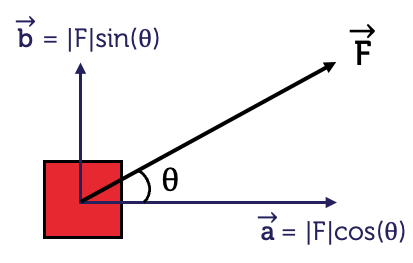
Choose a coordinate system before doing any calculation. Unless the question says otherwise, use:
- right as positive ;
- up as positive ;
- left as negative ;
- down as negative .
For a force , its components may be written as and . The components are not separate “extra” forces added to the situation. They are a useful representation of the original force in two perpendicular directions.
The key geometric fact is simple:
That means Year 11 right-triangle trigonometry applies directly.
The core method: sketch first, then use trigonometry
When an angle is measured above the positive horizontal, the horizontal component is adjacent to , while the vertical component is opposite .
Therefore:
Rearranging gives the two formulas worth remembering:
This is not a rule to memorise blindly. It follows from the triangle:
- cosine connects adjacent and hypotenuse;
- sine connects opposite and hypotenuse.
Vector components from magnitude and direction
Watch “Vector components from magnitude and direction” from Khan Academy for a visual explanation of why a vector can be split into horizontal and vertical components.
Watch the first quadrant method. Focus on how the diagram is drawn before any calculation, and why the horizontal component uses cosine when the angle is measured from the positive horizontal. Then watch signs by quadrant to see how direction determines whether a component is positive or negative.
A reliable working routine
For every component question, use this order:
- Draw axes and indicate the positive directions.
- Sketch the original vector in its stated direction.
- Draw the horizontal and vertical components to make a right triangle.
- Mark the given angle exactly where the question locates it.
- Decide which component is adjacent and which is opposite.
- Calculate component magnitudes using sine or cosine.
- Attach the correct sign or direction.
- Include the correct unit.
Worked example: force above the horizontal
A force acts at above the horizontal.
Because the angle is measured from the horizontal:
The vertical component is:
So, to an appropriate number of significant figures:
Both are positive because the force points right and up.
Before trusting the calculator result, look back at the sketch. Since is less than , the vector is closer to horizontal than vertical. The horizontal component should therefore be larger than the vertical component. Our values, and , pass that check.
The most common trap: the angle may be measured from the vertical
The statement “horizontal is cosine and vertical is sine” is only true when the angle is measured from the horizontal.
If the angle is measured from the vertical, the relationships swap.
For example, suppose a force acts North East. Begin from North, then turn toward East. The angle is therefore between the force and the vertical direction.
You have two safe options:
- Use the given angle and identify sides relative to it.
- Convert it to an angle from the horizontal: above East.
The second method uses the familiar horizontal-angle formulas:
The same result can be obtained directly from the angle:
The important idea is not which version you use. It is that you identify adjacent, opposite, and hypotenuse from the actual marked angle.
Resolution of vectors - Learning Lab - RMIT University
Read this short RMIT University Learning Lab explanation to consolidate the idea of rectangular components and see a compass-direction force resolved carefully.
In the section “Components of a vector,” read the opening explanation, then examine the two diagrams immediately below it. Notice that the component vectors are horizontal and vertical, while the original force is the hypotenuse. Next, in “Example 1 – resolving components of force vectors,” begin at the direction conversion and continue through the worked calculation. Focus on why North 30^\circ East is also 60^\circ above the horizontal.
Signs tell you the direction of each component
A component is a vector quantity, so its sign matters. A component’s magnitude might be correct while its direction is wrong, and that would still be a Physics error.
Using the usual convention of right and up as positive:
| Direction of original vector | Sign of | Sign of |
|---|---|---|
| Up and right | Positive | Positive |
| Up and left | Negative | Positive |
| Down and left | Negative | Negative |
| Down and right | Positive | Negative |
There are two dependable ways to handle signs.
Method 1: Use an angle from the positive -axis
If a vector has a standard angle measured anticlockwise from positive , calculate directly:
The calculator gives the signs automatically.
For a vector at :
This makes sense: points up and left.
Method 2: Use a positive reference angle, then assign signs
Physics questions often use wording such as “ below the horizontal” or “ west of north.” In these cases, calculate positive component magnitudes from the small reference angle, then apply signs based on the sketch.
For instance, an force acts below the horizontal toward the left.
The magnitude of the horizontal component is:
The magnitude of the vertical component is:
The force points left and down, so both components are negative:
A labelled sketch protects you from assigning the wrong sign.
Checking your result like a physicist
A calculation is not finished when you press equals on a calculator. Use short checks that target the most likely errors.
1. Check the calculator mode
If the question provides , make sure the calculator is in degree mode. Radian mode will produce a completely incorrect result.
2. Check size against the diagram
Each perpendicular component must have a magnitude less than or equal to the original vector’s magnitude.
If a vector produces a component of , something has gone wrong.
Also compare the angle with the component sizes:
- a vector close to horizontal should have a larger horizontal component;
- a vector close to vertical should have a larger vertical component;
- at , equal horizontal and vertical components are expected.
3. Check reconstruction using Pythagoras
The components should rebuild the original magnitude, apart from rounding:
For the force above:
This confirms that the component magnitudes are consistent with the original vector.
4. Check units and directions
Write the quantity and unit clearly:
- force components in ;
- velocity components in ;
- displacement components in .
Use either signed values, such as , or written directions, such as “ west.” Do not give a positive number without stating a left, right, up, or down direction when direction matters.
For your Physics error log, useful precise entries might be:
| First incorrect move | Error category | Repair |
|---|---|---|
| Used sine for the horizontal component when the angle was from the horizontal | Reasoning | Mark adjacent and opposite before selecting a ratio |
| Got correct magnitudes but made a leftward component positive | Execution | Draw axes and write signs before calculating |
| Used an angle from North as though it were measured from East | Question interpretation | Mark the given angle on the diagram; convert angles only when needed |
| Calculator gave an unexpected value because it was in radian mode | Execution | Check degree or radian mode before every trig calculation |
Key takeaways
To resolve a two-dimensional vector, represent it as perpendicular horizontal and vertical components.
When is measured from the positive horizontal:
But do not memorise those formulas without a sketch. If the given angle is measured from the vertical, adjacent and opposite change, so the sine and cosine relationships may swap.
Your most reliable process is:
- Draw axes and the vector.
- Mark the angle where it is actually given.
- Build the right triangle.
- Use sine or cosine based on adjacent and opposite.
- Assign signs from the vector’s direction.
- Check magnitude, direction, units, and calculator mode.
Next, you will shift to Economics and practise constructing cause-and-effect chains. The underlying habit remains the same: make relationships explicit rather than trying to hold an entire problem in your head at once.
Can't find a good explanation? Sign up and we'll make it for you
Sign up