
Hello. In the previous English Advanced lesson, you practised letting the question guide your annotations rather than simply spotting techniques. The same habit matters in Studies of Religion I. Before deciding what content to use, first determine what the question is instructing you to do with that content.
This is the final lesson in Finding Your Starting Point. By the end, you should be able to identify a question’s command verb and use it to choose the correct response type, depth, and structure. This will help prevent a common assessment problem: writing accurate religious knowledge that does not actually answer the task.
The command verb is the task, not decoration
Consider these two questions:
- Describe one ethical teaching about environmental ethics in Islam.
- Explain how one Islamic ethical teaching guides adherents’ responses to environmental issues.
Both questions concern ethical teaching. However, they require different work.
The first asks, essentially, What is the teaching? What are its key features? The second asks, How does the teaching shape action, and why is that connection meaningful? If you write an explanation for Question 1, you may waste time and leave out the clear description required. If you only describe the teaching for Question 2, you have not shown the relationship demanded by “explain.”
A reliable first move in any SOR question is to underline four parts:
| Part of the question | What to ask yourself |
|---|---|
| Command verb | What intellectual action must I perform? |
| Content | What specific syllabus knowledge is relevant? |
| Focus words | What precise angle must I address? |
| Scope | How many examples, areas of study, traditions, or stimulus details are required? |
For Question 2 above, your breakdown might look like this:
- Command verb: explain
- Content: one Islamic ethical teaching
- Focus: how it guides adherents’ responses
- Scope: environmental issues
This stops you from writing everything you remember about Islam, environmental ethics, or stewardship. Your knowledge must be selected and organised to fulfil the command.
The NSW Government glossary gives the official starting meanings for the verbs you will meet across subjects. Its important warning is that command verbs should not be treated as rigid formulas; the wording of the whole question still matters.
Glossary of key words | NSW Government
Read the NSW Government’s glossary to establish the official meanings of common command verbs. The goal is not to memorise every entry at once, but to notice the distinct actions each verb requires.
Begin with the introductory guidance, especially the warning about context. Then read the alphabetical entries from Analyse through Investigate, pausing at Describe, Explain, Identify, Analyse, Discuss, Evaluate, and Justify. For each, ask: “Would my answer mainly name, describe, connect, break apart, or judge?”
Five levels of response
The command verbs used in school questions can be seen as increasing in intellectual demand. The increase is not merely “write more.” It means that each higher level includes a different kind of thinking.
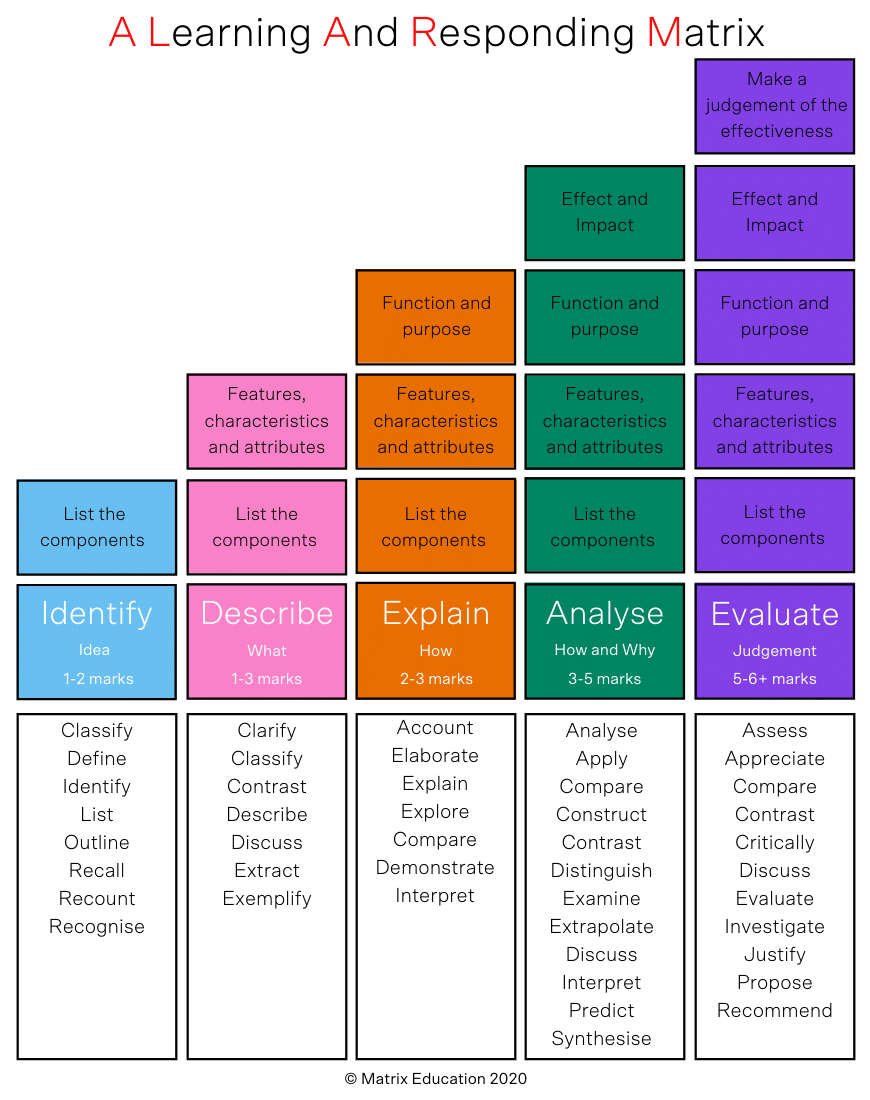
Use the matrix as a visual reminder, not as a strict mark-allocation rule. In an actual SOR assessment, the marks, wording, supplied stimulus, and dot points determine how much detail you need.
1. Identify: name the correct thing
Identify means recognise and name. It requires accuracy and directness, usually without a developed explanation.
Question: Identify one principal belief in Christianity.
Appropriate response: Christians believe in the Trinity: one God expressed as Father, Son, and Holy Spirit.
The answer gives a specific belief. Adding a long account of Jesus’ life would not improve an “identify” answer unless the question specifically required it.
A common error is naming a broad topic instead of the exact item requested. If asked to identify an ethical teaching, “environmental ethics” is an area of ethics, not itself a teaching. You need a precise teaching within that area.
2. Describe: show features or characteristics
Describe means provide characteristics and features. It answers “what?” in a fuller way than identify.
Question: Describe one ethical teaching in Buddhism.
Appropriate response: The first precept teaches Buddhists to refrain from taking life. It encourages respect for living beings and discourages violence, including harm toward animals and humans.
This response stays focused on what the teaching is and what it says. It does not need a detailed chain showing how a belief produces a particular practice unless the question asks for that link.
A useful test is this: Could someone understand the main features of the teaching from my answer? If yes, you are probably describing.
3. Explain: make a relationship clear
Explain requires you to show how or why. The NSW glossary defines it as relating cause and effect and making relationships evident.
In SOR, explanation often means connecting:
- a belief with a practice
- an ethical teaching with an adherent’s response
- a significant person or school of thought with its influence
- a historical change with its effect on Australia’s religious landscape
Question: Explain how the first precept influences Buddhist ethical decision-making.
Appropriate response: The first precept influences Buddhist ethical decision-making because it requires adherents to avoid causing harm to living beings. Since compassion, or karuna, is a central Buddhist value, Buddhists may apply the precept by rejecting violence and considering the suffering their choices could cause. Thus, the precept connects religious belief about compassion with everyday ethical conduct.
Notice the structure:
- State the relevant teaching.
- Show the belief or principle behind it.
- Explain how it shapes a response or practice.
- Return to the wording of the question.
A description would say what the precept requires. An explanation makes the belief–teaching–action relationship visible.
HSC Studies of Religion | Exam Technique
Watch this short extract from HSC Studies of Religion | Exam Technique by ATAR Notes HSC. It highlights why accurate knowledge can still lose marks when a response becomes descriptive instead of meeting the command verb.
Watch the directive reminder. Listen for the distinction between responding to the command verb and drifting into description. Apply that warning when you read the sample questions below.
Analyse and evaluate: the deeper responses
The verbs analyse and evaluate often appear in longer responses, but they demand different things.
Analyse: break apart, connect, draw implications
To analyse is to identify components, examine the relationships between them, and draw out implications. In SOR, this usually means more than giving a sequence of facts. You need to show how the parts of an issue work together.
Question: Analyse how one significant practice expresses the principal beliefs of Judaism.
A weak descriptive response might list features of Shabbat:
Shabbat begins at sunset on Friday and ends after nightfall on Saturday. Families may light candles, share a meal, attend synagogue, and avoid work.
These facts may be accurate, but the response has not yet analysed anything.
An analytical response selects components and explains their relationship:
Shabbat expresses the Jewish belief in God as creator because its weekly observance recalls the creation narrative in Genesis, in which God rested on the seventh day. Refraining from work therefore does more than provide rest: it distinguishes sacred time from ordinary labour and allows adherents to imitate God’s pattern of creation. The shared meal and worship also strengthen the Jewish understanding of covenant community, making Shabbat both an individual religious discipline and a communal expression of Jewish identity.
The response does three things:
| Analytical move | What it looks like in the example |
|---|---|
| Identifies components | Rest from work, sacred time, shared meal, worship |
| Connects components | Each part is linked to creation, covenant, and community |
| Draws an implication | Shabbat shapes both personal observance and communal identity |
When you see analyse, look for at least two connected ideas. A single isolated fact, even a detailed one, is rarely enough.
Evaluate: make and support a judgement
To evaluate means to make a judgement based on criteria and determine value, effectiveness, significance, or extent. An evaluative response contains explanation and evidence, but it also makes its own reasoned judgement.
Question: Evaluate the effectiveness of interfaith dialogue in promoting social cohesion in Australia.
An answer that only explains possible benefits is not yet an evaluation:
Interfaith dialogue brings people of different religions together. It can reduce misunderstandings and encourage respect.
To evaluate, establish criteria and reach a conclusion:
Interfaith dialogue is effective in promoting social cohesion because it creates direct contact between religious communities, reducing ignorance and challenging prejudice. Initiatives such as shared community events and formal interfaith councils can build mutual understanding and cooperation. However, its effectiveness is limited when participation is restricted to already engaged groups or when broader social prejudices remain unaddressed. Overall, interfaith dialogue is a valuable contributor to social cohesion, but it is most effective when supported by education, inclusive community participation, and action against discrimination.
The judgement is not simply “good” or “bad.” It is qualified:
- effective in particular ways
- limited under particular conditions
- ultimately judged against clear criteria: reducing prejudice, building cooperation, reaching communities
For “evaluate” questions, use judgement language deliberately:
- effective to a significant extent
- valuable but limited
- most significant because…
- less effective when…
- overall, the evidence indicates…
A practical command-verb decoder
Before you plan an answer, translate the verb into a visible instruction. This takes about ten seconds and can protect many marks.
| Command verb | Translate it into a task | What your response needs |
|---|---|---|
| Identify | Name it accurately. | A precise term, teaching, belief, person, practice, or example |
| Define | State what it means. | Essential meaning; no unrelated detail |
| Outline | Give the main features briefly. | A concise overview |
| Describe | Show what it is like or what it includes. | Features, characteristics, accurate details |
| Explain | Show how or why. | Clear causal or belief–practice relationships |
| Analyse | Break it into parts and show their connections and implications. | Several linked components; developed reasoning |
| Discuss | Explore key issues, often considering more than one perspective. | Relevant points developed with evidence; a balanced treatment where appropriate |
| Compare | Show similarities and differences. | Both sides considered through the same points of comparison |
| Evaluate | Judge using criteria. | Evidence, limitations or alternatives, and a sustained conclusion |
| Justify | Defend a position or conclusion. | A clear claim supported by reasons and evidence |
A command verb does not remove the need for SOR evidence. At every level, accuracy matters. As the response becomes more demanding, add relevant support such as sacred-text references, authoritative teachings, ritual details, historical examples, or contemporary Australian examples.
The 2022 SOR I exam feedback makes this difference visible. In questions requiring description, better responses accurately described a specific ethical teaching. In questions requiring explanation, better responses explicitly connected principal beliefs to the particular elements of a significant practice. That difference is exactly what command verbs are designed to test.
Studies of Religion 2022 HSC exam pack | NSW Government
Read selected NESA feedback to see how command verbs affect real SOR I responses. Focus on the contrast between a response that accurately describes content and one that explains relationships within religious life.
Start with the general feedback, especially the response checklist. Then in the Section II feedback, read from the tradition examples. Compare the language used for describe with the language used for explain, particularly the repeated emphasis on making explicit links between beliefs and practices.
Responding to the whole question
A frequent mistake is to notice the command verb but overlook a second instruction elsewhere in the question.
Compare:
Explain how a significant practice expresses the principal beliefs of Christianity.
with:
Explain the extent to which a significant practice expresses the principal beliefs of Christianity.
Both require explanation. The second also requires a judgement about extent. A strong response would explain several connections, then judge whether the practice expresses the beliefs fully, strongly, partially, or in limited ways.
Similarly, a stimulus question has two non-negotiable demands:
- perform the command verb
- use the stimulus meaningfully
For example:
Using the stimulus, analyse how one significant person or school of thought has influenced a religious tradition.
Do not attach the stimulus as an afterthought in the introduction. Select details from it and integrate them into your analytical points. The stimulus is evidence or a lens for the answer, while the verb tells you what to do with that evidence.
Before writing, use this quick planning prompt:
Because the question says [verb], I will [required thinking action] about [specific content], focusing on [key words], using [required evidence or stimulus].
For example:
Because the question says evaluate, I will make a judgement about the effectiveness of interfaith dialogue in promoting social cohesion, using specific Australian examples and recognising limitations.
That one sentence can become the backbone of an introduction or short response.
Diagnose common command-verb mistakes
Use your cross-subject error log when you spot one of these patterns in your work.
| What happened | Error type | Targeted repair |
|---|---|---|
| You described Shabbat when asked to explain how it expresses beliefs. | Question interpretation | Circle the command verb and write “belief + practice + how” before planning. |
| You named an ethical issue, such as euthanasia, rather than an ethical teaching about it. | Knowledge | Revise the difference between an issue and the tradition’s specific teaching. |
| You gave a judgement in an evaluate response but offered no criteria or evidence. | Reasoning | Add “effective according to what?” before writing your conclusion. |
| You knew the material but answered a prepared question instead of the actual wording. | Question interpretation | Underline focus words and check each paragraph against them. |
| You wrote “this shows” repeatedly without explaining the connection. | Reasoning | Replace it with “This expresses… because…” or “This influences… by…” |
| You did not use the required stimulus. | Execution | Put two stimulus words or details into your plan before drafting. |
The point of the log is not to label yourself as “bad at SOR.” It is to make revision efficient. “Need to study harder” is vague; “I described instead of analysing relationships” tells you exactly what to practise next time.
Key takeaways
Command verbs tell you the type and depth of thinking a question requires:
- Identify asks you to name accurately.
- Describe asks for features and characteristics.
- Explain asks how or why, usually through clear relationships.
- Analyse asks you to connect components and draw implications.
- Evaluate asks for a reasoned judgement based on criteria and evidence.
Always read beyond the verb: identify the exact content, focus words, scope, and any stimulus requirement. In Studies of Religion, strong responses combine this task awareness with precise terminology and relevant evidence.
In the next module, you will move to Mathematics Advanced and practise rearranging algebraic equations while preserving equivalence. Although the subject changes, the same assessment habit remains: interpret the instruction carefully, make the required reasoning visible, and check that every part of your answer fulfils the question.
Can't find a good explanation? Sign up and we'll make it for you
Sign up