
Hello. In the previous lesson, you assessed Solana as the execution and settlement environment for an institutional Exponent deployment. The key distinction was that fast, inexpensive transactions do not by themselves ensure liquidity, sound custody, or manageable operational risk.
Now we turn from the chain to the economic environment. Exponent does not manufacture yield: it packages and trades claims on yield generated elsewhere in Solana. That means conditions in staking, lending and credit, and market liquidity continually shape which participants want fixed yield, which want floating yield, and which are willing to make markets.
By the end of this lesson, you should be able to explain an Exponent market in the language a portfolio manager or liquidity provider needs: what is driving the underlying yield, whether that yield is predictable, who is likely to supply PT or YT exposure, and whether quoted returns compensate for liquidity and dependency risk.
Exponent is a transmission mechanism, not an isolated yield source
At a high level, a yield-bearing Solana asset can be separated into two economic claims with a fixed maturity:
- A principal token (PT) converges to one unit of the underlying yield-bearing asset at maturity. Its discount before maturity implies a fixed return.
- A yield token (YT) receives the yield generated by that underlying until maturity. Its value depends on the amount of yield ultimately realized relative to the price paid for the YT.
This turns a single variable-yield position into a rate market. One participant can seek certainty by buying PT; another can seek amplified exposure to changing yield by buying YT; liquidity providers and market makers can quote prices between them.

The most useful way to analyze supply and demand is to separate three layers of supply:
| Layer | What is supplied? | Why it matters on Exponent |
|---|---|---|
| Underlying-yield supply | Staked SOL, liquid-staking tokens, lending deposits, or other assets generating yield | Determines the economic capacity from which PT and YT claims can be created. |
| Token supply | Matched PT and YT units created when an underlying position is split | Every newly created unit produces both claims; the market decides which claim the originator keeps and which it sells. |
| Tradable liquidity | PT/YT orders, CLMM liquidity, and market-maker inventory | Determines whether investors can enter or exit near a fair implied rate. |
These layers can move independently. A large amount of SOL may be staked, for example, while little of it is routed into an Exponent maturity. Or plenty of PT and YT may exist, but only modest size may be executable without moving the implied rate.
The core economic question is therefore not simply, “Is Solana yield high?” It is:
Is the expected yield attractive and sufficiently reliable for the risk, and is there enough capital on both sides of the PT/YT market to express differing views?
How Does Exponent Work? Risk Analysis — Hindenrank
Read Hindenrank’s “How Does Exponent Work? Risk Analysis” as a compact orientation to yield stripping and the link between underlying lending yields, YT valuation, and AMM liquidity. It is a third-party overview rather than primary protocol documentation, so use it to frame the economic relationships and verify live market details independently.
In “Core Mechanisms,” read the mechanism overview, following the distinction between PT exposure, YT exposure, and the yield-bearing assets supplied by Solana protocols. Then, in “How the Pieces Interact,” locate the discussion beginning “PT holders who need early exit before maturity depend on AMM liquidity.” Read the liquidity and lending-yield links. Focus on why a high headline yield is not enough if the underlying rate falls or an early PT exit is illiquid.
A useful institutional correction to keep in mind: a PT is often described as “fixed yield,” but that does not mean risk-free or economically identical to a government zero-coupon bond. The fixed component is conditional on the underlying asset being redeemable as designed, the integrated protocols functioning, and the holder either waiting until maturity or being able to exit at an acceptable market price.
Staking conditions: the level, composition, and predictability of yield matter
Solana staking yield is not a single homogeneous cash flow. A validator’s revenue can include protocol issuance, transaction-related fees, and MEV-related rewards such as Jito tips. These components differ sharply in predictability.
- Issuance rewards are generally the more structural component. They depend on protocol-level issuance, validator performance, and validator commission.
- Priority fees tend to rise when competition for blockspace increases.
- Jito tips and other MEV-related revenue are closely related to transaction activity and arbitrage opportunities, so they can be materially more variable.
[PDF] Protocol Analysis - Austrian Blockchain Center - ABC research
Read the Austrian Blockchain Center research report’s Chapter 2.1, “Solana Staking Overview,” as a framework for decomposing a staking return into issuance, priority-fee, and Jito-tip components. The figures and market statistics in the report are time-specific; the enduring lesson is the differing stability of these revenue sources.
On p. 8, under “2.1 Solana Staking Overview,” begin with the paragraph explaining validator rewards and read the three revenue sources. Continue through subsection “2.1.1 Issuance of New Solana,” paying particular attention to why issuance is relatively stable. Then read subsections “2.1.2 Transaction Fees” and “2.1.3 Jito Tips,” especially the fee explanation and the Jito-tip discussion. As you read, classify each component as structural, cyclical, or event-sensitive yield.
How stable issuance affects PT demand
Suppose an underlying liquid-staking token earns mostly issuance-based rewards and has reliable validator performance. Its expected yield may not be especially exciting, but it is comparatively easier to forecast.
That tends to support:
- demand for PTs from treasuries, yield funds, and managers who value a known maturity payoff and want to reduce uncertainty;
- supply of YTs from holders willing to give up future yield in exchange for a fixed return; and
- more defensible fixed-rate pricing, because the market has a clearer view of the cash-flow source.
The mechanism is similar to a fixed-income market: predictability reduces the risk premium investors demand. It does not eliminate protocol, liquidity, validator, or asset-price risk, but it makes the yield component easier to underwrite.
How activity-driven staking revenue affects YT demand
Now consider an LST whose incremental yield is meaningfully affected by priority fees and Jito tips. Rising on-chain activity can increase these components. If the market has not already priced in the rise, a YT can become more valuable because it captures the yield generated until maturity.
That can increase demand from:
- proprietary trading firms with a view on Solana transaction activity;
- funds expecting elevated DEX volume, liquidations, token launches, or arbitrage;
- market makers able to price the relationship between network activity and yield; and
- holders seeking a capital-efficient way to express a bullish view on variable staking income.
But realized activity is not enough. The relevant comparison is between future yield priced into the YT today and future yield actually realized. If the market already expects a period of intense activity, the YT may be expensive before the activity occurs.
This is the central distinction between a yield observation and an investment thesis:
| Observation | Investment interpretation |
|---|---|
| Priority fees were high last week | Historical revenue was high. |
| Priority fees will remain high through the maturity | A forecast about future YT cash flows. |
| The market prices a high forward yield | A statement embedded in PT/YT prices. |
| The YT is attractive | A judgment that realized future yield will exceed what its current price implies. |
Staking-market conditions can shift both sides
A rise in expected staking yield does not mechanically produce one universal outcome for PTs. It can create two opposing forces:
- Fixed-income demand may increase because the available fixed yield becomes more attractive.
- PT prices may decline if the market’s implied fixed rate rises, since a higher yield to maturity corresponds to a larger discount before maturity.
Which force dominates depends on the marginal participant. If institutional buyers are seeking to lock an attractive rate, PT demand may be strong. If holders expect yields to keep rising and prefer to retain their YT exposure, fewer may be willing to sell YT in order to lock fixed returns.
State the yield denomination precisely
For a PT based on an LST, it is essential to state the denomination of the “fixed” claim. A PT may converge to one unit of the LST at maturity, while the LST itself can appreciate relative to SOL as staking rewards accrue.
Therefore, an investor should distinguish:
- the PT’s fixed discount and convergence in units of the underlying yield-bearing token;
- the LST’s changing exchange rate relative to SOL; and
- the portfolio’s final return in its reporting currency, such as USD.
This matters especially for institutional communication. “Fixed yield” without its underlying asset and maturity is incomplete.
Credit conditions: utilization is both a yield opportunity and a warning signal
Exponent can package yield-bearing deposits from Solana credit markets. In a lending protocol, the supply rate is usually linked to borrower demand and utilization:
When utilization rises, borrow rates generally rise to encourage additional supply and discourage incremental borrowing. Lender supply APY rises as a consequence, subject to reserve factors, incentive programs, and the protocol’s interest-rate model.
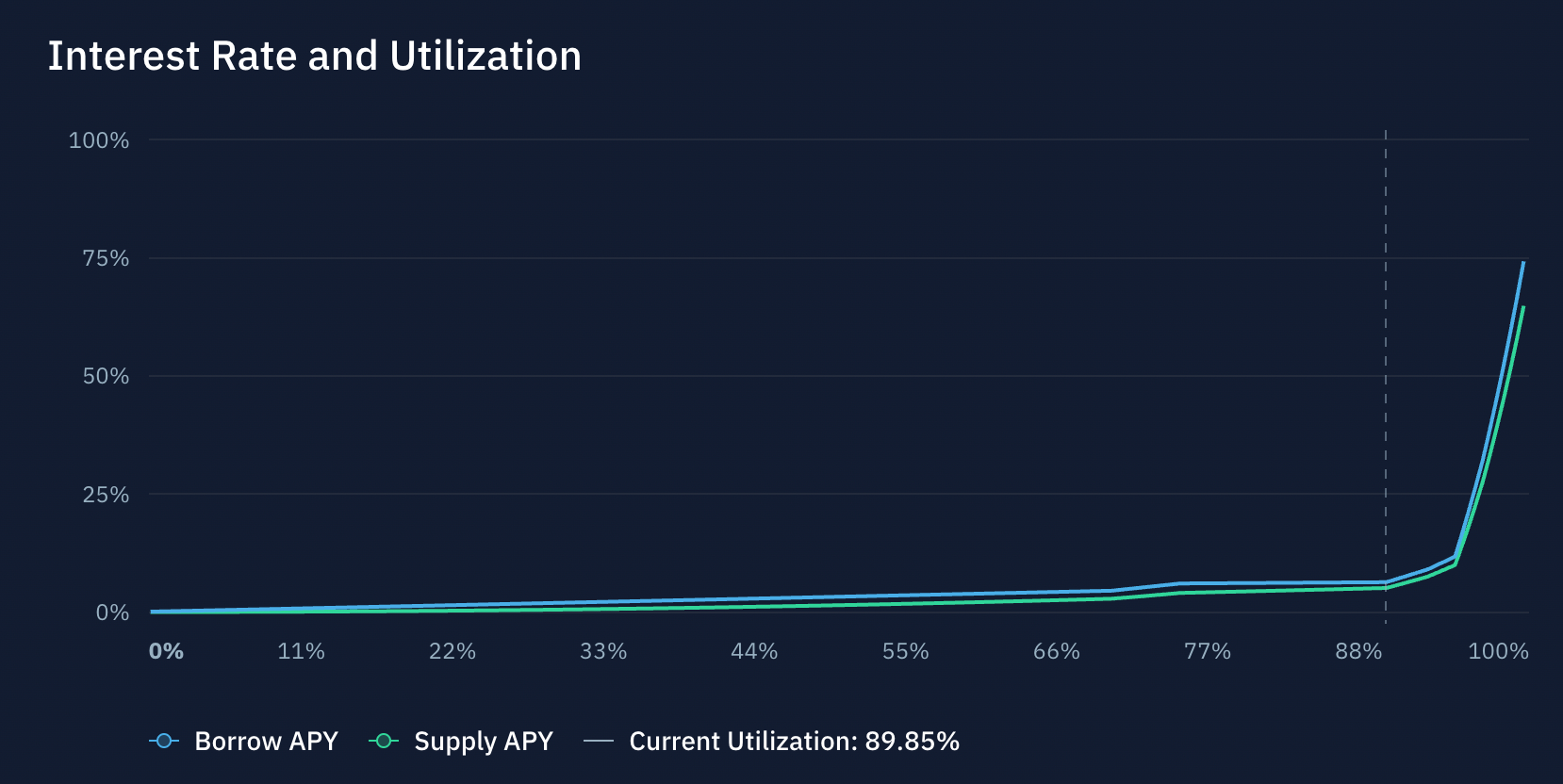
A sharp increase in lending APY can be attractive to a PT buyer seeking to lock a higher fixed return. Yet it also changes the risk analysis.
Moderate utilization: a healthier foundation for fixed-rate demand
At moderate utilization, the lending market has meaningful borrower demand while retaining enough supplied liquidity that lenders can generally withdraw without severe delay. Rates may be sufficiently attractive to create interest in PTs, while the possibility of an abrupt rate reversal is lower than in a stressed, near-cap market.
This setting can support:
- PT demand from allocators seeking an attractive but credible fixed return;
- YT demand from participants expecting utilization to increase further;
- underlying asset supply from lenders comfortable depositing into the money market; and
- market-maker participation because fair-value estimation is less dominated by tail-risk scenarios.
High utilization: elevated APY can be a symptom, not merely a benefit
When utilization approaches the steep part of the rate curve, supply APY may look compelling. But the rate often reflects a market imbalance: available lender liquidity is scarce relative to borrowing demand.
For an Exponent position, that produces a two-sided effect.
On one side, a high supply APY can increase interest in locking a PT yield. On the other, it can reduce confidence in the durability and accessibility of the underlying position:
- If borrowers repay, deleverage, or are liquidated, utilization can fall quickly and floating yield can collapse.
- If lenders rush to withdraw, available liquidity may be constrained by outstanding loans.
- If the high APY is driven by short-lived token incentives rather than organic borrower interest, YT cash flows may be less durable than the displayed rate suggests.
- If the market fears credit deterioration or a collateral shock, a high rate may carry a larger risk premium rather than represent a free return.
Thus a credit market can show high current APY while PT demand remains weak and YT pricing remains cautious.
The immediate pricing implications of a credit-rate shock
Consider an unexpected increase in borrow demand that pushes a lending market’s supply APY above prior expectations.
- Existing YT holders may benefit, because future yield through maturity may be higher than the market previously expected.
- A newly issued PT may offer a higher implied fixed yield, which means a lower PT price relative to its maturity claim.
- Existing PT holders who need to sell before maturity may face mark-to-market losses if implied rates rise.
- New PT buyers may find the higher fixed yield attractive, provided they accept the underlying credit and liquidity risk.
- Holders of the underlying yield-bearing position must decide whether to retain YT exposure or sell it to lock in a fixed return.
The opposite applies when utilization falls. YT expectations tend to weaken; PT prices may rise as implied fixed yields decline. This is why a PT holder who exits early has rate exposure even though holding until maturity gives a defined redemption relationship.
Liquidity conditions: market depth determines whether yield can become an executable strategy
Yield fundamentals determine the expected cash flows; liquidity determines whether those claims can be traded efficiently.
For an Exponent market, institutional liquidity analysis has at least three levels:
| Liquidity layer | Question to ask | Consequence if liquidity is weak |
|---|---|---|
| Underlying asset liquidity | Can the LST, lending receipt token, or other underlying be redeemed or traded at reasonable cost? | The asset supporting PT/YT redemption may itself be hard to realize. |
| Exponent PT/YT liquidity | Can the institution enter or exit a maturity at the intended size without unacceptable implied-rate movement? | A good yield thesis may be untradeable or costly to unwind. |
| Liquidity-provider capital | Are CLMMs, order-book makers, or RFQ participants actively quoting the relevant maturity and rate range? | Wider spreads, shallow depth, unstable prices, and poor exit quality. |
Rate liquidity is not ordinary spot-token liquidity
In a conventional spot market, liquidity providers think primarily about a token’s price range. In a rate market, Exponent’s Rate CLMM concentrates liquidity around implied-APY ranges. The LP is effectively expressing where it expects the market-clearing fixed rate to remain.
This is capital-efficient when the market trades within the selected range. It becomes more demanding when implied yields move rapidly:
- A change in expected staking revenue can shift the relevant rate range.
- A utilization shock in a lending protocol can reprice future yield.
- A large PT or YT trade can consume localized liquidity and alter the quoted implied rate.
- As maturity approaches, time decay and PT convergence change the market’s risk profile.
A liquidity provider may earn trading fees and potentially benefit from the economics of the underlying asset, but that return must compensate for active management, inventory changes, adverse selection, and rebalancing costs.
Fragmentation changes the meaning of a quoted APY
A dashboard may show an attractive implied PT yield. Before treating it as investable, ask:
- What size is available within the approved execution tolerance?
- Is liquidity distributed across one pool, multiple venues, or different maturities?
- How much of the apparent liquidity is active and in range?
- Can the position be exited before maturity if risk limits require it?
- Does the underlying asset have independent liquidity and redemption capacity?
- Is the quoted yield compensating for economic risk, or for simply being hard to trade?
In thin markets, the implied yield can contain a substantial liquidity premium. A PT discount may not be evidence that the market has discovered an unusually high-risk-adjusted return. It may instead reflect that marginal buyers demand compensation for committing capital until maturity or taking uncertain exit risk.
A combined market map: four regimes an institutional team should recognize
The most important practical skill is combining the staking, credit, and liquidity signals rather than reading any one of them in isolation.
| Market regime | Underlying condition | Likely Exponent effect | Institutional interpretation |
|---|---|---|---|
| Stable staking, moderate credit utilization, deep PT liquidity | Yield is relatively forecastable; lending markets are functioning without acute liquidity stress. | PT demand can be durable; YTs may be priced around modest variable-yield expectations; LPs can quote tighter markets. | The cleanest setting for a maturity-matched fixed-yield allocation. |
| Rising network activity and rising credit demand | Priority fees, MEV revenue, and lending rates may be increasing. | YT demand may rise; implied fixed rates can rise; PTs can reprice lower before maturity. | Separate a genuine forward-yield thesis from already-priced excitement. |
| Very high utilization or incentive-driven lending APY | Headline yield is elevated, but may be unstable or reflect scarce lender liquidity. | PTs may need a higher implied yield to attract buyers; YT value becomes highly sensitive to a rate reversal; liquidity can become cautious. | Underwrite rate durability, withdrawal conditions, borrower quality, and incentive dependence—not the displayed APY alone. |
| Risk-off conditions and thin secondary liquidity | Allocators withdraw, market makers reduce inventory, and underlying tokens may trade at wider spreads. | PT discounts can widen; YTs may be difficult to value; CLMM liquidity may be out of range. | A hold-to-maturity position may remain viable, but early-exit assumptions should be revised sharply. |
Notice that a “bullish Solana” environment does not automatically mean every Exponent instrument is attractive. Strong activity can be favorable for a YT linked to activity-sensitive revenue, while causing implied rates to rise and creating mark-to-market pressure for an existing PT holder. The appropriate instrument depends on the institution’s exposure, horizon, and ability to manage liquidity.
A practical monitoring sheet for an Exponent market
For an institutional sales or capital-markets conversation, a useful framing is: the instrument is only as attractive as the market conditions supporting its yield and tradability.
Monitor the following categories together.
| Area | Core indicators | What may change on Exponent |
|---|---|---|
| Staking | Net LST APY, validator commission, validator performance, issuance schedule, priority fees, MEV/Jito contribution | The expected and perceived reliability of YT cash flows; the fixed yield demanded by PT buyers. |
| Credit | Utilization, borrow APY, supply APY, rate-curve kink, incentives, collateral conditions, withdrawal availability | Expected lending yield; likelihood of sharp YT repricing; risk premium in PT pricing. |
| Market liquidity | PT/YT depth, order-book spread, CLMM in-range liquidity, volume, slippage, LP concentration, maturity-specific open interest | Execution quality, early-exit capacity, and the credibility of displayed implied yields. |
| Underlying dependencies | LST exchange rate, lending-protocol health, oracle conditions, redemption mechanics, governance changes | Whether the contractual-looking maturity payoff can be realized economically and operationally. |
For a client discussion, avoid leading with the highest available APY. A stronger statement is:
The opportunity is a claim on a specified source of Solana yield through a specified maturity. The return depends on the yield source, the market’s implied-rate pricing, the depth available at the target size, and the institution’s ability either to hold until maturity or to exit under stressed conditions.
Key takeaways
Exponent’s PT and YT markets transmit conditions from Solana’s underlying yield economy into tradable fixed-rate and floating-yield prices.
- Staking conditions matter because issuance, priority fees, and MEV-related revenue have different degrees of predictability. Stable yield tends to support PT demand; unexpected growth in variable components can support YT demand.
- Credit conditions matter because utilization and borrower demand drive lending yields. High supply APY can be attractive, but it may also signal unstable rates, incentive dependence, or constrained withdrawal liquidity.
- Liquidity conditions determine whether an attractive implied rate is genuinely executable. Depth in the underlying asset, PT/YT market, and rate-liquidity venues must all be assessed.
- A higher displayed yield is not automatically a better opportunity. It may represent improved expected cash flows, a liquidity premium, a credit-risk premium, or a transient incentive.
- For institutional positioning, always connect the product to its yield source, maturity, expected exit route, and residual risks.
In the next module, you will move into institutional protocol diligence, beginning by separating custody, settlement, counterparty, and smart-contract risk in a DeFi transaction.
Can't find a good explanation? Sign up and we'll make it for you
Sign up