
Hello, and welcome to the first English lesson. Since English is your first exam, this module builds the fast, reliable reading habits you need for unseen texts before moving into technique analysis and short-answer writing.
An unseen text can feel difficult because you meet it and its questions at the same time. The goal is not to uncover every possible interpretation. It is to form a defensible view of what the text is saying, why it has been made, and who it is trying to reach. Today, you will learn a repeatable way to identify its central idea, purpose, and intended audience using evidence from the text.
The three questions behind every unseen text
Before looking closely at individual words or techniques, establish the text’s overall situation:
- What is the text mainly saying? This is its central idea.
- What does the creator want the text to do? This is its purpose.
- Who is the creator trying to reach? This is its intended audience.
These answers should fit together. A youth-health campaign about vaping, for example, might communicate the central idea that vaping has serious health consequences; its purpose may be to warn and discourage young people from vaping; and its intended audience may be teenagers who vape or are considering it.
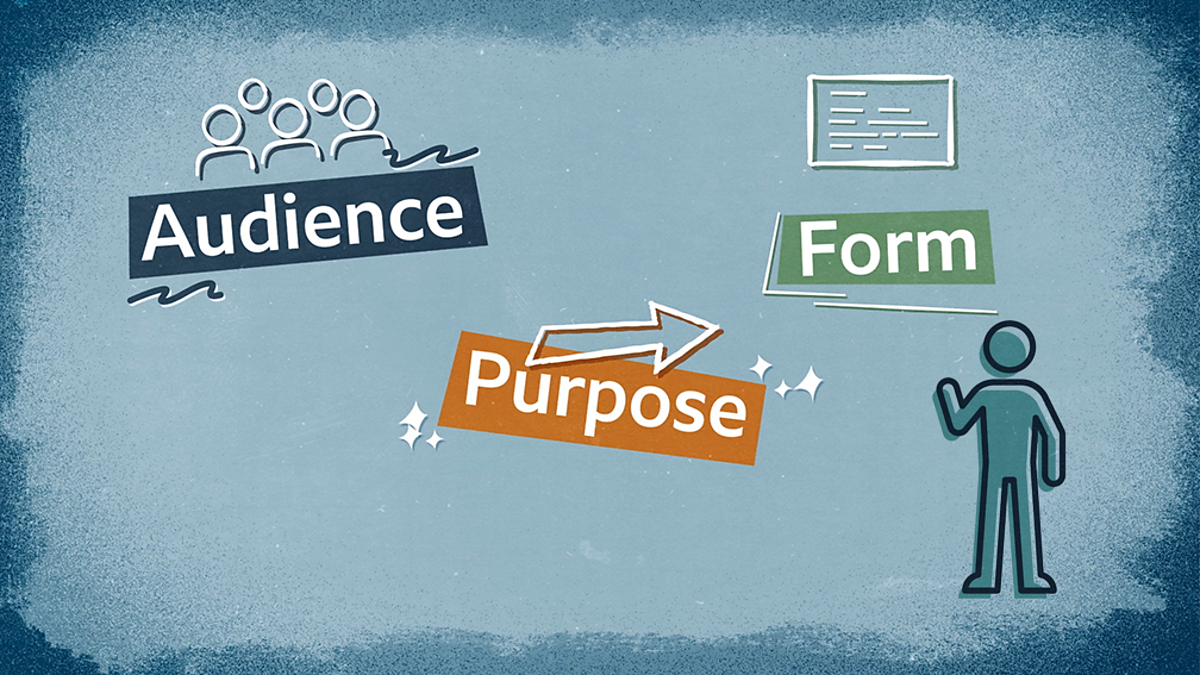
The image also includes form: the type of text, such as a poster, feature article, speech, advertisement, memoir extract, poem, or social-media post. Form is not one of today’s three final answers, but it is an important clue. A formal government fact sheet and a humorous online post may address the same topic, yet their different forms signal different purposes and audiences.
BBC Bitesize - Audience, purpose and form
Read BBC Bitesize’s “Audience, purpose and form” to establish the core definitions and see how vocabulary and tone provide audience clues.
In “Introduction to audience, purpose and form,” read from purpose and audience. Focus on the distinction between the reason a text exists and the people it is designed to reach. Then, in “Identifying audience through language,” read the paragraph beginning “What type of vocabulary is used?” and especially the audience clues. Notice that vocabulary indicates not only age, but also knowledge, interests, and the relationship the writer assumes with readers.
Central idea: move beyond the topic
A topic is the subject a text deals with. It is usually a word or short phrase:
- homelessness
- family memory
- school pressure
- environmental damage
- sport
A central idea is the text’s main insight, argument, or representation of that topic. It needs to be a complete statement:
-
Topic: homelessness
Central idea: Homelessness is often invisible to comfortable Australians and demands collective responsibility. -
Topic: family memory
Central idea: Vivid memories preserve emotional connections to loved ones across time. -
Topic: school pressure
Central idea: Academic pressure can distort young people’s wellbeing when achievement is treated as their only value.
The distinction matters in an exam. Writing “the text is about grief” identifies only the topic. Writing “the text represents grief as painful but necessary to acknowledge” identifies an idea the text develops.
Find the “big message” before the details
On your first reading, do not begin by hunting for metaphors, camera angles, or sophisticated terminology. Instead, briefly locate the text’s centre of gravity. Look for:
- the title or headline
- what is repeated, contrasted, or emphasised
- the speaker’s or writer’s attitude
- a shift in viewpoint or emotion
- the final sentence, image, slogan, or call to action
For a narrative or poem, the central idea may be implied rather than stated directly. Ask: What does the experience reveal? For an article, speech, or advertisement, ask: What position is the writer taking, and what do they want the audience to believe?
A useful provisional sentence is:
This text suggests that [idea about the topic].
Keep it provisional at first. Then test it against two or three parts of the text. If your statement explains the title, the ending, and the strongest repeated pattern, it is probably a sound central idea.
Purpose: what the text is trying to achieve
Purpose is the creator’s intended goal. It is not simply the text’s topic and not just a label such as “to persuade.” A strong explanation states both the action and its target.
| Too vague | More precise |
|---|---|
| The purpose is to inform. | The purpose is to inform local residents about flood-preparation procedures. |
| The purpose is to persuade. | The purpose is to persuade young voters that public transport funding deserves political support. |
| The purpose is to entertain. | The purpose is to entertain readers while satirising the unrealistic standards of influencer culture. |
Common purposes include to:
- inform or explain
- persuade or advocate
- warn
- instruct
- encourage participation
- entertain
- commemorate
- challenge assumptions
- express or explore an experience
- provoke sympathy, concern, or reflection
Texts often have more than one purpose. A feature article about a social issue may inform readers through facts while also persuading them to reconsider their assumptions. In this case, identify the dominant purpose first, then acknowledge the secondary one only if it clearly matters.
Be careful with the difference between purpose and effect:
- Purpose: what the creator intends to achieve.
- Effect: a likely response produced in the audience.
For example:
The article aims to challenge readers’ assumptions about homelessness, encouraging them to feel greater empathy and recognise a social responsibility to act.
“Challenge assumptions” is the purpose. “Feel empathy” and “recognise responsibility” describe likely effects that help explain how successful that purpose might be.
A dependable purpose sentence is:
Through this [form], the creator seeks to [precise verb] [audience] about [issue or idea], encouraging them to [think, feel, or do something].
Audience: infer a real group, not “everyone”
The intended audience is the group the text is primarily designed to reach. “Everyone” is almost never precise enough, even when a text appears broad. A public advertisement may be available to all viewers but specifically target parents, commuters, young adults, donors, consumers, or voters.
Identify an audience by combining clues rather than guessing from the topic alone.
| Clue in the text | What it may suggest |
|---|---|
| Technical terminology defined carefully | A non-specialist audience interested in the issue |
| Unexplained specialist vocabulary | Readers who already possess relevant knowledge |
| Slang, hashtags, direct second-person address | A younger or online audience |
| Formal register, evidence, statistics, policy language | Adults, decision-makers, or an informed public audience |
| Imperatives such as “Donate,” “Register,” or “Speak up” | People positioned to take a specific action |
| References to shared local places or events | A community connected by location or experience |
Audience analysis should be evidence-based and flexible. Avoid unsupported assumptions such as “teenagers like informal language” on its own. Instead, identify the textual feature and explain what it assumes about readers:
The colloquial phrase “we’ve got you” and the hashtag create an accessible, supportive voice, suggesting the poster targets students who may be reluctant to report bullying.
This is much stronger than merely writing “the audience is teenagers.”
A text may also have a secondary audience. A school newsletter could address students directly while reassuring parents and the wider school community. Still, if a question asks for the intended audience, lead with the group most directly addressed.
A rapid exam-reading routine
In a 90-minute English exam, reading strategically protects your writing time. The following routine is designed for a first encounter with an unfamiliar text.
Human Experiences - Reading Comprehension, Unseen Texts | HSC Texts and Human Experiences Lesson 6
Watch Schooling Online’s “Human Experiences - Reading Comprehension, Unseen Texts,” which demonstrates how reading the questions first helps you find a text’s big message and relevant evidence efficiently.
Watch the reading strategy. Focus on the order of operations: inspect question keywords, read for each text’s central theme, then return to locate details relevant to the particular question. Treat mark value as a guide to the scope and depth of your response, rather than trying to explain every feature you notice.
Use this adapted routine during reading time:
- Read the questions first. Underline the key focus: an idea, attitude, experience, relationship, or representation. The question tells you what matters most.
- Identify form and situation. Who seems to be speaking? Where might this text appear? Is it a speech, article, story, poster, or review?
- Read once for the big message. Write a three- to six-word margin note, such as “memory keeps love present” or “warning against casual cruelty.”
- Infer purpose and audience. Look at register, tone, knowledge assumed, direct address, and any call to action.
- Return to the question. Only then select the strongest details that support the answer you need to write.
Your first reading does not need to produce a perfect interpretation. It needs to produce a focused, supportable one.
Worked example: connecting the three elements
Imagine this short text appears as an online post from a local council:
This Saturday, heat is expected to reach dangerous levels. Check on older neighbours, refill water bottles, and avoid outdoor exercise during the hottest part of the day. A five-minute call could save a life.
Here is how to reason from the evidence.
1. Identify the central idea
The topic is heat. The central idea is more developed:
During extreme heat, simple acts of preparation and community care can protect vulnerable people.
This is supported by the focus on practical precautions and the final claim that a short call “could save a life.”
2. Identify the purpose
The post gives instructions: “Check,” “refill,” and “avoid.” These imperatives show that the council is not only reporting weather conditions. Its primary purpose is:
to warn and instruct community members to take protective action during dangerous heat.
The phrase “A five-minute call could save a life” also encourages people to care for others, not merely themselves.
3. Identify the intended audience
The direct address assumes readers can make choices about hydration, outdoor activity, and checking on neighbours. The audience is therefore not simply “everyone.” A precise answer is:
local residents, particularly adults and carers who can prepare themselves and support vulnerable neighbours.
Notice how form helps: a local-council online post is likely designed for people in a particular geographic community. Its concise imperative style also suits readers who need quick, practical information.
A compact exam-style synthesis
When a question asks you to discuss the text broadly, you could write:
The local-council post conveys the central idea that community care and practical preparation are essential during extreme heat. Its urgent imperatives, including “Check” and “avoid,” reveal a purpose of warning and instructing local residents to reduce health risks. By addressing readers who can check on “older neighbours,” the post particularly targets adults and carers able to protect vulnerable community members.
This answer does not over-explain every word. It establishes a clear interpretation, selects relevant evidence, and connects each point to the text’s overall communicative situation.
Common mistakes to avoid
Confusing central idea with topic
“The text is about climate change” is not enough. State what the text suggests about climate change.
Naming a generic purpose
“To persuade” is only the beginning. Explain what belief, feeling, or action the creator wants to influence.
Giving an audience with no proof
Do not write “the audience is young people” unless language, form, imagery, content, or context supports it.
Treating form as purpose
“It's a speech” identifies form. A speech may inform, persuade, commemorate, or inspire. You still need to explain what it aims to achieve.
Searching for hidden meanings too early
An unseen-text response rewards clear reasoning anchored in evidence. A plausible central idea, carefully supported, is more useful than an elaborate interpretation with no textual basis.
A final checklist for reading time
Before writing, mentally complete these statements:
- Central idea: The text suggests that …
- Purpose: The creator aims to …
- Audience: The text primarily targets …, shown through …
- Evidence: The strongest supporting detail is …
- Question focus: This matters because the question asks about …
If you can complete these five statements, you have established a strong foundation for most unseen-text questions.
Central idea is the text’s main message about its topic; purpose is what the creator wants the text to achieve; and audience is the particular group the creator is trying to reach. Form, tone, vocabulary, assumed knowledge, and calls to action provide useful clues, but your final interpretation should always be precise and supported by details from the text.
In the next lesson, you will build on this foundation by explaining how specific language techniques shape meaning in an unseen text.
Can't find a good explanation? Sign up and we'll make it for you
Sign up