
Hello. You have now worked through the central social questions of game theory: when choices are interdependent, how to map an interaction, why cooperation can fail, how repeated contact and credibility change the game, and how negotiation improves when you uncover interests rather than argue over positions.
In the previous lesson, you revised a proposal after learning what the other side actually valued. This final lesson adds a discipline that keeps strategic thinking connected to reality: make a small prediction, try one ethical move, observe what happens, and update your assumptions. The aim is not to “test” or manipulate people. It is to become more accurate, more curious, and more respectful in everyday strategic interactions.
By the end, you will have a compact protocol for running one low-stakes strategy experiment and comparing the response with your forecast.
Forecasts are useful precisely because they can be wrong
Game theory begins with a model of what others might do. Everyday strategic thinking needs something more: a way to check the model against actual people in an actual context.
The TED-Ed challenge below shows the distinction vividly. In the “two-thirds of the average” game, a perfectly rational chain of reasoning points to zero. But real groups do not usually produce that result, because people make different assumptions about how deeply everyone else will reason.
Game theory challenge: Can you predict human behavior? - Lucas Husted
Watch “Game theory challenge: Can you predict human behavior?” by Lucas Husted on TED-Ed. It shows why a strategically elegant prediction can differ from observed human behavior—and why your assumptions about other people’s reasoning matter.
Watch the result gap to contrast the theoretical equilibrium with typical observed guesses. Then watch levels of reasoning and notice that each forecast rests on an assumption about what other participants are likely to think.
The practical lesson is not “people are irrational.” It is more precise:
A strategic prediction is conditional: it depends on your assumptions about incentives, constraints, information, habits, and expectations.
For instance, imagine you offer a colleague two equally workable ways to review a short document:
- Option A: a 15-minute call tomorrow;
- Option B: an asynchronous written review by tomorrow.
You may predict they choose B because they have said they dislike meetings. But the observed choice might be A, because the document is ambiguous and a conversation would be faster. Your prediction was not useless; it surfaced a mistaken assumption. You predicted based on a general preference, while the other person responded to the specific task.
That is the habit this lesson develops: state the forecast before seeing the result. Otherwise, hindsight makes almost any result seem obvious.
A strategy experiment is a small, respectful comparison
A useful everyday experiment has four components:
- A specific interaction involving a real choice.
- One intentional strategic move you will try.
- A prediction about the other person’s response, including the assumptions behind it.
- An observation and comparison after the interaction.
The word experiment can sound more formal than needed. You are not trying to prove a universal law from one conversation. You are gathering a single, concrete data point to improve your understanding of an interaction.
The following framework captures the necessary discipline: define what you mean, define the comparison, and keep other relevant conditions as stable as possible.
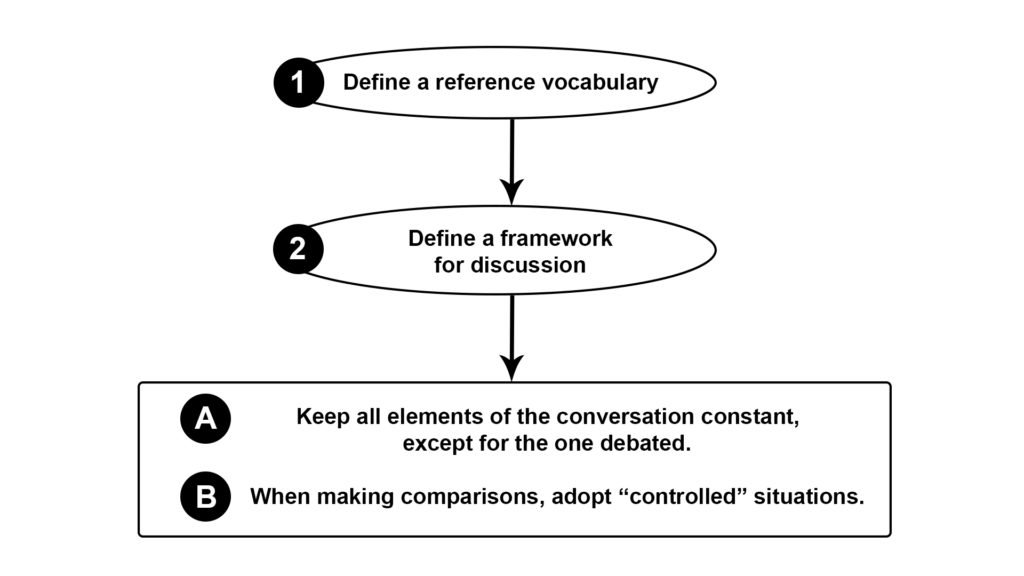
Suppose you want to learn whether a teammate prefers receiving a request as a short written message or a brief call. The reference vocabulary might be:
| Element | Clear definition |
|---|---|
| Participant | A teammate with whom you already collaborate regularly |
| Strategic move | Offer two acceptable formats for the same small task |
| Fixed elements | Same task, same deadline, similar effort, same ability to decline |
| Variable | Communication format: written or call |
| Predicted response | They will choose written feedback |
| Observable outcome | Which format they choose and, if they volunteer it, their reason |
Holding everything constant is never perfect in ordinary life. Mood, workload, timing, and relationship history all matter. But the framework prevents a common error: changing five things at once and then crediting one of them for the outcome.
For example, if you make a request more polite, reduce its scope, offer a deadline extension, and ask through a different channel, a faster “yes” does not tell you which change mattered. A small comparison is more informative when the choice is narrow and the context is stable.
The Behavioural Insights Team’s nudge guide offers a practical five-step structure: choose a specific behavior, understand the context, design a small intervention, test it, then reflect and redesign.
[PDF] Little Book of Green Nudges - Behavioural Insights Team
Read this section from the Behavioural Insights Team as a compact guide to turning a broad behavioral idea into a specific, observable, and revisable test. Its examples concern sustainability, but the design logic transfers to ethical everyday strategy experiments.
On pp. 33–35, begin in “Five steps to make your nudge a success.” Read choosing a target, then continue through “Understand your context” and “Design your nudge.” Focus on choosing an observable action rather than trying to measure an attitude such as “being cooperative.” On pp. 37–40, read testing guidance. Notice the distinction between measuring an outcome, comparing it to a baseline or alternative, and checking for unintended effects.
For this course, “nudge” is only a source of design ideas. Your standard is higher than effectiveness alone: the other person must retain meaningful choice, and your experiment must not exploit hidden vulnerabilities.
Choose a safe question worth learning from
The best first experiment is deliberately modest. It should involve a relationship that can easily absorb an awkward result and a choice that does not affect money, safety, status, performance evaluation, confidential information, or someone’s access to an important service.
Good candidates are usually recurring, low-stakes coordination problems:
| Question you could test | Ethical strategic move | What you observe |
|---|---|---|
| Does a collaborator prefer choices or an open question when scheduling a short discussion? | Offer two equally convenient time slots, plus a genuine option to suggest another. | Their choice, counteroffer, or decline |
| Does a friend respond better to a concrete request than a vague invitation? | Ask for one small, optional action with a clear time and effort estimate. | Whether and how quickly they accept, decline, or negotiate |
| Does a household member value a reminder at a particular moment? | Ask permission to try one agreed reminder before a routine task. | Whether the task happens and their feedback on the reminder |
| Do you predict someone’s preference accurately in a small joint decision? | Present two acceptable packages that differ on one dimension, such as timing versus convenience. | Chosen package and stated reasoning |
Avoid these as first experiments:
- testing a romantic partner during an active conflict;
- experimenting with subordinates, students, clients, or anyone dependent on you;
- withholding important information to observe a reaction;
- introducing friction, pressure, public exposure, or shame;
- using private messages, recordings, or personal data without clear permission;
- making changes to operational processes, customer communication, or performance-related work without the appropriate approval.
At work, a safe experiment should be transparent and reversible. It should not alter another person’s workload or opportunities without their agreement. In practice, this means you might say, “I am trying to make my requests clearer. Would you be open to telling me whether this format works better for you?” That makes the other person a participant with agency, not an unwitting subject.
The ethical gate: autonomy before cleverness
A strategically effective move can still be a poor move if it relies on pressure, deception, or information asymmetry that the other person would reasonably object to. In this course, ethical strategy preserves the other person’s ability to understand, choose, decline, and repair the interaction.
Before you run an experiment, use this four-part gate:
- Low stakes: If the result goes badly, can everyone return to the prior arrangement with little cost?
- Voluntary participation: Can the other person decline or choose another option without penalty or embarrassment?
- Transparency: Would you be comfortable explaining your purpose and method afterward?
- Minimal data: Are you recording only what is needed, without names, private details, screenshots, or recordings?
If any answer is “no,” shrink or redesign the experiment. For example, replace “I will see whether a teammate reacts to delayed information” with “I will ask whether they prefer updates at the start or end of a workday.” The latter is more respectful and gives them a meaningful choice.
Read this guidance from the Behavioural Insights Team to ground your experiment in respect, consent, and harm prevention. The source discusses larger research projects, so apply its principles proportionately to a small everyday interaction.
In the section “Be prepared for ethical quandaries” on pp. 16–17, read the ethical review. Then read consent planning. For a low-stakes trial, translate this into plain language: explain what you are trying, invite rather than pressure, identify possible discomfort in advance, and decide not to collect unnecessary personal information.
A simple rule of thumb: if the move works only because the other person does not realize what is happening, do not use it.
The field protocol: predict, run, record, compare
Use the following protocol for one experiment you can complete today or in the next few days. A live conversation, a short planning exchange, or a routine request is ideal because you can observe the response directly.
1. Write a prediction before the interaction
Do not write, “They will probably like it.” Make the predicted action observable.
Use this sentence:
When I offer [person or role] a choice between [Option A] and [Option B], they will most likely [specific observable response], because I assume [incentive, constraint, belief, or preference].
Then add:
- Confidence: low, medium, or high.
- Alternative forecast: what else might they do?
- Evidence: what prior observation supports your assumption?
- Disconfirming clue: what would make you doubt the assumption?
Example:
When I offer my project collaborator a choice between a 15-minute call and an asynchronous review of the same one-page draft, they will choose asynchronous review, because I assume that avoiding meetings matters more to them than resolving ambiguity quickly.
- Confidence: medium.
- Alternative forecast: they choose a call because the draft needs discussion.
- Evidence: they often prefer written updates.
- Disconfirming clue: they have recently asked for more synchronous alignment.
Notice that the forecast concerns behavior, not personality. “They are disorganized” is a vague attribution. “They may decline a same-day request because their calendar is full” is a testable situational hypothesis.
2. Design one controlled, voluntary choice
Keep the alternatives genuinely acceptable to you. Do not offer a fake option merely to steer someone toward your preferred answer.
For an interpersonal experiment, keep these elements fixed:
- the purpose of the request;
- expected effort;
- deadline;
- ability to decline;
- tone and relationship context.
Vary only the feature you want to learn about: timing, format, degree of structure, sequence, or framing.
A transparent script might be:
“I am trying to improve how I coordinate small tasks with people. For this one, would you prefer a 15-minute call tomorrow or comments on the one-page draft by tomorrow? Either is fine, and it is also fine to say neither works.”
The last sentence matters. It prevents a choice architecture from becoming social pressure.
3. Run a brief pre-mortem
Before acting, imagine that the experiment was a failure. What could have gone wrong?
Common answers include:
- the options were not truly comparable;
- the timing was unusually bad;
- the person felt evaluated or pressured;
- your wording implied that one answer was preferred;
- you interpreted a polite response as genuine preference;
- the result was shaped by a constraint you did not know about.
Choose one mitigation. For example: “I will ask at the end, ‘Was either option actually inconvenient?’” This turns a silent confound into useful information.
4. Run it once, without improvising the hypothesis afterward
Make the request or present the options as planned. Listen closely. Your goal is not to persuade the person toward your predicted answer. Let them choose, counteroffer, ask a question, or decline.
If they propose Option C, record it. A counteroffer is often the most informative response because it reveals a constraint your initial design missed.
5. Record facts immediately
Write three short notes immediately after the interaction:
| Separate these | Example |
|---|---|
| Observed facts | “They chose a call and said the document raised two unclear questions.” |
| Your interpretation | “Clarifying ambiguity mattered more than avoiding meetings in this context.” |
| Remaining uncertainty | “I do not know whether this is true for routine drafts or only urgent ones.” |
This separation protects you from quietly rewriting what happened to fit your initial story.
Compare the response with the prediction
The comparison is where the strategic learning happens. Do not reduce it to “I was right” or “I was wrong.” Compare at three levels.
Was the predicted action accurate?
- Accurate: they selected the option you forecast.
- Partly accurate: their counteroffer points in the same direction but changes a detail.
- Inaccurate: they chose the other option, declined, or responded in an unexpected way.
A correct prediction is not necessarily a validated theory. One choice may have been driven by a temporary constraint. An incorrect prediction is not a failure. It is often the higher-value result because it exposes an assumption worth revising.
Were your assumptions accurate?
Return to the “because I assume…” clause. Ask:
- Which assumed incentive or constraint was supported?
- Which was contradicted?
- Did the person reveal a new interest?
- Did a situational factor matter more than a stable preference?
For the collaborator who chose a call, the revised understanding might be:
For ambiguous work, speed of alignment can outweigh their general preference for fewer meetings.
This is more useful than the global claim, “They like calls.”
What will you do differently next time?
Make only one small update. For example:
- “For short, unambiguous drafts, I will offer asynchronous review first.”
- “For decisions with dependencies, I will offer a short call first.”
- “Before predicting a response, I will ask about current workload rather than rely on a general impression.”
This is iteration, not self-judgment. The point is to replace an untested story about another person with a better calibrated working hypothesis.
The following reflection template is enough for your first trial:
| Prompt | Your note |
|---|---|
| My original prediction | |
| My confidence and assumptions | |
| What I actually observed | |
| Was the prediction accurate, partly accurate, or inaccurate? | |
| What context did I overlook? | |
| What did the other person’s response reveal? | |
| One revised rule for a similar future interaction | |
| Any ethical concern or unintended effect? |
Keep the conclusion proportionate to the evidence. One respectful interaction can improve your forecast for a similar situation; it cannot diagnose someone’s personality or establish a general law of behavior.
A final perspective on strategic thinking
Throughout this course, the recurring question has been: What will happen when my choice meets other people’s choices? You can now approach that question with more than intuition.
You can:
- recognize the strategic structure of an interaction;
- distinguish coordination, cooperation, and conflict;
- anticipate another person’s incentives and perspective;
- understand why stable outcomes can still be undesirable;
- build cooperation through repeated interaction, reciprocity, repair, and credible commitments;
- negotiate by exploring interests and revising packages;
- test a modest prediction ethically instead of treating your assumptions as facts.
The central habit is simple but demanding: model people carefully, act respectfully, observe honestly, and update. That is strategic thinking in its most useful social form—not control over others, but clearer judgment and better cooperation amid uncertainty.
Can't find a good explanation? Sign up and we'll make it for you
Sign up