
Hello, and welcome to the negotiation module. This module turns the strategic lens from predicting behaviour to shaping conversations and agreements. A practical place to start is not with clever arguments, but with a sobering question: what will each side actually do if no agreement is reached?
By the end of this lesson, you will be able to assess bargaining power in a realistic negotiation by identifying each side’s fallback option, called a BATNA. You will also distinguish a real fallback from a vague hope, and use that distinction to decide how firmly—or flexibly—to negotiate.
The no-deal comparison
Imagine you are negotiating a job offer, a project deadline, a freelance rate, or the purchase of a used car. It is tempting to frame the situation as:
“How do I persuade them to say yes?”
A more useful frame is:
“Is an agreement with them better than the best outcome available without them?”
That best no-deal outcome is your BATNA: Best Alternative to a Negotiated Agreement.
A BATNA is not:
- your ideal result;
- every possible alternative;
- a threat;
- an option that exists only in your imagination.
It is the best realistic course of action you can take without the other party’s cooperation.
For example, suppose you are considering a job offer:
- The offered role pays less than you hoped.
- You could remain in your current job, where you have stability and a known team.
- You could pursue another interview process, but no other offer exists yet.
- You could take time off to search, but this would reduce your income.
Your BATNA may be staying in your current job for now. It is not “getting a better offer somewhere else,” because that outcome is uncertain and still depends on another employer saying yes.
A BATNA gives you a comparison standard. If the deal on the table is worse than your BATNA, you should try to improve it or be prepared to walk away. If it is better, rejecting it just to “win” may be costly.
Alternatives and BATNA in Interest Based Negotiation - Noam Ebner
Watch “Alternatives and BATNA in Interest Based Negotiation” by Noam Ebner: Negotiation, Conflict Resolution & ADR. It introduces BATNA through familiar car-buying and salary-negotiation examples, then shows how it protects you from accepting a poor deal under pressure.
Watch the definition to establish the key idea: alternatives are actions available outside the present conversation. Continue with choosing the best, focusing on the difference between having many options and identifying the single best realistic one. Finish with using BATNA, which explains how the alternative becomes a benchmark rather than merely a bargaining threat.
Bargaining power is comparative, not personal
People often describe negotiation power as confidence, seniority, charisma, or the ability to speak forcefully. Those can affect a conversation, but they are not its foundation.
Bargaining power is largely about alternatives. A person with a good fallback can decline an unattractive deal. A person with few viable alternatives may have to make concessions even when they dislike the terms.
Crucially, power is relative. You need to assess both sides.
Consider an employee, Maya, negotiating a compensation package with a prospective employer.
| Side | If no agreement is reached | Quality of the fallback |
|---|---|---|
| Maya | Remain in her current role while continuing a job search | Stable income and a tolerable job, but delayed career change |
| Employer | Hire a second-choice candidate, redistribute work, or reopen the search | Possible, but may involve delay, recruitment cost, and less certainty |
Maya may have more bargaining power than she first assumes: she does not need to accept immediately. But the employer may also have a reasonable alternative. Neither side has unlimited power.
The assessment changes if new facts emerge:
- Maya’s current employer is planning layoffs.
- The employer has a project deadline in three weeks.
- The second-choice candidate has already accepted another role.
- Maya has a written offer elsewhere.
Each fact changes the attractiveness, feasibility, or timing of someone’s fallback. That is why bargaining power is not a permanent personality trait. It is a property of the situation.
A good assessment separates three levels of certainty:
| What you know | How to treat it |
|---|---|
| A signed offer, available supplier, or confirmed internal option | Evidence of a credible alternative |
| A promising lead or likely approval | A possible alternative, discounted for uncertainty |
| “I’m sure I can find something better” | A hope, not yet a BATNA |
Build your BATNA before estimating theirs
The classic method is simple: generate options, improve the promising ones until they are practical, then choose the best one. The work is not mathematical, but it does require intellectual honesty.
Best Alternative to a Negotiated Agreement (BATNA)
Read “Best Alternative to a Negotiated Agreement” from Beyond Intractability. It gives a clear definition of BATNA, a practical process for selecting one, and an essential reminder: a realistic negotiation analysis includes the other side’s alternatives too.
Begin with the opening explanation of BATNA. Read why BATNA is a benchmark, including the used-car example and the caution that relationship costs can matter. Then go to the section “Determining Your BATNA.” Read the three-step process, followed by the job-search example. Notice that an alternative becomes useful only when it is made practical enough to act on. Finally, read the section “BATNAs and the Other Side,” especially the counterpart analysis. Focus on the word “consider”: the other side’s BATNA is often an evidence-based estimate, not something you can know with certainty.
When comparing alternatives, do not compare only money. A lower-paying job may be preferable to a higher-paying one if it has substantially better timing, security, development prospects, or working conditions. Likewise, an employer may prefer a more expensive contractor who can start immediately over a cheaper one who creates a costly delay.
A compact way to pressure-test a fallback is to ask:
- Can I actually do this without their agreement?
- What would it cost me in money, time, effort, risk, and relationships?
- How likely is it to work?
- What must happen before it becomes available?
- Would I genuinely choose it if the negotiation ended today?
If the answer to the last question is “probably not,” it is not your BATNA.
From BATNA to a walk-away threshold
Your BATNA is a plan. A walk-away threshold is the point at which you would choose that plan rather than accept the proposed deal.
Suppose Maya’s best alternative is staying at her current job for six more months. The new employer’s offer includes salary, remote-work days, title, start date, and development budget. Her threshold should reflect the whole package, not salary alone.
For instance, she might decide privately:
- a lower salary could be acceptable if the role is fully remote and offers a meaningful scope of responsibility;
- a higher salary might still be unacceptable if the role requires relocation within a month;
- below a particular package of terms, staying put is better.
The threshold protects against two opposite errors:
- accepting a weak agreement because you fear losing the opportunity;
- rejecting a good agreement because you are emotionally attached to “winning.”
The image below shows this logic in a price-only negotiation.
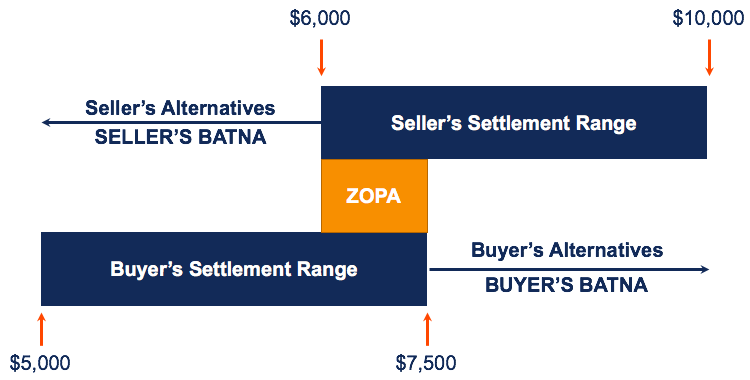
If the seller can do at least as well elsewhere at $6,000, then accepting less makes little sense. If the buyer can obtain an equivalent alternative for $7,500, paying more makes little sense. The overlap is the Zone of Possible Agreement, or ZOPA.
Real negotiations are rarely about a single price. The same principle still applies, but the overlap may involve combinations of terms:
- a lower fee with a faster payment schedule;
- a smaller salary increase with stronger learning opportunities;
- a later delivery date with a reduced scope;
- a lower purchase price with a longer warranty.
For now, the key point is modest but powerful: you cannot judge whether a proposal is good until you know what no deal would mean. In the next lesson, you will use priorities like these to revise proposals rather than treating every negotiation as a single-issue contest.
Estimate the other side’s fallback without pretending to read minds
Knowing your own BATNA prevents you from negotiating blindly. Estimating the other side’s BATNA tells you why they may accept, resist, delay, or walk away.
This is perspective-switching applied to negotiation. Ask:
- If they do not reach agreement with me, what can they do instead?
- Who else could meet their need?
- What would delay cost them?
- Which internal constraints limit them: budget, policy, approval, capacity, or precedent?
- What might they value besides the visible issue?
- Who must they justify the agreement to?
For the prospective employer, possible fallbacks might include hiring another candidate, using a contractor, shifting work to existing staff, delaying the project, or reducing scope. Each has a different cost.
Do not jump from “they need this” to “they have no alternative.” Most counterparts have some alternative. Your task is to estimate how good it is.
The Best Way to Win a Negotiation, According to a Harvard Business Professor | Inc.
Watch the excerpt “The Best Way to Win a Negotiation, According to a Harvard Business Professor” from Inc. It emphasizes an important discipline: know your own fallback, but focus the conversation on what the other side loses or gains if no agreement is reached.
Watch both fallbacks. Listen for the distinction between obsessing over your own no-deal position and understanding the counterpart’s motivation for being at the table. The latter directs attention toward the value your proposal creates for them.
The ethical way to test your estimate is through curious, concrete questions rather than pressure or bluffing. For example:
- “If we cannot make this timeline work, how would the team handle the project?”
- “Which parts of this proposal are easiest to change, and which are constrained by policy?”
- “What would a successful outcome need to look like for you internally?”
- “Are there deadline or budget constraints I should understand before proposing options?”
Such questions may reveal that a counterpart’s firm position is a real constraint. Or they may reveal flexibility that neither side had previously considered.
A counterpart who rejects your proposal is not necessarily irrational. They may have different priorities, incomplete information, reputational concerns, or constraints imposed by people not in the room. Treating their behaviour as information to investigate usually produces a better strategy than treating it as a personal obstacle.
A one-page bargaining-power check
Before an upcoming real conversation, make a brief private note using this structure:
| Field | What to write |
|---|---|
| Agreement sought | The package or outcome you would prefer |
| My realistic alternatives | Actions available if this discussion ends without agreement |
| My BATNA | The best practical alternative, stated concretely |
| My walk-away threshold | The lowest acceptable overall package before choosing the BATNA |
| Their likely alternatives | Their plausible routes without an agreement with you |
| Evidence and uncertainty | What you know, what you infer, and what you still need to ask |
| Bargaining implication | Whether to hold firm, explore trade-offs, improve your alternative, or gather information |
The phrase “stated concretely” matters. Compare:
- Vague: “I can probably find another client.”
- Concrete: “Two warm leads could become paid work next month, but neither is confirmed; my reliable fallback is extending my current contract for one month.”
The second statement may feel less dramatic, but it is more strategically useful.
Finally, remember that a BATNA is not a license to issue ultimatums. If you have a strong, credible alternative, you can communicate it calmly:
“I would prefer to make this work. At the same time, I have another viable option, so I would need the overall package to meet these conditions.”
If your alternative is weak, do not invent one. Bluffing can damage trust and may collapse when the other side asks for specifics. Instead, improve your position where possible: create additional options, seek information, extend your timeline, or reduce dependence on a single outcome.
Key takeaways
A BATNA is your best realistic outcome without the current agreement. It is the benchmark for deciding whether a deal is worth accepting, not merely a backup plan to mention at the table.
To assess bargaining power:
- identify your own viable alternatives and select the best one;
- translate it into a private walk-away threshold;
- estimate the other side’s alternatives, constraints, and costs of no agreement;
- distinguish evidence from assumptions;
- use questions and credible information ethically to test the picture.
In the next lesson, you will use this understanding of alternatives and priorities in a role-play: revising a proposal once you learn what matters most to the other side.
Can't find a good explanation? Sign up and we'll make it for you
Sign up