
Hello! Welcome back to our course on the Venezuelan crisis.
Introduction
In our last lesson, we examined the critical support Venezuela receives from its key international allies, Russia and China, identifying them as the country's "geopolitical shield" and "economic lifeline," respectively. Today, we turn our attention to the primary foreign policy tool used by the United States and its partners to counter that support and pressure the Maduro government: international sanctions.
Your work in the Foreign Office and your study of policy analysis have shown you that sanctions are a complex instrument of statecraft. They are not a monolithic tool but come in various forms, each with a different target and intended effect. This lesson is designed to give you a precise, policy-oriented understanding of this toolkit.
Our learning outcome is to: Distinguish between the different types of international sanctions imposed on Venezuela (e.g., individual vs. sectoral).
We will cover:
- A clear framework for categorizing sanctions.
- The specifics of individual sanctions, which target persons and entities.
- The mechanics of sectoral sanctions, which target entire industries.
- The real-world complexities that can blur the lines between these categories.
This lesson should take you approximately 60 minutes to complete.
1. A Framework for Understanding Sanctions
Before diving into the details, it's helpful to establish a clear framework. Sanctions are restrictive measures imposed by one country or a group of countries on another to achieve specific foreign policy objectives, such as changing a behavior, deterring aggression, or upholding international norms.
In the context of Venezuela, the U.S. sanctions regime has evolved significantly, escalating from narrowly focused measures to some of the most comprehensive sanctions ever imposed. We can broadly categorize them into two main types:
- Individual Sanctions: Often called "targeted" or "smart" sanctions. These are designed to act like a scalpel, aiming to penalize specific individuals, groups, or entities involved in activities deemed harmful (e.g., human rights abuses, corruption, drug trafficking). The goal is to isolate these actors without causing widespread harm to the general population.
- Sectoral Sanctions: These are much broader measures that act more like a sledgehammer. They target entire sectors of a country's economy, such as its financial, oil, or mining industries. The objective is to cripple the state's ability to generate revenue and fund its operations.
The following timeline provides an excellent visual overview of how both individual and sectoral sanctions have been applied to Venezuela over the last decade. Notice the clear escalation from individual sanctions in the early years to the imposition of heavy sectoral sanctions starting around 2017.
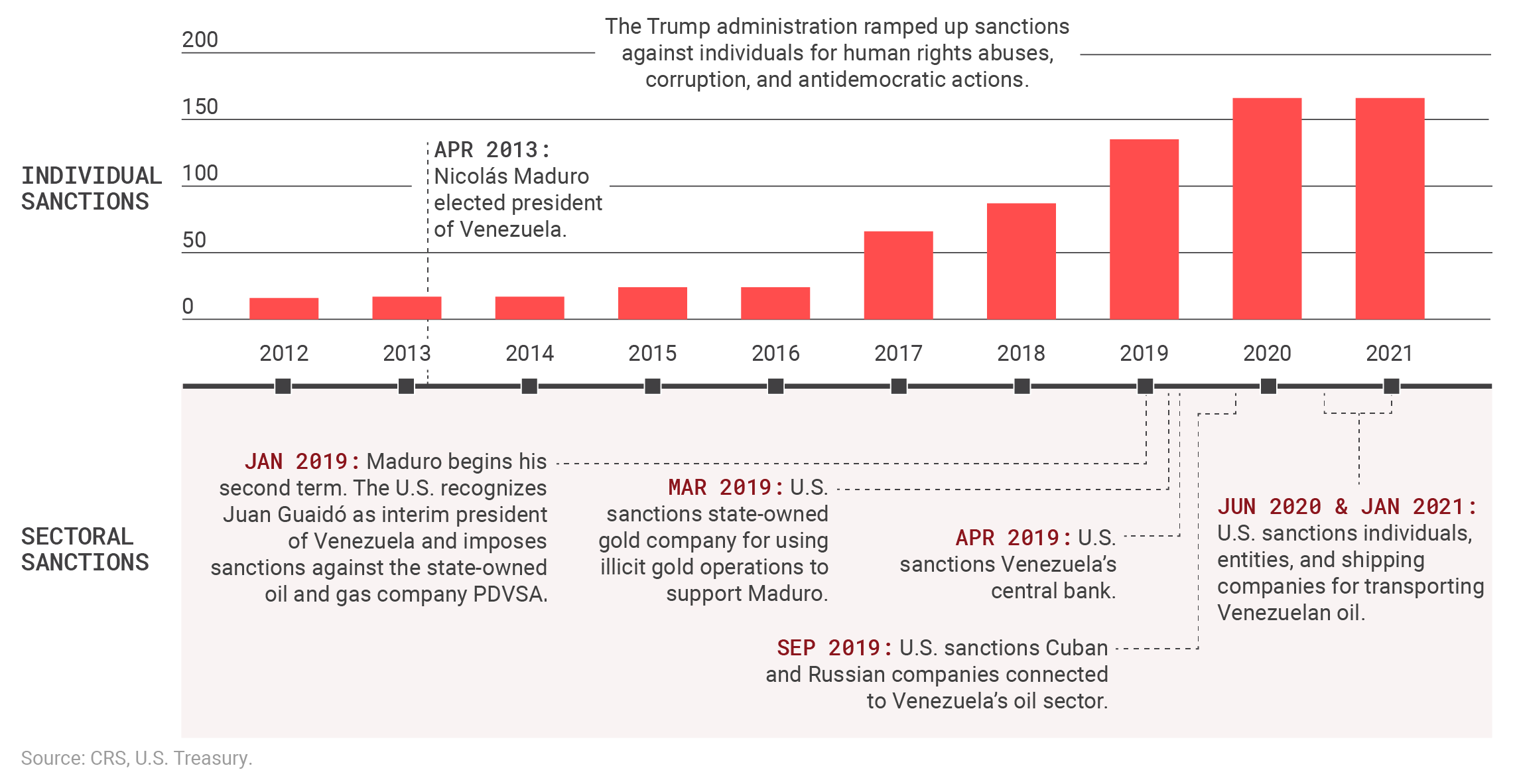
This timeline from the Center for Economic and Policy Research (CEPR) illustrates the chronological application of U.S. sanctions on Venezuela. The bar chart at the top shows the cumulative number of individuals sanctioned, while the timeline below marks the imposition of key sectoral sanctions against entities like the state oil company (PDVSA) and the central bank.
We will now explore each of these categories in detail.
2. Individual ("Targeted") Sanctions
Individual sanctions are the most common type and are often the first step in a sanctions strategy. They are based on the principle of holding specific individuals and entities accountable for their actions.
The primary mechanisms for individual sanctions are:
- Asset Freezes: Blocking access to any property or financial assets held within the jurisdiction of the sanctioning country. Individuals and entities subject to this are often placed on a list, such as the U.S. Treasury's "Specially Designated Nationals and Blocked Persons" (SDN) List.
- Travel Bans / Visa Restrictions: Preventing designated individuals and often their immediate family members from entering the sanctioning country.
To understand the legal basis and specific reasons for these sanctions against Venezuelan officials, please read the following sections from a Congressional Research Service (CRS) report. This is the type of briefing material commonly used in government, and it provides a concise, factual overview.
Reading (10 mins)
Please read the sections titled "Visa Restrictions," "Terrorism-Related Sanctions," "Drug-Trafficking-Related Sanctions," and "Targeted Sanctions Related to Antidemocratic Actions, Human Rights Violations, and Corruption" in the document below.
As the report shows, these sanctions target a wide range of activities, from undermining democratic processes and human rights abuses to corruption and support for terrorism.
A crucial point of clarification comes from the U.S. Treasury's Office of Foreign Assets Control (OFAC), the body that administers these sanctions. They make it clear that sanctioning an official does not automatically mean the entire government is sanctioned.
Reading (2 mins)
Please read the first FAQ in this document from OFAC. It directly addresses this distinction.
Venezuela Sanctions (Individual vs. Government Blocking Sanctions)
This distinction is key to the "targeted" nature of these sanctions. In theory, a U.S. person could still engage in a transaction with a Venezuelan government ministry, but they could not enter into a contract signed by a minister who is on the SDN list.
3. Sectoral Sanctions
Sectoral sanctions represent a major escalation. Instead of targeting individuals, they aim to cut off a country's key economic arteries. In Venezuela's case, this has primarily meant targeting its ability to finance itself through the oil and financial sectors.
The CRS report you reviewed earlier also outlines this escalation.
Reading (8 mins)
Now, please read the sections titled "Additional Financial Sanctions," "Broader Sectoral Sanctions," and "Sanctions on the Maduro Government" from the same CRS report.
These sanctions moved beyond individuals to prohibit transactions with major state-owned enterprises and the government itself. The key targets were:
- The Financial Sector: Prohibiting U.S. persons and institutions from dealing in new debt or equity issued by the Venezuelan government or its state oil company, PDVSA. This effectively cut Venezuela off from U.S. capital markets.
- The Oil Sector: Sanctioning PDVSA directly, freezing its assets in the U.S. (most notably its subsidiary, CITGO) and prohibiting U.S. firms from doing business with it.
- The Gold and Mining Sector: Sanctioning the state-owned gold company, Minerven, to block another source of illicit revenue for the government.
To understand the technical mechanics of these financial sanctions, the OFAC FAQs provide precise definitions.
Reading (5 mins)
Please review the following FAQs. Focus on how "debt" and "equity" are defined (FAQ 511) and how the sanctions were applied to specific sectors like oil and gold (FAQs 507, 508, 629).
As you can see, these measures are far broader and are designed to have a systemic impact on the target country's economy, a stark contrast to the targeted nature of individual sanctions.
4. Synthesis and Real-World Nuance
The distinction between individual and sectoral sanctions is clear in theory, but how does it play out in practice?
Video Analysis (5 mins)
The following video clips feature an economist discussing the sanctions. In the first clip, he explicitly compares the European Union's approach (focusing on individual sanctions) with the U.S. approach (which includes broad economic/sectoral sanctions).
Watch the first clip, focusing on this comparison.
This comparison neatly summarizes the core distinction we've been discussing. The EU has deliberately avoided broad sectoral sanctions due to concerns about their humanitarian impact, sticking to the "smart sanction" model.
However, even "smart" individual sanctions can have unintended, broader consequences. This is due to a phenomenon known as overcompliance. Financial institutions, fearing the severe penalties for accidentally violating sanctions, may decide to de-risk entirely by refusing to do any business related to a sanctioned country, even if the transactions are legally permissible.
Now, watch the next clip from the same interview, where the speaker explains this concept of overcompliance with a powerful example.
This concept of overcompliance is critical for any policy professional to understand. It shows that even the most carefully "targeted" sanctions can have diffuse, unintended effects on the general population, blurring the clean line between a "scalpel" and a "sledgehammer."
Conclusion
In this lesson, we have systematically distinguished between the major types of international sanctions imposed on Venezuela.
Key Takeaways:
- Sanctions can be broadly categorized into individual (targeted) and sectoral measures.
- Individual sanctions aim to penalize specific persons and entities for defined misconduct (e.g., corruption, human rights abuses) through tools like asset freezes and visa bans.
- Sectoral sanctions are a significant escalation, designed to cripple a state's economy by targeting entire industries like finance, oil, and mining, thereby cutting off revenue streams.
- The U.S. has employed an escalating combination of both, starting with individual sanctions before moving to comprehensive sectoral sanctions against PDVSA, the central bank, and the government itself.
- In practice, the distinction can be blurred by overcompliance, where financial institutions' aversion to risk causes even targeted sanctions to have broader, unintended consequences for the general population.
Preview of the Next Lesson:
Having established a clear understanding of the types of sanctions, our next lesson will delve into their consequences. We will analyze the stated goals versus the principal observed effects of U.S. oil sanctions on the Venezuelan economy and the Maduro government's stability, examining the ongoing debate about their effectiveness and humanitarian impact.
Can't find a good explanation? Sign up and we'll make it for you
Sign up