
Hello! Welcome to the next lesson in our course.
In our previous lessons on kinematics, we focused on describing the motion of particles—their position, velocity, and acceleration—without considering the causes of that motion. We learned to use both rectangular (x-y) and normal-tangential (n-t) coordinates to analyze motion along straight and curved paths.
Today, we transition from kinematics to kinetics. We will now investigate the why behind the motion. The central goal of this lesson is to achieve the following learning outcome:
Apply Newton's second law (F=ma) to solve for forces and accelerations in particle dynamics problems.
We will connect the forces acting on a particle to the acceleration it experiences. This is one of the most fundamental principles in all of mechanics. We will see how to apply this law systematically using different coordinate systems, building directly on the kinematic skills you've already developed.
1. The Foundation: Newton's Second Law and the Equations of Motion
At the heart of kinetics is Newton's Second Law of Motion. It provides the essential link between the forces acting on a body and the resulting change in its motion.

The equation is a vector relationship. This is powerful because it means we can break it down into scalar component equations along the axes of a chosen coordinate system. This is where our work in kinematics pays off.
-
In Rectangular (x-y) Coordinates:
These equations are perfect for analyzing rectilinear motion or projectile motion, where accelerations are easily expressed along horizontal and vertical axes. -
In Normal-Tangential (n-t) Coordinates:
This system is ideal for analyzing motion along a known curved path, as it directly relates forces to the change in an object's speed () and its change in direction (). The force is often called the centripetal force—the net force required to keep an object moving in a curve.
A Systematic Approach to Solving Problems
To apply these equations correctly and consistently, we will follow a structured problem-solving strategy. This approach organizes the problem and ensures all forces and motions are accounted for.
Applying Newton’s Laws of Motion
To effectively apply Newton's law, we need a consistent strategy. This resource from OpenStax's 'University Physics' outlines a clear, step-by-step approach.
Read the 'Problem-Solving Strategy' section at the beginning of the page. These five steps will be our roadmap for almost every problem in kinetics.
In essence, the strategy is:
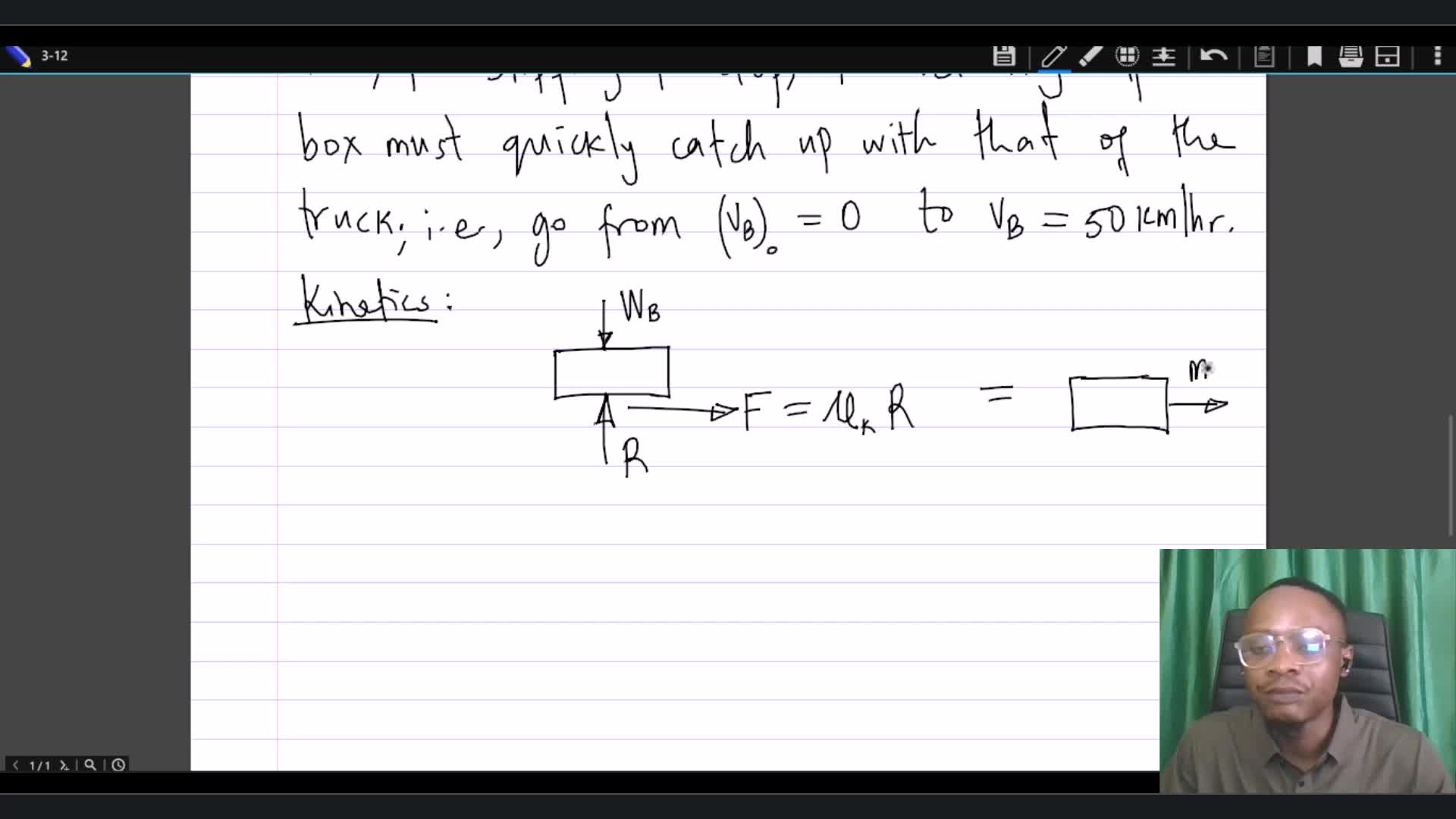
- Draw a Free-Body Diagram (FBD): You've done this in Statics. Identify and draw all external forces acting on the body of interest (e.g., weight, normal forces, friction, tensions).
- Draw a Kinetic (or Mass-Acceleration) Diagram: On the other side of an equals sign, draw the body with its acceleration vector, . This helps visualize the "effect" side of the equation.
- Choose a Coordinate System: Select the system (rectangular or n-t) that best aligns with the motion.
- Apply the Equations of Motion: Write the equations for each coordinate direction.
- Solve: Solve the resulting algebraic equations for the unknowns. You may need to use kinematic relationships from previous lessons if acceleration is not constant or if you need to find velocity or position.
2. Application in Rectangular Coordinates
Let's see this strategy in action for problems best suited to rectangular coordinates, such as blocks on flat or inclined surfaces and systems connected by pulleys. The video below provides excellent worked examples.
F=ma Rectangular Coordinates | Equations of motion | (Learn to Solve any Problem)
This video, from the Question Solutions channel, demonstrates how to apply the \sum F = ma equations in rectangular coordinates to a variety of common dynamics problems.
Watch the video from 01:41 to 07:54. The first example (starting at 01:41) deals with a crate on a horizontal surface, and is a great review of static vs. kinetic friction. The second example (starting at 05:28) involves a crate on an inclined plane, highlighting the importance of choosing a smart coordinate system.
As you saw in the video, a key step for inclined plane problems is to rotate your coordinate system. By aligning the x-axis with the incline and the y-axis perpendicular to it, the acceleration vector lies entirely along one axis (). This simplifies the equations of motion significantly, as the only force you need to resolve into components is the weight vector.
Test your understanding!
A 40 kg crate is placed on an inclined plane at an angle of 25°. A force N is applied parallel to the incline, pushing the crate up. The coefficient of kinetic friction between the crate and the plane is . What is the acceleration of the crate? (Use ).
Show answer
-
FBD and Coordinate System:
- Choose an x-axis pointing up the incline and a y-axis perpendicular to it.
- Forces in the y-direction: Normal force (positive y), and the y-component of weight (negative y).
- Forces in the x-direction: Applied force (positive x), the x-component of weight (negative x), and the friction force (negative x, opposing motion).
-
Calculate Forces:
- Weight: N.
- Weight components: N, N.
-
Apply Equations of Motion:
- Y-direction (): The crate does not accelerate off the plane.
- Now calculate the kinetic friction force:
- X-direction ():
- Y-direction (): The crate does not accelerate off the plane.
-
Solve for Acceleration:
Answer: The acceleration of the crate up the incline is .
3. Application in Normal-Tangential (n-t) Coordinates
Now, let's turn our attention to objects moving along curved paths. As we saw in the last lesson, the n-t coordinate system is perfectly suited for this. This is especially relevant to your aerospace goals, as it's the natural way to analyze forces during aircraft maneuvers.
Recall the equations of motion in n-t coordinates:
- : The net tangential force causes the particle to speed up or slow down.
- : The net normal force (centripetal force) causes the particle to change direction and stay on its curved path.
The following video shows how to apply this framework.
F = ma Normal and Tangential Coordinates | Equations of motion| (Learn to solve any question)
This video, also from Question Solutions, applies the F=ma principle in n-t coordinates. Pay attention to how the forces are resolved into components that are either tangential or normal to the path of motion.
Watch the video from the beginning to 05:51. The introduction (until 01:12) is a good recap. The first example (starting at 01:12) is a simple case of finding the maximum speed on a merry-go-round. The second example (starting at 02:53) is more involved, showing how to find forces on a car traveling along a mathematically defined curve.
A classic aerospace application of n-t coordinates is analyzing a "level, coordinated turn." In this maneuver, the pilot banks the aircraft so that the lift force not only supports the aircraft's weight but also provides the necessary centripetal force to make it turn.
Test your understanding! (Aerospace Application)
An F-16 fighter jet is performing a level, coordinated turn at a constant speed of m/s. The pilot banks the aircraft at an angle of to the horizontal. What is the radius of the turn, ? (Use ).
Hint: The lift force acts perpendicular to the wings. Resolve it into vertical and horizontal components.
Show answer
-
FBD and Coordinate System:
- Use a coordinate system where 'y' is vertical and 'n' (normal) is horizontal, pointing towards the center of the turn.
- Forces: Weight acts straight down. Lift acts at from the vertical axis.
-
Apply Equations of Motion:
- The speed is constant, so tangential acceleration is zero (). We only need to consider the normal and vertical directions.
- Vertical direction (): The aircraft is in a level turn, so there is no vertical acceleration.
- Normal direction (): The horizontal component of lift is the only force acting in the normal direction. It provides the centripetal force.
-
Solve for Radius ():
- Substitute the expression for from the vertical equation into the normal equation:
- The mass cancels out!
- Rearrange to solve for :
- Plug in the values:
- Substitute the expression for from the vertical equation into the normal equation:
Answer: The radius of the turn is approximately 3.7 km. This shows the immense radius required for high-speed turns. The pilot would be experiencing a G-force of Gs.
Conclusion
In this lesson, we made the pivotal step from describing motion to explaining it. By combining Newton's Second Law with our knowledge of kinematics, we can now solve for unknown forces or the resulting accelerations.
Key Takeaways:
- Newton's Second Law, , is the bridge between kinetics and kinematics.
- The key to solving kinetics problems is a systematic procedure: draw a Free-Body Diagram, choose an appropriate coordinate system, and write the component equations of motion.
- For rectilinear motion, use rectangular coordinates (, ). Aligning axes with the direction of acceleration is a crucial strategy.
- For curvilinear motion, normal-tangential coordinates are often superior (, ), as they directly relate forces to changes in speed and direction.
Next Lesson Preview:
While the method is powerful for finding forces and accelerations at a specific instant, it can be cumbersome for problems where you need to relate forces to changes in speed over a distance. In our next lesson, we will introduce an alternative approach derived from Newton's Second Law: the Work-Energy Principle. This method provides a powerful shortcut for solving problems involving forces, velocity, and displacement.
Can't find a good explanation? Sign up and we'll make it for you
Sign up