
Hello! Welcome to your final lesson on the dynamics of particles.
In the previous lesson, we explored the Principle of Work and Energy, which provides a powerful method for relating forces, displacement, and changes in speed. It's a scalar approach that shines when the distance over which a force acts is important. However, many situations, especially in aerospace, involve forces that act over a very short time—think of a landing gear absorbing the shock of touchdown, two objects colliding, or the firing of a thruster. For these scenarios, a different approach is more effective.
Today, we will introduce the Principle of Impulse and Momentum. This principle is derived directly from Newton's second law but is formulated to analyze the effects of forces acting over a time interval.
By the end of this lesson, you will be able to:
- Apply the impulse-momentum principle to analyze collisions and impacts between particles.
This involves understanding the concepts of impulse and momentum, the principle of their conservation, and a key parameter used to characterize collisions: the coefficient of restitution.
1. The Impulse-Momentum Principle
Let's start by defining our fundamental terms. Your background in physics will likely make these concepts familiar, but we will define them formally in the context of dynamics.
Linear Impulse and Momentum; Collisions
These notes from MIT OpenCourseWare provide a concise derivation of the principle. This aligns with your preference for a formula-based approach grounded in fundamental laws.
Read the first page of the document, covering the sections 'Linear Momentum' and 'Principle of Linear Impulse and Momentum'. Focus on how Newton's second law is rewritten in terms of momentum and then integrated over time.
As you just read, we can summarize the key ideas as follows:
-
Linear Momentum (): The momentum of a particle is the product of its mass and velocity . It is a vector quantity.
Newton's second law can be expressed as the time rate of change of momentum: . -
Linear Impulse (): Impulse is the effect of a force integrated over the time it is applied. It is also a vector quantity, pointing in the same direction as the force.
-
The Principle of Impulse and Momentum: By integrating Newton's second law with respect to time, we arrive at the principle, which states that the initial momentum of a particle plus the impulse applied to it equals its final momentum.
Or more simply:

This principle is extremely powerful for analyzing problems involving impulsive forces—large forces acting over a very short duration, like a bat hitting a ball.
2. Conservation of Linear Momentum in Collisions
The impulse-momentum principle becomes even more useful when we analyze a system of two or more interacting particles, such as during a collision.
Consider two particles, A and B, colliding. During the brief moment of impact, the force that A exerts on B is equal and opposite to the force B exerts on A (Newton's Third Law). These are internal forces to the system of (A+B). If we assume no other significant external forces (like gravity or friction) act on the system during the very short collision time, the net impulse on the system is zero.
This leads to the Principle of Conservation of Linear Momentum: If the net external impulse on a system of particles is zero, the total momentum of the system remains constant.
For a two-particle collision, this is expressed as:
This single equation is the foundation for analyzing all collisions. Let's see it in action.
Dynamics: Lesson 26 - Impulse and Momentum Collision Examples
In this video, Jeff Hanson analyzes a classic bullet-and-block problem. He first uses conservation of momentum to find the velocity immediately after the collision.
Watch the segment from 16:06 to 22:15. Notice how he sets up the conservation of momentum equation for the bullet-block system to solve for the block's initial velocity after the bullet passes through. The second part of his analysis (finding the stopping time) is a good review of the single-particle impulse-momentum principle.
3. Characterizing a Collision: The Coefficient of Restitution
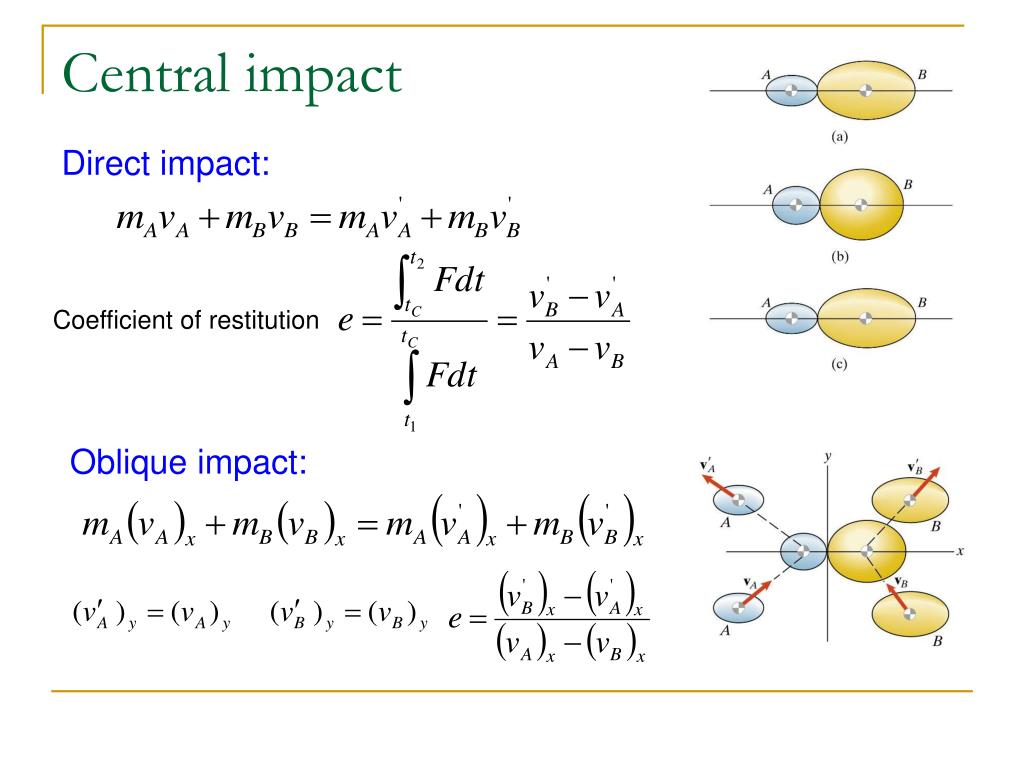
In the bullet-block example, we had enough information to solve the problem. However, in a typical collision where two objects bounce off each other, the conservation of momentum equation alone isn't enough. If two particles A and B collide, we have two unknowns (their final velocities, and ), but only one equation.
We need a second equation that describes the nature of the collision itself. This is provided by the coefficient of restitution ().
Impact: Coefficient of Restitution (learn to solve any problem)
This short clip from Question Solutions gives a clear, practical definition of the coefficient of restitution and the different types of impacts.
Watch the first 1 minute and 33 seconds. Pay attention to the definition of the 'line of impact' and the physical meaning of different values of 'e'.
To summarize:
- The line of impact is the line perpendicular to the surfaces at the point of contact.
- The coefficient of restitution () is the ratio of the relative separation velocity to the relative approach velocity, both measured along the line of impact.
where the subscript 'n' denotes the velocity component along the line of impact.
The value of tells us how "bouncy" the collision is:
- Perfectly Elastic Collision (): Kinetic energy is conserved. Think of ideal billiard balls.
- Inelastic Collision (): Some kinetic energy is lost to heat, sound, and deformation. This is the most common type of collision.
- Perfectly Inelastic Collision (): The particles stick together after impact (). This corresponds to the maximum possible loss of kinetic energy.
4. Solving Impact Problems
With our two main tools—conservation of momentum and the coefficient of restitution—we can now solve impact problems. We'll look at two cases.
A. Direct Central Impact (1D)
This is the simplest case, where the motion of both particles is along the line of impact before and after the collision.
Problem-Solving Strategy:
- Set up the conservation of momentum equation in one dimension.
- Set up the coefficient of restitution equation.
- Solve the two simultaneous equations for the two unknown final velocities.
Let's see a worked example.
Impact: Coefficient of Restitution (learn to solve any problem)
The video from Question Solutions now demonstrates how to solve a standard direct impact problem.
Watch from 01:33 to 02:41. Notice how the two equations are set up and solved systematically.
Test your understanding!
A 10 kg ball (A) moving to the right at 5 m/s strikes a 2 kg ball (B) that is at rest. The collision is head-on. If the coefficient of restitution is , find the velocities of both balls after the impact.
Show answer
Let the positive direction be to the right.
Given:
- kg, m/s
- kg, m/s
1. Conservation of Momentum:
2. Coefficient of Restitution:
3. Solve the System:
From Eq. 2, we have . Substitute this into Eq. 1:
Now find :
Answer: After the collision, ball A moves to the right at 3.5 m/s, and ball B moves to the right at 7.5 m/s.
B. Oblique Impact (2D)
This is a more general case where the initial velocities are not aligned with the line of impact. Aerospace applications like docking or planetary fly-bys often involve oblique impacts.
Problem-Solving Strategy:
- Define a coordinate system with the n-axis (normal) along the line of impact and the t-axis (tangential) perpendicular to it.
- Resolve the initial velocity vectors of both particles into n and t components.
- Along the n-axis: Treat it as a 1D impact problem. Apply both the conservation of momentum and coefficient of restitution equations to the n-components of velocity.
- Along the t-axis: Assuming the surfaces are smooth (no friction during impact), there is no impulse in the tangential direction. Therefore, the tangential component of momentum for each particle is conserved.
- Solve for the final velocity components (, , , ).
- Combine the final components to find the magnitude and direction of the final velocities.
The following video shows this process for a ball hitting a fixed surface.
Impact: Coefficient of Restitution (learn to solve any problem)
This final example from Question Solutions deals with an oblique impact. Although it's a ball hitting a stationary table, the principle of resolving velocities into components along and perpendicular to the line of impact is the same.
Watch from 04:44 to 06:50. Focus on how the problem is broken down into two separate impacts and how, for each impact, the velocity component tangential to the impact surface remains unchanged while the normal component is modified by the coefficient of restitution.
Conclusion
This lesson completes our study of particle dynamics by introducing the impulse-momentum principle. Where the work-energy method relates force and distance, the impulse-momentum method relates force and time.
Key Takeaways:
- The Impulse-Momentum Principle () is the fundamental tool for analyzing forces applied over a time interval.
- For systems with zero net external impulse, such as during a collision, total momentum is conserved.
- Collisions are characterized by the coefficient of restitution (), which relates the relative velocities of separation and approach along the line of impact.
- Impact problems are solved by applying conservation of momentum and the coefficient of restitution equation. For oblique impacts, this is done by resolving velocities into components normal and tangential to the line of impact.
Next Lesson Preview:
We have now covered the essentials of particle dynamics. However, most real-world objects in engineering—from gears to aircraft—are not particles; they are rigid bodies that can both translate and rotate.
In the next module, we will begin our study of the Planar Kinematics of Rigid Bodies. Our first lesson will focus on relating the angular motion (like angular velocity, ) of a body to the linear motion (velocity, ) of points on that body, starting with the case of fixed-axis rotation. This is the first step toward analyzing the complex motion of aerospace structures and mechanisms.
Can't find a good explanation? Sign up and we'll make it for you
Sign up