Introduction
Hello again! In our last lesson, we focused on verifying a single, promising sacrificial line by calculating it to a clear conclusion. This is a crucial skill for executing winning attacks. However, chess often presents us with several good-looking options. How do you decide which one is truly the best, especially under the pressure of the clock?
This is where today's lesson comes in. We will focus on a powerful decision-making tool: the elimination method. Our goal is to learn how to apply the elimination method to narrow down the best move in complex tactical positions.
Instead of trying to prove one move is the absolute best—which can be incredibly difficult—it's often much easier and more practical to find flaws in the other candidate moves and discard them. The move that survives this process of elimination is usually your strongest choice. This systematic approach is fantastic for improving your decision-making accuracy and avoiding blunders, moving you closer to that 1500 ELO goal.
The Core Idea: Eliminate to Illuminate
In our previous lessons, we built a process for evaluating moves based on Checks, Captures, and Threats (CCT). This helps us generate a list of candidate moves. The elimination method is the next logical step: how to filter that list.
The key insight is psychological and practical: finding a clear flaw in a variation is often faster and more certain than proving a long, complex line leads to a win.
Let's watch a short video that explains this core concept very clearly.
How to Find the Best Move EVERY Time-Chess Calculation Guide
The presenter in this video from ChesswithAkeem gives a concise explanation of the elimination method. Pay attention to his advice on how to approach a position with many candidate moves.
Watch from 20:46 to 22:01. The key takeaway is when he says, 'It's not about seeing the candidate move and trying to choose which one... is better. It's actually the opposite. It's about eliminating the candidate move that you don't like.'
This brings us to a simple, four-step mental process:
- Generate Candidates: Use the CCT method to list the most forcing and active moves.
- Quick Scan: Briefly look at each candidate. Does it have an obvious drawback? Does it hang a piece, walk into a check, or allow a simple counter-tactic?
- Eliminate: If you find a clear refutation or a significant downside, cross that move off your mental list.
- Deep Calculate: For the one or two moves that remain, perform the deeper, more focused calculation you've been practicing.
For a more formal look at this thinking tool, let's turn to a chapter from a book by Grandmaster Sipke Ernst and Karel van Delft.
Chapter 8: The Elimination Method
This PDF excerpt from the book 'Find Your Next Move' has a chapter dedicated to our topic. It provides examples of how a Grandmaster uses this method in practice.
Please find and read 'Chapter 8: The Elimination Method' in the PDF. It begins on page 56. Focus on the first example (Game 36) to see how Grandmaster Alexander Kotov used this principle to find a winning move.
A Formal System for Finding the Best Move
Your background in development gives you a great appreciation for structured processes and algorithms. Just as you'd write code with clear, sequential steps to avoid bugs, we can apply a similar system to our chess thinking to avoid blunders.
The following resource provides a detailed 8-step system that formalizes the entire process of threat assessment, candidate generation, and, crucially, elimination.
The System – Brief Description
This article, 'On Mastering Chess Tactics - Part 2', presents an 8-step thinking system designed to be followed consistently on every move. It's essentially an algorithm for safe and effective move selection.
Please read section 2, which outlines the 8 steps of the system. Pay close attention to steps 5 through 8, as they form the core of the candidate-test-eliminate loop.
Now, let's see this system in action. The most valuable part of an algorithm is seeing it applied to a real problem. The same article provides an excellent walkthrough.
The System in Action – Example 1
This next section provides a fantastic step-by-step example of the system at work in a common opening, the Cambridge Springs Defense. Notice how a 'natural' looking move is proven to be a blunder through this rigorous process.
Read through 'The System in Action – Example 1'. Follow the logic as the author evaluates the candidate move 7. Bd3. See how in Step 7 ('Conduct a post-reconnaissance'), a fatal flaw is discovered, leading to the move being eliminated in Step 8 and the better move Nfd2 being chosen.
This example perfectly demonstrates the power of elimination. The move Bd3 seems logical—it develops a piece and prepares to castle. However, the systematic check reveals it allows a double attack. By eliminating this flawed candidate, White avoids disaster and finds a solid, safe move.
Practice Arena: Your Turn to Eliminate
Let's apply this method to a new position. It is White to move.
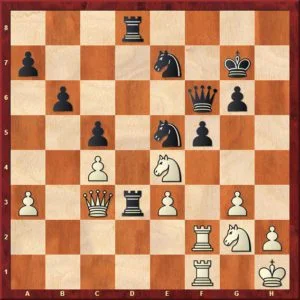
This position is complex. There's no immediate checkmate. This is exactly the kind of situation where a structured thinking process shines. Let's walk through it.
Step 1 & 2: Reconnaissance & Threats
The position is balanced. Black's pieces are well-developed. There are no immediate, overwhelming threats from Black that we must deal with. This means we have time to formulate our own plan.
Step 5: Search for Candidate Moves
Let's generate a few logical candidates for White:
- Candidate A:
e4— An ambitious pawn break in the center. It challenges Black's control and aims to open lines for our pieces. It's a very forcing and tactical option. - Candidate B:
Ne5— A classic positional move. It places a knight on a strong central square, putting pressure on Black's position and restricting their pieces. - Candidate C:
Qc2— A flexible, improving move. It moves the queen to a safer, more useful square, prepares to support thee4push, and connects the rooks.
Step 6, 7 & 8: Execute, Reconnaissance, and Eliminate
Let's put each candidate to the test, looking for drawbacks.
-
Testing
e4: This is the most complex. A likely sequence is1. e4 dxe4 2. Nxe4 Nxe4 3. Qxe4. In this resulting position, Black can play3...f5, kicking our queen and seizing space. The position becomes very sharp and hard to calculate. While perhaps not a blunder, it leads to complications that might not be favorable. Verdict: Risky. Let's see if there's a safer option. -
Testing
Ne5: After1. Ne5, Black will likely trade knights:1...Nxe5 2. dxe5. Now Black has a choice, for instance2...Bxe5 3. Bxe5 dxe5. The position simplifies significantly. White is fine, but we've allowed Black to resolve the central tension easily. Verdict: Solid, but might let the opponent off the hook too easily. -
Testing
Qc2: After1. Qc2, what has changed? White's position has improved without taking any risks. The queen is better placed. Thee4push is now better supported. We haven't created any weaknesses. Black has no simple, forcing reply. The move is strong and flexible. Verdict: No clear drawback. It improves our position and keeps all our options open.
Decision:
We eliminated e4 as potentially too risky and Ne5 as possibly letting Black equalize too simply. The move Qc2 survives the elimination process. It is a safe, strong, and practical choice that improves our position with minimal downside. This is a hallmark of strong play: making steady improvements while avoiding unnecessary risks. (For what it's worth, Qc2 is one of the top engine recommendations in this position).
Conclusion
Today you've added a critical tool to your mental toolkit for chess improvement. By systematically eliminating flawed moves, you can navigate complex positions with greater confidence and accuracy.
Key Takeaways:
- Simplify by Eliminating: In complex positions with multiple options, focus on finding reasons to discard moves rather than trying to prove one is perfect.
- Structure Your Thinking: Use a consistent process like the 8-step system (Reconnaissance -> Threats -> Rank -> Focus -> Candidates -> Test -> Post-Recon -> Eliminate/Repeat) to ensure you don't miss anything.
- Practicality over Perfection: The goal is to find a safe, strong move that improves your position. The "best" move is often the one that poses problems for the opponent without creating unnecessary risks for yourself.
Preview of the Next Lesson:
We have now spent a whole module honing your core calculation skills—calculating single lines (sacrifices) and choosing between multiple lines (elimination). Now, it's time to apply these abilities to a core strategic concept. In our next lesson, we will begin the "Principles of Attack" module by learning how to identify the conditions for launching a successful kingside attack based on piece placement and pawn structure.