
Hello! Welcome to the final lesson in our module on "Advanced Concurrency & Performance."
In our last session, we explored advanced caching patterns like write-through and write-behind, along with crucial eviction policies. We established that a single cache layer, even a powerful distributed one like Redis, has inherent trade-offs, particularly around network latency for every request. For the high-traffic, low-latency systems you'd build at a FAANG or top fintech company, we can do better.
Today, we will address that by designing a system that uses multiple layers of caching. This is a very common topic in system design interviews for mid-to-senior roles, as it demonstrates your ability to make nuanced architectural decisions to optimize performance at scale.
Our learning outcome is to design a multi-level caching strategy for a high-traffic, read-heavy service. We will cover the rationale, a standard architectural blueprint, and how you can implement a key part of it in a Spring Boot application.
Why One Layer Isn't Always Enough
Let's quickly review the two main types of caching locations we've discussed:
-
In-Process Cache (e.g., Caffeine):
- Pros: Extremely fast, as it lives in the application's own memory (RAM). No network calls are needed.
- Cons: Data is siloed. Each instance of your microservice has its own separate cache. An update in one instance isn't reflected in others, leading to inconsistency. The cache size is also limited by the application's heap memory.
-
Distributed Cache (e.g., Redis):
- Pros: Provides a large, shared cache accessible by all service instances, ensuring data consistency across the cluster.
- Cons: Every cache access requires a network round-trip, which is orders of magnitude slower than an in-memory read.
A multi-level strategy aims to get the best of both worlds by combining these layers. The fundamental principle is to place caches at different points between the user and the data source, serving requests from the fastest, closest cache possible.
To see how this works in practice, let's watch a short clip illustrating a multi-layered approach for an e-commerce site.
REST API Caching Strategies Every Developer Must Know
In this segment from the video "REST API Caching Strategies Every Developer Must Know" by ByteMonk, you'll see a clear, step-by-step example of a request flowing through multiple cache layers.
Watch the clip from 09:35 to 11:25. Pay attention to the order of layers the request travels through (Browser -> CDN -> Application Cache -> Database) and how each layer serves a specific purpose.
Designing a Multi-Level Caching Architecture
A common and effective blueprint for a high-traffic service involves three distinct layers. Think of these like the L1, L2, and L3 caches in a CPU, each offering a different balance of speed and size.
For a structured overview of these layers, let's turn to a well-written article on the topic.
System Design: Building Distributed Caching Strategies for ...
The article "System Design: Building Distributed Caching Strategies" by Ayush Mourya provides an excellent breakdown of a multi-layer caching architecture. We will focus on the section that defines the layers.
Read the section "Multi-Layer Caching Architecture" (from the beginning of the section down to, but not including, "Smart Cache Invalidation Strategies"). Focus on the stated purpose, technology, and use case for each of the three layers (L1, L2, and L3).
Let's summarize and expand on those layers:
Layer 1: In-Process Cache (L1)
This is the fastest cache, living inside each microservice instance. Its goal is to serve repeated requests for the same data from the same instance with near-zero latency.
- Purpose: Ultra-fast, low-latency access.
- Technology: In-memory libraries like Caffeine or Guava Cache.
- Characteristics:
- Access is measured in nanoseconds.
- Data is not shared between service instances.
- Size is limited by the application's heap.
- Typical Use Cases: Caching frequently accessed, rarely changing data like application configuration, user permissions/roles, or metadata for a "hot" item that a single user is interacting with repeatedly.
Layer 2: Shared Distributed Cache (L2)
This is the workhorse layer, providing a unified cache for your entire application cluster. When L1 misses, the application checks L2.
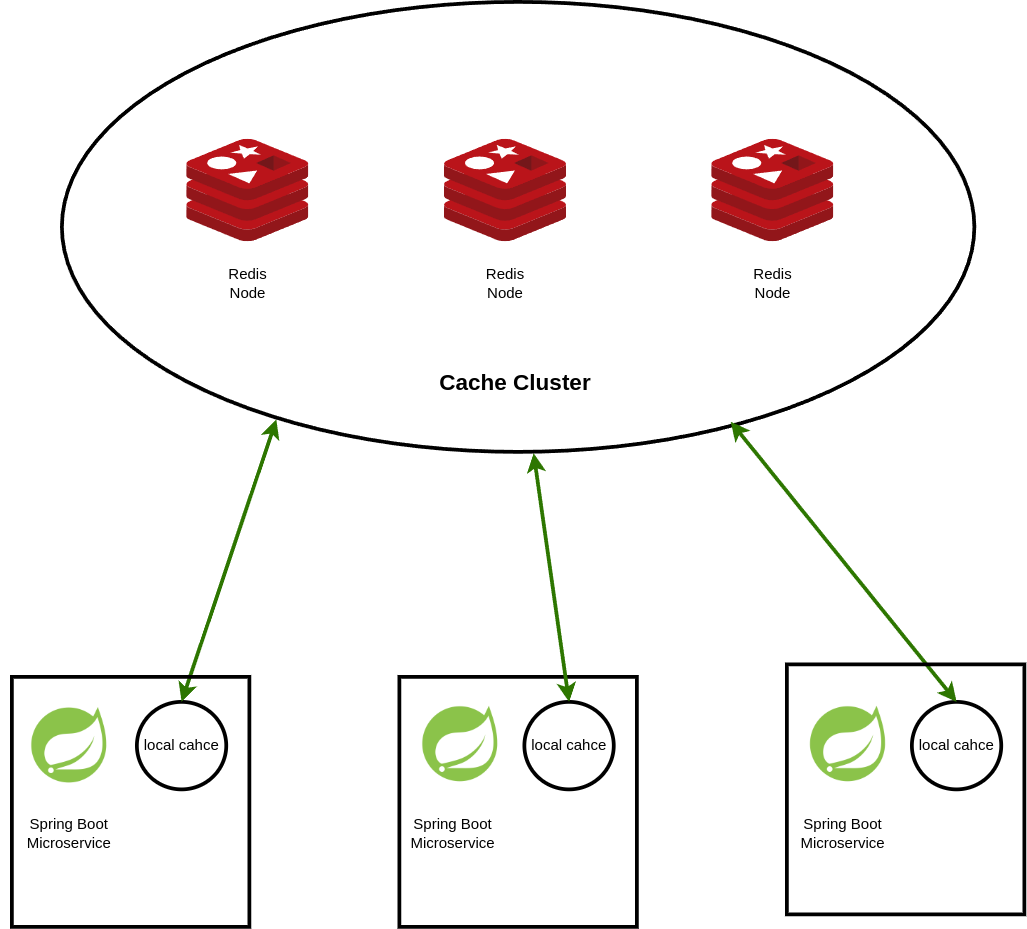
- Purpose: A consistent, shared cache for all application instances.
- Technology: A dedicated caching service like Redis or Memcached.
- Characteristics:
- Access is slower due to the network hop (typically <10ms).
- Can store a much larger volume of data.
- Acts as a single source of truth for cached data across the service.
- Typical Use Cases: Caching results of expensive database queries, pre-computed API responses, or user session data.
Layer 3: CDN / Edge Cache (L3)
This layer sits at the edge of the network, geographically close to your users. Its goal is to reduce network latency caused by physical distance.
- Purpose: Serve content to users from a location near them, reducing round-trip time.
- Technology: Content Delivery Networks like AWS CloudFront, Cloudflare, or Akamai.
- Characteristics:
- Drastically reduces latency for global users.
- Offloads a massive amount of traffic from your origin servers.
- Typical Use Cases:
- Static Assets: Images, videos, CSS, and JavaScript files.
- Public API Responses: Caching API responses that are not user-specific (e.g., a list of public products).
The following video provides an excellent summary of these cache locations and their trade-offs, which will help solidify your understanding.
Caching in System Design Interviews w/ Meta Staff Engineer
Let's revisit the "Caching in System Design Interviews" video. The speaker, a Meta Staff Engineer, provides a clear breakdown of where caching can live in your system.
Watch from 01:53 to 07:59. This covers external caching (our L2), in-process caching (our L1), CDNs (our L3), and client-side caching. Focus on the trade-offs he highlights for each location.
Test your understanding!
You are designing the caching strategy for a high-traffic e-commerce platform. For each of the following data types, which cache layer(s) (L1, L2, L3) would be most appropriate and why?
- The product image for a popular new sneaker.
- The contents of a user's shopping cart.
- The user's shipping address, which is displayed on every page of the checkout flow.
Show answer
-
Product Image: L3 (CDN) is the primary choice. The image is static content requested by users globally. Caching it on a CDN minimizes latency and offloads traffic from your application servers. The browser's cache (a form of client-side cache) would also be used.
-
Shopping Cart Contents: L2 (Distributed Cache) is the best fit. A user's shopping cart must be consistent across devices and sessions. It cannot be stored in an L1 cache, as the user might be load-balanced to a different service instance. It's user-specific, so an L3 CDN is not appropriate.
-
User's Shipping Address: This is a perfect candidate for a hybrid L1/L2 strategy. During the checkout flow, the same address is likely requested many times in quick succession by the same service instance.
- It should be stored in the L2 cache to be accessible across the cluster.
- When first fetched for the checkout flow, it should also be populated into the L1 cache of that specific instance. Subsequent requests from that instance will be served lightning-fast from L1, improving the responsiveness of the UI.
Implementation: A Hybrid L1/L2 Cache in Spring Boot
Let's get practical. The most common multi-level pattern you will implement as a service developer is the L1/L2 hybrid cache. This combines an in-process cache (Caffeine) with a distributed cache (Redis) and is highly effective for read-heavy microservices.
The key challenge is consistency: if an item is updated or removed, how do we ensure it's evicted from the L1 cache of all service instances? The solution involves using the distributed cache (Redis) as a messaging bus to broadcast invalidation events.
The following article provides a complete, production-ready implementation guide for this pattern in Spring Boot.
Hybrid Cache Strategy in Spring Boot: A Guide to Redisson ...
The article "Hybrid Cache Strategy in Spring Boot" on DEV.to provides a step-by-step guide to integrating Caffeine (L1) and Redisson (L2) for a powerful hybrid caching solution.
Read the article from the beginning through the "Conclusion." Pay close attention to the roles of the CacheResolver and the CacheEntryRemovedListener, as these are the key components that orchestrate the two layers and maintain consistency.
Key Implementation Takeaways
Here's the workflow from the article, which is crucial to understand for an interview:
-
Read Operation (
get):- The application first checks the L1 (Caffeine) cache. If it's a hit, data is returned instantly.
- If it's an L1 miss, the application checks the L2 (Redis) cache.
- If it's an L2 hit, the data is returned to the application and also written into the L1 cache for future requests.
- If it's an L2 miss, the application queries the database, then writes the result to both L2 and L1.
-
Write/Update Operation (
put):- The data is written to the L2 (Redis) cache.
- It is also written to the L1 (Caffeine) cache of the current instance.
-
Eviction/Invalidation (
evict):- A request is sent to L2 (Redis) to delete the key.
- Redis, via Redisson's features, publishes a message about the key removal.
- The
CacheEntryRemovedListenerin all service instances subscribes to these messages. - Upon receiving a removal message, each instance evicts that key from its own L1 (Caffeine) cache.
This final step is what solves the consistency problem of a simple in-process cache.
Conclusion
You have now designed a robust, multi-level caching strategy suitable for a high-traffic, read-heavy service. This approach moves beyond simple caching patterns and into the realm of advanced system architecture, which is exactly what interviewers for senior roles are looking for.
Key Takeaways:
- Multi-level caching combines different cache types (in-process, distributed, CDN) to optimize for both speed and scale.
- A common three-layer architecture consists of an L1 In-Process Cache (for speed), an L2 Distributed Cache (for consistency and shared state), and an L3 CDN (for geographic latency).
- The L1/L2 hybrid pattern is a powerful and practical implementation for microservices, but requires a mechanism (like a pub/sub listener) to synchronize invalidations and maintain consistency.
- In a design interview, you should be able to justify which layer is appropriate for which type of data and explain how you would handle challenges like data consistency.
Next Up
We have concluded our deep dive into advanced performance patterns. We will now shift our focus to another critical pillar of microservices architecture: security. In the next lesson, we will begin Module 6 by exploring the foundational framework for modern authentication and authorization: "Explain the OAuth 2.0 framework, including roles (Resource Owner, Client, etc.) and common grant types."
Can't find a good explanation? Sign up and we'll make it for you
Sign up