
Hello again! Welcome to our second lesson.
In our last session, we witnessed the violent birth of a new city, Santa Fe de Bogotá, founded by Gonzalo Jiménez de Quesada on the ashes of the Muisca world. We ended by framing the next step as an analysis of the "user interface" of this new colonial city.
Today, we will do exactly that. Our learning goal is to deconstruct the visual and social design of colonial Bogotá by analyzing the Spanish grid plan, Plaza de Bolívar, and the role of religious institutions.
Think of this as a deep dive into the UX of power. The Spanish weren't just building settlements; they were designing systems of control. The physical layout of their cities was a primary tool for imposing a new social, political, and religious order. For you, as a designer, this is a fascinating historical case study in how physical space can be engineered to shape human behavior and reinforce a rigid hierarchy.
The Blueprint for an Empire: The Laws of the Indies
Unlike the often organic, sprawling growth of European cities, the Spanish colonial project was remarkably systematic. When you look at the historic centers of cities from Bogotá to Santiago to Mexico City, you see a repeating pattern. This wasn't a coincidence; it was by design, mandated by a comprehensive rulebook for colonization.
To understand this blueprint, let's explore the "Laws of the Indies," the design system for the Spanish-American city.
How conquistadors designed cities in the Americas
The YouTube channel City Beautiful has an excellent video, 'How conquistadors designed cities in the Americas,' that explains the logic and key components of this standardized urban plan. It uses Bogotá as a prime example right from the start.
Please watch from the beginning to 05:27. As you watch, focus on answering two key design questions: The 'Why': Why did the Spanish Empire feel the need to create a standardized set of laws for building cities, rather than letting them develop organically? (See 01:03 - 03:42) The 'What': What were the core components of the prescribed design? Pay attention to the plaza, the street grid, and the placement of key buildings. (See 03:42 - 05:27)
As the video explains, the Laws of the Indies were a masterclass in efficiency and control. Facing the immense task of colonizing two continents, the Spanish Crown created a replicable template for its conquistadors.
This template had two core visual and functional elements:
- The Grid Plan (La Traza): A rectilinear grid of streets intersecting at right angles. This design was not just for neatness; it was for order, surveillance, and the rational division of property. It was a stark visual imposition of logic and control over the natural landscape.
- The Plaza Mayor (Main Square): At the heart of the grid was a central, open square. This was not simply a park; it was the city's central node, the focal point where all forms of power converged.
The laws dictated that the most important institutions of colonial life had to be built around this plaza, creating a powerful and inescapable visual statement of the new order. Let's look at how this played out in Bogotá's main square.
The Heart of Power: Deconstructing the Plaza de Bolívar
Bogotá's Plaza Mayor (today known as Plaza de Bolívar) was the symbolic and literal center of the New Kingdom of Granada. Its design was a physical manifestation of the colonial power structure.
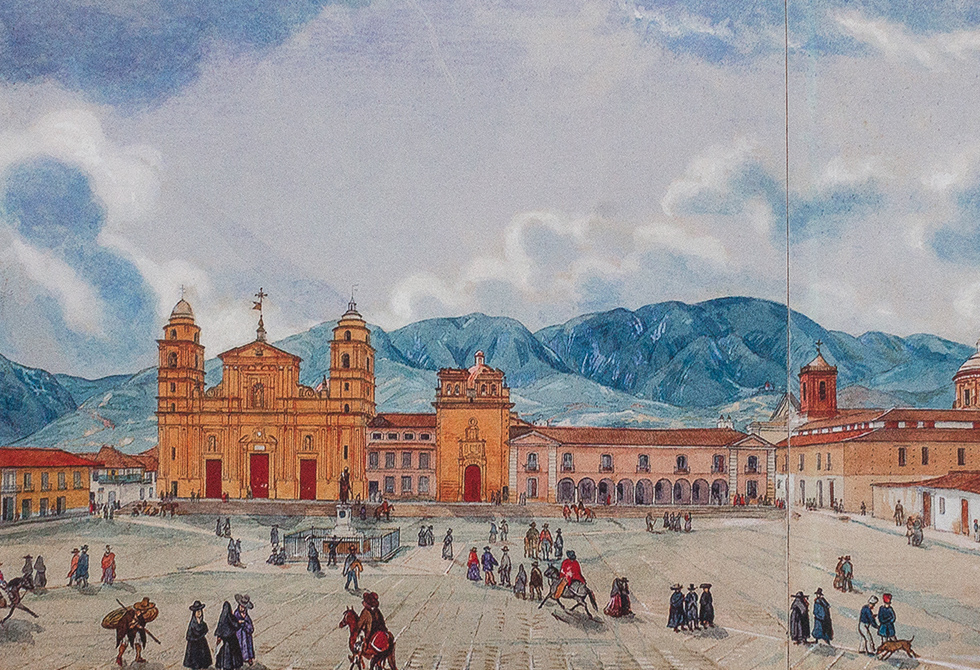
The article below describes the function of this central square and the key institutions that surrounded it.
Colonial Cities of Latin America
The article 'Colonial Cities of Latin America' from Highbury Nomad provides an excellent analysis of how the Plaza Mayor was used as a deliberate symbol of imperial dominance.
Please read the first three paragraphs of the article, and then the section below that begins 'Many major Latin American metropolises...'. Focus on how the plaza brought together political, religious, and military power, and note the role of religious orders as 'engines of assimilation'.
As the article highlights, the plaza was a "showcase" for power. In Santa Fe de Bogotá, this was explicitly clear in its architecture. While many of the original colonial buildings have been replaced, their modern successors stand in the same locations, preserving the original logic of the space.
Let's break down the plaza's design by the types of power it projected:
1. Religious Power: The Church and Its Influence
The eastern side of the plaza was dedicated to the Catholic Church.
Plaza de Bolívar Bogotá: History, Landmarks, and What to ...
To understand the specific buildings, let's turn to the 'Plaza de Bolívar Bogotá' travel guide. While it describes the modern buildings, it gives us clear insight into the historical importance of their locations.
Please read the sections describing the Catedral Primada de Colombia and the adjacent Capilla del Sagrario. Also, read the section that begins 'From a historical perspective...'. Notice how the article explicitly confirms that the layout followed the 'Spanish colonial tradition'.
The Catedral Primada de Colombia and the Capilla del Sagrario physically dominated one entire side of the square. This was intentional. The Church was the primary institution for social control and cultural assimilation.
- Social Control: The church bells dictated the rhythm of daily life—when to wake, pray, and rest.
- Cultural Assimilation: Religious orders like the Franciscans, Dominicans, and Jesuits ran schools and missions, working to convert the indigenous population and instill Spanish Catholic values. As the Highbury Nomad article puts it, they were "engines of assimilation." Their presence was woven into the urban fabric, with churches and convents clustered near the center.
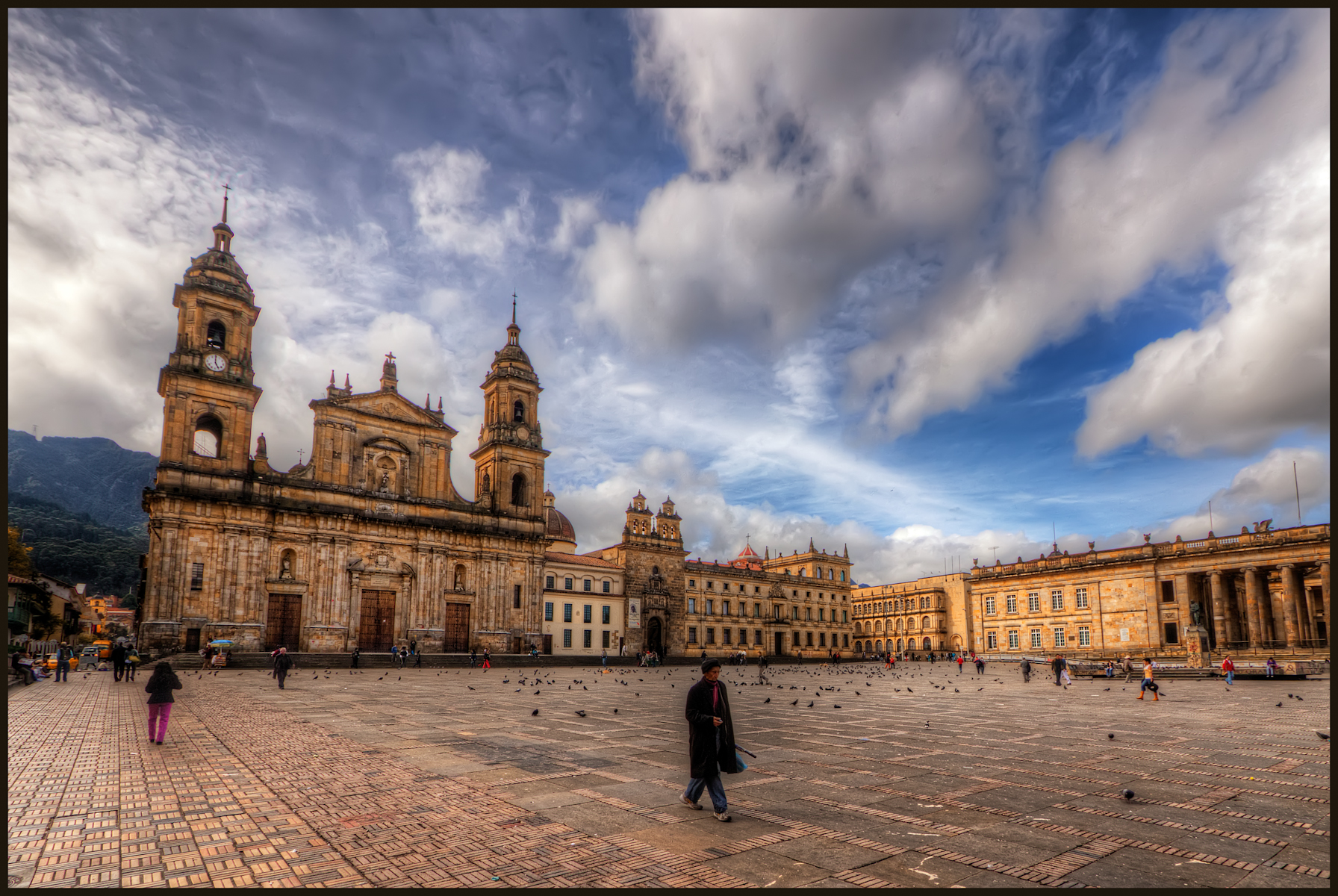
2. Political and Judicial Power
The other sides of the plaza were reserved for the colonial administration.
- The Royal Audience (Real Audiencia), which held judicial and executive power, was located on the northern side, where the Palace of Justice stands today.
- The Cabildo (Town Hall), the seat of local municipal government, occupied the western side, where the Palacio Liévano (City Hall) is now.
- The residence of the Viceroy, the King's representative, was on the southern side, later replaced by the National Capitol.
This arrangement meant that anyone standing in the plaza was physically surrounded by the institutions of colonial rule. There was no escaping the presence of the Crown and the Church.
Test your understanding!
From a user experience perspective, what message does the layout of the Plaza Mayor send to an inhabitant of the colonial city? How does it communicate the "information architecture" of the society?
Show answer
The layout communicates a clear and rigid hierarchy. The "main navigation" of society is laid out for you: God (the Cathedral) and the King (the government buildings) are the most important, centrally located, and visually dominant elements. All other aspects of life—commerce, residence, social activity—are secondary and radiate outwards from this central hub of power. It's an interface designed for orientation towards authority, not for exploration or decentralized interaction.
The Social Grid: From Urban Plan to Social Hierarchy
The visual design of colonial Bogotá was a direct reflection of its social design. The grid plan and the central plaza were tools to organize not just streets, but people.
Proximity to power equaled social status.
- The Center: The most prestigious lots, right on or near the Plaza Mayor, were granted to the most powerful and wealthy Spanish officials, clergy, and encomenderos (holders of land grants with rights to indigenous labor). Their large, ornate houses with internal courtyards reflected their status.
- The Intermediate Zone: Moving a few blocks out, you would find the homes of lesser merchants, artisans, and Spanish-born citizens of lower rank.
- The Periphery: The outer edges of the grid were reserved for the lower classes. This is where the majority of the indigenous and mestizo (mixed-race) population lived, often in more modest dwellings. Enslaved Africans were typically housed within the properties of their owners, closer to the center, but in service quarters completely separated from the main living areas.
This spatial segregation made the social hierarchy visible and tangible. Where you lived literally defined who you were in the colonial system. The grid was a mechanism for sorting society and keeping everyone in their designated place.
Conclusion
In this lesson, we have deconstructed the intentional design behind colonial Bogotá. We've moved beyond seeing a collection of old buildings and instead analyzed it as a complete system designed to impose and maintain order.
Here are the key takeaways:
- A Standardized Blueprint: Spanish colonial cities were not accidental. They were built according to the Laws of the Indies, a design system that prioritized control, order, and replicability across an empire.
- The Power of the Plaza: The Plaza Mayor (today's Plaza de Bolívar) was the heart of the system, a central node where religious power (the Cathedral) and political power (the Cabildo, Royal Audience) were concentrated and put on display.
- A City Designed for Hierarchy: The grid plan and the allocation of land based on proximity to the plaza created a physical manifestation of the rigid colonial social hierarchy. Your place in society was reflected by your place in the city.
We have now seen how the Spanish designed the physical "container" for their new society. In our next lesson, we will fill that container by visualizing the rigid social hierarchy of colonial Bogotá using a diagram. We will then explore the tensions this rigid system created, setting the stage for the dramatic events of the independence movement.
Can't find a good explanation? Sign up and we'll make it for you
Sign up