
Hello. In the previous lesson, you separated three kinds of brevity: laconic language withholds, terse language has a clipped edge, and succinct language preserves the essentials efficiently.
This lesson makes a similar distinction among words for unclear language. Equivocal, ambiguous, and enigmatic may all describe something difficult to interpret, but they locate the difficulty in different places: in a speaker’s noncommittal stance, in a phrase with multiple possible meanings, or in a puzzling mystery. By the end, you should be able to use each word precisely in literary analysis and workplace communication.
Three different kinds of uncertainty
Begin with the question each word answers.
| Word | Central question | Core meaning | Typical setting |
|---|---|---|---|
| ambiguous | “Which of these meanings is intended?” | Capable of more than one interpretation | A sentence, policy, instruction, headline, gesture |
| equivocal | “What position is the speaker actually taking?” | Deliberately or noticeably noncommittal; open to different interpretations in a way that evades clarity | A reply, statement, promise, public comment |
| enigmatic | “Why does this remain so puzzling?” | Mysterious, baffling, or resistant to explanation | A person, motive, image, event, remark, literary text |
The important distinction is not simply whether meaning is unclear. It is why it is unclear.
- An ambiguous sentence can be read in two or more ways.
- An equivocal response avoids giving a firm answer, often because the speaker does not want to commit.
- An enigmatic remark may not offer several neat interpretations at all. Instead, it feels mysterious, suggestive, and difficult to resolve.
AMBIGUOUS Definition & Meaning | Dictionary.com
Read Dictionary.com’s comparison of ambiguous, equivocal, and enigmatic. It gives a compact account of the distinctions that will organize the rest of this lesson.
In the “Synonym Usage” section, read the full comparison. Focus especially on the contrast between accidental multiple meanings, deliberate evasion, and puzzlement arising from mystery or significance. Then continue to the “Explanation” section. Read the headline example, noticing how a sentence can produce two distinct grammatical readings.
Ambiguous: language with competing interpretations
Ambiguous is pronounced roughly am-BIG-yoo-us. Use it when the wording itself permits more than one plausible meaning.
Consider this sentence:
The manager told the analyst that she would present the findings.
Who will present: the manager or the analyst? The pronoun she can refer to either person. The sentence is ambiguous because its structure does not settle the question.
This kind of ambiguity is especially important in professional writing. A vague sentence merely lacks detail; an ambiguous sentence actively allows distinct readings. That difference matters.
Compare:
-
“We will revisit the issue soon.”
This is vague: soon is not specific. -
“We will meet the client with the revised budget.”
This can be ambiguous: does with the revised budget describe the meeting, or the client? -
“We will meet the client on Tuesday and present the revised budget.”
This is clearer and more unambiguous.
Ambiguity often arises from a few recurring sources:
-
Unclear pronoun reference
“When Jordan spoke to Morgan, they seemed frustrated.”
Who seemed frustrated? -
Misplaced or loosely attached modifiers
“We discussed the proposal with the regional office.”
Did the discussion happen at the regional office, or did the regional office participate? -
Uncertain word scope
“Employees may not access confidential files without approval.”
Does without approval modify all access, or only some kinds of access? -
Compressed headlines or labels
“Squad helps dog bite victim.”
Is the victim a person bitten by a dog, or is the squad helping a dog bite someone?
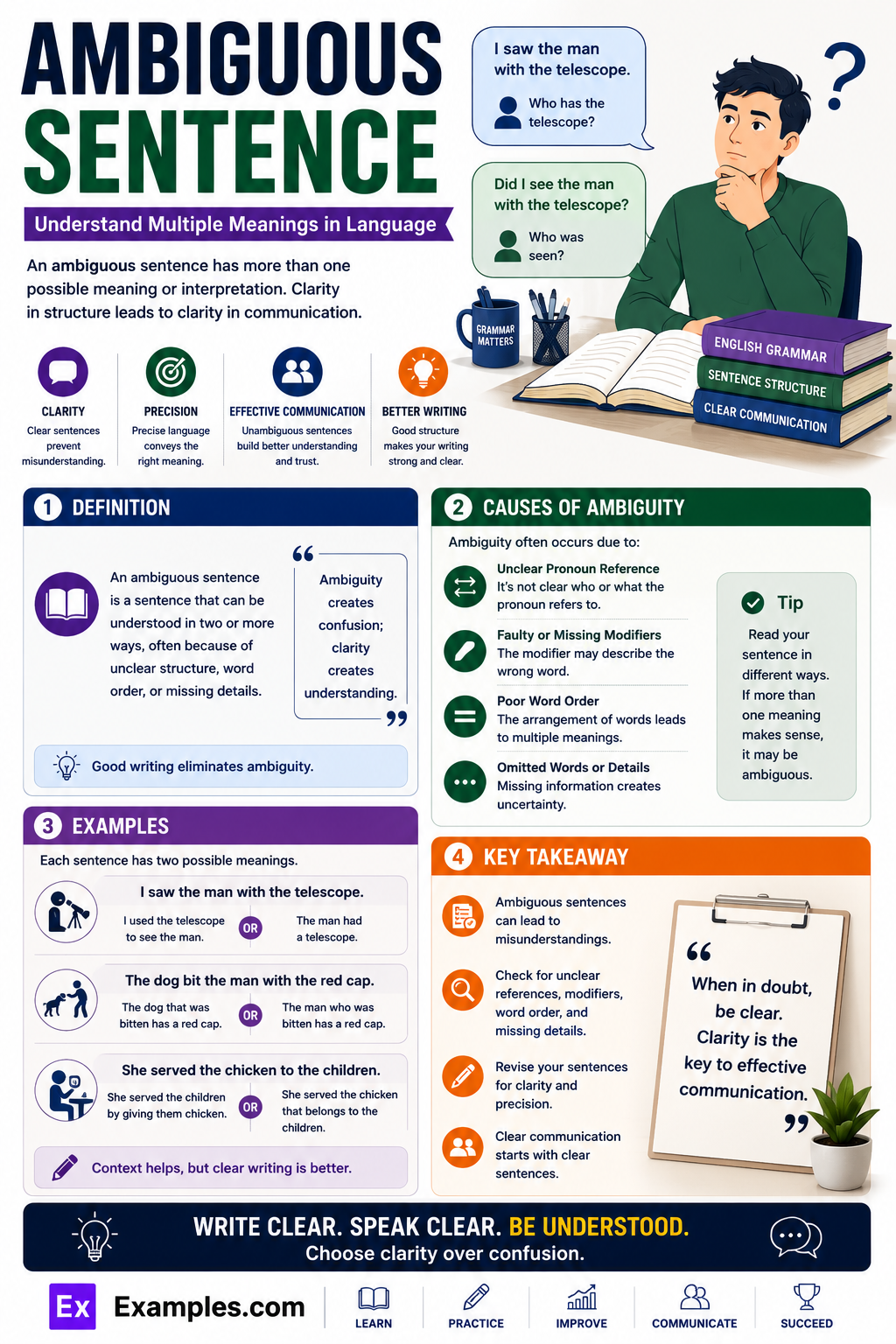
In literary writing, ambiguity is not always a defect. A poet may deliberately make an image ambiguous so that it can sustain several meanings. In a contract, safety instruction, project brief, or performance review, however, ambiguity is usually a problem because readers may act on different interpretations.
A useful sentence for analysis is:
The novel’s ambiguous ending permits both a literal and a symbolic reading.
Here, ambiguous does not accuse the author of evasion. It identifies a feature of the text: more than one interpretation is genuinely available.
Equivocal: language that avoids commitment
Equivocal is pronounced roughly ih-KWIV-uh-kul. It is more charged than ambiguous. An equivocal statement may technically allow several interpretations, but the emphasis falls on the speaker’s failure to take a clear position.
Imagine this exchange:
Question: “Can you confirm that the deadline will move?”
Reply: “We are actively evaluating the timeline.”
The reply may sound polished, but it does not answer the question. It neither confirms nor denies a change. If the speaker has enough information to be direct and is avoiding a commitment, the reply is equivocal.
The word often carries a mild criticism. It suggests that the ambiguity may be strategic: the speaker wants room to retreat later, deny an implication, or avoid a difficult truth.
EQUIVOCAL Definition & Meaning
Merriam-Webster’s entry on equivocal clarifies why the word can imply evasiveness and contrasts it directly with ambiguous and enigmatic.
In the “Did you know?” section, read the usage note. Pay attention to the contrast with unequivocal and the warning that equivocal wording can allow a speaker to avoid a firm position. Then read the entries for enigmatic, ambiguous, and equivocal in the “Synonyms of equivocal” section, beginning with these distinctions. Notice that the entry treats intention to deceive or evade as the distinctive feature of equivocal language.
Consider the difference in emphasis:
“The policy statement was ambiguous.”
This means readers could reasonably interpret the policy in multiple ways. You are diagnosing a problem in the wording.
“The spokesperson’s answer was equivocal.”
This means the spokesperson did not clearly state a position. You are diagnosing a problem in the response, and perhaps implying that the lack of clarity served a purpose.
That implication must be used responsibly. Not every incomplete answer is equivocal in the strongest sense. Someone may be unable to answer because the facts are genuinely unsettled. Before calling language equivocal, look for context: Was the person asked a direct question? Did they substitute generalities for a yes-or-no answer? Did they avoid committing despite having an apparent reason to do so?
These examples show appropriate use:
- “The executive gave an equivocal assurance that staffing levels would be ‘reviewed.’”
- “Her equivocal reply left the committee unsure whether she supported the proposal.”
- “The witness was equivocal when asked whether he had seen the document.”
- “The author’s equivocal treatment of the narrator’s guilt prevents a final moral judgment.”
In that last literary example, equivocal suggests that the author refuses to make the narrator’s status definite. It is stronger than saying the treatment is merely unclear.
The helpful opposites
Remember the opposites as well:
-
Unambiguous means allowing only one reasonable interpretation.
“The revised instruction was unambiguous: submit one file by 5 p.m.” -
Unequivocal means leaving no doubt about a position, judgment, or commitment.
“The director gave unequivocal approval.”
A policy can be unambiguous in wording, while a leader can be unequivocal in stance. In practice, clear professional communication often needs both.
Enigmatic: mystery rather than mere confusion
Enigmatic is pronounced roughly en-ig-MAT-ik. It describes something puzzling in a way that feels mysterious, elusive, or possibly significant.
Consider this line:
“At dawn, the archive will remember what we forgot.”
The sentence is grammatically understandable. It is not necessarily ambiguous in the technical sense of having two competing grammatical readings. Yet its meaning is strange and difficult to pin down. What could it mean for an archive to remember? Is it a metaphor for history, institutional memory, guilt, or lost evidence?
The line is enigmatic.
An enigmatic statement frequently produces questions, but it does not necessarily conceal an answer on purpose. Its mystery may arise from symbolism, unusual imagery, incomplete knowledge, or the sense that it gestures toward a deeper significance.
Use enigmatic for:
- a character whose motives remain difficult to understand;
- a symbolic object in a novel;
- an event that seems to defy ordinary explanation;
- a cryptic-sounding utterance whose importance is unclear;
- a text that remains puzzling after serious interpretation.
Examples:
- “The stranger’s enigmatic smile makes the scene unsettling rather than merely unclear.”
- “The poem’s final image is enigmatic: vivid enough to matter, but resistant to paraphrase.”
- “Her refusal to explain the disappearance remained enigmatic for years.”
- “The CEO’s two-word message was enigmatic, though not necessarily evasive.”
That final example is worth pausing over. A message can be both brief and enigmatic, just as a character can be laconic and enigmatic. The first adjective identifies how little is said; the second identifies the mystery created by what is said.
Choosing precisely: diagnose the source of the difficulty
When you encounter unclear language, avoid reaching automatically for ambiguous. Instead, identify what is most distinctive.
| Situation | Best word | Why |
|---|---|---|
| An instruction can reasonably be carried out in two different ways. | Ambiguous | The wording supports competing interpretations. |
| A manager answers a direct question without revealing a position. | Equivocal | The response avoids commitment. |
| A novel’s closing scene feels strange, symbolic, and unresolved. | Enigmatic | The central quality is puzzling mystery. |
| A public statement has two readings because its author wants plausible deniability. | Equivocal, possibly also ambiguous | The wording may be ambiguous, but the speaker’s evasive purpose makes equivocal more pointed. |
| A confusing sentence has an unclear pronoun. | Ambiguous | The problem lies in referential uncertainty, not necessarily intent. |
The same piece of language can receive more than one description, but the word you choose tells your reader what to notice.
For example:
“I cannot rule out any future changes.”
If spoken in response to “Will you cut the budget?”, it may be equivocal because it avoids a firm commitment. It is not automatically enigmatic; the statement is not mysterious in a deep or puzzling way. Nor is it necessarily ambiguous in the grammatical sense. Its weakness is strategic noncommittal language.
By contrast:
“The door was open before anyone arrived.”
This may be ambiguous if the context leaves open several meaningful readings of before anyone arrived. But in a mystery novel, the broader event could also be enigmatic if no plausible explanation emerges.
A compact memory aid
Keep these three prompts available when reading or revising:
- Ambiguous: Which meaning is intended?
- Equivocal: What is the speaker avoiding saying?
- Enigmatic: Why does this remain mysterious?
For professional writing, the practical goal is usually to eliminate ambiguity and avoid sounding equivocal when a decision is required. In literary criticism, however, ambiguity and enigma can be purposeful artistic effects. Precision lies in describing the particular effect, rather than labeling every difficult passage “unclear.”
Key takeaways
Ambiguous language allows more than one plausible interpretation; the focus is on the wording and its competing meanings. Equivocal language avoids a definite position, often suggesting deliberate evasion or an unwillingness to commit. Enigmatic language, events, or people are puzzling and mysterious, often with an implication of hidden significance.
In the next module, you will shift from unclear language to character and motive, beginning with magnanimous, benevolent, and altruistic—three related terms for generosity that differ in what drives or expresses it.
Can't find a good explanation? Sign up and we'll make it for you
Sign up