
Hello, and welcome. This course will prepare you to analyse how technology companies define and communicate “ethical AI,” and to assess when that communication may function as responsibility signalling, legitimation, or potentially ethics-washing. We begin with a necessary foundation: corporate texts often use AI ethics, responsible AI, AI safety, AI governance, and legal compliance almost interchangeably. Analytically, they are related, but they do not mean the same thing.
By the end of this lesson, you should be able to read a corporate statement such as “we build safe, responsible, and compliant AI” and identify what kind of claim each word makes, what evidence would substantiate it, and what remains unaddressed.
Five related terms, five different questions
A useful starting principle for your future thesis is:
The label a company chooses is itself evidence about framing, but it is not evidence that the company has achieved what the label promises.
A company can call an AI system “ethical” without explaining whose values informed the judgment, what harms were considered, or who can challenge a harmful outcome. Conversely, a company may describe concrete safeguards without using the word ethics at all. Your task is therefore to separate vocabulary, substantive commitments, and operational evidence.
Here is a working distinction.
| Term | Central question | Typical level of claim | What a credible corporate claim would usually include |
|---|---|---|---|
| AI ethics | What ought this system and organization do? | Normative values and moral judgment | Values, affected stakeholders, reasoning about harms, rights, fairness, dignity, or acceptable uses |
| Responsible AI | How will the organization put values into practice across the AI lifecycle? | Organizational practice and commitment | Impact assessments, inclusive design, documentation, training, review processes, monitoring |
| AI safety | Could this system cause unacceptable harm, and how is that prevented or controlled? | System and deployment risk | Testing, evaluations, safeguards, incident reporting, human intervention, limits on use |
| AI governance | Who has authority, responsibility, oversight, and decision procedures? | Organizational structure and accountability | Policies, roles, escalation routes, inventories, audit, board oversight, lifecycle controls |
| Legal compliance | Does the system meet applicable binding requirements? | Legal status in a specified jurisdiction and context | Identified laws, documented obligations, controls, records, legal review, evidence of compliance |
These are overlapping analytical categories, not a simple hierarchy. For example, privacy may be:
- an ethical issue concerning autonomy and dignity;
- a responsible-AI commitment concerning data practices;
- a governance issue concerning policy, roles, and controls;
- and a legal-compliance issue where data-protection law applies.
The relevant question is not, “Which single category does privacy belong to?” It is: What is the company claiming about privacy, at what level, and with what evidence?
AI ethics: the normative umbrella
AI ethics concerns judgments about what ought to be done: what kinds of AI use are acceptable, who may be harmed, whose interests count, what rights should be protected, and what trade-offs are justified.
Ethics is therefore not reducible to technical performance. A highly accurate system can still be ethically problematic if, for instance, it enables unjust exclusion, concentrates power, removes meaningful human recourse, or is used in a domain where automated judgment should not be decisive.
In corporate communication, ethical language often appears through terms such as:
- human-centred;
- fair;
- inclusive;
- trustworthy;
- respectful of rights;
- beneficial;
- aligned with our values.
These terms are not meaningless. But they are broad. When you encounter them in a corporate text, look for answers to four questions:
-
Which values are named?
Fairness, privacy, safety, autonomy, accessibility, sustainability, human rights, or something else? -
Who defines those values?
Executives, engineers, external experts, affected communities, regulators, customers, or a combination? -
Which stakeholders are visible?
Users and customers may be named, while workers, people represented in training data, non-users, communities, or public institutions may be absent. -
What happens when values conflict?
A company that values both privacy and transparency, for example, must still explain how it handles tensions between them.
Ethics is thus the broadest normative language in this set. It asks whether a system is right, justified, and socially acceptable, not merely whether it functions as designed.
Responsible AI: translating values into organizational practice
If AI ethics supplies the normative questions, responsible AI usually names the organizational effort to make those values actionable throughout design, development, deployment, and monitoring.
NIST describes AI risk management as a key component of responsible AI, while also linking responsible AI to human centricity, social responsibility, sustainability, equity, and accountability. This matters because it prevents an overly narrow reading: responsible AI is not just a technical checklist for bias or security.
Artificial Intelligence Risk Management Framework (AI RMF 1.0)
Read selected parts of NIST’s Artificial Intelligence Risk Management Framework (AI RMF 1.0). Use it as a rigorous vocabulary for distinguishing organizational responsibility, trustworthy system characteristics, and governance structures.
First, in the Executive Summary on page 1, read from the discussion of responsible AI. Focus on the distinction between managing AI risks and the wider aspirations of responsible AI: human centricity, social responsibility, sustainability, equity, and accountability. Next, go to Section 3, “AI Risks and Trustworthiness,” on pages 11–12. Read from the overview of trustworthiness, then continue through the discussion of trade-offs on page 12. Notice that validity, safety, security, accountability, transparency, privacy, and fairness are treated as context-sensitive characteristics rather than as one universal score. Within the same section, read Subsection 3.2, “Safe,” on pages 13–14, and Subsection 3.4, “Accountable and Transparent,” on pages 14–15. Focus on the different evidence implied by safety claims versus accountability claims. Finally, read Section 5.1, “Govern,” on pages 21–23. In the prose before Table 1, read from the explanation of governance. Then examine Table 1, especially GOVERN 1.1 on legal and regulatory requirements, GOVERN 2 on accountability structures, and GOVERN 5 on engagement with relevant AI actors.
A strong responsible-AI claim therefore normally connects abstract principles to recurring practices. For example:
“We are committed to fairness” is an ethical aspiration.
“We conduct pre-deployment disparate-impact assessments, document the results, define remediation thresholds, and review outcomes after deployment” is a responsible-AI practice claim.
The second statement is still not automatically proof that the system is fair. But it gives you observable items that can later be verified, compared, or challenged.
Responsible AI is wider than a product feature
A company may describe a model as “responsible,” but responsibility is rarely located in the model alone. It may concern:
- decisions about whether to build or buy a system;
- the provenance and use of data;
- procurement requirements for third-party tools;
- design choices and model evaluations;
- user interface and disclosure design;
- restrictions on deployment contexts;
- ongoing monitoring and incident response;
- the ability to withdraw, modify, or decommission a system.
This lifecycle orientation will be important when you later examine corporate documents. A polished set of principles is not equivalent to a responsible-AI program; it may be one component of such a program.
AI safety: preventing harmful states and dangerous failures
AI safety is more specific than AI ethics. It concerns whether an AI system, under defined conditions, could cause unacceptable harm to people, property, or the environment, and what controls reduce that risk.
Safety claims may concern:
- unreliable performance in high-impact settings;
- harmful or dangerous outputs;
- loss of human control;
- failures outside expected operating conditions;
- misuse that creates physical, psychological, financial, or social harm;
- failures to detect or correct an error before harm occurs.
Safety has a strongly practical orientation. In a credible safety communication, you would expect some account of how risks are identified and controlled: testing, evaluations, scenario analysis, monitoring, human oversight, access restrictions, reporting channels, or procedures for pausing a system.
It is important not to collapse safety into security:
- Safety concerns harmful outcomes, including those caused by ordinary error, unreliability, poor design, or inappropriate deployment.
- Security concerns protection against unauthorized access, attacks, data poisoning, model theft, or adversarial exploitation.
They may overlap. A security breach can create a safety risk, but a biased recruitment model can be unsafe or harmful without being compromised by an attacker.
Likewise, safety is not identical to fairness. A model may be technically reliable and secure while systematically disadvantaging a group. NIST makes this point sharply: desirable AI cannot be established by optimizing one characteristic while neglecting others.
For corporate analysis, phrases such as frontier safety, safety-first, robustness, red teaming, evaluations, and risk mitigation should prompt a focused question:
What type of harm is being treated as the safety problem, and which harms are outside the stated safety boundary?
A frontier-model developer may frame safety mainly around catastrophic misuse or technical loss of control. A consumer-facing company may frame it around harmful content, fraud, privacy, or user wellbeing. Neither framing is neutral: it defines what the company treats as a relevant risk.
Governance: the architecture that makes responsibility answerable
AI governance is the organizational architecture through which an organization makes, monitors, documents, and revises AI-related decisions. It answers questions such as:
- Who can approve an AI use case?
- Who is accountable when a system causes harm?
- Which systems are inventoried and assessed?
- What rules apply to procurement and third-party models?
- When must a team escalate a concern?
- Who can pause, modify, or retire a system?
- How are affected people or external stakeholders heard?
- How are legal duties, internal principles, and technical controls connected?
NIST places Govern at the centre of its AI Risk Management Framework, surrounding it with the continuing activities of mapping context and risks, measuring them, and managing them.
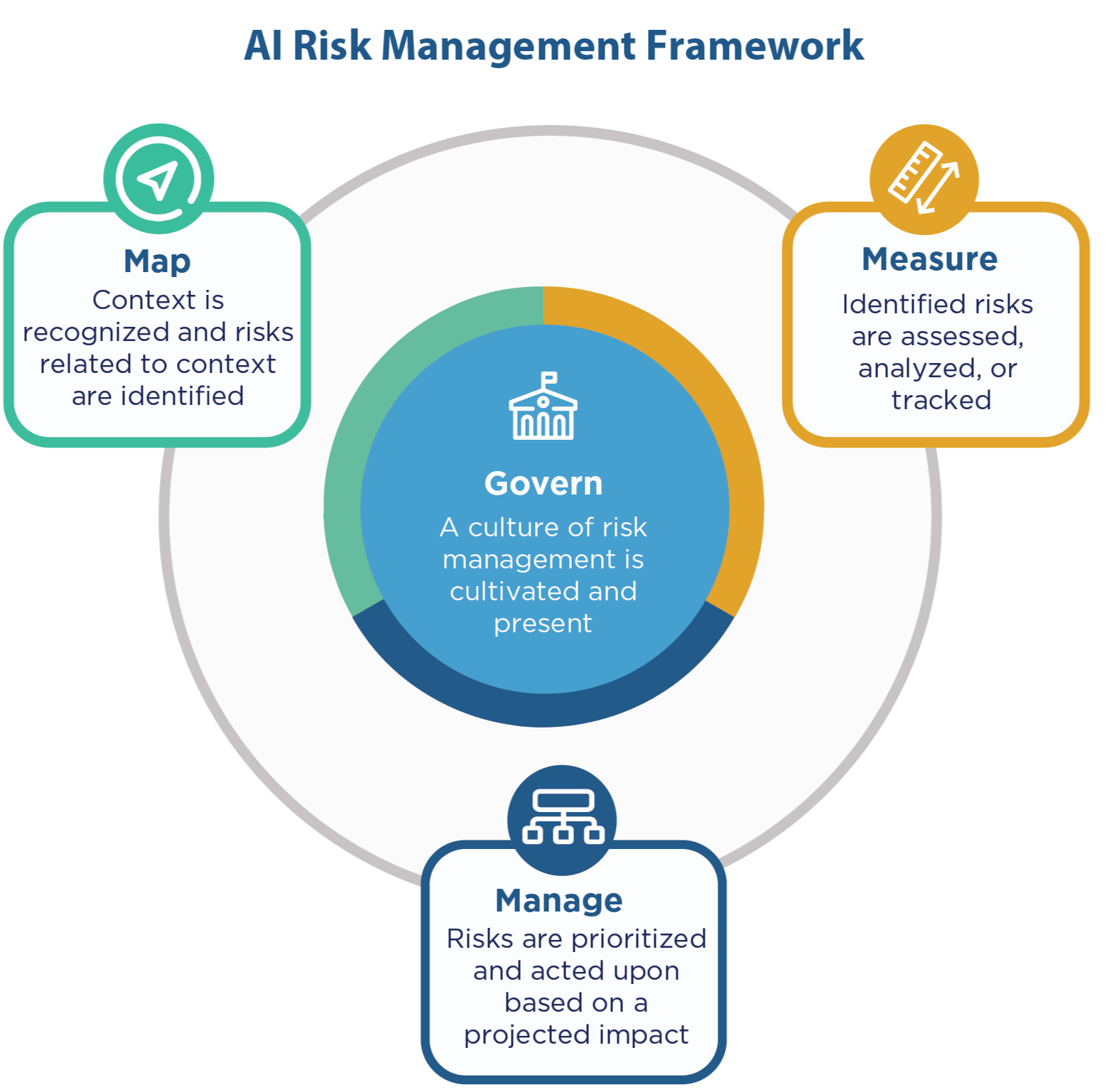
This image helps clarify a frequent corporate conflation. A company may say “we govern AI responsibly” when it actually describes only model testing. Testing is valuable, but it is not governance by itself. Governance requires the organizational conditions that make testing consequential: decision rights, documented procedures, accountable roles, resources, and follow-through.
What is Responsible AI? A Guide to AI Governance
Watch IBM Technology’s What is Responsible AI? A Guide to AI Governance for a concise practitioner account of why AI responsibility involves people, processes, and tools rather than a purely technical solution. Treat it as an industry perspective that illustrates governance language, not as independent proof that any company has effective governance.
Watch the sociotechnical framing, which introduces the need to address people, workflows, and tools together. Then watch accountability beyond law. Focus especially on the problem of diffuse responsibility and the distinction between meeting legal requirements and dealing with outcomes that may still be ethically unacceptable.
A useful distinction for your coding later is this:
- A safety claim says the system is tested or controlled against harmful outcomes.
- A governance claim says who required that testing, who reviews it, what happens if it fails, and how the organization remains accountable over time.
Governance can incorporate safety, responsible AI, and legal compliance, but it is not reducible to any one of them.
Legal compliance: necessary, context-specific, and not ethically sufficient
Legal compliance means conformity with applicable binding legal and regulatory requirements. Unlike broad claims of ethicality, compliance should be interpreted with attention to precise scope:
- Which jurisdiction?
- Which law or obligation?
- Which product, model, or use case?
- At what point in time?
- Who has determined compliance, and on what basis?
A company may truthfully state that its product is designed to comply with relevant requirements while leaving open difficult ethical questions. The IBM video calls attention to the possibility of AI that is “legal yet still terrible.” This is a valuable analytic reminder: legality and ethical acceptability are connected, but they are not synonymous.
For example, compliance may establish a minimum obligation concerning data handling, consumer information, or risk controls. Ethical inquiry can still ask whether the system should be deployed at all, whether its benefits and burdens are fairly distributed, and whether affected people have meaningful power to contest decisions.
At the same time, do not treat compliance claims dismissively. Legal duties can matter materially because they may require documentation, risk assessment, human oversight, reporting, or remedies. The critical point is narrower:
A legal-compliance claim establishes neither complete ethical justification nor effective governance unless the organization explains the relevant legal scope and supporting practices.
In corporate communication, legal compliance can also function rhetorically. A phrase such as “compliant by design” can reassure regulators, enterprise customers, and public-sector buyers. Your later framing analysis will examine how that reassurance is constructed for different audiences.
How to classify a corporate claim
Consider this fictional statement:
“Our AI is ethical, safe, responsibly developed, and compliant with applicable regulations.”
It contains four distinct claims, but it does not explain any of them.
| Phrase | Most immediate category | What it asserts | What you would need to look for next |
|---|---|---|---|
| “ethical” | AI ethics | The company presents its AI as morally justified | Named values, stakeholder inclusion, ethical reasoning, boundaries and trade-offs |
| “safe” | AI safety | The system is claimed to avoid or control harms | Defined risks, evaluation methods, safeguards, limitations, monitoring and incident evidence |
| “responsibly developed” | Responsible AI | The organization claims appropriate lifecycle practices | Data practices, impact assessments, governance processes, training, documentation, oversight |
| “compliant with applicable regulations” | Legal compliance | The company claims it meets relevant legal obligations | Applicable jurisdiction, named requirements, documented controls, assessment or assurance |
| No explanation of decision rights | Governance is under-specified | The statement does not tell us who is responsible or accountable | Roles, review bodies, approval authority, escalation, audit, remedies |
The statement could become more informative if it specified its scope:
“Before deployment in defined high-impact contexts, our teams conduct documented safety evaluations and fairness assessments; an internal review function approves use cases, and the system is monitored for incidents after release.”
This does not prove that the organization is ethically exemplary. It does, however, make claims that can be studied. It identifies processes, organizational actors, timing, and a partial boundary around the deployment context.
A practical annotation protocol
When collecting corporate materials, annotate each notable statement using five short fields:
-
Label used
Is the company saying ethical, responsible, safe, trustworthy, governed, or compliant? -
Object of the claim
Does the statement refer to a model, product, use case, data practice, organizational program, or the company as a whole? -
Mechanism or evidence
Does it name concrete practices, metrics, documents, audit processes, restrictions, or accountable roles? -
Scope and boundary
Which countries, customers, users, deployment contexts, risks, or time periods are included? What appears excluded? -
Accountability and contestability
Who is responsible, who can challenge a decision, and what happens when the system fails or causes harm?
This protocol will let you move beyond keyword counting. Two companies may both use the phrase “responsible AI,” while one uses it as a broad reputational identity and the other ties it to verifiable lifecycle controls. The shared phrase should not force you to treat the communications as equivalent.
A compact distinction to retain
Use this formulation as a first-pass guide:
- AI ethics concerns the values and moral justification of AI.
- Responsible AI concerns organizational practices that operationalize those values.
- AI safety concerns preventing and controlling harmful system outcomes.
- AI governance concerns authority, accountability, policies, and oversight across the lifecycle.
- Legal compliance concerns meeting applicable binding legal obligations.
An organization may have one without fully having the others. It may comply with law while neglecting moral harms; conduct safety testing without adequate accountability; publish ethical principles without operational responsibility; or build governance procedures that do not meaningfully include affected stakeholders.
For your thesis, this distinction protects you from two errors: accepting broad ethical language at face value, and dismissing all corporate ethics communication as empty before examining its content and evidence.
Key takeaways
Corporate claims about AI responsibility operate at different levels: moral values, organizational practice, system risk, institutional oversight, and law. Their overlap is real, but their differences are analytically productive.
When analysing a text, do not ask only, “Does this company claim to be ethical?” Ask:
- What kind of claim is being made?
- What harms, values, and stakeholders are named?
- What mechanisms make the commitment actionable?
- What boundaries and omissions structure the claim?
- What evidence would be needed to assess it?
In the next lesson, we will take the next step: why “ethical AI” has no technically fixed meaning, and why contestation over its definition is central rather than incidental to corporate AI communication.
Can't find a good explanation? Sign up and we'll make it for you
Sign up