
Welcome. This course approaches complex software from its lowest enforceable boundaries outward: CPU privilege transitions, memory isolation, user processes, IPC, and eventually browser rendering and sandboxing. In this first module, the focus is the x86-64 boundary between ordinary application code and kernel code.
This lesson traces one concrete Linux system call, write(1, "hello\n", 6), from its userspace setup through the processor’s syscall instruction, Linux’s entry code and dispatch, and the return to the instruction after syscall. By the end, you should be able to narrate the path while distinguishing what the CPU hardware does from what Linux software must do.
Start with the contract: write from a userspace program
A system call is the controlled interface through which a ring-3 program requests work that requires kernel authority: reading a file, creating a process, mapping memory, communicating over a socket, and so on. It is not an ordinary function call. An ordinary call can jump only to code that the current process is permitted to execute; a system call causes a processor-defined transition into ring 0 at an entry address chosen earlier by the kernel.
At the source level, a C program might say:
write(1, "hello\n", 6);
The familiar C library function is normally a wrapper. It may perform checking, cancellation handling, or error translation, but its essential low-level job is to place a syscall number and arguments in the Linux x86-64 syscall ABI registers, then execute the syscall instruction.
For the 64-bit Linux syscall ABI:
| Register | At entry to the kernel |
|---|---|
rax | System-call number |
rdi | Argument 1 |
rsi | Argument 2 |
rdx | Argument 3 |
r10 | Argument 4 |
r8 | Argument 5 |
r9 | Argument 6 |
rcx | Will be overwritten with userspace return address |
r11 | Will be overwritten with saved flags |
For write on x86-64 Linux, the syscall number is . A minimal assembly-level setup in GNU assembler’s AT&T syntax looks like this:
mov $1, %eax             # __NR_write
mov $1, %edi             # file descriptor: stdout
lea message(%rip), %rsi  # address of "hello\n"
mov $6, %edx             # byte count
syscall
Using the 32-bit register names such as eax and edi is common here: writing one of them zero-extends the corresponding 64-bit register. The string pointer is still a full 64-bit virtual address.
The fourth argument deserves special attention. The ordinary System V x86-64 C calling convention uses rcx as its fourth integer argument register. The syscall convention instead uses r10, because the CPU itself overwrites rcx during syscall. Linux’s internal syscall wrappers can rearrange values as necessary before entering ordinary C-compatible code.
Syscalls, Kernel vs. User Mode and Linux Kernel Source Code - bin 0x09
Watch “Syscalls, Kernel vs. User Mode and Linux Kernel Source Code” by LiveOverflow for a concise visual introduction to the user/kernel boundary, the syscall instruction, and the use of a syscall number.
Watch the syscall interface to establish why libc wrappers exist and why system calls are the application-to-kernel boundary. Then watch hardware entry for the role of IA32_LSTAR, ring 3, ring 0, and syscall-number dispatch. Focus on the key security property: userspace chooses a request and its data, but it cannot choose the kernel instruction address that executes.
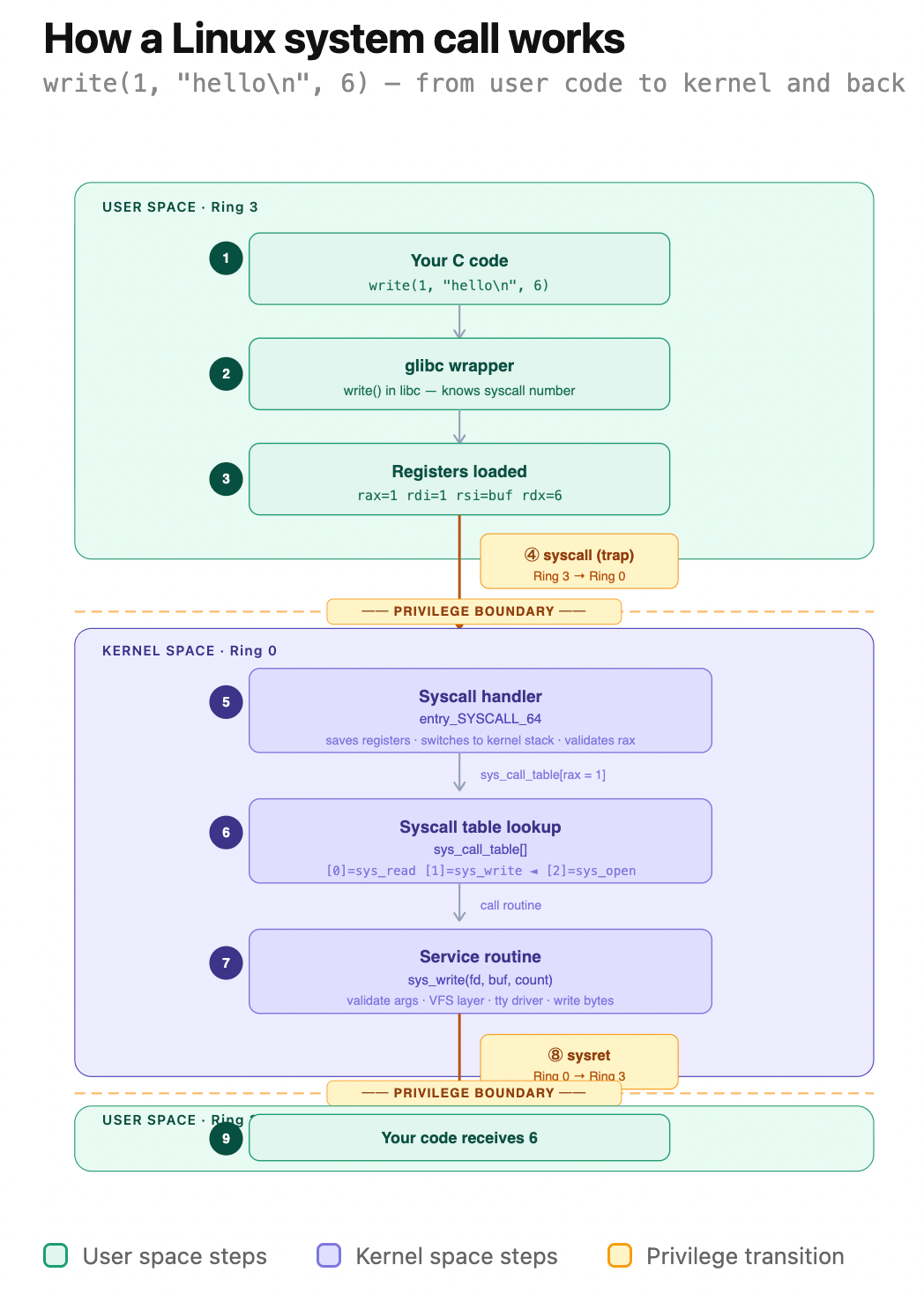
The supplied “How a Linux system call works” diagram gives a useful role-level map of this journey. One correction is important before relying on it: on modern x86-64, the syscall instruction is not an old-style software interrupt and does not automatically push a frame or switch stacks. Linux explicitly builds the saved state and switches to a kernel stack in its entry code.
What the processor does at syscall
The instruction syscall is a deliberately narrow gate. During boot, Linux programs model-specific registers, or MSRs, on each CPU. The important ones here are:
IA32_LSTAR: the 64-bit kernel entry address used bysyscall.IA32_STAR: supplies the code and stack segment selectors used on entry and return.IA32_FMASK: specifies flag bits to clear as the kernel begins execution.
When ring-3 code executes syscall, the CPU performs a transition with a tightly specified register-level effect:
- It saves the address of the next userspace instruction in
rcx. - It saves the userspace
rflagsvalue inr11, then masks selected active flags for kernel execution. - It loads kernel privilege segment state and loads
ripfromIA32_LSTAR. - It does not push anything on a stack and does not change
rsp.
That final point explains much of the entry assembly. At the first kernel instruction, rsp still points at a userspace stack, whose contents and address are untrusted. Kernel code must not treat it as a safe execution stack.
entry_64.S source code [linux/arch/x86/entry/entry_64.S] - Codebrowser
Read the opening portion of the current Linux entry_64.S source in Codebrowser. It is valuable because the comments document the CPU-to-kernel interface directly beside the instructions that implement Linux’s response.
In entry_64.S, read the comments and instructions around lines 50–122, beginning with the explanation of the hardware contract. Then continue through the entry_SYSCALL_64 label, including the code that saves the old stack pointer and loads cpu_current_top_of_stack. In the “Construct struct pt_regs on stack” block at lines 101–122, identify which values came directly from the CPU (rcx and r11) and which Linux saves itself.
The modern entry routine begins at entry_SYSCALL_64. Its first responsibilities can be understood in terms of trust and location rather than memorizing every macro:
-
Establish kernel per-CPU state.
swapgsexchanges the active GS-base value with a kernel-controlled one. Linux uses the kernel GS base for per-CPU data, including information needed to find a safe stack.swapgschanges a base register; it is not itself a stack switch. -
Preserve the userspace stack pointer. Linux saves the old
rspin per-CPU scratch storage. It needs that exact value later to resume the caller. -
Switch to the current task’s kernel stack. Linux loads a known kernel stack top into
rsp. On systems using page-table isolation, entry code may also switch to an appropriate kernel page-table context. These mitigation details evolve across kernel versions, but the essential rule does not: privileged execution proceeds on kernel-controlled state. -
Construct a
pt_regsrecord on that kernel stack. Linux pushes a software-built representation of the interrupted userspace context: userspace stack selector and pointer, flags, code selector, instruction pointer, original syscall number, and general-purpose-register state.
The source calls this struct pt_regs. It is a central object: tracing, signal delivery, ptrace, auditing, syscall filtering, and the return path all need a consistent representation of the task’s saved machine state. The exact layout will be the subject of the next lesson; for now, notice its origin. For a syscall, much of this record is constructed by Linux, rather than automatically pushed by the processor.
There is also a boundary of responsibility here. The kernel has gained authority, but the arguments in rdi, rsi, and other registers are still supplied by an untrusted process. In write, the buffer pointer identifies userspace memory, not kernel memory. Correct kernel code must validate and safely copy or access user-provided data; entering ring 0 does not make user pointers trustworthy.
From syscall number to Linux service routine
Once the entry code has captured the context, the current Linux source calls do_syscall_64. It receives a pointer to the saved register state and the syscall number. The dispatcher checks whether the number is valid for the active ABI, then selects the corresponding kernel syscall implementation.
Conceptually, dispatch is table lookup:
For our example, the number selects the 64-bit write syscall implementation. The handler receives the semantic arguments:
- file descriptor ,
- pointer to
"hello\n", - byte count .
From there, write follows kernel objects rather than raw hardware. Linux resolves file descriptor in the calling process’s descriptor table; it may refer to a terminal, a pipe, a redirected file, or something else. The syscall handler eventually returns a result. On success, that is normally the number of bytes written, here .
At the raw syscall layer, errors are conventionally negative error values in rax, such as a negative value corresponding to a bad file descriptor or invalid address. A libc wrapper generally turns this into the C-facing convention of returning and setting errno. That translation is why observing a syscall boundary and observing a C function boundary are not quite the same thing.
A useful way to validate the first half of the trace on a Linux machine is to run:
strace -e write ./your_program
strace shows the kernel-facing operation, not merely the source-level call spelling. If output is produced through printf, the trace may reveal one or more write calls, but buffering means the relationship is not necessarily one printf call per write syscall.
Returning safely to ring 3
When the selected handler finishes, it leaves its raw return value in rax, and Linux records that as the return value in the saved context. The kernel then performs exit work. Depending on what occurred during the call, this can include checking pending signals, rescheduling, tracing hooks, and security-related state transitions.
Linux has two principal architectural ways to return to userspace:
sysretqis the fast return path for a clean, valid 64-bit syscall context.iretqis the more general return mechanism. Linux chooses it when the saved state requires a robust slow path, for example after state modifications that make the direct syscall-return assumptions unsafe.
For the ordinary fast sysretq case, the meaning matches the processor’s entry contract:
- Linux restores general-purpose registers from the saved context.
- It restores the saved userspace
rsp. - It places the saved userspace instruction pointer in
rcx. - It places the saved userspace flags in
r11. - It executes
swapgsagain to restore the userspace GS-base context. - It executes
sysretq.
The processor then resumes at the instruction immediately following syscall, in ring 3. From the caller’s viewpoint, the wrapper simply returns, with rax holding the result.
entry_64.S source code [linux/arch/x86/entry/entry_64.S] - Codebrowser
Continue in Codebrowser with the return half of entry_64.S. The important lesson is that Linux does not always take one fixed exit route: it attempts a fast SYSRET return only when the userspace context is suitable.
Read lines 124–171, beginning with the return-path choice. Follow the syscall_return_via_sysret block through sysretq at line 167; focus on why rsp, rcx, and r11 need special treatment. Then scan lines 560–660, from the general return path, to see the alternative iretq endpoint. You do not need to memorize mitigation macros or trampoline-stack details yet.
It is tempting to summarize the trace as “the program calls the kernel and the kernel returns.” That hides the important machinery. A more accurate compact account is:
- A userspace wrapper places the syscall number and arguments in the syscall ABI registers.
syscalltransfers control to Linux’s preconfigured entry address, while saving the return instruction pointer inrcxand flags inr11.- Linux replaces the unsafe userspace-stack context with kernel-controlled per-CPU state and a kernel stack, then builds
pt_regs. - Linux validates and dispatches the numeric request to its syscall implementation.
- The handler produces a result in
rax; Linux performs required exit work. - Linux restores a safe userspace context and returns through
sysretqwhen possible, otherwiseiretq.
The key takeaways are that a syscall is both an ABI contract and a privilege transition; syscall itself does less automatic saving than many people expect; and Linux entry code is responsible for creating the safe, inspectable state needed to run kernel code and later resume the task. The syscall number selects a service, but it does not grant trust to its arguments.
Next, we will look closely at the privilege-transition state itself: what fields are saved, why pt_regs resembles an interrupt-return frame, and how saved rip, rsp, flags, and segment state determine where execution can safely resume.
Can't find a good explanation? Sign up and we'll make it for you
Sign up