
Kia ora. In the previous lesson, you linked subduction beneath the North Island to magma formation in the Taupō Volcanic Zone, and then linked underground magma heat to geothermal activity. Now you will make that knowledge usable in Geography answers by learning six essential terms precisely.
This is the final lesson in the Tarawera Setting Before 1886 module. By the end, you should be able to describe Mount Tarawera and the Lake Rotomahana area using magma, vent, fissure, ash, scoria, and geothermal activity without mixing them up. Plan for about 30 minutes, including a short cue-card recall session.
One volcanic setting, six connected terms
A useful way to organise the vocabulary is to think about where each thing belongs:
| Term | What it means | Where it belongs in the Tarawera setting |
|---|---|---|
| Magma | Molten rock beneath Earth’s surface | Underground beneath Mount Tarawera |
| Vent | An opening where volcanic material reaches the surface | At the surface, often within or beside a crater |
| Fissure | A long, narrow crack in Earth’s crust | Can form a line along which magma reaches vents |
| Ash | Very fine fragments of volcanic rock, minerals, and volcanic glass | Blown into the air, then deposited over land |
| Scoria | Dark, bubbly volcanic rock formed from gas-rich magma | Ejected in larger fragments, often around volcanic vents |
| Geothermal activity | Surface activity caused by heat from inside Earth, usually involving heated groundwater | Hot springs, steam, geysers, and silica-rich water near Lake Rotomahana |
These terms describe different parts of one system. Magma is underground molten rock. If it rises through a crack and reaches the surface, it may emerge through a vent. At Tarawera in 1886, the eruption involved a long fissure, rather than only one central volcanic opening. The eruption produced both coarse, bubbly scoria and fine ash.
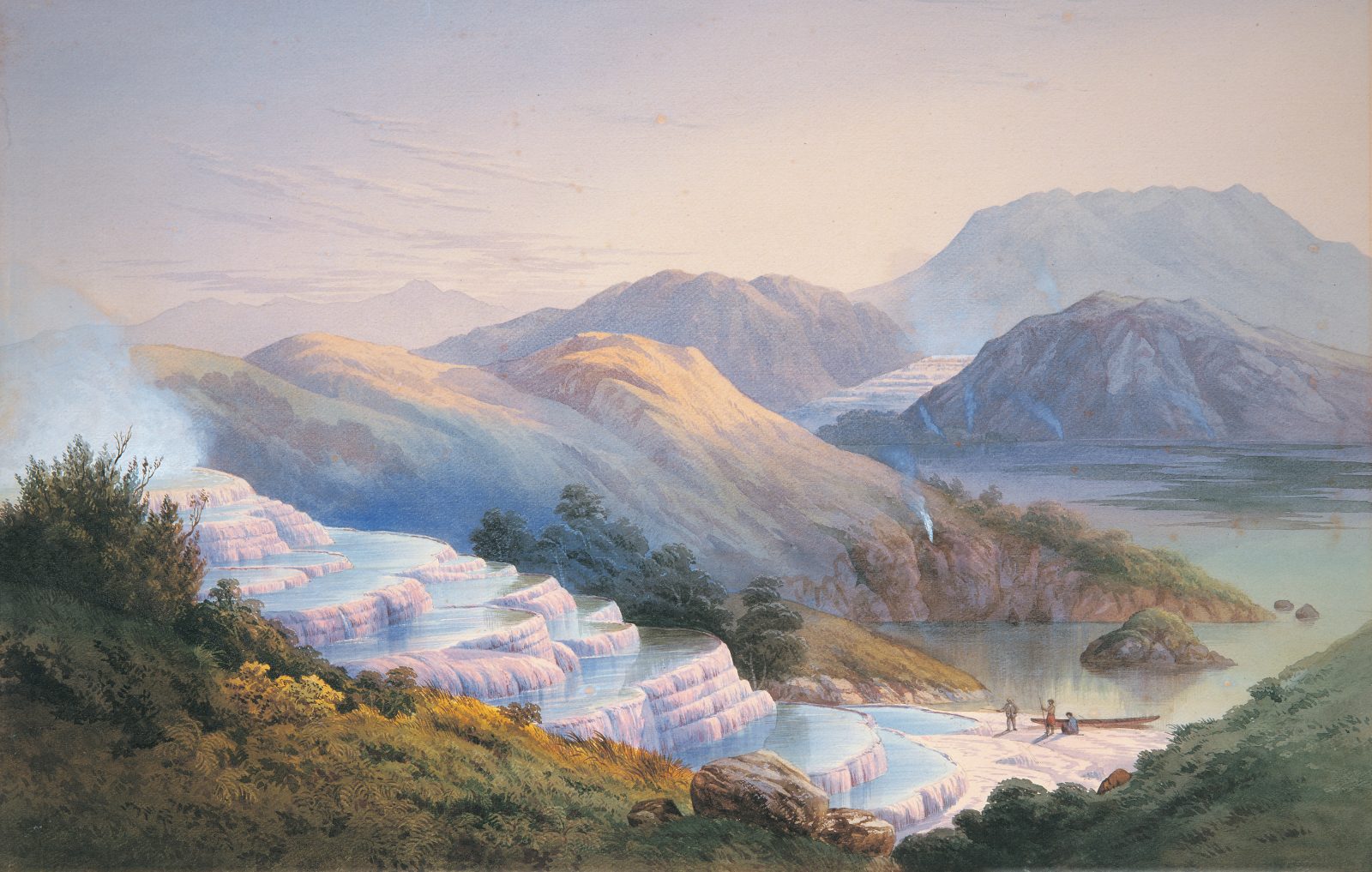
Geothermal activity is different from an eruption. It occurs when underground heat warms groundwater, which can then emerge as hot springs, steam vents, geysers, or mineral-rich pools. Before 1886, geothermal water near Lake Rotomahana deposited silica to form the Pink and White Terraces.
The historical painting below depicts the pre-eruption terraces and steam in the Lake Rotomahana landscape. It is an artist’s representation rather than a photograph, but it helps show that the area was known for visible geothermal activity before the eruption.
Two distinctions that prevent common mistakes
A fissure is not exactly the same as a vent.
- A fissure is a crack or fracture in the crust.
- A vent is an opening through which volcanic material escapes.
- A fissure can become a line of vents if magma rises through it.
Ash is not the same as scoria.
- Ash consists of very small volcanic particles. It is not ash from a fire and is not simply smoke.
- Scoria is larger, rough, gas-bubble-filled volcanic rock. It is often dark grey, black, or reddish brown.
The TED-Ed animation gives a brief, general explanation of magma rising through fractures in rock. Its example is not Tarawera, but use it to strengthen the difference between underground magma and a surface opening.
Volcanic eruption explained - Steven Anderson
Watch Volcanic eruption explained by TED-Ed. It provides a clear visual introduction to magma and shows how fractures can create pathways to the surface.
First, watch magma origins to confirm that magma is molten rock below the surface. Then watch fractures and fissures. Focus on the idea that weakened or fractured crust can provide a route for magma to reach the surface; at Tarawera, such a route developed as a major fissure.
Applying the words to Mount Tarawera
The six terms are most useful when they form a clear description, rather than appearing as isolated definitions.
In the Tarawera area, magma beneath the volcano provided heat to surrounding rocks and groundwater. This heat supported geothermal activity around Lake Rotomahana. Hot, silica-rich water built the Pink and White Terraces slowly over a long period.
In June 1886, rising magma forced its way through the crust. A major fissure opened across the Mount Tarawera area. Volcanic material erupted from openings along this fractured zone. These openings were vents. Some vents produced fountains of glowing scoria, while fine ash was blasted high into the atmosphere and later fell across the surrounding region.
Te Ara’s account gives you strong, specific evidence for this vocabulary. Notice that it uses fissure, craters venting, scoria, ash, and rift in the same description.
Te Ara Encyclopedia of New Zealand
Read this account from Te Ara Encyclopedia of New Zealand to see the key Tarawera terms used in a real description of the beginning of the 1886 eruption.
In the section “The eruption,” read the eruption account. Begin with the earthquakes at Te Wairoa and continue to the final sentence stating when the eruptions ended. Focus particularly on the wording about the fissure through Ruawahia Dome, the summit craters “venting” scoria and ash, and the later 17-kilometre rift.
A rift is a large zone where the ground has split or pulled apart. For this course, it is safe to describe the 1886 Tarawera rift as a long zone of fracture that included the eruption fissure system. Your key assessed term is likely fissure, so use that word when describing the narrow fracture through which magma moved upward.
This photograph shows the rugged summit landscape at Mount Tarawera today. The exposed dark and reddish deposits include volcanic ash and scoria from past eruptive activity.

Make your descriptions accurate
A Geography explanation is stronger when every term does a particular job. Compare the vague and precise versions below.
| Vague wording | More accurate wording |
|---|---|
| “Lava came out of a crack.” | “Magma rose through a fissure and erupted through vents along Mount Tarawera.” |
| “The volcano made smoke.” | “An eruption blasted fine ash into the atmosphere.” |
| “Rocks came out of the volcano.” | “Glowing scoria was ejected from vents along the summit.” |
| “The terraces were volcanic.” | “Geothermal activity heated silica-rich groundwater, which deposited silica and formed the terraces.” |
| “Tarawera had a big hole.” | “A fissure opened through the volcano, creating a long fractured eruption zone.” |
Be especially careful with magma. Magma is underground. Once molten rock is at the surface, it is normally called lava. In a Tarawera answer, a safe sentence is:
Rising magma moved upward through a fissure and erupted through volcanic vents.
That wording does not incorrectly call all erupted material “magma,” and it also shows that you understand the underground-to-surface process.
Here is a model paragraph using all six terms:
Before 1886, Mount Tarawera was part of the volcanic and geothermal landscape of the Taupō Volcanic Zone. Magma beneath the area heated groundwater, causing geothermal activity around Lake Rotomahana. This geothermal water deposited silica and formed the Pink and White Terraces. During the 1886 eruption, rising magma forced open a long fissure across Mount Tarawera. Volcanic vents along the fissure ejected glowing scoria and blasted fine ash into the atmosphere. The ash and other volcanic material later covered large areas of the surrounding landscape.
Notice the structure:
- Start with the underground cause: magma.
- Describe the pre-eruption setting: geothermal activity.
- Describe the pathway: fissure and vents.
- Name the erupted materials: scoria and ash.
Turn the vocabulary into cue cards
Use one idea per card. Read the front, say the answer aloud without looking, then check the back. If your answer is incomplete, say the full correct version once before moving on.
Definition cards
| Front of card | Back of card |
|---|---|
| What is magma? | Molten rock beneath Earth’s surface. |
| What is a volcanic vent? | An opening where volcanic material reaches Earth’s surface. |
| What is a fissure? | A long, narrow crack or fracture in Earth’s crust. |
| What is volcanic ash? | Very fine fragments of volcanic rock, minerals, and glass ejected during an eruption. |
| What is scoria? | Dark, bubbly volcanic rock formed from gas-rich magma and ejected during an eruption. |
| What is geothermal activity? | Activity caused by heat from inside Earth, such as hot springs, steam, geysers, and heated groundwater. |
Relationship cards
| Front of card | Back of card |
|---|---|
| How are a fissure and a vent different? | A fissure is a long crack in the crust; a vent is an opening through which volcanic material escapes. A fissure may contain several vents. |
| How are ash and scoria different? | Ash is very fine volcanic material; scoria is larger, bubbly volcanic rock. |
| How did magma contribute to the Pink and White Terraces before 1886? | Magma underground heated groundwater. The geothermal water carried and deposited silica, forming the terraces. |
| Use fissure, vent, scoria, and ash in one Tarawera sentence. | In 1886, a fissure opened across Mount Tarawera, and vents along it erupted glowing scoria and fine ash. |
For a quick final recall check, cover the answers and try to tell this short Tarawera story from memory:
Magma underground heated groundwater, producing geothermal activity. Later, rising magma opened a fissure. Vents along the fissure erupted scoria and ash.
If you forget a word, identify which category it belongs to: underground material, opening/pathway, erupted material, or heated-water activity.
Key takeaways
- Magma is molten rock below the surface.
- A fissure is a long crack in the crust; a vent is an opening where volcanic material erupts.
- Ash is fine volcanic material, while scoria is coarser, bubbly volcanic rock.
- Geothermal activity involves heat from inside Earth warming groundwater, producing features such as hot springs and steam.
- At Tarawera, magma and geothermal activity shaped the setting before 1886; the fissure eruption then produced vents, ash, and scoria.
Next, you will move into the 1886 eruption itself and put its warning signs and main events of 10 June into chronological order.
Can't find a good explanation? Sign up and we'll make it for you
Sign up