
Kia ora. In the last lesson, you located the Tarawera setting: Lake Rotomahana lay south-west of Mount Tarawera; the Pink Terraces were on the lake’s western shore, and the White Terraces were on its northern to north-eastern side.
Now we will make that map knowledge visual. By the end of this lesson, you should be able to describe what the terraces looked like before 1886, where each one sat beside Lake Rotomahana, and how they differed. This should take about 25–30 minutes.
Picture the terraces as a landscape, not two buildings
The Pink and White Terraces were natural silica formations. They were not constructed steps. Hot water flowed from geothermal springs across the hillside, leaving broad mineral surfaces that formed a series of pools and ledges. From a distance, each formation looked like a huge staircase cascading down towards Lake Rotomahana.
The word terrace is useful because it suggests a series of broad, fairly level steps. But the real formations were more irregular and natural than a staircase in a house. Their surfaces included rounded pool rims, shallow basins, smooth mineral edges, and flowing water. Visitors could see steam rising from the warm water in this active volcanic landscape.
The two terraces were separated by the lake:
- The White Terraces, or Te Tarata (“the tattooed rock”), stood on the north-east side of Lake Rotomahana.
- The Pink Terraces, or Ō-tū-kapua-rangi (“fountain of the clouded sky”), stood on the western side of Lake Rotomahana.
So a strong spatial description is:
Before the 1886 eruption, the Pink and White Terraces were separate geothermal silica formations beside Lake Rotomahana, south-west of Mount Tarawera. The White Terraces were on the lake’s north-eastern shore, while the Pink Terraces were on its western shore. Both descended in stepped pools towards the lake.
Study the evidence: size, shape, colour, and water
Read this short section from Searching for the Pink and White Terraces by Science Learning Hub. It gives the core facts you are most likely to need in a Year 11 description.
Searching for the Pink and White Terraces
Read Science Learning Hub’s overview to identify the shared staircase-like form of the terraces, then the key differences in their scale and appearance. The following section also explains why paintings and photographs are important evidence for a landscape that no longer exists in its pre-1886 form.
In “Background information about the terraces”, read from the description of both terraces. Focus on the White Terrace’s fan-shaped steps and the Pink Terrace’s clear warm pools. Then read the paragraph under “The Terraces by Charles Blomfield”, beginning the evidence and setting. Notice that art, photographs, and written accounts are our main sources for reconstructing their former appearance.
The details can be organised as a direct comparison:
| Feature | White Terraces — Te Tarata | Pink Terraces — Ō-tū-kapua-rangi |
|---|---|---|
| Location | North-east shore of Lake Rotomahana | Western shore of Lake Rotomahana |
| Overall scale | The larger formation | Smaller and lower |
| Shape | Broad, fan-shaped cascades of steps | More compact, delicate stepped pools |
| Appearance | Bright white silica, often compared with marble | Pink or rose-coloured silica, with clear warm pools |
| Relationship with the lake | Descended about 25–30 m to the shoreline | Descended in pools and steps towards the lake |
You do not need to memorise every measurement. The most helpful evidence is that the White Terraces were approximately 240 metres wide at their base and formed a dramatic fan of many large steps. The Pink Terraces were smaller, but their warm, clear bathing pools and pink colouring made them equally famous.
What the historical image can show us
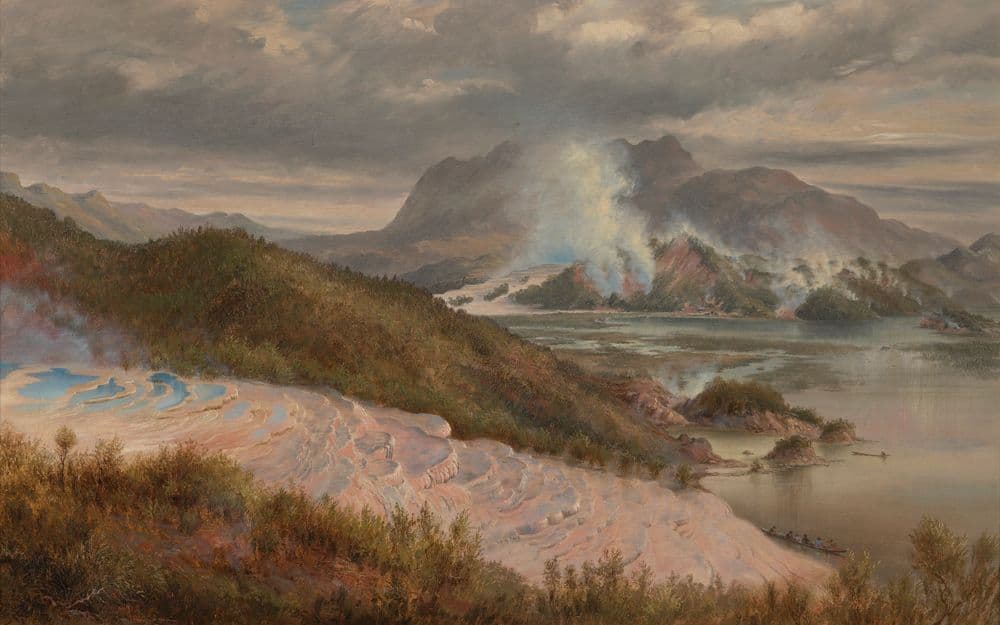
Look closely at Blomfield’s painting. In the foreground, the pale terraces are arranged in wide, curving levels rather than straight lines. Their pink-white tones contrast with the dark green vegetation and grey-blue water of Lake Rotomahana. Steam shows that this was a geothermal setting: heat from below ground was affecting water at the surface.
The painting is useful evidence, but use it carefully in geography. An artist may choose colours, lighting, and viewpoints to make a scene memorable. Therefore, the safest statements are those also supported by other evidence:
- the terraces were large, pale mineral formations;
- they consisted of stepped pools;
- they were directly beside Lake Rotomahana;
- warm water and steam were present;
- the landscape around them was volcanic and vegetated.
Paintings, early photographs, visitor accounts, and Māori knowledge preserve the pre-eruption landscape because the 1886 eruption changed it so dramatically.
Build a precise description
A good descriptive answer needs more than “they were pink and white.” Include:
- Place: Lake Rotomahana, near Mount Tarawera.
- Relative location: Pink on the west; White on the north-east.
- Form: natural, staircase-like silica pools and steps.
- Differences: White was bigger and fan-shaped; Pink was smaller, lower, and rose-coloured.
- Setting: warm geothermal water flowed over the terraces into the lake.
Here is a model paragraph:
Before the 1886 Mount Tarawera eruption, the Pink and White Terraces were two large natural silica formations on the shores of Lake Rotomahana. The Pink Terraces, called Ō-tū-kapua-rangi, were on the western side of the lake. They were smaller and lower than the White Terraces, with delicate pink-coloured steps and clear, warm pools. The White Terraces, or Te Tarata, were on the north-eastern side of Lake Rotomahana. They were larger, with broad white, fan-shaped cascades of many mineral steps descending towards the lake. Both terraces were part of an active geothermal landscape, where warm water and steam were visible.
Notice that the paragraph keeps description separate from a detailed explanation of how silica was deposited. You will learn that process next.
Memorise the contrast, not a long list
Use this compact recall frame:
| Prompt | Recall answer |
|---|---|
| Pink: where and what? | West side of Lake Rotomahana; smaller, lower, pink, warm clear pools. |
| White: where and what? | North-east side of Lake Rotomahana; larger, broad, white, fan-shaped steps. |
| Both: what were they? | Natural silica terraces, like stepped pools descending into the lake. |
For a one-minute retrieval routine, cover the table and say the answers aloud. Then sketch Lake Rotomahana as an oval: write Pink on the left, White at the upper right, and add short labels such as “smaller/pink/pools” and “larger/white/fan steps.” Check only after you have attempted it from memory.
Key takeaways
Before 1886, the Pink and White Terraces were remarkable geothermal silica formations beside Lake Rotomahana:
- Both looked like enormous, natural staircases of mineral pools flowing down to the lake.
- The Pink Terraces were on the western shore: smaller, lower, delicate, and pink-coloured, with warm clear pools.
- The White Terraces were on the north-eastern shore: larger, broad, bright white, and fan-shaped, with many large steps.
- Paintings, photographs, and written accounts are important evidence for their former appearance.
Next, you will explain the process that created these remarkable steps: how geothermal water carried dissolved silica and deposited it as it cooled.
Can't find a good explanation? Sign up and we'll make it for you
Sign up