
Good to see you again. In the previous lesson, you learned that cell membranes regulate the movement of materials such as oxygen, carbon dioxide, glucose, ions, and water. Those movements help individual cells remain functional. This lesson scales the idea up: the body must also regulate conditions in its internal environment—including temperature, blood glucose, water balance, and blood pressure.
The overall process is called homeostasis. By the end of this lesson, you should be able to construct a negative-feedback loop for an internal variable: identify the disturbance, sensor, control center, effector, corrective response, and return toward a healthy range.
Homeostasis: stable does not mean perfectly constant
Homeostasis is the maintenance of relatively stable internal conditions despite changing conditions outside the body or changes in activity. “Relatively stable” is important. Your body temperature, blood pressure, and glucose concentration vary somewhat throughout the day; the body continually adjusts them so they remain within a workable range.
A set point is the reference value, or target range, that a regulatory system uses for comparison. For example, core body temperature is often described as being near , but it naturally varies with time of day, activity, and other factors. Homeostasis does not freeze the body at one exact number. It keeps a variable from drifting too far.
A useful way to think about any homeostatic system is:
- A body variable changes away from its usual range.
- The body detects that change.
- A control system compares the current condition with the target range.
- It activates body parts that can correct the change.
- The correction reduces the original disturbance, so the response eventually decreases or stops.
That last feature makes the process negative feedback. Here, negative does not mean harmful, and it does not mean that the variable must decrease. It means the response opposes the initial change:
- If body temperature is too high, the response promotes cooling.
- If body temperature is too low, the response promotes warming.
- If blood glucose is too high, the response reduces it.
- If blood glucose is too low, the response raises it.
In each case, the response counters the deviation.
Homeostasis - BEST Way to Learn Negative Feedback Loops + Blood Pressure & Body Temperature Examples
Watch the opening of Homeostasis - BEST Way to Learn Negative Feedback Loops + Blood Pressure & Body Temperature Examples by Siebert Science. It introduces homeostasis and gives a clear framework for the parts of a negative-feedback loop.
Watch the framework. Focus on the distinction between the set point, sensing, integration by a control center, and the effector response. The ruler analogy is useful for one key idea: systems usually make continual small adjustments rather than remaining exactly at the set point.
The essential parts of a negative-feedback loop
To construct a loop, first identify the regulated variable: the condition the body is trying to keep within range. It could be body temperature, blood glucose concentration, blood pressure, blood water balance, or blood pH.
Then label the components precisely.
| Part of the loop | What it does | Temperature-regulation example |
|---|---|---|
| Variable and set range | The condition being regulated and its desired range | Core body temperature near |
| Stimulus | A deviation away from the usual range | Temperature rises above the range |
| Sensor (receptor) | Detects the current condition or the deviation | Temperature-sensitive nerve cells in skin and brain |
| Control center (integrator) | Compares incoming information with the set range and selects a response | Hypothalamus in the brain |
| Effector | A tissue, organ, or cell that carries out the instruction | Sweat glands, skin blood vessels |
| Response | The physical change produced by the effectors | More heat leaves the body |
| Feedback result | The response reduces the original deviation | Temperature falls toward its normal range |
One common error is to call every part of the pathway a “sensor.” The sensor detects; the control center decides what correction is needed; the effector performs the correction.
Another common error is to treat the “response” as the same thing as an effector. They are related but different:
- A sweat gland is an effector.
- Increased sweating and evaporation are part of the response.
- Heat loss and a fall in body temperature are the outcome of that response.
Read the short OpenStax explanation for a concise, formal statement of these components before applying them to an example.
1.5 Homeostasis - Anatomy and Physiology 2e
Read “Negative Feedback” from OpenStax Anatomy and Physiology 2e. It defines the components you will use to build your own loop.
In the subsection “Negative Feedback,” read the core definition. Notice that a sensor reports a physiological value, the control center compares it with a normal range, and an effector creates the corrective change. Keep those roles distinct as you read.
Constructing a loop: body temperature rises too high
Body temperature regulation is a particularly useful model because the corrective response is easy to connect to physics. Heat can transfer from the body to the environment. Increasing blood flow near the skin and evaporating sweat both increase heat loss.
Suppose someone exercises on a warm day. Their body produces extra heat through metabolism, and their core temperature begins to rise above its normal range.
We can construct the loop in a disciplined sequence.
1. State the variable and the deviation
The variable is core body temperature.
The stimulus is not merely “exercise.” Exercise is a cause of extra heat production. The actual homeostatic stimulus is:
Core body temperature rises above its normal range.
Naming the deviation precisely matters because the eventual response must oppose that change.
2. Identify the sensors
Temperature-sensitive nerve cells, often called thermoreceptors, in the skin and brain detect temperature information. They provide the system with evidence that body temperature is too high.
The skin sensors are useful because external conditions matter, while sensors in the brain help monitor internal temperature more directly.
3. Identify the control center
The hypothalamus, a region of the brain, serves as the main temperature-control center. It receives temperature information and compares it with the set range.
If the temperature is too high, the hypothalamus coordinates cooling responses. It is not itself doing the cooling; it is directing other structures to do it.
4. Name the effectors and their actions
Several effectors can contribute:
- Sweat glands release sweat onto the skin.
- Blood vessels near the skin dilate, meaning they widen and allow more warm blood to reach the body surface.
Sweat cools the body principally when it evaporates. Evaporation requires energy, which is taken as thermal energy from the skin and nearby blood. More warm blood near the surface also makes heat transfer to the surrounding air easier.
5. State how the response opposes the deviation
The effectors increase heat loss. As heat loss rises, core temperature falls toward its set range. When the temperature is no longer too high, the stimulus weakens, and the hypothalamus reduces the cooling response.
Written as a complete loop:
Body temperature rises above its normal range. Thermoreceptors in the skin and brain detect the rise. The hypothalamus compares the temperature with its target range and activates sweat glands and skin blood vessels. Sweating and greater skin blood flow increase heat loss. As temperature falls toward its normal range, the cooling signals diminish.
Notice the logic: a rise in temperature triggers processes that make temperature fall. That opposition is why it is negative feedback.
The same variable can have two opposite corrective pathways
A regulated variable may deviate in either direction. Negative feedback must be evaluated relative to the initial change, not by asking whether the response is “up” or “down.”
For temperature regulation:
| Initial deviation | Control-center response | Effectors | Result |
|---|---|---|---|
| Temperature is too high | Promote heat loss | Sweat glands; widened skin blood vessels | Temperature decreases toward the range |
| Temperature is too low | Promote heat conservation and heat production | Narrowed skin blood vessels; skeletal muscles shiver | Temperature increases toward the range |
When you are cold, shivering consists of rapid skeletal-muscle contractions. Muscle activity uses ATP and releases heat. Narrowing blood vessels near the skin limits heat loss by keeping more warm blood deeper in the body.
Both the “too hot” and “too cold” cases are negative feedback:
- Too hot, then temperature decreases.
- Too cold, then temperature increases.
The direction of the correction changes, but each correction counters the original deviation.
Homeostasis - BEST Way to Learn Negative Feedback Loops + Blood Pressure & Body Temperature Examples
Continue with Siebert Science’s body-temperature example to see both branches of the same regulatory system.
Watch temperature control. For each branch, pause mentally after the initial deviation and predict the needed direction of the response before listening to the effectors. Pay particular attention to why sweating aids cooling and shivering aids warming.
A reusable construction method
When asked to draw, label, or explain a negative-feedback loop, use this six-part method.
-
Name the regulated variable and normal range.
Example: core body temperature near . -
Describe a specific deviation.
State whether it is too high or too low.
Example: core temperature rises above its usual range. -
Identify the sensor.
What detects that the variable has changed?
Example: thermoreceptors in skin and brain. -
Identify the control center.
What compares the information with the set range and sends instructions?
Example: hypothalamus. -
Identify the effectors and their actions.
What structures act, and what do they do?
Example: sweat glands secrete sweat; skin blood vessels dilate. -
Explain the correction and loop closure.
How does the response move the variable back toward range? Why does the response later decline?
Example: heat loss rises, temperature falls, and cooling signals diminish as the deviation becomes smaller.
A high-quality written loop includes a causal explanation, not just a list of vocabulary. Compare these two answers.
Too vague:
“Temperature increases. The hypothalamus tells the sweat glands to sweat. This is negative feedback.”
Complete:
“When core temperature rises above its normal range, thermoreceptors in the skin and brain signal the hypothalamus. The hypothalamus activates sweat glands and promotes dilation of blood vessels near the skin. Sweat evaporation and increased heat transfer cause greater heat loss, reducing temperature toward its normal range. As temperature returns toward range, the cooling response decreases.”
The complete version makes the regulated variable, sensors, control center, effectors, and corrective effect visible.
A second example: blood glucose after a meal
The same template applies when the controlled variable is chemical rather than thermal. After a carbohydrate-containing meal, digestion and absorption add glucose to the bloodstream. Blood glucose concentration rises.
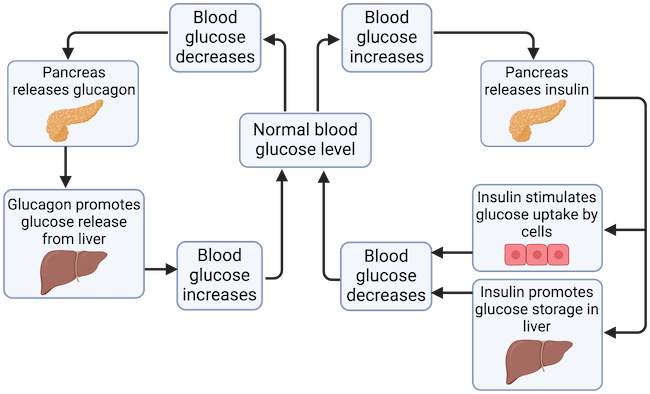
For the high blood glucose branch, the loop can be written as follows:
- Variable: blood glucose concentration.
- Stimulus: blood glucose rises above its normal range.
- Sensor and control center: specialized cells in the pancreas detect the increase and release the hormone insulin.
- Effectors: liver, muscle, fat, and other body cells respond to insulin.
- Response: cells take up glucose; liver and muscle cells store some glucose.
- Outcome: blood glucose falls toward its normal range, reducing the stimulus for insulin release.
The pancreas is a useful reminder that one organ can participate in more than one role. In this simplified loop, pancreatic cells both detect glucose conditions and initiate the hormone signal. The effectors are the responding body cells, especially liver and muscle cells that remove glucose from the blood.
When blood glucose falls too low, a complementary branch uses glucagon, another pancreatic hormone. Glucagon promotes glucose release from the liver, causing blood glucose to rise toward the normal range. This is also negative feedback because the response opposes a low glucose level.
We will return to insulin and glucagon in detail during the digestion and energy-balance module. For now, use this example to test whether you can recognize the common structure beneath two very different body problems: overheating and low glucose are detected, interpreted, and corrected by effectors.
Avoid these four misunderstandings
“Negative feedback means the response is harmful.”
No. The word negative refers to the relationship between the disturbance and the response. The response reduces the disturbance.
“The body stays exactly at the set point.”
Usually not. Regulated variables fluctuate within an acceptable range. Feedback processes continually keep those fluctuations from becoming too large.
“A sensor fixes the problem.”
A sensor detects the condition. It may send a nerve signal or release a chemical signal, but the physical correction is carried out by effectors.
“If a variable is low and the body raises it, that is positive feedback.”
No. Raising a low variable can be negative feedback if the increase counteracts the initial fall. Positive feedback instead amplifies the original change. For example, a system in which a rise caused further rise would be positive feedback, not the stabilizing process studied here.
Key takeaways
Homeostasis keeps internal body conditions within workable ranges, even as the environment, diet, and activity change. Negative feedback is its major control strategy: a deviation triggers a response that opposes that deviation.
To construct a loop, identify:
- the regulated variable and normal range;
- the deviation from that range;
- the sensor;
- the control center;
- the effectors;
- the corrective response that returns the variable toward range.
In body-temperature control, thermoreceptors signal the hypothalamus, which activates effectors such as sweat glands, skin blood vessels, or skeletal muscles. In blood-glucose control, the pancreas coordinates hormone signals that cause body cells and the liver to remove or release glucose.
Next, the course moves into nervous-system control. You will examine how neurons communicate: electrically along their length and chemically across synapses.
Can't find a good explanation? Sign up and we'll make it for you
Sign up