
Hello! This is the first lesson in your density test sprint. Before calculating density, you need to be able to trust the numbers and units you put into the formula. This lesson builds the measurement skills behind nearly every density question: SI prefixes, scientific notation, and significant figures.
By the end, you should be able to convert values such as milligrams to kilograms or cubic centimetres to cubic metres, write very large or small values compactly, and round a final calculated answer without accidentally claiming more precision than the measurement supports.
1. SI units and prefixes: the language of measurements
Physics uses the International System of Units, abbreviated SI. Its base units include:
- length: metre,
- mass: kilogram,
- time: second,
- temperature: kelvin,
Density is a derived quantity because it combines mass and volume. You will commonly see density written in or .
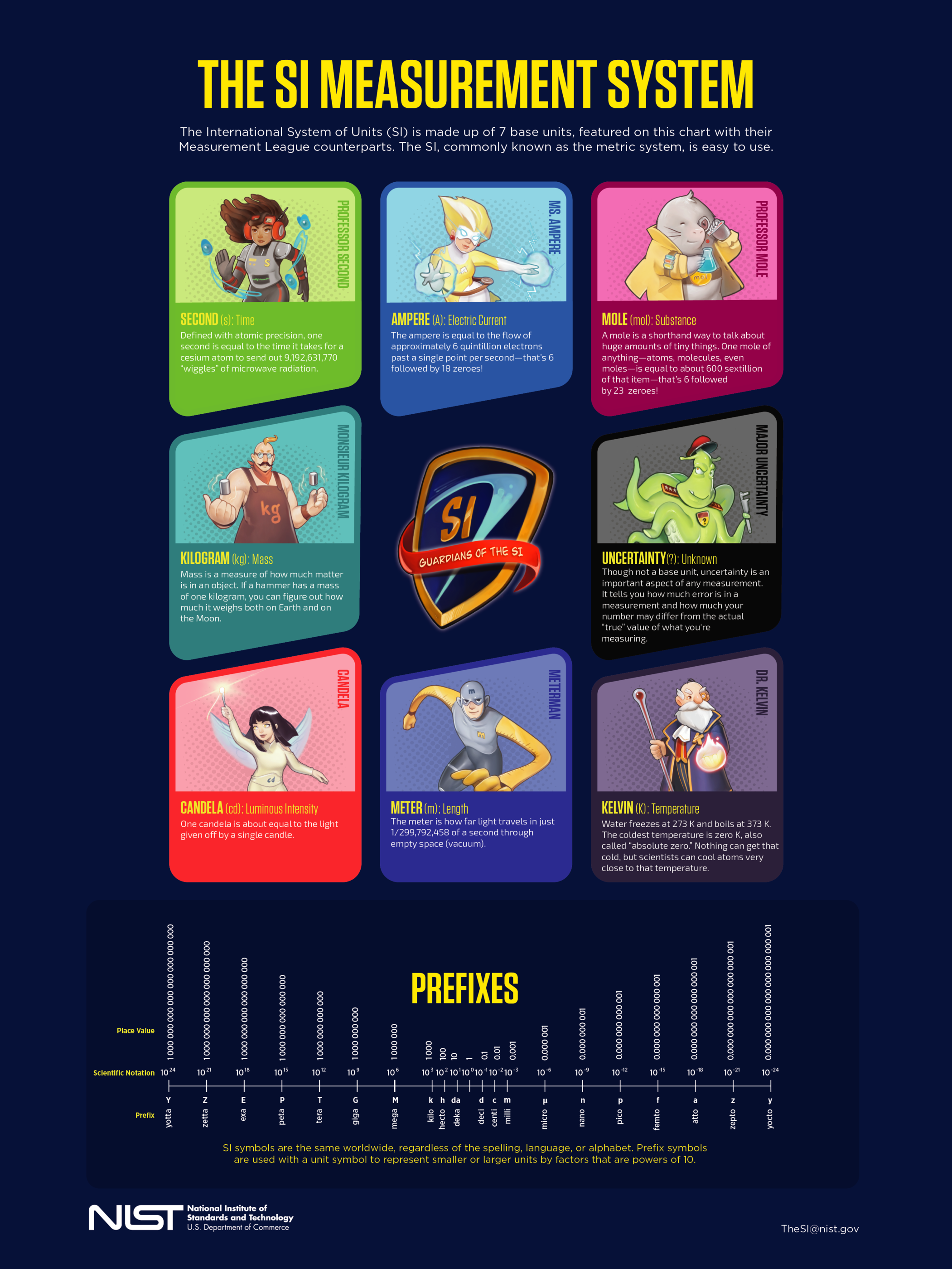
A prefix changes a unit by a power of ten. The prefix is part of the unit, so is not “metres times grams”; it means milligram.
| Prefix | Symbol | Meaning | Relative to the base unit |
|---|---|---|---|
| mega | million | ||
| kilo | thousand | ||
| centi | hundredth | ||
| milli | thousandth | ||
| micro | millionth | ||
| nano | billionth |
The essential translations are:
Pay close attention to capital letters. is mega, while is milli. Therefore, and differ by a factor of . That is a billionfold difference.
Metric Unit Prefix Conversions: How to Convert Metric System Prefixes | Crash Chemistry Academy
Watch “Metric Unit Prefix Conversions” from Crash Chemistry Academy for a compact visual treatment of prefixes and conversions. It also explains the crucial special rule for squared and cubed units.
Watch the prefix scale to connect prefix symbols with powers of ten. Then watch conversion factors, focusing on placing the original unit so it cancels and the desired unit remains. Finish with area and volume; volume conversions are especially important for density.
2. Convert units by making the unwanted unit cancel
A quick “move the decimal point” shortcut can work for simple metric conversions, but a more reliable test method is to write a conversion factor: a fraction equal to 1.
For example, because ,
Multiplying by this fraction changes the unit but not the physical amount.
Suppose a sample has mass , and you need milligrams:
The units cancel, leaving . This cancellation is your built-in error check.
A useful size check
Before calculating, decide whether the numerical value should get bigger or smaller:
-
Converting to a smaller unit gives a larger numerical value.
For instance, becomes . -
Converting to a larger unit gives a smaller numerical value.
For instance, becomes .
If your result contradicts this expectation, recheck the conversion factor.
Density-unit conversion: grams per cubic centimetre to kilograms per cubic metre
This conversion appears often because is convenient in school labs, while is the SI form.
Start with the mass conversion:
For volume, remember that volume has three dimensions:
So, convert :
The result has the same physical density, just expressed in different units.
A shortcut worth memorising is:
This means a density of is .
3. The cubic-unit trap: volume conversions must be cubed
A common density-test error is correctly converting a length but forgetting that a volume is cubed.
For length:
For volume:
The exponent is multiplied by three because there are three length dimensions:
Likewise:
Two volume facts are especially helpful in density questions:
And in SI cubic metres:
Do not treat and as though they differed by only . They differ by .
Test habit: whenever you see a squared or cubed unit, put parentheses around the conversion before applying the power. For example,
That written structure makes it much harder to lose the exponent.
4. Scientific notation: a clean way to handle extreme values
Scientific notation, also called standard form, has the format
where
and is an integer.
The first number, , contains the meaningful digits. The exponent tells you the scale.
For a large value:
For a small value:
A positive exponent makes the ordinary number large; a negative exponent makes it smaller than 1.
Writing a number in scientific notation
- Place the decimal after the first non-zero digit.
- Count how many places it moved.
- If the original number was large, the exponent is positive.
- If the original number was less than 1, the exponent is negative.
For example:
The decimal moves five places to form , so the exponent is .
Returning to ordinary notation
To interpret a scientific-notation result, use the exponent as the number of decimal places:
Scientific notation is very useful in density conversions because it avoids long strings of zeros:
Scientific Notation - Fast Review!
Watch “Scientific Notation – Fast Review!” from The Organic Chemistry Tutor to practise moving confidently between ordinary numbers and scientific notation.
Watch writing notation for the rule that the first number must be between 1 and 10, including positive and negative exponents. Then watch reading notation to practise converting scientific notation back to ordinary decimal form. Pause briefly before each worked example and predict the sign and approximate size of the answer.
5. Significant figures: report only the precision your data supports
Significant figures, often shortened to sig figs, show the precision of a measured value. They matter because a calculator can display many digits that your measurements did not justify.
Counting significant figures
Use these rules.
- Every non-zero digit is significant.
has 3 significant figures.
- Zeros between non-zero digits are significant.
has 4 significant figures.
- Leading zeros are not significant. They only locate the decimal point.
has 3 significant figures: , , and the final zero.
- Trailing zeros after a decimal point are significant.
has 4 significant figures.
- Trailing zeros in a whole number without a decimal point may be unclear. Scientific notation removes the ambiguity.
could mean different levels of precision. But:
has 2 significant figures, while
has 4 significant figures.
Rounding in calculations
The operation determines the rounding rule.
| Calculation type | Rule |
|---|---|
| Multiplication or division | Round to the fewest significant figures in the measured inputs. |
| Addition or subtraction | Round to the fewest decimal places in the measured inputs. |
Density is found from a mass divided by a volume, so it follows the multiplication/division rule.
For a density-style calculation, suppose measurements are and . The calculator gives:
The volume has only 2 significant figures, so the final result must have 2 significant figures:
Do not round intermediate steps early. Keep a few guard digits on your calculator, then round only the final answer.
Exact numbers do not limit significant figures
Some values are exact, not measured. Examples include:
and
These conversion definitions are exact, so they do not reduce the precision of a measurement. If is measured to 3 significant figures, then:
The converted result should still show 3 significant figures.
A test-ready workflow
For any question involving measurements, use this sequence:
- Write the given value with its unit.
- Identify the required unit.
- Use a conversion factor so unwanted units cancel.
- Treat squared and cubed units with their corresponding powers.
- Use scientific notation when zeros make the calculation hard to read.
- Keep full calculator precision until the last line.
- Round the final answer using the correct significant-figure rule.
- Write the unit in the final answer. A number without a unit is incomplete physics.
You now have the numerical foundation for density questions: prefixes express powers of ten, conversion factors protect your units, cubic units require cubic conversions, scientific notation keeps extremes manageable, and significant figures keep answers physically honest.
Next, you will focus on the quality of the measurements themselves: choosing instruments, distinguishing accuracy from precision, identifying anomalous data, and improving an investigation.
Can't find a good explanation? Sign up and we'll make it for you
Sign up