
Good to see you again. Last lesson established that mass, volume, and density are scalars: each has a size but no direction. Now we use those quantities together to solve the calculation questions that commonly make up the core of a density test.
By the end of this lesson, you should be able to look at a question, decide whether it asks for density, mass, or volume, choose the correct version of the equation, keep the units consistent, and present a full-mark calculation.
1. What density actually tells you
Density describes how much mass is packed into a given volume.
A dense material has a large mass in a small space. For example, a small piece of iron has much more mass than the same-sized piece of wood. That does not mean iron is simply “heavier”; it means that, for equal volumes, iron has more mass.
Density is calculated by dividing mass by volume:
You may see density written as either , pronounced “rho,” or . They mean the same thing.
- or = density
- = mass
- = volume
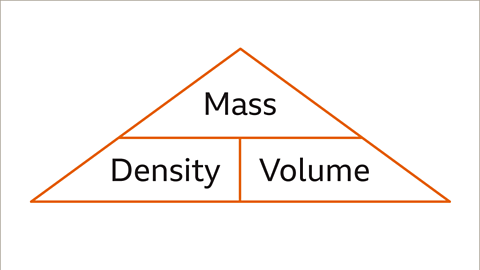
The triangle can help you remember the operations, but in an exam always write the full equation you are using.
What is density and how is it different for solids, liquids and gases? - BBC Bitesize
Read the BBC Bitesize explanation to consolidate the density equation, its rearrangements, and the standard unit pairings used in school physics.
In the section “What is the equation for calculating density?”, read the equation and unit rules. Pay particular attention to the three versions of the equation and the link between the units given and the density unit produced.
Density does not depend on sample size
If you have a uniform material at the same temperature, a larger sample has more mass and more volume, but its density stays the same.
For example, suppose a liquid has:
- mass and volume ;
- mass and volume .
Both samples have density:
and
The second sample is bigger, but it is not denser.
Quick self-check
Without calculating, decide which material is denser:
- Material A: in
- Material B: in
Same mass, but Material A occupies less volume, so A is denser.
2. The three equations you need
Start from the central relationship:
If the question asks for density, divide mass by volume.
If it asks for mass, multiply density by volume.
If it asks for volume, divide mass by density.
A useful exam habit is to write down what you know before choosing the equation:
| Question asks for | You should know | Equation |
|---|---|---|
| Density | mass and volume | |
| Mass | density and volume | |
| Volume | mass and density |
Do not choose the equation based only on whether you see multiplication or division in the numbers. Choose it based on the quantity the question asks you to find.
3. Finding density
Suppose a metal sample has a mass of and a volume of .
The question asks for density, so use:
Substitute the values, including units:
The final unit is because grams are being divided by cubic centimetres.
Full-mark layout
For a calculation question, use this pattern:
- Write the equation.
- Substitute numbers with units.
- Calculate.
- Give a final answer with the correct unit.
For the example:
This layout makes it easier for a marker to award method marks even if you make an arithmetic error.
Common mistake
A student calculates:
but writes .
That is wrong because density is not a mass. The unit must show mass per volume:
4. Finding mass
Now suppose a block has density and volume . Find its mass.
The unknown is mass, so use:
The parts cancel, leaving grams:
Both measurements were given to three significant figures, so the final answer should be:
Notice the unit logic:
This is a powerful check. If you are finding mass, your final unit should be a mass unit, usually or .
Fast sense-check
If volume increases while density stays the same, mass must increase. That agrees with multiplication in:
5. Finding volume
Suppose a liquid has mass and density . Find its volume.
The unknown is volume, so use:
The grams cancel, leaving cubic centimetres:
For a liquid, you can also give this as:
because:
Fast sense-check
For a fixed mass, a denser material must take up less volume. That agrees with division in:
A large density in the denominator gives a smaller volume.
Watch Tyler DeWitt’s “Density Practice Problems” for a compact demonstration of all three types of calculation. The emphasis on units and significant figures is especially useful for test answers.
Watch finding density to review mass divided by volume and the resulting density unit. Then watch finding mass, focusing on why multiplying density by volume leaves a mass unit. Finish with finding volume, where the density fraction is used so that grams cancel and the final unit is volume.
6. Units: the part that prevents easy mistakes
Use matching units whenever possible.
| Mass given in | Volume given in | Density unit should be |
|---|---|---|
The safest pairings for your test are:
and
Two conversions are particularly useful:
A mixed-unit example
A material has density and volume . Find its mass in kilograms.
The density uses , but the volume is in , so the units do not match. Convert the density:
Now use:
Written with two significant figures:
The main lesson: convert before substituting if the mass and volume units do not match the density unit.
7. Test-day method: read, choose, substitute, check
Use this routine for every density calculation.
- Underline the quantity to find. Is it density, mass, or volume?
- Write the correct full equation.
- Check units before calculating. Convert if necessary.
- Substitute values with their units.
- Calculate and round sensibly.
- Check the final unit matches the quantity found.
Here is a final-unit checklist:
- Finding density: , , or
- Finding mass: or
- Finding volume: , , or
If you find “mass” and your answer has , stop: you have either used the wrong equation or made a unit error.
8. Short independent practice
Try these without looking back at the worked examples. Use the full-mark layout each time.
-
A rock has mass and volume . Calculate its density.
-
A metal has density . Calculate the mass of of the metal.
-
A sample has mass and density . Calculate its volume.
-
Air in a small room has volume and density . Calculate the mass of the air.
-
A material has mass and volume . Calculate its density in . Convert the volume first.
-
Two blocks are made from the same material. Block B has twice the mass and twice the volume of Block A. Compare their densities and explain briefly.
Answers for self-checking
- First convert volume:
Then:
- Their densities are the same because both mass and volume change by the same factor.
You now have the full calculation toolkit:
The key is not memorising a triangle alone. Identify the unknown, write the complete equation, keep units consistent, and make sure the final unit fits the quantity you found.
Next, you will use these calculations in a density investigation: measuring mass and volume for regular and irregular objects, then using a graph to determine density from its slope.
Can't find a good explanation? Sign up and we'll make it for you
Sign up