
Welcome back. In the previous lesson, you learned to state a source’s main message: its central argument in your own words. Now you will take the next step. Once you have an interpretation, you need to prove that it comes from the source rather than from a guess.
By the end of this lesson, you should be able to select short, exact quotations from written sources or specific visual details from cartoons and posters that genuinely support an interpretation. This is a core skill for inference, purpose, comparison, and reliability questions later in the course.
Evidence is the proof; interpretation is the claim
An interpretation is what you conclude from a source. Evidence is the exact word, phrase, action, object, or visual feature in the source that led you to that conclusion.
Consider this written source:
“The new fare rise forces some lower-paid residents to choose between travel and other necessities.”
You might interpret the source as saying:
The source criticises the fare increase for unfairly harming lower-income residents.
That is an interpretation. The most precise supporting evidence is:
“forces some lower-paid residents to choose between travel and other necessities”
This is strong because it directly shows both:
- who is affected: “lower-paid residents”;
- how seriously they are affected: they must choose between transport and necessities.
By contrast, simply selecting “new fare rise” would be weak evidence. It tells us the topic, but it does not prove that the writer sees the policy as unfair or harmful.
A useful rule is:
Choose evidence that proves your specific interpretation, not evidence that merely proves the source is about the same topic.
The Khan Academy example below models this distinction. Notice how the presenter selects details about Poirot’s extreme neatness to support the more general inference that he is meticulous.
Supporting an inference with logical reasoning and evidence | Reading | Khan Academy
Watch Khan Academy’s “Supporting an inference with logical reasoning and evidence.” It shows how exact details can support an interpretation rather than merely repeat the source.
Watch the Poirot example. Focus on the difference between the claim that Poirot is meticulous and the precise descriptive details used to support it. Notice that several details are available, but the strongest ones show his concern with tiny imperfections.
What makes source evidence precise?
Precise evidence is usually short, relevant, and specific.
| Test | Ask yourself | Strong evidence | Weak evidence |
|---|---|---|---|
| Relevance | Does it support this interpretation? | A phrase describing harm, if your claim is about harm | A phrase that only names the issue |
| Specificity | Does it identify an exact detail? | “lower-paid residents” | “people” |
| Strength | Does it make the interpretation convincing? | A direct accusation, contrast, or striking image | A vague background detail |
| Accuracy | Have I quoted or described it correctly? | A short exact quotation | A distorted or invented quotation |
For written sources, evidence will often be a brief quotation. You do not need to copy an entire sentence. Select the few words that carry the meaning.
For visual sources, evidence is a precise reference to what is shown. Avoid vague statements such as “the cartoon has many people” or “the poster is colourful.” Instead, identify the meaningful feature: who is central, what they are doing, what is exaggerated, and what labels or symbols appear.
The title and caption within a cartoon can also be evidence if they are part of the original source. A date, author, or place supplied separately is usually provenance, not content evidence. Provenance matters, but you will use it more fully in reliability and purpose questions.
A quick selection method under exam conditions
Before writing, take a few seconds to match your claim to the source.
-
State your interpretation mentally.
For example: “The cartoon portrays Britannia as under violent attack.” -
Underline or label possible evidence.
In a written source, underline loaded words, judgments, causes, or consequences. In a visual source, label significant actions, facial expressions, objects, captions, and contrasts. -
Ask the evidence test.
“If I showed this detail to someone, would it help them understand why I reached my interpretation?” -
Choose the strongest one or two details.
A precise quotation or visual detail is better than a long list. -
Keep the evidence tied to your claim.
Do not add details just because they are dramatic or easy to spot.
Dr Amy Calladine’s source-analysis toolkit gives a practical planning routine that fits this approach: annotate key words in a written source and quickly label important images in a visual source before drafting an answer.
[PDF] Show me the evidence! A primary source toolkit for GCSE History.
Read the relevant planning guidance in Dr Amy Calladine’s toolkit. It gives a fast way to identify useful evidence before you begin writing under exam time pressure.
On p. 40, find “Writing an Analysis: First Steps.” Read the four-step planning method, especially steps 2 and 3. Focus on the difference between underlining key content or labelling key images and summarising the source’s overall message. Your annotations should be selected with the question in mind, not a record of every detail you notice.
Applying the method to a cartoon
Study James Gillray’s 1798 cartoon, Britannia’s Assassination.
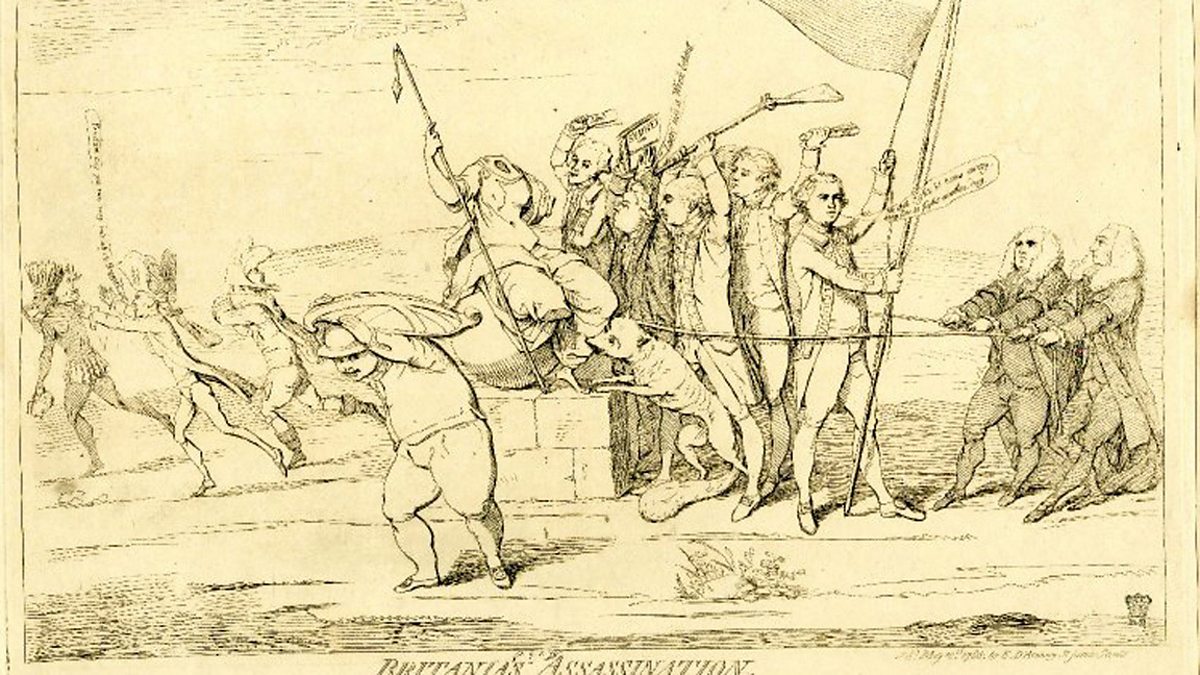
A sensible interpretation is:
The cartoon portrays Britannia as the victim of a coordinated and violent attack.
Now select details that match the important words in the interpretation: victim, coordinated, and violent.
Strong evidence includes:
- the printed title, “BRITANNIA’S ASSASSINATION”;
- Britannia is shown headless;
- several figures surround and attack her with raised weapons.
Each detail fits the interpretation. The title makes the violent judgment explicit; the headless body presents Britannia as a victim; the surrounding attackers suggest that the assault comes from more than one direction.
A concise evidence-supported answer could begin:
The cartoon portrays Britannia as the victim of a coordinated and violent attack. This is shown by the title “Britannia’s Assassination” and by the headless Britannia being attacked by several armed figures.
Notice what this answer does not do:
- It does not describe every person in the cartoon.
- It does not name the figures without clear labels or contextual knowledge.
- It does not use the date “1798” as if the date itself proves the visual interpretation.
- It does not replace evidence with a vague phrase such as “the cartoon is violent.”
When evidence is visual, write enough detail that a reader could locate the feature in the image.
Do not evidence-dump
A common mistake is to include many quotations or visual details without choosing the best ones. More evidence is not automatically better evidence.
Imagine you interpret a source as criticising a government for failing ordinary citizens. These are possible details:
- “the minister wore a blue suit”;
- a small building in the background;
- “families abandoned” in large print;
- a crying parent standing beside an empty food cupboard.
The final two details are much stronger because they directly show the alleged failure and its effect on families. The minister’s clothing may be visible, but it does not support the interpretation.
Use this comparison:
| Approach | Example | Problem or strength |
|---|---|---|
| Evidence dump | “There is a minister, a cupboard, a parent, a sign, and some houses.” | Describes without proving a point. |
| Vague evidence | “The source shows poor families.” | Does not identify the exact feature. |
| Precise evidence | “The slogan ‘families abandoned’ and the empty food cupboard portray families as neglected.” | Selects details that match the interpretation. |
The following Khan Academy video gives the same exam-useful principle: search for the most relevant details, then prefer the details that make your claim clearest and most convincing.
Citing evidence in literary analysis | Reading | Khan Academy
Watch Khan Academy’s “Citing evidence in literary analysis.” Although its example is from fiction, its method for selecting evidence transfers directly to Social Studies sources.
Begin with claims and proof to reinforce why an interpretation needs source support. Then watch finding proof for the process of locating relevant, specific details. Watch using a quotation, then finish with testing strength. Focus on the question: which detail best demonstrates the claim?
Matching evidence to the exact claim
Evidence is not “strong” by itself. Its strength depends on the interpretation you are trying to support.
Return to Britannia’s Assassination:
| Interpretation | Best supporting evidence |
|---|---|
| Britannia is under violent attack. | The word “Assassination,” the headless Britannia, and raised weapons |
| Several attackers are involved. | The group of figures surrounding Britannia from different sides |
| The cartoon is about a threat to Britannia. | Britannia’s central position as the attacked figure, reinforced by the title |
Suppose instead you wrote:
“The cartoon praises Britain’s strength.”
The same evidence would not support that claim. A headless Britannia under attack is much more consistent with weakness, danger, or victimhood than with strength. This is why you should always check whether your evidence makes your interpretation more likely, rather than simply being a real feature of the source.
For a written source, use the same discipline. If your interpretation is that a writer is optimistic, select words such as “successful,” “improving,” or “hopeful.” Do not choose a statistic merely because it is precise unless it actually demonstrates improvement.
A compact answer structure
When a question asks you to support an interpretation, this structure is reliable:
Interpretation: The source suggests that…
Evidence: This is shown by “…” / This is shown by the way that…
For a written source:
The writer suggests that the fare rise is unfair to lower-income residents. This is shown by the phrase “forces some lower-paid residents to choose between travel and other necessities.”
For a visual source:
The cartoon suggests that Britannia is under a severe attack. This is shown by the title “Britannia’s Assassination” and the image of a headless Britannia surrounded by armed figures.
At this stage, your priority is choosing the right evidence. In the next lesson, you will develop the final and most important link: explaining clearly how that evidence proves your interpretation.
Key takeaways
Precise source evidence is the exact material from a source that supports your interpretation.
When selecting it:
- match the evidence to the specific claim you are making;
- quote short, meaningful words or phrases from written sources;
- refer precisely to actions, labels, symbols, or contrasts in visual sources;
- select the strongest one or two details rather than listing everything;
- keep provenance separate from source content unless the question specifically requires it.
You can now move from “I think the source means this” to “I think the source means this, and here is the exact evidence for it.” Next, you will learn to explain the reasoning link between that evidence and your interpretation.
Can't find a good explanation? Sign up and we'll make it for you
Sign up