
Welcome. This module turns from Daoism’s historical setting to one of its most memorable and most misread ideas: wu wei. You will sometimes see Dao written as Tao and wu wei rendered as non-action. That translation is memorable, but it causes trouble immediately.
For this course, treat wu wei as non-forcing action: acting with careful attention to the actual shape of a situation, rather than trying to overpower it through strain, panic, ego, or a rigid plan. It can involve decisive, demanding action. It is not a philosophical permission slip to ignore the dishes, the deadline, or the crisis.
By the end of this lesson, you should be able to tell wu wei apart from three look-alikes: laziness, passivity, and literal inactivity.
The translation trap
The two characters in wu wei can suggest “without action,” so it is understandable that the phrase is often heard as “do nothing.” But early Daoist texts do not recommend becoming inert. Their concern is a particular kind of action: action that is overly deliberate, controlling, and out of tune with the conditions in which it occurs.
A useful modern shorthand is:
Wu wei is not the absence of action; it is the absence of unnecessary forcing.
That wording is not a complete translation, and no short English phrase is. But it protects us from the central mistake.
Watch “EASTERN PHILOSOPHY: Wu Wei” from The School of Life for a concise first pass through the apparent contradiction: “non-action” that is nevertheless highly effective action.
Watch the translation trap for the distinction between inactivity and unforced action. Then continue with flow and flexibility, focusing on the claim that responding to circumstances is different from imposing a rigid ideal on them. The familiar language of being “in the zone” is helpful, but keep in mind that wu wei is broader than a pleasant productivity state.
The Daoist background matters here. Dao literally means “way,” but in these texts it points beyond a route or a rulebook. It names the underlying course, pattern, or way of things. A river has a course; wood has a grain; a social situation has pressures, relationships, and limits. In each case, acting well begins with noticing what is actually there.
Read the opening sections of “Wu-Wei: Acting without Desire” from 1000-Word Philosophy. It gives a compact account of Dao as the natural structure of a situation and introduces the idea that wu wei concerns alignment rather than mere withdrawal.
In Section 1, “The Dao,” read the orientation from the opening paragraph through the explanation of Dao as more than a human invention. Then read all of Section 2, “Acting according to the natural structure of a situation.” When you reach the alignment sentence, pause over “attuned”: the point is not blind obedience, but responsive perception.
There is no need, at this stage, to settle a large metaphysical question—whether the Dao is best understood as a cosmic source, the intelligible pattern of nature, or something that resists both descriptions. For understanding wu wei, the practical point is simpler: do not substitute your fantasy of the situation for the situation itself.
Four things that can look alike from a distance
Imagine someone encountering a difficult task and not immediately charging at it. From the outside, that pause could be wise or irresponsible. The difference lies in what follows and why.
| Stance | What happens to necessary action? | Relation to the situation | Typical inner posture |
|---|---|---|---|
| Laziness | It is avoided or indefinitely postponed. | The real demand is evaded. | “I cannot be bothered.” |
| Passivity | It is surrendered to events or other people, even when intervention is needed. | One gives up agency. | “Nothing I do matters.” |
| Literal inactivity | No outward action occurs for now. | It may be wise, foolish, or neutral depending on context. | “I am waiting.” |
| Wu wei | Appropriate action is taken, which may include waiting, speaking, yielding, or acting firmly. | One works with actual conditions and available leverage. | “What does this situation require, without my adding needless force?” |
Wu wei is not laziness
Laziness avoids effort because effort is unpleasant. Wu wei does not avoid effort as such; it avoids wasteful effort.
A surgeon may spend hours operating. A parent may have a difficult conversation. A person may defend a colleague, leave a harmful job, or spend months learning a craft. None of these is inconsistent with wu wei. The question is not, “Did this require energy?” It is, “Was the energy intelligently and proportionately applied?”
The phrase effortless action can mislead here too. “Effortless” describes the quality of action at its best: unstrained, unself-conscious, responsive. It does not mean that preparation, training, or courage have vanished.
A pianist can play a difficult passage without visible struggle precisely because years of attention have made the instrument, body, and music cooperate. Calling that performance “effortless” does not erase the practice behind it.
Wu wei is not passivity
Passivity says, “Let whatever happens happen.” Wu wei says, “Respond without trying to dominate every variable.”
That difference becomes ethically important. Daoist non-forcing is not an instruction to accept exploitation, cruelty, or preventable harm. A necessary boundary can be set without theatrical aggression. A refusal can be calm and exact. Sometimes the least forced action is a clear “no.”
Water is a central Daoist image partly because it is yielding without being helpless. It does not argue with a rock or try to become a hammer; it goes around it, wears it down over time, or finds another channel. Yielding is therefore a strategy of responsiveness, not a confession of defeat.
Wu wei is not simply doing nothing
Sometimes doing nothing for a moment is the right move: not sending the angry message, not making a panicked change, not interrupting before you understand. But the stillness is not automatically wu wei.
Consider two silences in a meeting:
- One person remains silent because they are disengaged and hope someone else handles the problem.
- Another person waits long enough to understand the disagreement, then identifies the actual decision needed and says one clarifying sentence.
Both begin with inaction. Only the second is plausibly non-forcing. It is an active restraint in the service of an appropriate response.
What, then, is being “forced”?
Forcing does not just mean using physical force. It is an orientation toward action: treating reality as raw material that must immediately obey our preferred outcome.
It often has recognizable symptoms:
- acting before seeing the constraints;
- escalating pressure because the first attempt did not work;
- confusing anxiety with urgency;
- applying a favorite technique regardless of fit;
- trying to control people rather than address the situation;
- equating exhaustion with seriousness.
This is not a Daoist argument against plans, analysis, or technical competence. It is an argument against becoming captured by them.
A systems example makes the distinction concrete. Suppose a deployment has produced rising error rates.
- Laziness ignores the alert.
- Passivity watches the dashboard while assuming the incident belongs to somebody else.
- Forcing starts a broad redesign under pressure, changes several variables at once, and destroys the ability to tell what went wrong.
- Wu wei, in the practical sense, begins by reading the system: isolate the change, assess blast radius, use the rollback or mitigation that fits the evidence, communicate clearly, and escalate when needed.
The non-forcing response may be fast and intense. What makes it different is that it uses the system’s actual structure rather than fighting it blindly. The Daoist point is not “never intervene.” It is “do not hack through the joint when there is a space beside it.”
Desire, control, and the quieter kind of agency
Daoist discussions of wu wei often criticize action driven by personal desire. This does not mean that one must become a desireless machine, with no preferences, commitments, or projects. Ordinary desires—to eat, rest, complete meaningful work, protect someone—are not the target of the everyday lesson.
The target is a more distorting attachment:
“This must go exactly as I imagined, on my timetable, and in a way that confirms my control.”
That attachment can make a person act against clear feedback. In contrast, wu wei asks for a quieter agency: still present, still capable, but less occupied with proving itself.
The shift resembles the difference between steering a boat and trying to command the wind. Steering is real action. It involves skill, attention, and sometimes considerable exertion. But it begins with the wind and water that are actually present.
A picture to keep in mind
The next lesson will dwell on the story of Cook Ding, the butcher whose knife moves through an ox with extraordinary precision. For now, notice the visual contrast in this traditional painting: there is action, a tool, and concentrated work—not a person reclining in refusal to act.
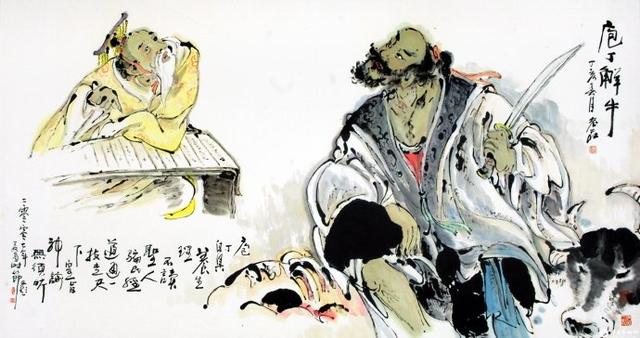
The story’s point is not that butchery is spiritually effortless, nor that expertise can be reduced to “going with the flow.” Cook Ding acts with astonishing concentration. He attends to the spaces and joints instead of treating the ox as an undifferentiated obstacle. His blade lasts because he does not attack what does not need attacking.
That is the image to retain: not no knife, but a knife that finds the openings.
A compact diagnostic
When you encounter a stressful task, wu wei does not provide a prewritten answer. It offers a way to inspect the quality of your response. Before acting, ask:
-
What is actually happening?
Separate observed facts from the story anxiety has added. -
What genuinely needs doing?
Identify the responsibility rather than using “non-forcing” to evade it. -
Where am I adding force?
Look for unnecessary complexity, repetition, escalation, or attempts to control what cannot be controlled. -
What is the smallest adequate intervention?
“Smallest” does not mean timid; it means proportionate to the situation. -
What feedback would make me revise course?
Non-forcing is responsive, not stubbornly relaxed.
These questions are not an ancient Daoist checklist. They are a contemporary aid for preserving the core contrast: attentive responsiveness versus avoidance, surrender, or coercion.
Key takeaways
- Wu wei is best approached as non-forcing or unstrained action, not as literal inaction.
- It differs from laziness because it does not evade needed work.
- It differs from passivity because it does not abandon agency or necessary boundaries.
- It differs from simply waiting because stillness is only wu wei when it is an attentive, fitting response.
- “Effortless” means free of needless friction at the moment of action; it does not mean effortless to learn or guaranteed to succeed.
- The practical challenge is to see the situation clearly and act with its real contours rather than against them.
Next, we will enter the story of Cook Ding in detail. His nineteen-year-old knife will give us a vivid model of why Daoists link mastery not to brute force, but to perception, timing, and responsiveness.
Can't find a good explanation? Sign up and we'll make it for you
Sign up