Welcome back. In our previous lesson, you implemented a crucial compliance feature: the ability for a designated administrator to freeze and unfreeze investor accounts. This "soft lock" is the first line of defense in many compliance workflows. Today, we will build upon that by implementing a "hard lock" action: a forced transfer.
This lesson addresses the implementation of a forcedTransfer function, which grants an administrator the power to move tokens on behalf of an investor. This capability is essential for any token aspiring to represent a real-world regulated asset. It provides the mechanism to comply with legal judgments, execute asset recovery for users who have lost their private keys but can prove their identity, or resolve other exceptional situations that require direct intervention. For someone with your background in asset management software, this concept should be familiar; it's the on-chain equivalent of a system administrator's ability to correct records or execute mandated actions, but with the added transparency of the blockchain.
The Need for Administrative Intervention
While blockchain's immutability is a core strength, the world of regulated finance demands pathways for legal and administrative recourse. A security token must be able to accommodate off-chain legal realities. The ability to force a transfer is not a bug or a vulnerability; it's a required feature for legal compliance and operational robustness.
Industry standards for security tokens explicitly recognize this need. The feature allows an authorized issuer to move assets from an account—even a frozen one—to another, ensuring the token can be managed in alignment with court orders or regulatory requirements.
This GitHub repository for the CMTAT standard, a prominent Swiss framework for tokenized assets, provides excellent context on why forced transfers are a standard feature.
Please review the following parts of the README file: In the introductory table, read the purpose of the Forced Transfer feature. In the ERC20EnforcementModule section, find the interface definition. Note the description that to move tokens from a frozen address, the issuer must use the function forcedTransfer. Finally, examine the table at the end of the file. It shows that forcedTransfer is unique because it is authorized to operate on frozen accounts and bypasses the standard RuleEngine (i.e., compliance rules), which is exactly the behavior we need to implement.
This establishes that what we are building is a recognized and necessary pattern for tokenized securities.
Implementing the forcedTransfer Function
Now, let's add this powerful capability to our SecurityToken contract. The implementation involves three main steps: defining the function, securing it with access control, and ensuring it can bypass the freeze restriction we implemented previously.
1. Defining the Function and an Audit Event
First, we will define the function signature and a corresponding event. Emitting an event is non-negotiable for such a powerful administrative action, as it creates a permanent, public audit trail.
Add the following to your SecurityToken.sol contract:
// Add this event definition with your other events
event ForcedTransfer(
    address indexed operator,
    address indexed from,
    address indexed to,
    uint256 amount
);

// Add this function definition within the contract body
function forcedTransfer(
    address from,
    address to,
    uint256 amount
) public onlyRole(COMPLIANCE_ROLE) {
    // We will fill this in next
}
We secure the function with the onlyRole(COMPLIANCE_ROLE) modifier, ensuring that only an address with this specific administrative privilege can execute a forced transfer.
2. Bypassing the Freeze: Modifying the Hook
In our last lesson, we added a check to _beforeTokenTransfer that reverts any transaction involving a frozen account. A simple call to _transfer(from, to, amount) within our new function would trigger this hook and fail.
To solve this, we will make our _beforeTokenTransfer hook "smarter". Since the forcedTransfer function is called by the COMPLIANCE_ROLE administrator, the _msgSender() within the context of the transfer will be the administrator's address. We can use this to create a special path that bypasses the normal checks.
However, even a forced transfer should not be a free-for-all. A critical design decision is which rules to bypass and which to uphold. The following resource provides a well-reasoned implementation.
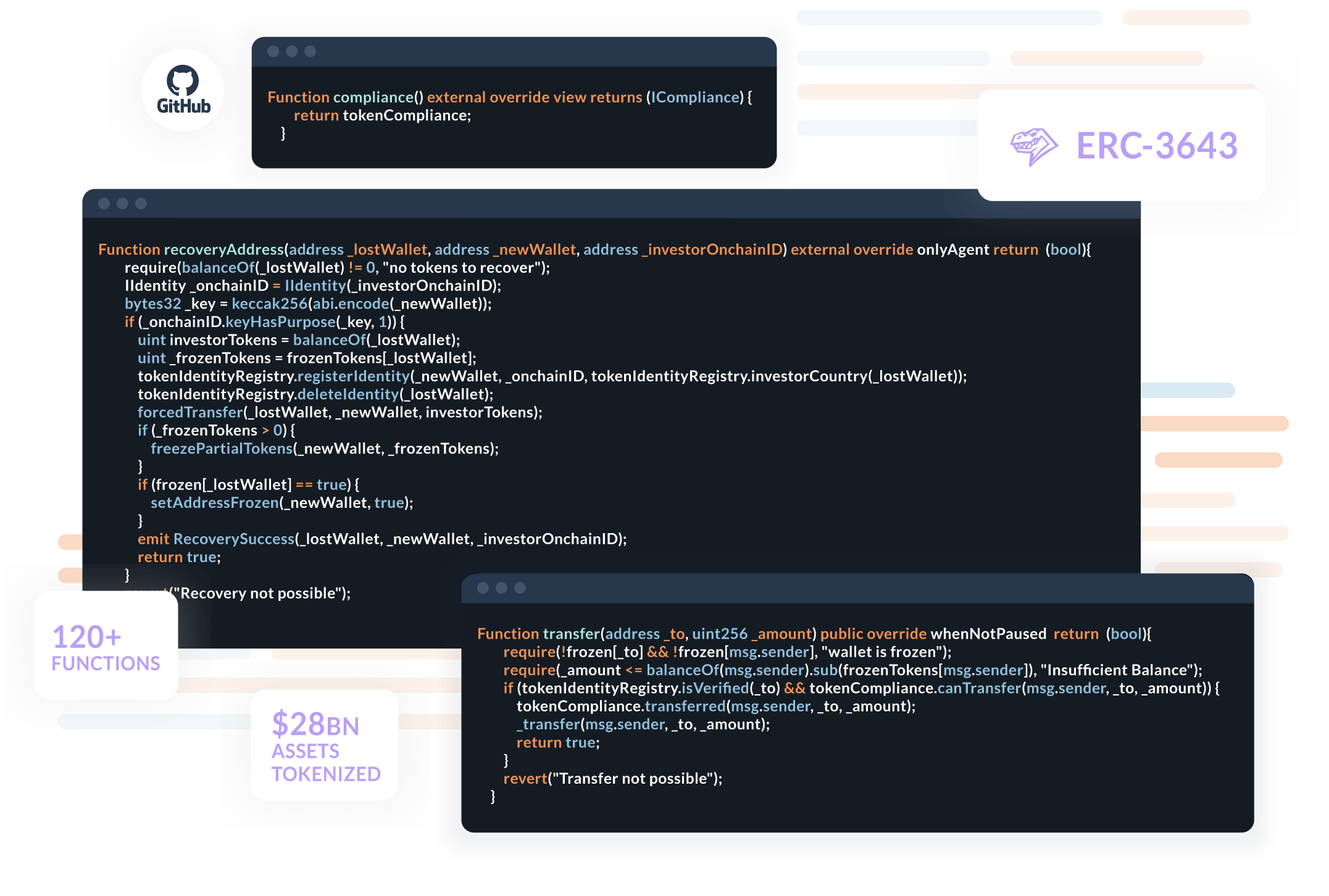
Part 2 Tutorial: Tokenizing Using ERC-3643 - Paragraph
This tutorial demonstrates building a token based on the ERC-3643 standard and includes a forcedTransfer implementation.
Focus on the logic within the forcedTransfer function. Notice two key things: it bypasses standard compliance checks but still enforces one crucial rule: require(_identityRegistry.isVerified(to), "receiver not verified"). This prevents an administrator from moving assets to an unvetted wallet, even under duress. We will adopt this same principle.
We will modify our _beforeTokenTransfer hook to implement this logic. If the initiator of the transfer holds the COMPLIANCE_ROLE, we will skip the freeze checks and the sender's allowlist check, but we will still verify that the recipient is on the allowlist.
Replace your existing _beforeTokenTransfer function with this updated version:
function _beforeTokenTransfer(
    address from,
    address to,
    uint256 amount
) internal virtual override {
    super._beforeTokenTransfer(from, to, amount);

    // The COMPLIANCE_ROLE can bypass normal transfer restrictions to execute a forced transfer.
    // _msgSender() will be the compliance admin in this context.
    if (hasRole(COMPLIANCE_ROLE, _msgSender())) {
        // Even in a forced transfer, the recipient must be a verified investor.
        if (to != address(0)) {
            require(investorRegistry.isVerified(to), "SecurityToken: Receiver not on allowlist");
        }
        // Exit the hook early, skipping the normal checks below.
        return;
    }

    // --- Normal transfer checks for all other users ---
    if (from != address(0)) {
        require(!_frozenAccounts[from], "SecurityToken: Sender account is frozen");
        require(investorRegistry.isVerified(from), "SecurityToken: Sender not on allowlist");
    }

    if (to != address(0)) {
        require(!_frozenAccounts[to], "SecurityToken: Receiver account is frozen");
        require(investorRegistry.isVerified(to), "SecurityToken: Receiver not on allowlist");
    }
}
This elegant solution uses our existing AccessControl system to create a conditional logic path within the transfer hook, cleanly handling the exception without adding complex state variables.
3. Completing the forcedTransfer Logic
With the hook updated, the forcedTransfer function itself becomes very simple. It only needs to perform basic checks and then call the standard _transfer function, which will now correctly apply our special-case logic.
Update your forcedTransfer function as follows:
function forcedTransfer(
    address from,
    address to,
    uint256 amount
) public onlyRole(COMPLIANCE_ROLE) {
    require(from != address(0), "SecurityToken: transfer from the zero address");
    require(to != address(0), "SecurityToken: transfer to the zero address");

    // The internal _transfer function will call our modified _beforeTokenTransfer hook,
    // which handles the freeze bypass and recipient verification.
    // The balance check is automatically handled by OpenZeppelin's _transfer function.
    _transfer(from, to, amount);

    emit ForcedTransfer(_msgSender(), from, to, amount);
}
That's it. Our SecurityToken now has a fully-featured, access-controlled, and auditable forced transfer capability that aligns with industry best practices.
Updated SecurityToken Contract
Here is the full contract incorporating the changes from today's lesson.
// SPDX-License-Identifier: MIT
pragma solidity ^0.8.20;

import "@openzeppelin/contracts/token/ERC20/ERC20.sol";
import "@openzeppelin/contracts/access/AccessControl.sol";
import "./IInvestorRegistry.sol";

contract SecurityToken is ERC20, AccessControl {
    bytes32 public constant MINTER_ROLE = keccak256("MINTER_ROLE");
    bytes32 public constant COMPLIANCE_ROLE = keccak256("COMPLIANCE_ROLE");

    IInvestorRegistry public investorRegistry;

    mapping(address => bool) private _frozenAccounts;

    event AccountFrozen(address indexed account);
    event AccountUnfrozen(address indexed account);
    event ForcedTransfer(address indexed operator, address indexed from, address indexed to, uint256 amount);

    constructor(
        string memory name,
        string memory symbol,
        address registryAddress
    ) ERC20(name, symbol) {
        require(registryAddress != address(0), "SecurityToken: Registry address cannot be zero");
        investorRegistry = IInvestorRegistry(registryAddress);

        _grantRole(DEFAULT_ADMIN_ROLE, msg.sender);
        _grantRole(MINTER_ROLE, msg.sender);
        _grantRole(COMPLIANCE_ROLE, msg.sender);
    }

    function mint(address to, uint256 amount) public virtual onlyRole(MINTER_ROLE) {
        _mint(to, amount);
    }

    function isFrozen(address account) public view returns (bool) {
        return _frozenAccounts[account];
    }

    function freezeAccount(address account) public onlyRole(COMPLIANCE_ROLE) {
        require(account != address(0), "SecurityToken: Cannot freeze the zero address");
        require(!_frozenAccounts[account], "SecurityToken: Account is already frozen");
        _frozenAccounts[account] = true;
        emit AccountFrozen(account);
    }

    function unfreezeAccount(address account) public onlyRole(COMPLIANCE_ROLE) {
        require(account != address(0), "SecurityToken: Cannot unfreeze the zero address");
        require(_frozenAccounts[account], "SecurityToken: Account is not frozen");
        _frozenAccounts[account] = false;
        emit AccountUnfrozen(account);
    }

    function forcedTransfer(address from, address to, uint256 amount) public onlyRole(COMPLIANCE_ROLE) {
        require(from != address(0), "SecurityToken: transfer from the zero address");
        require(to != address(0), "SecurityToken: transfer to the zero address");

        _transfer(from, to, amount);
        emit ForcedTransfer(_msgSender(), from, to, amount);
    }

    function _beforeTokenTransfer(
        address from,
        address to,
        uint256 amount
    ) internal virtual override {
        super._beforeTokenTransfer(from, to, amount);

        if (hasRole(COMPLIANCE_ROLE, _msgSender())) {
            if (to != address(0)) {
                require(investorRegistry.isVerified(to), "SecurityToken: Receiver not on allowlist");
            }
            return;
        }

        if (from != address(0)) {
            require(!_frozenAccounts[from], "SecurityToken: Sender account is frozen");
            require(investorRegistry.isVerified(from), "SecurityToken: Sender not on allowlist");
        }

        if (to != address(0)) {
            require(!_frozenAccounts[to], "SecurityToken: Receiver account is frozen");
            require(investorRegistry.isVerified(to), "SecurityToken: Receiver not on allowlist");
        }
    }
}
Conclusion
In this lesson, you implemented one of the most powerful and necessary administrative functions for a security token. By adding a forcedTransfer function, you have provided a crucial tool for legal compliance and operational management, bridging the gap between on-chain technology and off-chain legal frameworks.
Key Takeaways:
- A
forcedTransferfunction is a standard and required feature for regulated digital assets. - Access must be strictly limited to a specific administrative role, like our
COMPLIANCE_ROLE. - The function must be able to bypass certain restrictions (like account freezes) but should still enforce fundamental rules (like recipient eligibility).
- Modifying the
_beforeTokenTransferhook with role-based conditional logic is a clean and effective way to manage these exceptions. - Emitting a dedicated event is critical for maintaining a transparent and auditable on-chain history of administrative actions.
Our SecurityToken now has robust administrative controls. Next, we will shift our focus from compliance and control to one of the primary purposes of a security: distributing value. In the upcoming lesson, you will design and implement a dividend distribution mechanism.