
Introduction
Welcome to our final lesson on Immanuel Kant. Over the last few lessons, we've built a detailed picture of his ethical system. We began with the Formula of Universal Law, which provides the logical form of a moral maxim. Then, we explored the Formula of Humanity, which gives morality its content by demanding respect for the intrinsic dignity of all rational beings.
Today, we address a final, crucial question: What makes an action truly praiseworthy? Is it enough just to do the right thing? For Kant, the answer is a firm 'no'. The moral worth of an action lies not in its outcome, nor even in the action itself, but in the motive behind it.
This lesson focuses on one of the most important distinctions in Kant's ethics: the difference between acting from duty and acting merely in accordance with duty. By the end of our session, you will be able to explain this distinction and apply it to concrete examples, completing our understanding of what it means to have a "good will."
1. The Good Will: The Sole Unconditional Good
Before we can understand the motive of duty, we must start where Kant himself begins: with the concept of the good will. Kant famously opens his Groundwork by arguing that only one thing in the entire universe is good without any qualification or condition: a good will.
Qualities we often admire—such as intelligence, courage, wealth, or even happiness—are only good on the condition that they are guided by a good will. In the hands of a villain, courage becomes a tool for greater evil. Without a good will, happiness can lead to arrogance. For Kant, the good will is the indispensable condition for even being worthy of happiness.
Let's turn directly to Kant's foundational text to see how he establishes this idea.
[PDF] Groundwork for the Metaphysic of Morals - Early Modern Texts
In the opening pages of the Groundwork, Kant argues for the supreme value of the good will. He claims its worth is not derived from what it accomplishes but is intrinsic to its nature as a rational will striving to do what is right.
Please read the first five paragraphs of Chapter 1. Start with the famous opening sentence, 'Nothing in the world—or out of it!—can possibly be conceived that could be called ‘good’ without qualification except a GOOD WILL.' End with the paragraph that concludes, 'Its value wouldn’t go up or down depending on how useful or fruitless it was.' Focus on why Kant believes the good will is good 'in itself,' independent of its consequences.
Kant's point is radical. He argues that even if a person with a good will, through sheer bad luck, fails to achieve any of their positive aims, that will "would sparkle like a jewel all by itself, as something that had its full worth in itself." This places him in direct opposition to consequentialist theories, which locate moral worth entirely in the outcomes of actions.
This raises the central question: What kind of motive constitutes a good will? Kant's answer is: acting from duty.
2. Acting 'From Duty' vs. 'In Accordance with Duty'
Kant argues that for an action to have genuine moral worth, it must be done from duty, not merely in accordance with duty.
- In Accordance with Duty: This means you do the right thing, but your motive is something other than duty. Your reason might be self-interest, fear of punishment, or a natural feeling of sympathy or love. The action itself conforms to what duty requires, but the will is not motivated by duty.
- From Duty: This means you do the right thing because it is your duty. The motive is pure respect for the moral law itself, independent of any personal benefit or inclination.
To make this distinction clear, Kant provides a series of powerful examples. These are among the most famous passages in his work and are essential for grasping his view of moral worth.
[PDF] Groundwork for the Metaphysic of Morals - Early Modern Texts
Here, Kant illustrates his crucial distinction with four classic examples: the honest shopkeeper, the duty to preserve one's life, the philanthropist, and the duty to secure one's own happiness. These examples are designed to isolate the motive of duty from all other incentives.
Please read the section in Chapter 1 beginning '·My topic is the difference between doing something from duty and doing it for other reasons.·' and ending with 'Only by following this could his conduct have true moral worth.' Pay close attention to the motive of the agent in each scenario.
Let's break down these examples:
-
The Honest Shopkeeper: He gives all customers a fair price. This is in accordance with duty. But his motive is prudential self-interest: he fears losing customers if he doesn't. His action has no moral worth. Had he charged a fair price out of a direct principle of honesty, even if it might hurt his business, he would have acted from duty.
-
Preserving One's Life: Most people preserve their life because they have a powerful inclination to do so. This is in accordance with duty, but has no moral content. However, for a person so miserable that they wish for death, but who preserves their life not from inclination or fear but from duty, their action has genuine moral worth.
-
The Philanthropist: A person who is naturally sympathetic and finds "inner satisfaction in spreading joy" acts in accordance with duty. Their actions are "amiable" but have no true moral worth because they are driven by inclination. Contrast this with a person who, though clouded by their own sorrow and feeling no natural sympathy for others, tears themselves out of this "dead insensibility" and helps others purely from duty. Now, Kant says, their action has genuine moral worth.
These examples are often misunderstood. Kant is not saying that it's better to be a cold-hearted person or that you can only act morally if you hate doing the right thing. His point is that because we can never be certain of our hidden inclinations, moral worth is most clearly visible—both to ourselves and others—when inclination is absent or even runs contrary to our duty. These are the cases that test our commitment to the moral law itself.
3. Reason, Freedom, and the Human Condition
Why does Kant place such emphasis on this distinction? It's because it lies at the heart of his view of human freedom and rationality.
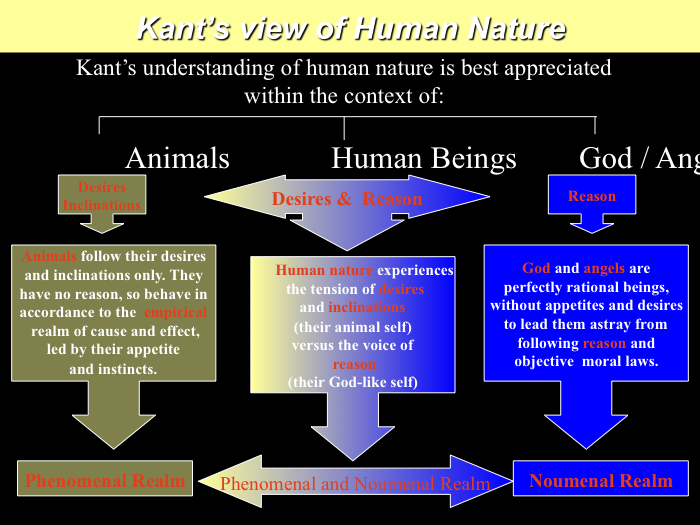
As the chart shows, human beings are unique. Unlike animals, we are not simply slaves to our desires and inclinations. Unlike a holy will (like God's), our will is not perfectly and automatically aligned with reason. We are "citizens of two worlds":
- The Phenomenal World: The world of our senses, desires, feelings, and inclinations.
- The Noumenal World: The world of pure reason, freedom, and the moral law.
When we act from inclination or self-interest, we are being determined by causes from the phenomenal world, just like an animal. But when we act from duty, we exercise our freedom (autonomy) by allowing our will to be determined by a law we give to ourselves as rational beings. This is an expression of our higher, noumenal self. Acting from duty is what makes us moral agents and is the source of our dignity.
This lecture provides a clear summary of this challenging but central idea.
Kant - Groundwork for the Metaphysic of Morals
The speaker in this lecture, Adam Rosenfeld, provides an excellent summary of why actions must be done 'from duty' to have moral worth, connecting it to the concepts of a good will, reason, and universality.
Please watch the segment from 50:23 to 59:00. The speaker brings together all the concepts we've discussed: good will, duty, and reason. Notice his key summary: 'In order for an action to have moral worth, it needs to be done for no reason other than it's right.'
Your Turn: Applying the Distinction
To solidify your understanding, let's analyze a new scenario.
Scenario: You are an IT analyst working for a large corporation. While reviewing code, you discover a significant security vulnerability that could expose the personal data of millions of users. The flaw is obscure, and you know that reporting it will cause a major project delay, create a lot of extra work for you and your team, and will likely displease your superiors.
Consider four possible ways you could respond:
- Response A: You decide not to report the flaw. You reason that it's unlikely to be discovered, and you don't want the hassle and negative attention that reporting it would bring.
- Response B: You report the flaw because you are afraid that if someone else finds it later, you might be blamed for negligence and could lose your job.
- Response C: You report the flaw because you have a strong sense of personal loyalty to your manager, who has always been kind to you, and you don't want to let her down.
- Response D: You report the flaw because you recognize a fundamental duty to protect people from harm and a duty of professional integrity, even though you anticipate negative personal consequences and feel no particular inclination to do the extra work.
Task:
Analyze each response according to Kant's framework:
- Which action is contrary to duty?
- Which actions are in accordance with duty, but not from duty? For each, identify the motive (self-interest, inclination, etc.).
- Which action is performed from duty and therefore has genuine moral worth?
Briefly justify your classifications for each of the four responses.
Conclusion
Today's lesson brings our journey through Kant's ethics to a close. We have seen that for an action to be truly moral, it is not enough for it to be the "right" action. It must be motivated by the right reason: a pure respect for the moral law itself. This is the distinction between merely acting in accordance with duty and acting from duty.
Key Takeaways:
- The only thing that is good without qualification is a good will.
- A good will is one that acts from duty.
- Acting from duty means doing the right thing because it is the right thing, motivated by respect for the moral law.
- Acting in accordance with duty means doing the right thing but for other reasons, such as self-interest or inclination (e.g., sympathy). Such actions, while not bad, have no genuine moral worth.
- This distinction is crucial because acting from duty is the ultimate expression of our freedom and rationality—our ability to rise above our inclinations and be guided by a law we give to ourselves.
Over the last several lessons, you have reconstructed the core of one of the most influential ethical systems in Western philosophy. From the a priori nature of the Good Will, we derived the form of the moral law (the Formula of Universal Law), its content (the Formula of Humanity), and finally, the nature of a morally worthy action (acting from duty). Kant's ideas about dignity, autonomy, and duty have profoundly shaped modern conceptions of human rights, justice, and the very meaning of moral life.
Can't find a good explanation? Sign up and we'll make it for you
Sign up