
Hello again. In the last lesson, you mapped your initiative to the priorities of Directors, VPs, and C-suite leaders. You identified that the technical recommendation stays consistent, while its emphasis changes according to the decision-maker’s accountability.
This lesson makes that connection more concrete. You will translate one software-engineering initiative into four executive lenses: business value, risk, cost, and strategic impact. The goal is not to make technical work sound grander than it is. It is to explain, with precision, what the work changes for the organization and what decision is required.
By the end, you will have a concise executive translation for your own initiative that you can reuse in a presentation opening, a business case, or a leadership meeting.
Technical work is the mechanism, not the message
An executive may care about architecture, reliability, deployment pipelines, or cloud infrastructure. But those subjects rarely constitute the decision by themselves. The decision is usually about whether to invest time, money, capacity, or leadership attention in a change that improves an organizational outcome.
Consider the difference:
| Technical statement | Executive translation |
|---|---|
| “We need to refactor the checkout service.” | “We need to remove a checkout constraint that is slowing high-priority changes and increasing the likelihood of customer-facing disruption during peak demand.” |
| “Our deployment process is too manual.” | “Release work is consuming engineering capacity and limiting our ability to respond quickly to customer and market needs.” |
| “We need better observability.” | “We need to shorten the time spent detecting and resolving production issues, reducing disruption to customers and internal teams.” |
| “We should migrate this workload.” | “We should reduce the operating cost and resilience exposure of a system that supports a revenue-critical journey.” |
The technical statement identifies what engineers will do. The translation identifies why the organization should care.
A useful discipline is to complete this sentence:
We recommend [technical initiative] because it will change [operational condition], which matters because it [creates value, reduces risk, affects cost, or enables strategy].
The final clause is where executive relevance begins.
These Presentation Skills Separate Employees from Executives
Watch the short excerpts from These Presentation Skills Separate Employees from Executives by Leaders Talk - ThinkEduca. They reinforce the standard for this lesson: lead with organizational impact, then state a recommendation with a reason and benefit.
Watch outcome first to hear the test for whether a point belongs in an executive briefing. Then watch action and benefit for a compact recommendation pattern. Apply the pattern to your own initiative, but use only claims you can support.
The important shift is from reporting activity to exercising judgment. Rather than saying, “Here is what the team found,” say, “Here is the condition we need to address, the consequence of leaving it unresolved, and the investment I recommend.”
The four lenses: value, risk, cost, and strategic impact
A strong executive explanation does not force every initiative to deliver all four benefits equally. A security remediation may primarily be about risk; a cloud-cost program may primarily be about cost discipline. Your job is to identify the dominant case and use the other lenses only when they are real and material.
1. Business value: what improves or becomes possible?
Business value is the positive organizational result created or protected by the initiative. It can include:
- revenue gained or protected;
- customer retention, conversion, or satisfaction;
- faster launches and shorter time to market;
- productivity released for higher-value work;
- improved service quality for employees or customers.
The key word is mechanism. Do not say, “Improving the platform creates revenue,” unless the relationship is direct and evidenced. Explain how the initiative creates the conditions for an outcome.
For example:
“Standardizing release automation will allow product teams to test and deliver priority customer improvements more quickly. The value is not the pipeline itself; it is reduced time between a validated customer need and a safe production release.”
That is a credible connection. It does not assume that every faster release produces revenue. It states what the initiative enables and leaves room to validate the commercial effect.
2. Risk: what exposure is reduced, and by how much?
Risk language should be concrete. “Risk reduction” alone is too vague to support a decision. Identify:
- The event: What could go wrong?
- The exposure: Who or what is affected?
- The impact: What is the likely consequence?
- The control: How does the initiative reduce likelihood, impact, or recovery time?
- The residual risk: What remains even after the investment?
For an availability initiative, the rough financial exposure can be estimated as:
The impact may include lost transactions, support costs, productivity loss, regulatory consequences, or damage to customer trust. You may not need a precise currency figure in an early discussion. But you should be able to describe the affected customer journey, the scale of interruption, and why action is timely.
Compare these statements:
- Weak: “The new architecture will eliminate outages.”
- Credible: “The proposed resilience work reduces the likelihood and duration of failures in the checkout path. It does not remove all service risk, but it addresses the two components responsible for most recent customer-facing incidents.”
The second statement demonstrates confidence without promising certainty that no engineering system can deliver.
3. Cost: what will the organization spend, save, defer, or give up?
Cost is broader than the project budget. A useful executive cost view includes four categories:
| Cost category | Questions to answer |
|---|---|
| Investment cost | What engineering capacity, vendor spend, tooling, or implementation work is required? |
| Running cost | What ongoing operating, licensing, cloud, support, or maintenance costs will change? |
| Transition cost | What temporary duplication, migration risk, training, or parallel operation is needed? |
| Opportunity cost | What feature, initiative, or capacity commitment will be delayed or displaced? |
A common credibility error is treating engineering time saved as automatic financial savings. If automation frees 500 hours of operational work, that is a real productivity gain. It becomes a cost reduction only if it reduces external spend, avoids a planned hire, or removes another cash expense.
Otherwise, state the benefit honestly:
“This change is expected to free capacity currently spent on manual release and incident work. We plan to redeploy that capacity to the customer onboarding roadmap.”
That is still valuable. It is simply a capacity reallocation, not a cash saving.
4. Strategic impact: what enduring capability or option does this create?
Strategic impact is not a synonym for “important.” It means the initiative contributes to an explicit organizational direction or creates a capability needed for future choices.
Examples include:
- enabling entry into a new market through compliance, localization, or scale;
- supporting a major product strategy with a reusable platform capability;
- reducing a constraint that prevents a strategic launch;
- creating a data, security, or delivery capability needed across several business areas;
- increasing the organization’s ability to respond to changing demand.
Strategic claims must be specific. Compare:
- Vague: “This modernization effort is strategically important.”
- Specific: “This first phase creates the release and resilience capability required to support the company’s planned expansion of the self-service product line without proportionally increasing operational risk.”
The second version identifies both the capability and the strategic context. If the connection cannot be named, call the work an operational or cost decision instead. Not every worthwhile initiative is strategic transformation.
Cross-Functional Communication for Technical Leaders: A Practical Guide - Refactor Talent
Read the relevant sections of Refactor Talent’s guide for a practical explanation of the technical leader’s role as a translator between engineering, product, and leadership. It provides a useful executive sequence: problem, business impact, recommendation, and trade-offs.
In “The Technical Leader as a Translator,” read the technical-to-business example. Then, in “Communicating With Executives,” read the executive structure. Notice that the technical explanation is not removed; it is placed after the decision-relevant impact.
Use operational metrics as evidence, not as the business outcome
Software delivery metrics can be persuasive evidence, particularly when they explain why an initiative is needed or show whether it worked. They should not become the whole story.
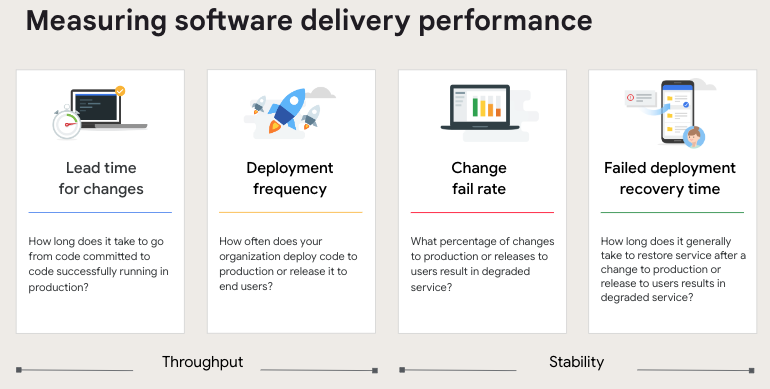
For example:
| Operational metric | What it can establish | What it cannot establish on its own |
|---|---|---|
| Lead time for changes | How quickly a validated change reaches production | Whether the change creates customer or financial value |
| Deployment frequency | How often the organization can release | Whether more releases are the right releases |
| Change fail rate | How often releases create degraded service or require remediation | The full customer or revenue cost of each failure |
| Failed-deployment recovery time | How long customers or teams experience the effect of a failed change | The total value of avoided disruption |
Suppose your initiative is to introduce automated testing and safer deployment practices for three customer-facing services. The operational measures may show that releases are slow and that failed changes take too long to recover. The executive translation then makes the business relevance explicit:
| Lens | Translation |
|---|---|
| Business value | Product teams can deliver validated customer improvements with less release delay. |
| Risk | Safer releases and faster recovery reduce customer exposure when changes fail. |
| Cost | Automation reduces recurring manual release and incident-response effort, while requiring upfront platform-team capacity. |
| Strategic impact | A repeatable delivery capability supports the planned roadmap without increasing operational fragility at the same rate. |
Notice the distinction: a deployment-frequency improvement is not itself the value claim. It is evidence that the organization can deliver customer or market outcomes faster.
Build a defensible claim rather than an impressive-sounding claim
Senior leaders will often test your assumptions. That is not resistance; it is part of responsible decision-making. Build your translation so it can survive those questions.
Classify each statement you make:
| Claim type | Example | How to present it |
|---|---|---|
| Established fact | “Two services accounted for most checkout incidents last quarter.” | State it directly and be ready with the source. |
| Estimate | “A 30% reduction in recovery time would reduce the duration of peak-period disruption.” | State the assumptions and provide a conservative range when appropriate. |
| Hypothesis to validate | “Faster release cycles may improve experiment velocity for onboarding.” | State what you will measure and when you will reassess. |
This distinction allows you to sound decisive without overstating certainty. Executive confidence is not the same as absolute confidence. It is clear judgment about what is known, what is estimated, and what needs validation.
AWS’s guidance on business cases is specific to migration and modernization, but its modeling discipline transfers well to many engineering investments. It separates infrastructure cost, productivity, resilience, and agility instead of treating “modernization” as a single, unmeasurable benefit.
Detailed business case - AWS Prescriptive Guidance
Read these parts of AWS Prescriptive Guidance as a modeling reference, not as a source of generic savings assumptions. The useful principle is to connect resilience and speed to concrete business exposure, then distinguish realistic estimates from conservative ones.
In “Develop the resilience value model,” begin at the paragraph that starts business exposure. Focus on the questions used to identify interruption impact. Then read the opening of “Develop the business agility value model,” from agility estimation. Apply the method to your context; do not reuse AWS-specific benchmark figures as if they were your organization’s data.
Create your executive translation canvas
Set aside about 15 minutes. Use the initiative and decision request from the previous lessons. Avoid selecting a broad label such as “platform modernization.” Choose a bounded decision, such as “fund a 12-week reliability phase,” “approve migration of these three services,” or “dedicate one team to release automation.”
Complete this canvas in plain language.
| Element | Your working statement |
|---|---|
| Decision required | What approval, priority change, or commitment do you need? |
| Technical initiative | What will engineering actually change? |
| Current operational condition | What constraint, failure pattern, cost driver, or delivery limitation exists now? |
| Business value | What customer, revenue, productivity, or delivery outcome does improvement support? |
| Risk exposure | What event or consequence becomes less likely, shorter, or less severe? |
| Cost and trade-off | What is the investment, ongoing cost effect, and opportunity cost? |
| Strategic impact | What named company priority, future capability, or strategic option does it support? |
| Evidence and assumptions | What data supports each important claim, and what still needs validation? |
Then turn the canvas into a concise recommendation:
I recommend [decision] to [technical initiative]. This addresses [current business-relevant condition] by [mechanism], with the expected benefit of [primary value or risk reduction]. The investment is [cost and trade-off], and it supports [specific strategic priority or capability].
Here is a worked example without invented financial figures:
“I recommend approving a 12-week release-reliability phase for our three highest-volume customer services. The work addresses slow, manual releases and prolonged recovery from failed changes, which currently expose a revenue-critical customer journey during peak periods. It is expected to shorten safe release cycles and reduce the duration of customer disruption; the trade-off is deferring a lower-priority internal enhancement. It also creates the delivery capability needed for the second-half checkout and pricing roadmap.”
This is not a full presentation. It is the decision-ready translation underneath one.
A quick quality check
Before using your statement, test it against these standards:
- Value: Is there a credible benefit beyond “better technology”?
- Risk: Have you named the affected customer, revenue, operational, or compliance exposure?
- Cost: Have you stated both investment and trade-off?
- Strategy: Can you name the initiative, goal, or capability this enables?
- Evidence: Could you distinguish facts from estimates if challenged?
- Focus: Is one lens clearly primary, rather than presenting an unfocused catalogue of benefits?
Rehearse the translation aloud
Spend five minutes standing up and delivering your translation without slides. Use only the completed canvas as a cue.
Aim for 60 to 90 seconds. Begin with the decision, not the technical history. If you lose your place, return to the four lenses in this order:
- What are we changing?
- What business value or risk exposure matters most?
- What does it cost or displace?
- Why does it matter to the organization’s direction?
Record one attempt if possible. On playback, listen for technical nouns that have no stated consequence: “microservices,” “observability,” “refactoring,” “Kubernetes,” “pipeline,” or “migration.” You do not need to remove those words. Add the business consequence immediately after them.
Key takeaways
A technical initiative becomes executive-relevant when you explain its organizational consequences, not simply its implementation. Use four lenses:
- Business value: what improves or becomes possible;
- Risk: what exposure is reduced;
- Cost: what is invested, saved, or displaced;
- Strategic impact: what lasting capability or strategic priority it supports.
Use delivery and operational metrics as evidence, while keeping the customer, financial, operational, or strategic outcome at the center. State facts directly, qualify estimates appropriately, and identify hypotheses that require validation.
Next, you will turn the strongest version of this translation into a single governing message: one sentence that gives your executive audience the central takeaway they should remember.
Can't find a good explanation? Sign up and we'll make it for you
Sign up