
Hello again. In the previous lesson, you worked with powers and roots, paying particular attention to what an exponent applies to. That distinction now becomes useful in algebra: , , and are different kinds of terms, even though they use the same letter.
This lesson introduces a central simplification skill: combining like terms. You will learn to identify the pieces of an algebraic expression, preserve signs correctly, group only genuinely matching terms, and verify that a simplified expression still gives the same result. This is the first step toward reading model formulas such as linear-regression equations clearly.
Expressions are collections of terms
An algebraic expression is a combination of numbers, variables, and operations. For example,
has three terms:
A term is separated from neighboring terms by an addition or subtraction sign. It is useful to treat subtraction as “adding a negative,” so the minus sign belongs to the term after it:
Each variable term has two pieces:
- the coefficient: the numerical multiplier;
- the variable part: the variable or variables, including their exponents.
For , the coefficient is and the variable part is . For , the coefficient is and the variable part is .
When no coefficient is written, it is :
Likewise,
The distinction between a coefficient and a variable part is the key to this lesson. You may combine the numerical coefficients only when the variable parts are identical.
Watch this concise visual introduction before moving into the detailed method.
An Intro to Combining Like Terms | Simplifying Expressions by Combining Like Terms | Math with Mr. J
In “An Intro to Combining Like Terms,” Math with Mr. J shows the visual process of spotting matching terms, grouping them, and handling signs. Watch it to establish a reliable first-pass routine.
Watch the basic idea for the definition of like terms, coefficients, and the role of constant terms. Then continue through powers and grouping, paying attention to why y and y^2 cannot be merged. Finish with negative terms, especially the advice to carry the sign with a term when rearranging an expression.
What “like” means
Two terms are like terms when they have the same variable part: the same variables, each raised to the same exponent. Their coefficients may differ.
For example, these are like terms:
because both have variable part . Therefore,
Likewise,
because both variable parts are .
The general pattern is:
Here, stands for an identical variable part. You add the coefficients and retain that shared part.
This should feel similar to counting objects: copies of one thing plus more copies of exactly the same thing gives copies. Algebra uses as the name of the thing being counted.
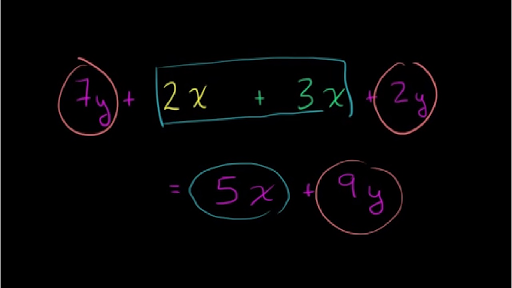
Terms that are not like terms
Do not combine terms merely because they contain a similar-looking variable.
| Terms | Like terms? | Reason |
|---|---|---|
| and | Yes | Both have variable part . |
| and | Yes | Both have variable part . |
| and | No | The variables differ. |
| and | No | The exponents differ. |
| and | Yes | Both are constants; neither has a variable part. |
| and | Yes | Multiplication order does not matter, so . |
| and | No | The exponent is attached to a different variable in each term. |
The most common mistake is confusing addition with multiplication:
but
Adding two copies of is not the same operation as multiplying by itself.
For a short written recap, use the following Khan Academy article. It reinforces the definition and includes examples with several variables and constants.
Combining like terms review (article)
Read Khan Academy’s “Combining like terms review” to see the coefficient rule stated compactly and applied to expressions with multiple kinds of terms.
In the section “What is combining like terms?”, read the definition and rule. Then continue through the “More examples” section. Notice how the author first collects the r-terms or x-terms, then handles ordinary constants separately. You can stop before “Check your understanding.”
A dependable simplification routine
When an expression has several terms, use the same three-stage process each time:
- Identify the terms, including their signs.
- Sort terms into groups with identical variable parts.
- Add the coefficients within each group, then write each unmatched term once.
Reordering is allowed because addition can be performed in any order. You are not changing the expression’s value; you are only making its structure easier to see.
Consider:
First identify the two groups:
- -terms: and
- -terms: and
Rewrite with like terms adjacent:
Then combine each group:
There is no reason to combine and : their variable parts differ. Thus is simplified.
The order of the final terms is usually not important:
and
are equivalent. Still, write answers in a consistent order, such as -terms before -terms, so that your work stays readable.
Worked examples: powers, constants, and negative signs
Example 1: terms with different powers
Simplify:
The -terms belong together, and the -terms belong together. Remember that the final has an implied coefficient of :
Now add the coefficients within each group:
The terms and remain separate. Their exponents differ, so they do not represent the same variable part.
Example 2: preserve every sign
Simplify:
Treat the subtraction as part of the term . Group matching terms without losing that negative sign:
Then combine:
A common error would be to move but accidentally turn into . Keeping the sign attached prevents this.
Example 3: constants are a group too
Simplify:
The variable terms are and . The constants are and :
Constants are like terms because they all have the same “no variable” part.
Example 4: two variables in one term
In data science, a formula may eventually contain several input variables. The same matching rule applies.
Simplify:
Because multiplication can be reordered,
so the first two terms match:
Do not merge the remaining terms. The first has variable part ; the second has .
Simplification preserves value
A simplified expression must have exactly the same value as the original expression for every permitted choice of its variables.
For instance, these expressions are equivalent:
If and , the original gives:
The simplified expression gives:
Checking one input does not prove equivalence for every possible input, but it is an excellent way to catch a sign error.
Since you are already comfortable in Python, you can verify several input pairs quickly:
def original(x, y):
    return 7*y + 2*x + 3*x + 2*y

def simplified(x, y):
    return 5*x + 9*y

for x, y in [(0, 0), (2, -1), (-3, 4)]:
    print(x, y, original(x, y), simplified(x, y))
The final two numbers on each line should match. Notice that Python requires * for multiplication, while handwritten algebra usually writes instead of . A later lesson will focus directly on translating algebraic notation into Python.
Key takeaways
Combining like terms is a way to make an expression shorter without changing its value.
- A term includes its sign; for example, is one negative term.
- A coefficient is the numerical multiplier, such as in .
- Like terms have exactly the same variable part, including exponents.
- Combine like terms by adding their coefficients and keeping the shared variable part.
- Constants can be combined with constants.
- and , or and , are not like terms.
- , while ; addition and multiplication must not be confused.
- Rewriting subtraction as addition of a negative term is a dependable way to preserve signs.
Next, you will use these simplification skills to solve one-variable linear equations. There, instead of merely rewriting an expression, you will find the value of a variable that makes an equation true.
Can't find a good explanation? Sign up and we'll make it for you
Sign up