
Hello! Welcome to the first lesson in our course on advanced algorithms and system design. As we discussed, our goal is to bridge the gap between your current experience and the requirements for roles at highly scalable, remote-first companies. We'll start by focusing on the advanced algorithmic patterns that are critical for modern technical interviews.
Today's lesson is all about the Sliding Window pattern. This is a powerful technique for solving problems that involve processing contiguous blocks of data, like subarrays or substrings, far more efficiently than a simple brute-force approach. By the end of this lesson, you'll be able to recognize problems that are a good fit for this pattern and apply it to solve them, a skill that is highly valued in technical interviews.
1. The Core Idea: Beyond Brute Force
Many problems involving arrays or strings ask you to calculate something over a contiguous sequence of elements. For example, "find the maximum sum of any subarray of size 3."
A straightforward approach would be to:
- Generate every possible subarray of size 3.
- Calculate the sum for each one.
- Keep track of the maximum sum found.
This works, but it's inefficient. If the array has elements and the subarray size is , this brute-force method has a time complexity of . For large inputs, this is too slow.
The Sliding Window pattern provides a much more elegant and efficient solution. Imagine a "window" of a certain size that you slide across the data. Instead of re-calculating everything for each new position of the window, you intelligently update your calculation by only considering the elements that enter and leave the window. This simple idea can often reduce the time complexity to a clean .
There are two main variations of this pattern, which we'll explore next.
2. Fixed-Size Sliding Windows
The simplest form of this pattern is when the window size is fixed. Let's consider the classic problem: "Given an array of integers and a number , find the maximum sum of a subarray of size ".
The key insight is that when we slide the window one position to the right, only two things change: one element leaves the window from the left, and one element enters from the right. We don't need to re-sum the elements that remain in the window.
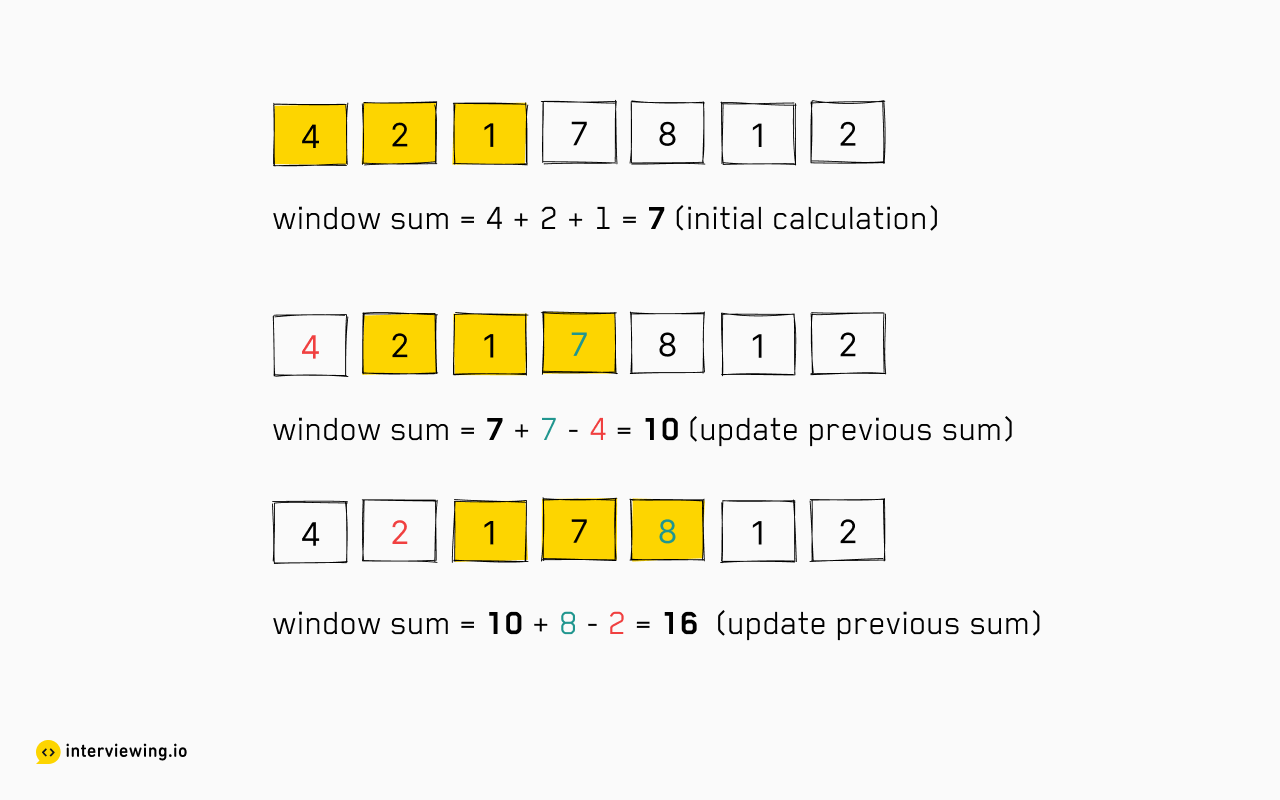
To see this principle in action, let's watch a detailed walkthrough. The following video explains both the naive approach and the optimized sliding window solution.
Sliding Window Algorithm for Tech Interviews - Full Course
Watch this segment from the "Sliding Window Algorithm for Tech Interviews" course on the freeCodeCamp.org channel. It provides an excellent, detailed explanation of the fixed-size window for the max subarray sum problem.
Focus on the logic explained from the initial problem setup to the end of the first naive approach. Then, pay close attention to the optimized solution from when the instructor introduces the concept of reusing the sum. The following complexity analysis until the end is also crucial.
As you saw in the video, the general recipe for a fixed-size window is:
- Compute the value for the first window (the first elements). This is your initial result.
- Iterate from the -th element to the end of the array. In each iteration:
- Add the new element (the one entering the window on the right).
- Subtract the old element (the one leaving the window on the left).
- Update your result (e.g., check if the new sum is the maximum).
This process ensures you only touch each element a constant number of times, leading to a linear time complexity.
3. Variable-Size Sliding Windows
Things get more interesting when the window size isn't fixed. Instead, it grows and shrinks based on a specific condition. This is the most common and powerful variant of the pattern.
A typical problem might be: "Given an array of positive integers and a target sum , find the length of the smallest contiguous subarray whose sum is greater than or equal to ".
Here, the strategy is:
- Expand the window by moving its right boundary (
windowEnd) one step at a time, adding the new element to our current sum. - Once the condition is met (e.g.,
windowSum >= S), we record the result (e.g.,minLength = min(minLength, window_size)). - Now, we must shrink the window from the left by moving its left boundary (
windowStart) forward, subtracting the element that's leaving. We keep shrinking as long as the condition is still met, trying to find a smaller, valid window. - We repeat this process until the right boundary reaches the end of the array.
Let's dive into a resource that explains this expand-and-shrink dynamic.
Pattern 01 : Sliding Window.md
This guide from GitHub provides several excellent examples. We'll focus on how it introduces the variable-size window concept.
Please read two sections. First, review the "Smallest Subarray" problem. Pay attention to the description of how the window shrinks after the sum condition is met. Next, read about the "Longest Substring" problem. This is a crucial example because it shows how to apply the same pattern to strings and introduces the need for a data structure—a HashMap—to keep track of the state within the window (in this case, character frequencies).
The core idea remains the same: the windowEnd pointer always moves forward, while the windowStart pointer only moves when a condition dictates a shrink. This ensures that each element is visited by both pointers at most once, maintaining the coveted time complexity.
4. Application to Complex String Problems
The true power of the sliding window pattern, especially in interviews, often comes out in string manipulation problems that require tracking more complex states than a simple sum. Problems involving permutations, anagrams, or distinct character counts are prime candidates.
For these, a HashMap (or a simple frequency array if the character set is small and known, like a-z) becomes your best friend. It allows you to maintain the state of the current window—specifically, the frequency of characters—in constant time for adds and removals.
Let's look at a problem where a simple set is not enough and a frequency map is required: finding anagrams in a string where characters can be repeated.
Sliding Window Algorithm for Tech Interviews - Full Course
Let's return to the freeCodeCamp video. This segment tackles a more advanced problem: counting substring anagrams where characters can be duplicates.
Watch from the problem description, which clearly explains why a set is insufficient for this problem. Then, watch the explanation of how to use a map (or Counter in Python) to track character frequencies from this point. Finally, watch the code walkthrough from the implementation start to see how this translates into a practical solution and how to analyze its complexity.
This example is vital because it demonstrates a key step-up in complexity. Recognizing when to use a simple counter, a set, or a frequency map is a sign of a deep understanding of the pattern. Given your background in Go and JavaScript, you can think of implementing this with map[rune]int in Go or a Map object in JavaScript.
5. How to Spot a Sliding Window Problem
You've now seen the mechanics. But in an interview, how do you identify that a problem is solvable with this pattern? Here are some clues.
Master the Sliding Window Pattern: Your Key to Acing DSA ...
This article provides a great, concise summary of how to identify these problems and a template for solving them.
Read the sections "When to Spot a Sliding Window Problem" and "The Step-by-Step Sliding Window Template". These heuristics are exactly the kind of pattern-matching you want to develop for interviews.
To summarize, look for problems involving:
- Input: An array, linked list, or string.
- Output: A value or subarray/substring that satisfies a condition (e.g., longest, shortest, max, min, count).
- Keywords: "subarray," "substring," "contiguous," "consecutive."
When you see these signs, your first thought should be to check if a brute-force approach involves nested loops over contiguous segments. If so, Sliding Window is very likely the optimal path.
Common Pitfalls
As you implement this pattern, be wary of a few common mistakes:
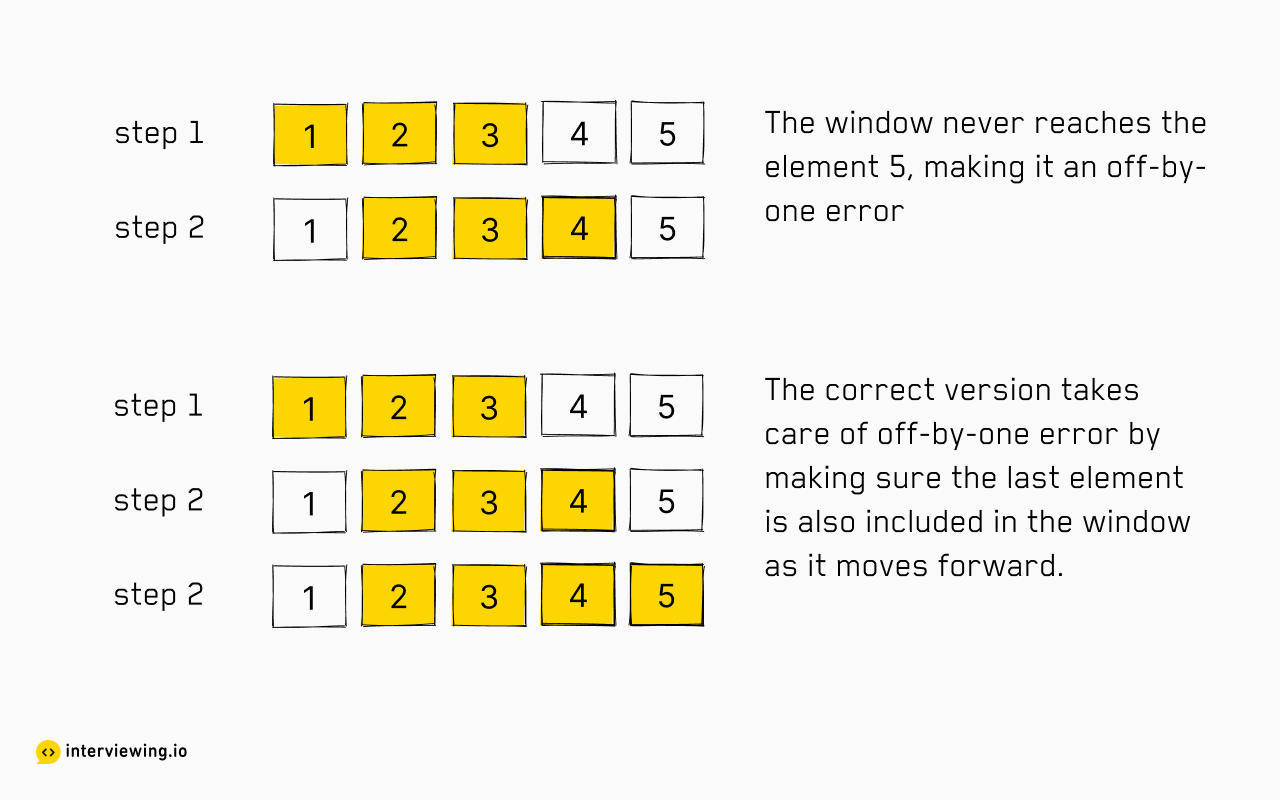
- Off-by-one errors: Calculating window size (
end - start + 1vs.end - start) and loop boundaries are classic sources of bugs. - Forgetting to update state: When you shrink the window, you must remember to remove the
startelement's contribution from your data structure (the sum, the HashMap, etc.). - Edge cases: Always consider empty arrays/strings, or cases where a solution is not possible.
Conclusion
In this lesson, we've dissected the Sliding Window pattern, a fundamental technique for optimizing array and string problems.
Here are the key takeaways:
- Core Idea: Avoid re-computation by sliding a conceptual window over the data and updating calculations based on elements entering and leaving the window.
- Efficiency: The primary benefit is reducing time complexity from polynomial (like or ) to linear ().
- Two Flavors: The window can be fixed-size (simple updates) or variable-size (dynamic expansion and shrinking based on a condition).
- State Management: For complex problems, especially with strings, use data structures like HashMaps to efficiently track the state of the elements within the current window.
In our next lesson, we will explore the Two Pointers technique. While it also uses two pointers, its applications and movement rules are distinct from the Sliding Window. It's another essential tool for your algorithmic arsenal, particularly for problems involving sorted arrays and searching for pairs or subsequences.