
Welcome back. In the previous lesson, you built a room-by-room damage matrix: each row connected a specific material and location to documented condition, evidence, preliminary action, and uncertainty.
That matrix now tells you exactly what to request. When a file is incomplete, the professional response is not “send more photos.” It is a targeted evidence request that identifies the gap, tells the field person what to capture or measure, and explains the estimate decision the information will support.
This lesson focuses on drafting those requests for photographs, measurements, reports, and field observations. The goal is to obtain enough reliable information to prepare a defensible preliminary scope—without converting unknown conditions into assumptions.
A request is an evidence instruction
A good request has a practical purpose: it closes a specific gap in the damage matrix.
Suppose your matrix says:
Ground Floor Kitchen | East wall lower drywall | Visible staining and apparent softening | P-12, P-13 | Approx. – SF visible | Final removal height and cavity condition unknown.
The missing information is not vaguely “more documentation.” There are at least three distinct gaps:
- The visible damage needs a location-confirming context photo.
- The repair quantity needs a field measurement, including removal height and wall length.
- The wall assembly needs a field observation after access, if access is authorized and performed.
Each gap supports a different decision. Treating them as one generic request increases the chance that the response still leaves the estimate unresolved.
A practical targeted request answers five questions:
| Element | What to state |
|---|---|
| Location | Exact floor, room, component, and position |
| Known condition | What the file already shows or reports |
| Missing evidence | Specific photo, measurement, report, or observation needed |
| Capture instructions | How the information should be documented |
| Purpose | The scope, quantity, method, or referral decision it will support |
The request should remain factual. It asks someone to document a condition, not to prove the conclusion you want to reach.
For example:
- Leading request: “Please send photos proving the cabinets must be replaced.”
- Evidence-led request: “Please provide photos of the cabinet interior, base, end panels, and floor-to-cabinet interface, along with a field observation of swelling, delamination, or loss of structural integrity. This will allow repairability of the affected cabinet components to be evaluated.”
The second request does not promise replacement. It asks for the evidence needed to determine whether repair, component replacement, or a different action is supportable.
Why photo requests need structure
Remote reviewers need photos to establish more than visible damage. They need to establish where the damage is, how extensive it is, and whether the claimed repair can be connected to the documented condition.
How to Take Photos for Insurance Claims | CompanyCam Blog
Read CompanyCam’s practical explanation of what a complete photo set needs to establish. Although it is written for claim documentation generally, its wide-context-to-detail structure is directly useful when you are requesting missing evidence from a field estimator or technician.
Start with “Why Insurance Companies Require Claim Photos,” especially the reason for context. Then read “What Photos to Take for a Complete Claim,” from “For insurance claims, capture these photos:” through the four photo types. Finish with “Three Mistakes That Delay Insurance Payments,” focusing on the first two mistakes: missing context and missing scale.
Use four photo categories as your baseline:
-
Wide context photo
Establishes room identity, elevation, relationship to fixtures, openings, or adjacent areas. -
Mid-range photo
Shows the affected material within its surrounding assembly. -
Close-up condition photo
Shows staining, swelling, delamination, cracking, residue, fastener failure, or another specific condition. -
Measurement or scale photo
Shows a tape measure, ruler, moisture-meter display, laser measure, or another usable reference.
A close-up of swollen MDF baseboard may establish that the material is swollen. It does not establish the room, total affected length, wall location, or whether the swelling continues behind a cabinet. A useful request asks for the missing level of evidence rather than duplicating photos already in the file.
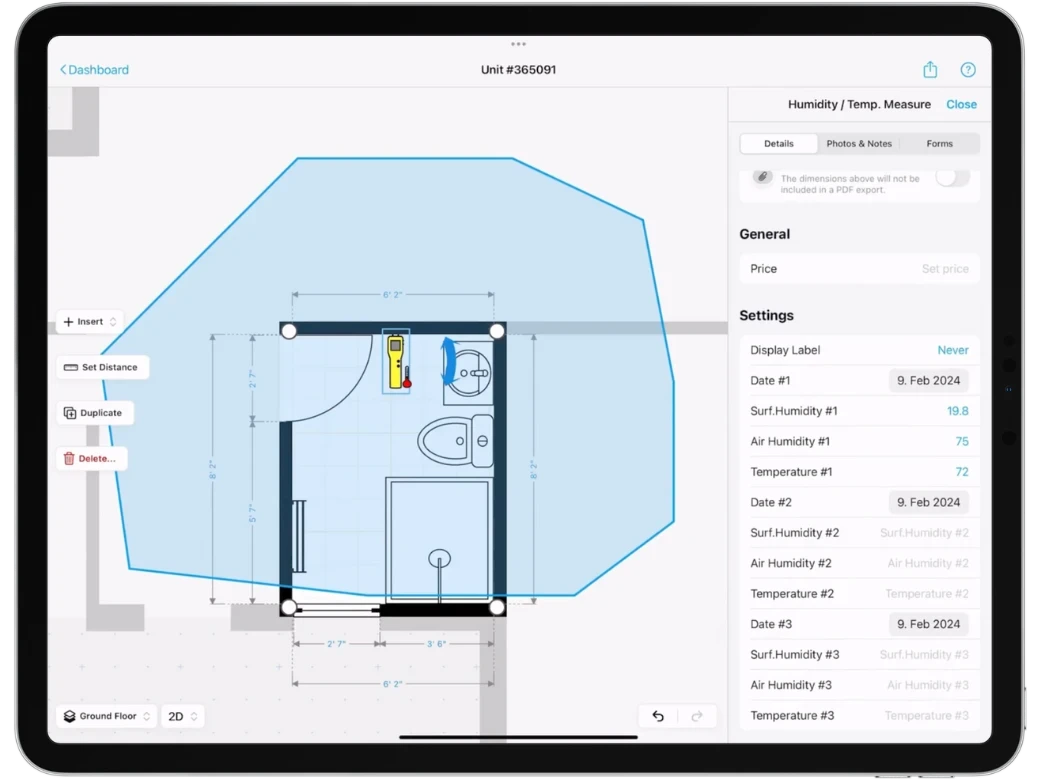
The following display illustrates the advantage of connecting measurements to a specific plan location. A humidity or temperature record becomes much more useful when the documented area is visible on the floor plan.
Diagnose the gap before drafting the request
Before writing anything, review the matrix row and classify the missing information. The same observed condition may require multiple evidence types.
Missing photograph
Request photos when the existing set cannot establish location, condition, continuity, scale, or post-demolition conditions.
Typical triggers include:
- close-ups with no room or elevation context;
- a stained ceiling photo with no image identifying the room above;
- a photo of damaged flooring with no view of transitions, walls, or connected areas;
- an opened wall cavity with no image showing the opening’s location;
- cabinet damage shown only from the exterior, with no view of interior or base components;
- demolition shown without pre-demolition condition photos.
Missing measurement
Request measurements when a quantity affects the estimate but is not reliably supported by a sketch, report, or photo-derived calculation.
Ask for the measurement that corresponds to the component—not merely a room dimension. Examples include:
- wall length and confirmed removal height;
- floor length and width, with closet or island deductions noted;
- baseboard linear footage by profile and affected wall;
- cabinet width, depth, height, and affected component dimensions;
- ceiling area and the dimensions of an opening or stain;
- roof slope, eave height, ridge length, or damaged elevation length.
A useful measurement request identifies units, start and end points, and relevant deductions or obstructions.
Missing report or record
Request a report when the answer depends on information that a photograph cannot reliably establish.
Examples include:
- drying logs and monitoring records for mitigation duration;
- moisture maps or meter readings with locations and dates;
- plumber findings concerning source, access, repair performed, and cause;
- industrial hygiene protocol or clearance documentation for environmental work;
- engineer findings for structural movement, framing damage, or load-bearing concerns;
- contractor bid or invoice when a bid amount may be retained or evaluated;
- product or manufacturer information where a specific assembly, system, or matching issue is asserted.
Do not request a report merely to create paperwork. Request it because it resolves a defined technical question.
Missing field observation
Use a field observation request when the needed fact requires competent in-person inspection rather than a broad conclusion.
For example, ask the field representative to document:
- whether drywall is soft, friable, detached, or visibly intact;
- whether insulation is wet, displaced, or present;
- whether a cabinet box, toe kick, end panel, or countertop substrate is affected;
- whether flooring is cupped, delaminated, loose, or continuous beneath fixed cabinets;
- whether visible framing is structurally altered, split, decayed, or only surface stained;
- whether an appliance, fixture, or mechanical component must be detached to access the documented repair area.
Avoid asking the field person to make a coverage decision or a conclusion outside their role. “Document whether the cabinet box is swollen or structurally compromised” is appropriate. “Confirm the loss requires full cabinet replacement” is not.
The minimum request format
A concise request can be written in this form:
Location and component: [specific location]
Current record: [what is observed or reported]
Please provide: [specific missing evidence and capture instructions]
Needed to determine: [quantity, condition, repairability, method, or referral need]
This format creates a direct link back to the matrix row.
Example: missing drywall extent
Location and component: Ground Floor Kitchen, east wall lower drywall behind and adjacent to base cabinets.
Current record: Photos P-12 and P-13 show staining and apparent softening; visible extent was preliminarily estimated at approximately – SF from photo scaling.
Please provide: One wide photo from the kitchen doorway showing the complete east wall, mid-range photos of the affected section, and a photo showing tape measurements for total wall length, cabinet width, and confirmed removal height. If wallboard is opened during authorized work, photograph the cavity before material removal and document insulation condition.
Needed to determine: Supported drywall, insulation, baseboard, protection, and cabinet-access quantities.
Notice what this request does not say:
- It does not state that all drywall must be removed.
- It does not assume insulation is wet.
- It does not assume cabinet removal is required.
- It does not treat the photo-derived range as a final quantity.
Example: missing cabinet repairability evidence
Location and component: Ground Floor Kitchen, base cabinet at east wall.
Current record: Photo P-15 shows swelling and delamination at the toe kick; cabinet interior and cabinet-box condition are not visible.
Please provide: Photos of the cabinet interior, lower shelf, end panel, toe kick, floor-to-cabinet interface, and adjacent cabinet connections. Include a tape measure showing cabinet width and toe-kick height. Provide a field observation describing whether swelling is limited to the toe kick or extends into the cabinet box, end panel, or adjacent flooring.
Needed to determine: Whether a component repair, detach-and-reset operation, cabinet repair, or replacement recommendation is technically supported.
Example: reported moisture without visible material damage
Location and component: Ground Floor Dining Room, shared wall with kitchen.
Current record: Field note reports elevated moisture; Photo P-20 shows no visible staining, distortion, or finish failure.
Please provide: The moisture record with date, meter type, reading, material tested, and exact test locations marked on a room sketch or photo. Provide wide and close-up photos of the wall before and after any authorized investigation, plus a field observation of visible material condition.
Needed to determine: Whether any investigation, drying, selective removal, or reconstruction work is supported. No repair quantity can be finalized from the current record.
This language keeps the record appropriately restrained. A meter reading may justify investigation or monitoring, but it does not automatically establish a replacement quantity.
Ask for photos that allow the reviewer to “stitch together” the scene
When a condition spans more than one photo, the photos should overlap enough for a reviewer to follow the assembly from one image to the next. This matters especially for long walls, floor runs, exterior elevations, roof slopes, and opened cavities.
FEMA’s public-assistance checklist is not a residential property estimating standard, but its documentation logic transfers well: distinguish the original component from the damaged portion, use several views, include scale, and make location traceable.
[PDF] Public Assistance Initial Damage Assessments - FEMA
Read the relevant checklist sections from FEMA as a documentation discipline, not as a residential-claim rulebook. Focus on how it separates component description, damage dimensions, photographs, and repair method so that another reviewer can validate the record.
In the section “Essential Documentation Information,” read the discussion beginning the original component record, then continue through the “Component Description and Damage” checklist. Next, in the “Damage Photographs” section, read the photo guidance. Focus on the transferable practices: whole-area views, component views, close-ups, scale, fixed location references, overlapping interior images, and clear lighting.
For interiors, a targeted request can specify a simple capture sequence:
Starting at the room doorway, provide overlapping photos around the affected room, then a mid-range photo of each affected wall or floor section, followed by close-ups and scale photos. Label each image with room name and wall position where possible.
For an exterior elevation or roof component, request a different sequence:
Provide a full elevation photo showing the entire wall and adjacent roofline; mid-range photos locating the affected component between fixed features; close-ups of the condition; and scale photos showing dimensions or a measuring device. Include eave height, slope, and access conditions where they affect the proposed work.
The purpose is not to demand a large photo volume. It is to obtain a coherent visual record that answers the unresolved question.
Measurement requests: make the quantity reproducible
A measurement request should allow a different estimator to reproduce the quantity without guessing what was measured.
Compare these two requests:
| Vague request | Reproducible request |
|---|---|
| “Measure the damaged wall.” | “Measure the Kitchen east-wall length from the inside corner beside the refrigerator to the corner at the patio opening. Record the wall height, confirmed removal height, width of the -inch opening, and length of baseboard proposed for removal.” |
| “Get flooring dimensions.” | “Provide floor length and width for the affected kitchen area, identify fixed cabinets and island dimensions, photograph each transition, and state whether the flooring is continuous into the dining room.” |
| “Measure the ceiling stain.” | “Measure the maximum length and width of the ceiling stain in the basement mechanical room, identify the room and wall orientation, and provide a wide photo showing the ceiling relative to the upstairs bathroom.” |
A few rules improve measurement requests:
- Request the existing component dimension separately from the damaged or proposed repair dimension.
- State the required unit: square feet, linear feet, inches, count, or another applicable unit.
- Ask for deductions only where they matter to quantity or method.
- Ask the person to identify the measurement endpoints.
- Request a scale photo when visual condition and measurement need to be tied together.
- Where measurements are preliminary, ask for field verification rather than presenting them as final.
This distinction is essential. “The wall is feet long” and “remove feet of wallboard” are different facts. The first describes the component; the second describes a proposed repair extent that needs its own evidentiary basis.
Reports and field observations: request the fact, not a preferred conclusion
Some of the most expensive errors in desk estimates occur when a missing report is silently replaced by an assumption.
Use a report request when the report is the source for a technical statement you would otherwise be unable to support. Make the purpose explicit.
| Missing record | Targeted request | What it resolves |
|---|---|---|
| Drying documentation | “Provide the equipment log, daily moisture readings, ambient readings, affected-material map, monitoring notes, and final dry-standard documentation for the affected rooms.” | Equipment duration, monitoring, adjustments, and mitigation chronology |
| Plumbing findings | “Provide the plumbing invoice or findings identifying the reported source location, repair performed, access required, and any documented cause.” | Source-area context and plumbing repair scope |
| Environmental protocol | “Provide the complete remediation protocol, including containment boundaries, material removal instructions, cleaning methods, required equipment, and clearance requirements.” | Environmental scope boundaries and required controls |
| Structural concern | “Provide the engineer’s findings, repair detail, or written field recommendation identifying affected members, dimensions, connection requirements, and any temporary support needs.” | Whether structural work can be scoped and how it should be described |
| Contractor bid | “Provide the itemized bid, including labor, material, equipment, allowances, exclusions, unit quantities, and any assumptions.” | Comparison with Xactimate items and support for retained bid pricing |
When requesting a field observation, ask for an observation that can be checked. Useful wording includes:
- “Document whether…”
- “Record the measured…”
- “Photograph and identify…”
- “State whether visible conditions include…”
- “Describe the material layers encountered after authorized access…”
- “Identify the location on the sketch or annotated photo…”
Avoid:
- “Confirm all affected material.”
- “Verify replacement is necessary.”
- “Determine the insurance scope.”
- “Find everything related to the loss.”
Those statements are too broad, may lead the responder, and do not define what evidence is needed.
Use a request log to control the file
For a small file, requests can be sent in an email or claim-management note. For a multi-room or complex file, maintain a request log alongside the damage matrix.
| Request ID | Matrix location | Missing item | Why it matters | Priority | Status |
|---|---|---|---|---|---|
| R-01 | Kitchen east wall drywall | Wall length, removal height, cavity photos | Drywall and insulation quantity; access method | High | Open |
| R-02 | Kitchen base cabinet | Interior and base-condition photos; dimensions | Repairability and cabinet scope | High | Open |
| R-03 | Dining room shared wall | Dated moisture record with mapped readings | Whether investigation or repair is supported | High | Open |
| R-04 | Kitchen flooring | Transition photos and continuity observation | Flooring extent and finish boundary | Medium | Open |
| R-05 | Reported plumbing source | Plumber findings or invoice | Source-area context and plumbing work | Medium | Open |
A request log prevents two common failures:
- Silent assumptions: an unanswered request disappears, but its associated line items remain in the estimate.
- Lost evidence: the requested information arrives, but no one updates the matrix, scope, or assumptions.
When information arrives, close the loop:
- Review whether it actually answers the request.
- Add the new photo, measurement, report, or observation to the matrix evidence references.
- Update technical status, quantity basis, proposed action, and uncertainty.
- Close the request only when the decision it was meant to support is now documented.
If the response is incomplete, keep the request open and narrow the follow-up. For instance, “additional cabinet photos received, but interior/base condition and dimensions remain undocumented.”
Prioritize requests by estimating impact
Not every gap deserves the same urgency. Prioritize requests that can materially change scope, cost, safety, method, or trade involvement.
High priority
Request promptly when the missing information affects:
- whether a material is technically included at all;
- a high-value repair or replacement decision;
- structural, electrical, plumbing, environmental, or safety concerns;
- whether mitigation work occurred and for how long;
- a large or uncertain quantity;
- whether two connected rooms or assemblies are actually part of the same documented loss.
Medium priority
Request when the gap affects:
- repair extent, access, detach-and-reset work, or finish continuity;
- material identification;
- whether a component is repairable;
- a meaningful quantity refinement;
- documentation quality for an otherwise supported item.
Lower priority
Document for later follow-up when the issue is unlikely to change the preliminary scope materially, such as a minor finish detail that can be confirmed during normal field verification.
Priority does not mean guessing while waiting. If an unanswered high-priority request prevents a reliable scope decision, record that limitation clearly. A preliminary estimate may need an exclusion, an allowance supported by company practice, or a statement that final quantity remains pending field verification. The next lesson will address how to express those boundaries in the preliminary scope itself.
A practical drafting checklist
Before sending a request, confirm that it passes this review:
- Is the room and component named exactly as they appear in the sketch and damage matrix?
- Does it state what is already observed, reported, inferred, or unknown?
- Does it request a defined item rather than “more documentation”?
- For photos, does it specify whether you need wide, mid-range, close-up, scale, pre-demolition, or post-access evidence?
- For measurements, does it name the dimensions, units, endpoints, and relevant deductions?
- For reports, does it identify the record and the technical decision it supports?
- For field observations, does it ask for documented facts rather than a desired conclusion?
- Can a reviewer see how the answer will change a scope, quantity, method, or referral decision?
- If no response arrives, is the unresolved condition visible in the matrix and later scope assumptions?
A strong request is short enough to act on and specific enough to produce usable evidence.
Key takeaways
Targeted information requests are the bridge between an incomplete damage matrix and a defensible preliminary scope.
- Start with the specific matrix gap, not a generic desire for more information.
- Request the evidence type that fits the uncertainty: photographs for visible condition and context, measurements for quantities, reports for technical records, and field observations for in-person facts.
- For photographs, distinguish wide context, mid-range location, close-up condition, and measurement/scale images.
- Ask for reproducible measurements with locations, units, endpoints, and deductions.
- Request facts and documentation—not conclusions that assume replacement, coverage, cause, or a preferred repair method.
- Track each request, update the matrix when evidence arrives, and keep unanswered high-impact gaps visible.
Next, you will convert the completed damage matrix into a preliminary scope that clearly states proposed work, assumptions, exclusions, and remaining verification needs.
Can't find a good explanation? Sign up and we'll make it for you
Sign up