
Hello! Welcome to the second lesson in our module on Maxwell's equations.
In our previous lesson, we laid out the complete set of four equations in their integral form, giving us a high-level map of the unified theory of electromagnetism. We saw that two of the laws describe fields originating from sources (using surface integrals), and two describe fields circulating around other fields (using line integrals).
Today, we'll dive deeper into the first pair: the two Gauss's laws. Our learning outcome is to explain the physical meaning of Gauss's law for electricity (charge as a source of E-field) and magnetism (no magnetic monopoles). This exploration will clarify the fundamental nature of electric and magnetic fields and their sources.
Gauss's Law for Electricity: The Source of the E-Field
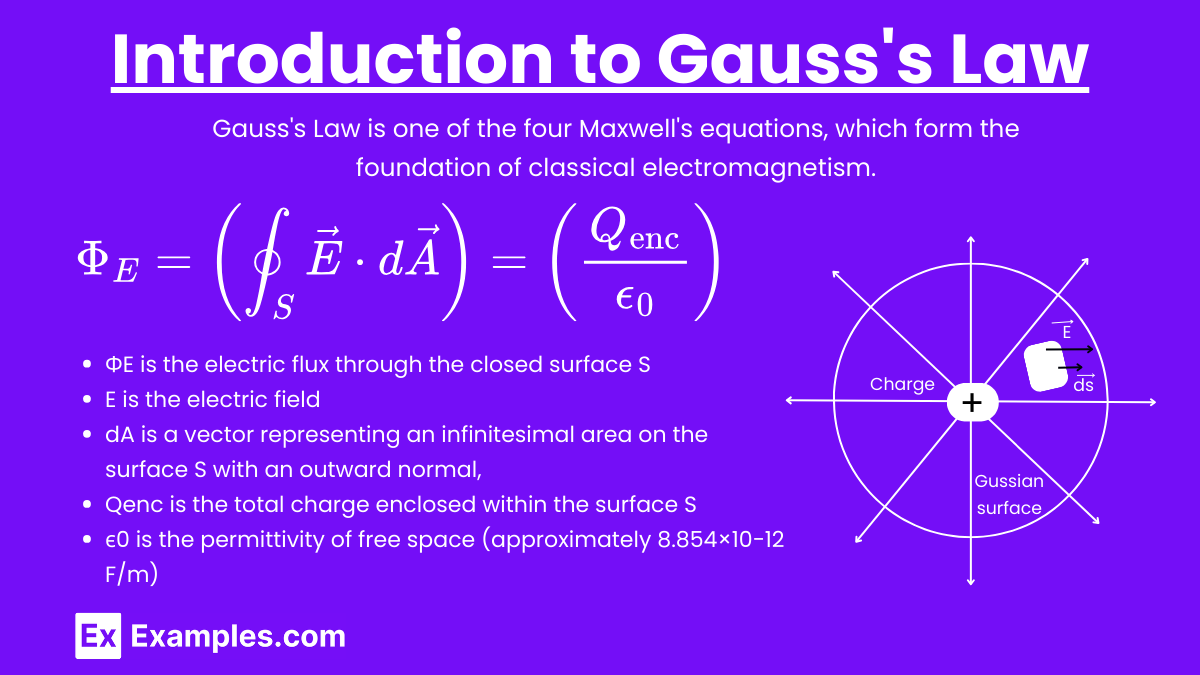
Let's start with the first of Maxwell's equations, Gauss's law for the electric field:
As we reviewed, the left-hand side represents the electric flux ()—the net "flow" of the electric field out of a closed surface . The right-hand side relates this flux to the total electric charge enclosed by that surface, .
The best way to build a physical intuition for this law is to see it derived from a simple case and then generalized.
Gauss law of electricity | Electrostatics | Physics | Khan Academy
The video 'Gauss law of electricity' by Khan Academy provides an excellent step-by-step development of the physical intuition behind this law. It starts with a simple spherical case and brilliantly explains why the result holds true for any shape and any charge configuration.
Please watch the video from the beginning to 14:40. Pay close attention to these key ideas: The definition of electric flux. Why the flux is independent of the radius of the sphere (the inverse-square law relationship). The 'bullet analogy' used to explain why the flux is the same even for an oddly shaped surface or an off-center charge. Why charges outside the closed surface contribute zero net flux.
The video brilliantly illustrates the core physical meaning of Gauss's Law for electricity:
- Electric charges are the sources and sinks of the electric field. A positive charge creates an outward flux (it's a "source"), and a negative charge creates an inward flux (it's a "sink").
- The total net flux through any closed surface, no matter its shape or size, is directly proportional to the net charge contained within it. The geometry cancels out, leaving a profound and simple statement about the relationship between charge and field.
A Deeper Look: The Differential Form
Your mathematical background, particularly with vector calculus, allows us to look at this law in another powerful way. The integral form relates the field over a surface to the total charge inside. The differential form makes a more local statement, relating the field at a point to the charge density at that same point.
By applying the Divergence Theorem, which states that , we can transform Gauss's law:
Since the total charge is the volume integral of the charge density (i.e., ), we get:
For this to be true for any volume , the integrands must be equal. This gives us the differential form:
This equation states that the divergence (the "outflow-ness") of the electric field at any point is directly proportional to the charge density at that point. This is the ultimate local statement that charge is the source of the electric field.
Maxwell’s Equations Part 1: Gauss’s Law for the Electric Field
The video 'Maxwell’s Equations Part 1' by Professor Dave Explains provides a clear summary of both the differential and integral forms and the connection between them.
Please watch from 02:00 to 05:06. This segment explains the physical meaning of the differential form and walks through the derivation from the integral form using the divergence theorem, which we just outlined.
Test your understanding!
Imagine a closed surface (like a sphere) in space.
- If the net electric flux through the surface is zero, what can you conclude about the net charge inside the surface?
- A single positive charge is placed at the center of the sphere, resulting in a flux . If a second charge, , is also placed inside the sphere, what will the new total flux be?
- If the original charge is moved from the center to a point just inside the surface, how does the total flux change?
Show answer
- According to Gauss's Law (), if the net flux is zero, the net enclosed charge must also be zero. This could mean there are no charges inside, or that there is an equal amount of positive and negative charge inside.
- The total enclosed charge is now . Therefore, the new total flux will be zero. The field lines from the positive charge will terminate on the negative charge, all within the sphere, so no net field lines exit the surface.
- The total flux does not change. As the Khan Academy video explained, Gauss's law guarantees that the flux depends only on the enclosed charge, not on its position within the surface. The flux will be distributed differently across the surface (stronger on the side closer to the charge), but the total integrated flux remains the same.
Gauss's Law for Magnetism: No Magnetic Monopoles
Now let's turn to the second of Maxwell's equations, Gauss's law for magnetism:
This equation is striking in its simplicity. Notice the immediate and profound difference from the law for electricity: the right-hand side is always zero.
The physical meaning is direct and fundamental:
- The net magnetic flux through any closed surface is always zero.
- This implies that there are no magnetic "charges" or magnetic monopoles. There is no magnetic equivalent of a single positive or negative electric charge that can act as a source or sink for the magnetic field.
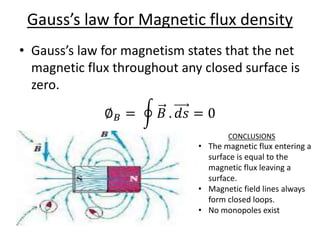
This is why if you break a bar magnet in two, you don't get an isolated north pole and an isolated south pole. Instead, you get two smaller magnets, each with its own north and south pole. The magnetic field lines loop from the north pole to the south pole outside the magnet, and continue inside the magnet from south to north to form a closed loop.
Gauss's Law for Magnetic Fields
The following webpage from EM GeoSci gives a concise explanation of Gauss's Law for magnetic fields and its physical implications.
Please read the introduction, the 'Integral equation' section, and the 'Discoverers of the law' section. Focus on how the equation \oint_S \mathbf{b} \cdot d\mathbf{a} = 0 leads to the conclusion that magnetic monopoles do not exist and that magnetic field lines form closed loops.
Just as with the electric field, we can also express this law in differential form using the divergence theorem:
This is a beautifully succinct statement: the magnetic field is divergence-free. It never originates from a single point.
Conclusion
In this lesson, we have unpacked the physical meaning of the first two of Maxwell's equations. They establish the "source rules" for static electric and magnetic fields.
Key Takeaways:
- Gauss's Law for Electricity () states that electric fields originate from and terminate on electric charges. The net electric flux out of any closed surface is a direct measure of the net charge contained within it.
- Gauss's Law for Magnetism () states that there are no magnetic monopoles. Magnetic field lines do not have sources or sinks; they always form continuous, closed loops. Consequently, the net magnetic flux through any closed surface is always zero.
These two laws paint a picture of fundamental asymmetry: electricity has its fundamental source particle (the electron, proton), while magnetism does not.
Preview of the Next Lesson:
We have now covered the "static" laws governing the sources of fields. In the next lesson, we will move on to the dynamic laws: Faraday's Law and the Ampère-Maxwell Law. These describe how changing electric and magnetic fields create circulating magnetic and electric fields, respectively. This is where the true dance of electromagnetism begins, leading directly to the concept of electromagnetic waves.
Can't find a good explanation? Sign up and we'll make it for you
Sign up